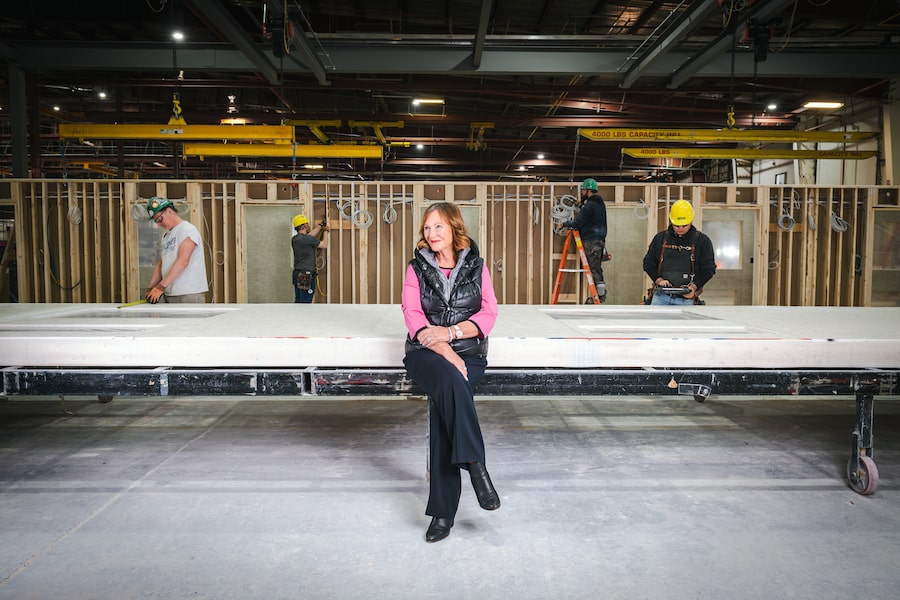
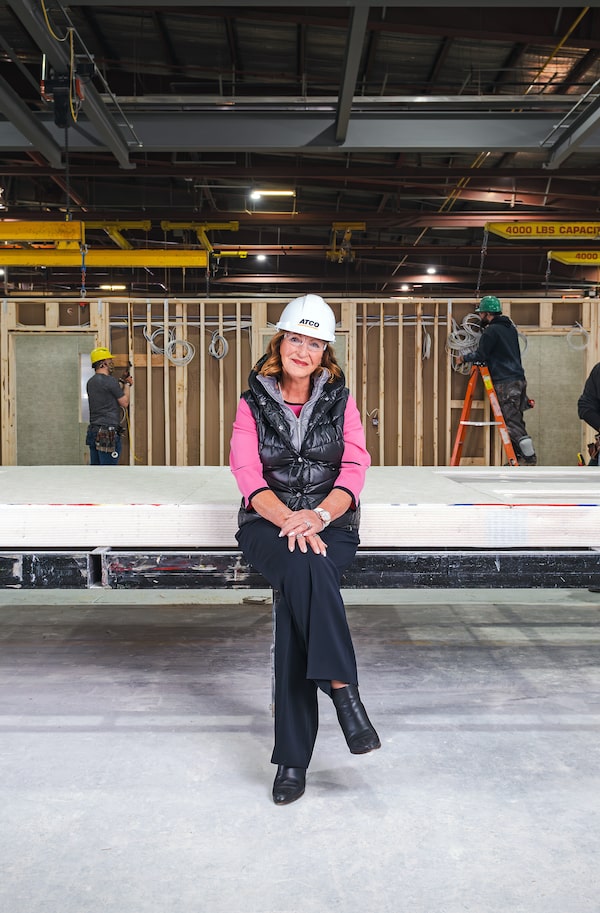
Nancy Southern just wants the Alberta separation argument to be put to bed already. It’s a waste of time. It makes no sense. It sucks the air out of the room at a time when Canada has far more pressing problems—like getting the economy on track and major projects built.
“Why? That’s my question. What, are we going to have our own army? Our own currency? What the hell does it mean?” says the CEO of ATCO Ltd. with a shake of her head and a roll of her eyes.
Tapping the fingers of her left hand with the pointer of her right—each nail perfectly manicured in a pale pink that matches her shirt, trousers and shoes—Southern ticks off her objections: The country’s population is already too small for such a huge land mass (tap); the Parliamentary system works well for Alberta and the rest of the provinces (tap); the whole idea scares away investors (tap). In short, she says: “We’re way better together.”
That Southern is dead set against secession—a notion reportedly supported by more than one million Albertans—is no surprise. She’s the staunchest of patriots, one who’s never forgotten what this country has done for her family (including funding half of the $4,000 her grandfather and father used to start the company in 1947 via so-called mustering-out credits for veterans of the Second World War).
That’s not to say she doesn’t understand the roots of secessionist fervour: a feeling of being treated unfairly by the rest of Canada, of Alberta not being given its due by the “elites” in Ottawa. Many years ago, she admits to feeling similarly frustrated. “Back in the ’80s, when I was young, I probably felt a little more like the radicals,” Southern says. “I thought Alberta was being hard done by. But it went away—because Alberta isn’t hard done by.”
Southern theorizes that the urge to separate also springs from years during which federal leaders failed to espouse a strong vision for the nation. But she believes there’s been a tidal shift under Prime Minister Mark Carney, especially in the wake of his “epic” speech at the World Economic Forum in Davos, leaving Albertans with little to grumble about. Southern points to a long list of moves that have given Canadians what she calls “this wonderful shot in the arm”: Carney’s elbows-up approach to foreign and domestic policy; the energy agreement he signed with Alberta that marked a seismic shift in the federal government’s relationship with the oil and gas sector, and the province writ large; the new Major Projects Office, whose raison d’être is to fast-track large energy, mining and infrastructure investments; his call to deepen Canada’s relationships with “like-minded countries”; and the swath of international trade deals and agreements he’s inked over the past year as we loosen our dependence on the United States.
It helps that the federal cabinet is commercially minded and willing to take risks, she adds. “The Davos speech was another catalyst to keep us moving and become a trading nation that punches above its weight again.”

Southern was destined to take over the family operation—though when it eventually happened, she had to contend with plenty of non-believers.Heather Saitz
ATCO’s varied business interests—cobbled together over nearly eight decades—are unique in how they dovetail with the current Canadian zeitgeist. It’s a sprawling conglomerate of units and subsidiaries operating in more than 100 countries, encompassing engineering, logistics, energy systems, construction and utilities (though it’s probably best known for the grey, white and yellow trailers that serve as temporary offices and worker housing on four continents). Utilities to support growing power demand? ATCO owns hydro, wind and solar assets, and more than 8,500 kilometres of natural gas pipelines. Electrification? ATCO has 88,000 kilometres of distribution and transmission lines. Bolstering our defence capabilities? It provides military camps, logistics and operational support at installations around the world. Boosting international trade? It owns 40% of Chile-based Neltume, which operates 17 ports in the U.S. and South America. Increasing Canada’s housing stock quickly and cheaply? Its modular infill duplexes and triplexes go up in eight to 12 weeks. It also has its hands in carbon capture and sequestration, disaster relief support, food services and more. All told, ATCO’s various divisions, subsidiaries and units bring in roughly $5 billion in annual revenue.
CEOs of publicly traded companies typically shy away from speaking out on political matters lest they spook shareholders. Not Southern. Canadian businesses and politicians, she says, have had a tendency over the past decade not to look to the future. But President Donald Trump—his trade policies, his tariffs and his upending of the established norms of the U.S.-Canada relationship—has woken Canada up. The country had been coasting, had lost its way, was complacent and taking its resources for granted. Both policy and investment had become risk-averse, and there was no longer an easy pathway for small manufacturers—like ATCO once was—to get a leg up.
Now, Southern is as optimistic as she’s ever been. The country had “lost that sense of being builders,” she says, becoming a nation of order-takers lacking the motivation or incentive to take hold of what’s possible. Not anymore.

With multiple bright and airy buildings spread over five acres and built almost entirely with Alberta materials and tradespeople, ATCO’s headquarters in southwest Calgary is far from a stuffy corporate office.Heather Saitz
We’re sitting on couches in Southern’s office, whose huge windows overlook the gardens of ATCO Park, the company’s headquarters in southwest Calgary. The complex is about as far as you can get from the corporate stuffiness that dominates downtown: bright and airy, with multiple buildings spread over five acres and built almost entirely, at Southern’s insistence, with Alberta materials and tradespeople. Its key feature is an event space and community hub called The Commons. On this afternoon, it’s packed with retirees playing mahjong, young mothers rocking babies, a book club discussing its latest read, and ATCO employees grabbing lunch at the café, whose menu features herbs, honey and organic vegetables from the gardens outside.
Up in Southern’s office, a heavy wooden desk—once used by her dad—dominates one wall. On another hangs a photo of her mother, Marg, seated in a car next to Queen Elizabeth II during the 1990 royal visit to Canada, during which Marg acted as lady-in-waiting. (The Southerns are dedicated monarchists.) Her two dogs, Sadie and Jack, would usually be poking around, but Southern has just touched down for a brief respite between trips, so they’re still with the sitter.

Nancy Southern’s father Ron was 17 when he pitched in $2,000 of his busboy earnings to start Alberta Trailer Hire with his dad.FRED LUM/The Globe and Mail
Southern has presided over ATCO since 2003, when she succeeded her father, Ron. He co-founded the company at 17 with his dad, Donald, putting up half the startup costs using money he’d saved working as a busboy. Alberta Trailer Hire was a niche operation that provided housing during Alberta’s first oil boom, which often saw workers bunking down in farmers’ silos or tar-paper shacks. In 1960, it secured its first large overseas housing contract, on the Mangla Dam hydropower project in Pakistan. Then it locked down the Guri Dam project in Venezuela. In 1961, it expanded into Australia, opening a modular-structures facility in Adelaide.
ATCO didn’t break into the utilities game until 1980, when it bought 58.1% of Canadian Utilities Ltd. from Philadelphia-based International Utilities, returning the company to Canadian ownership. Over the years, its utilities holdings have included the 1,000-megawatt gas-fired Barking Power Station in East London; WA Gas Networks, the largest gas distribution utility in Western Australia; and the Oldman River hydropower facility in Alberta. In 2015, it completed the longest transmission line in the province’s history, at roughly 500 kilometres, then launched its own electricity and natural gas retail company.
On the military front, ATCO’s Frontec subsidiary won a contract in 1987 to operate and maintain Canada’s North Warning System, which spans 5,000 kilometres and 47 radar sites. In 1994, it formed a joint venture with an Inuit company, which eventually became Nasittuq Corp. It had the contract until 2014, when Raytheon Canada stole it away. But Nasittuq wrestled it back in 2022 in a deal that included four two-year extension options.
The defence and emergency response file has grown substantially since that first contract in Canada’s North. It has helped operate and maintain the Alaska Radar System since 1994 and provided support services to the Canadian Armed Forces overseas.

ATCO workers have been at the forefront of recovery efforts during some of the most devastating natural disasters in Alberta’s history, including the 2013 floods.Chris Bolin/The Globe and Mail

In the aftermath of the devastating 2024 wildfires in Jasper, Alta., ATCO erected modular housing for displaced residents and emergency workers.Alanna Smith/The Globe and Mail
ATCO workers have also been at the forefront of recovery efforts during some of the most devastating natural disasters in Alberta’s history, including the 2013 floods, the Fort McMurray wildfires in 2016 and the 2024 Jasper wildfire. As employees rebuilt and reconnected power systems, ATCO deployed modular housing for workers and displaced residents.
ATCO’s somewhat scatter-gun approach hasn’t always endeared it to analysts. Southern says they have a hard time understanding its diversity and have often pushed her to narrow its focus. But while she admits ATCO’s broad scope can feel “a little unwieldy at times,” she and her leadership team have no intention of reining it in—especially now that each of its divisions seems poised for growth.
The structures and logistics unit, for example—which includes the manufacture, sale and lease of workforce and residential housing, as well as Frontec—had revenue of $901 million in the first nine months of 2025, up 21% from the same period last year. That was due in part to more permanent modular housing construction activity in Canada, led by a push from Ottawa.
ATCO’s current defence contracts are a meaningful opportunity for it to play a key role in the construction and maintenance of Canada’s security in the Arctic, too, Southern says. Likewise, Ottawa’s plan to bolster Canada’s data sovereignty offers another opening for ATCO. Southern says it can provide both the power and the transmission that sort of infrastructure requires, and she’s excited about ATCO’s recent investment in a new cybersecurity solution that can be modularized for remote locations, including data centres.
This past year brought a few changes, the biggest being that Southern stepped down as CEO of Canadian Utilities and was replaced by former COO Bob Myles. She hopes that will give her more time to focus on what matters to her most at ATCO: the 20,000 employees across its multitude of units.
“With the new cadre of leaders we have in place,” says Southern, “we’ve all sat down and said, ‘When we look at our history, our best years have been when we’ve focused on our complementary businesses, not just on one business.’”
Southern was destined to take over the family operation—though when it eventually happened, there were plenty of non-believers. “A lot of people just felt this was nepotism at its worst,” she says. “Who was this young woman thinking that she could take on the task? Many people in our own companies felt like that.”
She was born in Calgary in 1956; her sister, Linda, came along seven years later. Back then, many families—particularly well-off ones—raised their daughters “almost like princesses,” says Scott Brison, a former MP and close family friend who’s now BMO’s vice-chair of wealth management. Maybe they’d get married to a man who would work in the family company. That wasn’t Ron and Marg’s way, however. “Nancy and Linda were raised to be leaders of their respective businesses,” says Brison. He once asked Southern why her parents took such a different approach. Her answer was typically self-effacing: “Because they didn’t have any sons.”
The girls were enthusiastic show jumpers, and in 1975, their parents built Spruce Meadows, an equestrian facility, on the site of a former cattle feedlot. The investment paid off. That same year, Southern made the Canadian Equestrian Team. Linda competed in the 1996 Summer Games, and became president and CEO of Spruce Meadows in 2005; it’s now one of the world’s premier show-jumping venues, with Southern as executive vice-president and co-chair of tournaments.

Along the way, Southern took economics and commerce courses at the University of Calgary and Mount Royal, and had two children with her first husband. (She married her second husband, fellow equestrian Jonathan Asselin, in 1992, and they have one child together.)
Before joining the ATCO board in 1989, Southern honed her skills as an executive assistant in the early days of ATCO International and developed Spruce Meadows’ media services business from scratch. After seven years on the board, she became deputy chair and then deputy CEO, sharing control with her dad. In 2000, she was elected co-chair. Three years later, Ron, then 72, stepped down as ATCO’s CEO, ceding the position to his heir apparent (though he remained board chair until 2012; he died four years later). Southern’s promotion gave her full responsibility for ATCO, its affiliate Canadian Utilities, and all 18 companies under the ATCO umbrella. She was 46.
Jason Kenney, the former Alberta premier and cabinet minister under Stephen Harper, remembers the questions that swirled around Southern’s ascension. “To have a young woman as CEO of a major company was—still is, sadly—very rare in Canada,” he says. But Southern smashed the glass ceiling and did it with grace. “If there were any skeptics about her capacity to run a large enterprise,” says Kenney, who now sits on the ATCO board, “they have been completely demolished. I think she has demonstrated visionary leadership.”
Southern’s daughter, Kelly Koss-Brix, calls her mother “a pistol” and says her tough skin comes from being a rare female CEO in the energy sector. She gets emotional when she thinks about how her mom managed to balance work and family life. She had three kids at home, and always did her best to make lunches and attend sports and school events, says Koss-Brix, who has a eight-year-old daughter. “Looking back, it’s a real Superwoman kind of thing. When she was starting out, it wasn’t so easy for women. I feel very grateful that I’m in a different time in the world, and I’m very grateful that my role model growing up never even made it an issue.”
Kenney likes to tell a story that encapsulates what he calls “The Southern Way.”
Returning to his office on Parliament Hill one day after question period, Kenney was prepping for an afternoon booked solid with meetings. Instead, he found Southern lying in wait (a trick she surely learned from her dad, who would regularly travel to Ottawa for a week at a time to buttonhole ministers and their deputies on one issue or another). “Listen,” Southern told him. “I just happen to be in town, and there’s something really important. I hope you can find a few minutes for me.”
Kenney didn’t have much choice. “I mean, one of the province’s most important business leaders is hanging out in my lobby,” he says. “What am I going to do?” So he pushed his meetings back by 20 minutes, ushered her into his office and heard her out. Then he got her a meeting with the Alberta caucus. The end result? A policy change that the federal government had been considering around coal was nixed.
Still, challenges and tough times are inevitable when building a business, says Tom d’Aquino, former head of the Business Council of Canada. A family friend of the Southerns, he first met Nancy’s parents in the early 1980s. He says the enterprise she inherited was “built through periods of difficulty and trial, sweat, tears.” Through it all, d’Aquino says Ron and Marg were “unfailingly polite in everything they did and acknowledging people and thanking people.” He believes that witnessing those challenges informed how Southern does business today. “She’s always prepared to give credit to other people. She’s not beating her chest, saying, ‘Look how well I’ve done.’”

Nancy Southern speaks with fellow Canadian business leaders during a panel discussion about the domestic defence industry in May, 2025. Southern says ATCO’s current defence contracts are a meaningful opportunity for it to play a key role in the construction and maintenance of Canada’s security in the Arctic.Cole Burston/The Globe and Mail
Southern is adamant about staying open-minded in ATCO’s varied markets, and Brison says that speaks to how she takes calculated risks. “She has a real curiosity to take a look at opportunities that others might not necessarily look at, to dig a little deeper.”
Despite the size and global reach of ATCO, Kenney says it “still very much has the ethos of a family business,” with “a deep connection to Alberta and a sense of responsibility for the broader public good.”
ATCO’s annual general meetings are a prime example. Held in the Crystal Ballroom at the historic Fairmont Palliser in downtown Calgary, it feels more like a reunion than a get-’er-done AGM. Folks turn up early to greet each other with smiles, handshakes and hugs. On stage, Southern greets longtime shareholders in the audience and asks about their families.
ATCO remains under family control, with the Southerns owning 100% of the voting shares through Sentgraf Enterprises. But many of the non-voting shareholders are the grandchildren and even great-grandchildren of original investors, and Southern wants them to feel like it’s their company, too. “They deserve the respect and the time with management and other owners of the company to reminisce and to hear about what’s going on, what the future looks like and the accomplishments we’ve achieved,” she says.
A cynic might doubt Southern’s sincerity. Ask anyone who knows her, however, and they’ll insist it’s genuine. “There is nothing phony about Nancy Southern,” Brison says. “She’s down-to-earth, but that quality is matched with a very sophisticated mind and global understanding. And I can’t think of too many people in business or government who have that combination.”
Former Cenovus CEO Alex Pourbaix, who now sits on Canadian Utilities’ board, spent many years competing directly with ATCO while he was at TC Energy. He sums up Southern this way: “You probably want to eat your Wheaties before you go up against Nancy. She’s one of the few people in the energy industry that can pick up a phone, and it doesn’t matter if it’s a politician or a CEO—they’re going to take that call.”
It hasn’t all been smooth sailing. Multiple cases between the company and Alberta’s energy and utilities watchdog have been heard by the province’s Court of Appeal over the years, and ATCO has faced numerous fines.
In 2022, Southern apologized to shareholders about the shortcuts, lack of transparency and other failings that led to a $31-million fine against the company’s electrical subsidiary. An Alberta Utilities Commission (AUC) investigation had found that ATCO deliberately overpaid a First Nations group for work on a new transmission line in 2018 and then failed to disclose the reasons when it applied to be reimbursed by ratepayers for the extra cost. The utility also had to refund $16 million to the Alberta Electric System Operator after attempting to overcharge them for costs it shouldn’t have incurred. And in 2024, ATCO agreed to pay $3 million in fines for misleading the province’s utilities watchdog about the cost of two separate projects.
Last year, the AUC ordered ATCO to refund $71 million to customers in a long-running dispute over electricity rates. Southern told shareholders at the 2025 annual meeting that ATCO intended to challenge the commission over the issue. In September, the Alberta Court of Appeal said that it would hear the case.
“It’s our turn to really tighten our bootstraps, throw our hearts over the fence and get things done.”
– Nancy Southern, CEO of ATCO
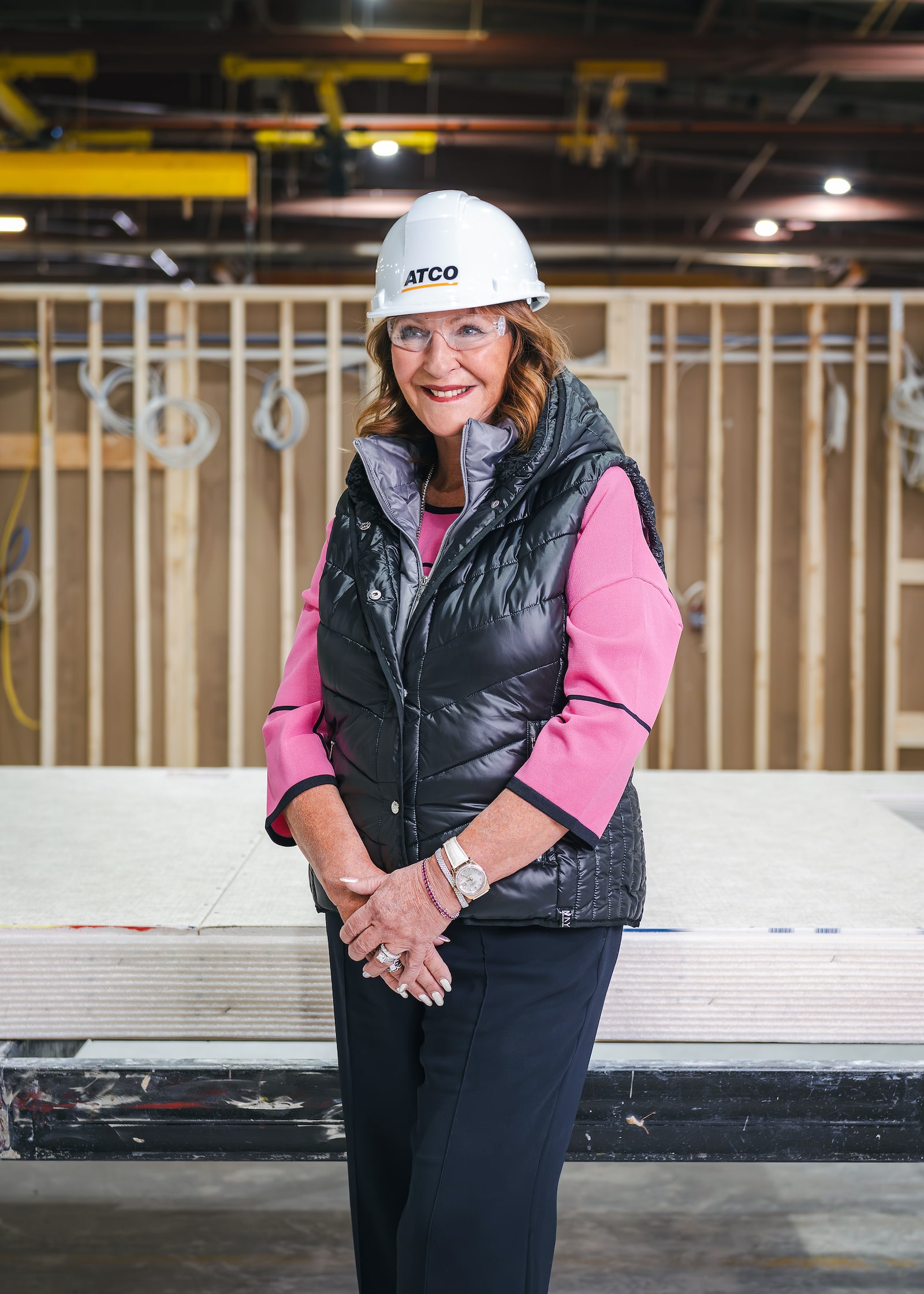
When we first floated the idea of profiling Southern a few years back, she made one point abundantly clear: It must not seem as though she were retiring, because she most certainly wasn’t.
Not much has changed. “I still love the business, and they’ll probably take me out kicking and screaming.”
While she believes ATCO has the best leadership today that it’s ever had, she acknowledges that, as CEO, she has a fiduciary responsibility to make sure there’s a succession plan in place. To that end, Southern—who turns 70 this summer—and her sister have worked hard with the next generation to make sure they understand their roles and responsibilities, as well as the legacy the family would like to see continue.
Koss-Brix, who spent 15 years competing internationally as an equestrian, is the eldest of that generation. She joined the Canadian Utilities board in mid-2023 and the ATCO board at the start of 2025, and Southern says she’s now working toward a senior governance role—perhaps vice-chair or chair. For her part, Koss-Brix is trying to learn as much as she can, as fast as she can. She doesn’t yet know what role she might play but says succession is “absolutely” front of mind. “Transitions and succession are thoughtful, deliberative processes. And it’s not about the individual,” she says. “It’s what’s right for the company and its shareholders and its customers and the people who work for us. It’s our responsibility as a family to make sure that continues, whatever it looks like.” She also doesn’t assume that the next CEO of ATCO will be a family member, and says the board and leadership will make sure it’s the right person at the right time.
But that’s all in the future.
For now, Southern is working to ensure ATCO is part of every major infrastructure project it can be, along with the push for more housing and the renewed focus on defence that are priorities for this federal government. She calls the memorandum of understanding signed by Ottawa and Alberta last year a “bright light that says, ‘Yeah, we’re going to get things done.’” Carney and Premier Danielle Smith took a political risk, she says. So her message to businesses? “Step up, support them and get behind it.”
Building Canada to its strongest will take collaboration between all levels of government, and it will come with a cost that will need to be balanced with how well the economy is doing, Southern says. And nothing will happen overnight, which makes her worry that enthusiasm and commitment might wane if people don’t see immediate results. “But I believe it’s incumbent on us as Canadians—and our company and all Canadian companies—to get at it and start building.”
When ATCO first started, there were no paths to building a global enterprise, no guarantees that the decisions Southern’s father and grandfather made would pay ever off. They’ve all made mistakes along the way—made money, lost money. But they kept trying, kept building. “That’s where we’re at today, in my mind,” Southern says. “It’s our turn to really tighten our bootstraps, throw our hearts over the fence and get things done.”