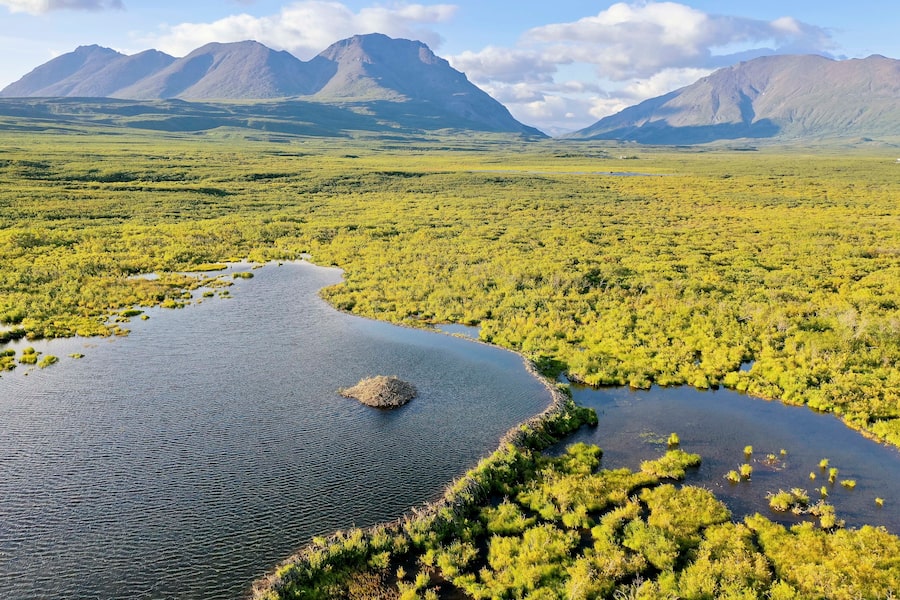

Under the midnight sun on July 14, 2024, Kevin Arey was at Shingle Point – a summer coastal camp for Inuvialuit families on the Yukon coast of the Beaufort Sea – when he was stopped in his tracks. There, in the ocean, was a beaver.
“Just swimming by, casually,” he says.
Mr. Arey is an Imaryuk Monitor, whose job is to protect fish, wildlife and traditional land use in the Inuvialuit Settlement Region, or ISR – the westernmost region of Inuit Nunangat, the Inuit homeland in Canada. He works along the Inuvik–Tuktoyaktuk Highway, the only public road in North America to reach the Arctic Ocean, its corridor lined by the creeks and lakes of the Mackenzie Delta, Canada’s largest.
Growing up, he had never seen a beaver on these lands and waterways, and certainly never in saltwater. Now, he says, “They’re everywhere – every square inch of the Delta.” That day was the only time he has seen a beaver, a freshwater semi-aquatic mammal, in the sea.
New research confirms what Inuvialuit communities have long witnessed: Driven by climate change, North America’s most famous rodent is moving into the Far North, with cascading consequences for waterways, wildlife and a way of life.
A study published Thursday in the journal Ecosphere provides new evidence of beavers’ expansion as far as the Arctic Ocean in the ISR, by dating the changes these semi-aquatic mammals have made to the tundra landscape as they spread northward.
“Arctic Indigenous communities are already observing rapid environmental change, and beaver range expansion is part of that shift,” says Helen Wheeler, associate professor of ecology at Anglia Ruskin University and senior author of the study. “Their impacts on lakes, rivers, fish populations and traditional practices make understanding these dynamics a priority for the Inuvialuit community.”
Beavers are “ecosystem engineers,” says Dr. Wheeler, transforming the landscapes they inhabit. They dam rivers and streams, pooling water upstream and starving flow downstream, fundamentally altering waterways.

Beavers can tolerate a little salinity, but mostly stick to fresh water. That's why Kevin Arey was surprised to find this one in the Beaufort Sea at Shingle Point (Tapqaq).Courtesy of Kevin Arey
Mr. Arey, who worked with the research team, has felt the impact of beaver activity. “Our travelling routes are changed. A lot of it’s due to rivers drying out, lakes drying out, and there’s so much beaver out there. You see them on every corner in the river. It’s changing our travelling routes, our hunting areas. We have to find new places, new routes to get to these places.”
Working along the Inuvik–Tuktoyaktuk Highway, researchers surveyed 60 beaver lodge and dam sites across a 130-kilometre stretch in partnership with Inuvialuit communities and the Imaryuk Monitors – Indigenous guardians in the ISR who monitor the environmental health of waterways and the highway.


The research combines tree-ring analysis – examining the gnaw marks beavers leave in willow and alder shrubs – with satellite imagery that tracks how beaver dams alter surface water.
By comparing gnaw marks on beaver-chewed willow and alder against the growth rings of nearby undisturbed shrubs – using them as a natural calendar – researchers were able to date beaver activity to the year.
They found evidence that beavers have been continuously present in the region since at least 2008, reaching as far north as the shores near Tuktoyaktuk, a hamlet at the northern tip of the Northwest Territories.
At one large lodge-dam complex, satellite data confirmed an abrupt and persistent expansion of surface water between 2015 and 2019, matching a spike in gnaw marks recorded in the shrub rings – strong evidence that beaver presence had increased significantly at the site.
“In the Arctic, we often lack the historical baselines needed to understand ecological change,” lead author Georgia Hole of Durham University said in a news release.
“Beavers effectively write their history into the landscape with each shrub they cut and every pond they create.”

The scars on this willow in the Northwest Territories are a telltale sign that beavers have been browsing here.Courtesy of Helen Wheeler, Anglia Ruskin University

This ancient wood in Alaska emerged from a permafrost bluff. The gnawing marks are evidence that beavers have been here before, likely during a previous warm period.Courtesy of Tom Glass
The change has been unmistakable on the land and waterways. Residents of Inuvik, Aklavik and Tuktoyaktuk – three communities in and around the lower Mackenzie Delta – have reported beavers in the region for two decades, but in recent years, sightings have increased sharply, with people describing them moving further north in growing numbers.
By 2017, hunters and trappers committees in all three communities had raised concerns about the animals’ impacts on fishing and travel routes, and about the potential implications for drinking-water quality.
By 2020, people described seeing beavers in almost every lake and creek in the lower Mackenzie Delta. By 2022, they had reached Paulatuk, on the shore of the Beaufort Sea.
The study documents in the Canadian Arctic what researchers working in Alaska first mapped as a continental pattern. In a foundational 2018 paper called Tundra be Dammed, University of Alaska Fairbanks ecologist Ken Tape and colleagues showed that beavers had created more than 12,000 new ponds across the Alaskan Arctic since the 1950s.
A modelling study by Dr. Tape published last year forecast that by 2050, under high-emissions scenarios, the entire North Slope of Alaska – currently beaver free – would become suitable beaver habitat.
That projection, Dr. Wheeler says, may already be conservative on the Canadian side. “In the ISR, the expansion is all the way up to the Arctic Ocean already.”

Beavers in the Far North can have company from other newcomer species as ‘borealization’ allows many forms of life to thrive at higher latitudes.Courtesy of Ken Tape
The beaver’s push northward is part of a broader phenomenon researchers call borealization: the movement of boreal species into the Arctic as the climate warms. Moose, snowshoe hare, river otter and muskrat have all extended their ranges in recent decades.
“Beavers are part of a larger trend,” says Tom Glass, a postdoctoral researcher at the University of Alaska Fairbanks. “The unique thing about beavers is that when they get there, they totally change what the Arctic looks like.”
That transformation accelerates the very warming that enabled it. Beaver ponds flood adjacent lowlands and, in permafrost landscapes, put sustained heat on the ground – thawing the frozen soils that store vast amounts of carbon and releasing greenhouse gases, including methane.
The latest research was conducted as part of the Barin project under Cinuk, the Canada-Inuit Nunangat-United Kingdom Arctic Research Programme.
The research team is now expanding their sampling into the Delta itself, which Dr. Wheeler suspects is the primary route of northward spread. A paper on community impacts drawn from interviews is also forthcoming.
For Mr. Arey, the work is ultimately about what is at stake. He still travels west from Inuvik toward Aklavik, and south to the coast where he was raised – hunting and fishing routes he has worked his whole life – to monitor wildlife. Beaver damming has dried out rivers, cut off fishing grounds and forced him to find new routes across land that has always been his to read.
“For the future of our children, to carry on the hunting and fishing – to keep a little bit of our heritage going,” he says. “The beaver problem here is real. It needs to be taken seriously.”
In our nature: More from The Globe and Mail
The Decibel podcast
The Arctic is getting warmer, fast. That’s a geopolitical challenge for Canada, and a potential threat to Inuit communities that risk becoming more remote and harder to feed. Journalist Jenn Thornhill Verma took The Decibel to Nunatsiavut, in northeastern Labrador, to see how elders are adapting. Subscribe for more episodes.
Ecology in context
For Earth Day, consider the buffalo and how everything depends on nature
New Zealand sees results in fight to save its strange, wonderful birds
In Vancouver’s Stanley Park, clearing dead trees ignites a fiery debate