Coca-Cola's Inflation Balancing Act: Price Increases vs. Volume
The Coca-Cola CompanyKO is pursuing a balanced inflation strategy that combines selective price increases with affordability initiatives to protect demand. Rather than relying solely on passing higher costs to consumers, Coca-Cola is using its Revenue Growth Management capabilities to tailor pricing, packaging and promotional strategies across markets. Management emphasized that while inflation continues to pressure certain consumer segments, especially lower-income households, the company is expanding affordable options through smaller pack sizes and entry-level offerings to maintain consumer engagement and brand loyalty.
The first-quarter 2026 results highlight this balanced approach. Organic revenues grew 10%, supported by 4% of pricing actions, while global volume increased 3%, indicating that consumers largely absorbed price increases without significantly reducing purchases. Coca-Cola’s executives noted that affordability remains a key component of their strategy, particularly in markets facing economic pressure. In North America, for example, the company introduced affordable single-serve and multi-serve packages to retain value-conscious consumers within the franchise.
At the same time, Coca-Cola faces rising input costs, particularly in commodities such as tea and coffee, while its bottling partners are exposed to inflation in aluminum and PET packaging. Management described these pressures as manageable due to established cost-control playbooks, procurement efficiencies and pricing capabilities developed over recent years. Rather than implementing aggressive price hikes that could harm demand, Coca-Cola is leveraging local market flexibility and consumer insights to determine the appropriate balance between pricing and volume growth.
Overall, Coca-Cola’s strategy suggests it is neither fully passing costs to consumers nor sacrificing demand. Instead, the company is using a combination of pricing power, affordability measures and operational efficiencies to navigate inflation while sustaining revenue growth and market share gains.
KO’s Peers: PEP & MNST’s Inflation Strategy
PepsiCo Inc.PEP and Monster Beverage Corporation MNST have adopted similar but distinct approaches to inflation, balancing strategic pricing actions with efforts to protect consumer demand as rising input and packaging costs continue to pressure margins.
PepsiCo’s inflation strategy in first-quarter 2026 focused on balancing pricing actions with affordability measures rather than relying solely on higher prices. The company credited effective net pricing for supporting 2.6% organic revenue growth, while also investing in affordability initiatives, particularly within its North American food business, to stimulate volume growth.
PEP’s management highlighted the use of sharpened price-pack architecture, productivity savings and commodity hedging programs to mitigate cost pressures. By combining selective price increases with value-oriented offerings and operational efficiencies, PepsiCo aimed to protect consumer demand while preserving profitability in an increasingly volatile inflationary environment.
Monster Beverage’s inflation strategy centers on selective pricing, cost management and product mix optimization rather than sacrificing demand. Management noted that higher aluminum costs and tariffs modestly pressured margins in first-quarter 2026, but these impacts were partially offset by pricing actions and hedging strategies.
MNST emphasized that prior pricing increases continue to perform as expected, with consumers showing resilience and category demand remaining strong. Monster Beverage also leverages a broad portfolio of premium and affordable brands, allowing it to address different consumer budgets while maintaining volume growth, market share gains and profitability despite inflationary pressures.
KO’s Price Performance, Valuation & Estimates
Shares of Coca-Cola have risen 2.2% in the past three months compared with the industry’s return of 0.5%.
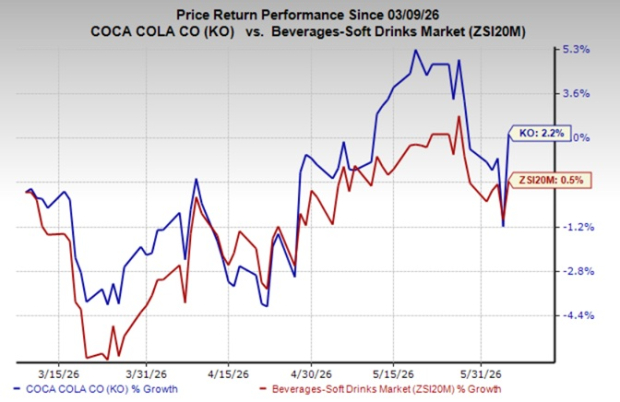
Image Source: Zacks Investment Research
From a valuation standpoint, KO trades at a forward price-to-earnings ratio of 23.67X compared with the industry’s average of 18.92X.
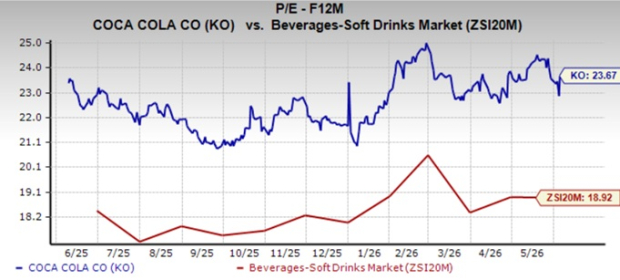
Image Source: Zacks Investment Research
The Zacks Consensus Estimate for KO’s 2026 and 2027 earnings per share implies year-over-year growth of 8.7% and 7%, respectively. The estimates for the aforesaid years have been unchanged in the past 30 days.
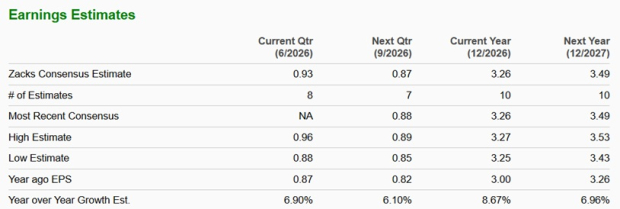
Image Source: Zacks Investment Research
Coca-Cola currently carries a Zacks Rank #3 (Hold). You can see the complete list of today’s Zacks #1 Rank (Strong Buy) stocks here.
Beyond Nvidia: AI's Second Wave Is Here
The AI revolution has already minted millionaires. But the stocks everyone knows about aren't likely to keep delivering the biggest profits. AI’s second wave is moving from infrastructure to implementation and these companies are at the forefront of this transition, positioned to become what Amazon and Google were to the internet era.
See Stocks Now >>This article originally published on Zacks Investment Research (zacks.com).
