What are these documents, and where did they come from?
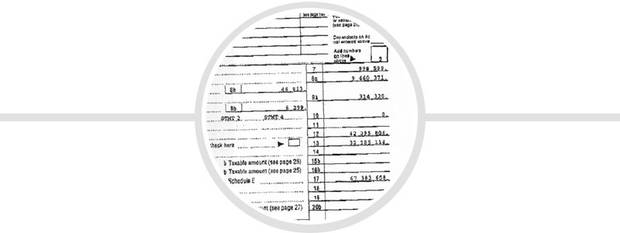
The two pages from Mr. Trump's 2005 tax return were obtained by journalist David Cay Johnston, who runs a website called DCReport.org, and reported on MSNBC's The Rachel Maddow Show on Tuesday. A stamp reading "Client Copy" is visible on one of the two pages.
WATCH: @Maddow's exclusive look at Trump's 2005 tax return https://t.co/ZZ5S0jbfcS pic.twitter.com/i1mCZiQqJt
— MSNBC (@MSNBC) March 15, 2017
Ms. Maddow said Tuesday that the return was mailed anonymously to Mr. Johnston. He speculated on the show that the documents could have been mailed from Mr. Trump, a known leaker of information, or his associates since they appeared to paint the president in a favourable light.

What they show about Trump's finances
The two pages show Mr. Trump earned $153-million and paid $36.5-million in income taxes in 2005, paying a roughly 25 per cent effective tax rate thanks to a tax he has since sought to eliminate. That effective tax rate is well above the roughly 10 per cent the average American taxpayer forks over each year, but below the 27.4 per cent that taxpayers earning $1-million a year average, according to data from the Congressional Joint Committee on Taxation.
The pages show Mr. Trump also reported a business loss of $103-million that year, although the documents don't provide detail. In a statement, the White House called it a "large-scale depreciation for construction," without elaborating.
The bulk of Mr. Trump's tax bill in 2005 was due to the Alternative Minimum Tax, a tax aimed at preventing high-income earners from paying minimal taxes. The AMT requires many taxpayers to calculate their taxes twice – once under the rules for regular income tax and then again under AMT – and then pay the higher amount. Critics say the tax has ensnared more middle-class people than intended, raising what they owe the federal government each year. Were it not for the AMT, Mr. Trump would have avoided all but a few million dollars of his 2005 tax bill.
Mr. Trump's campaign website called for the end of the AMT, which is expected to bring in more than $350-billion in revenues from 2016 to 2025.

How that fits with what we knew before
Mr. Trump's tax returns have been a much sought-after secret, both during and after the election. As a candidate and as president, Mr. Trump refused to release his tax returns, breaking a decades-long tradition.
The hefty business loss shown in the 2005 returns appears to be a continued benefit from his use of a tax loophole in the 1990s, which allowed him to deduct previous losses in future years. In 1995, Mr. Trump reported a loss of more than $900-million, largely as a result of financial turmoil at his casinos. Tax records obtained by The New York Times last year showed the losses were so large they could have allowed Mr. Trump to avoid paying taxes for up to 18 years. But Mr. Trump's 2005 filing adds to what we know by showing the AMT prevented him from realizing the full benefit of those deductions.
Although he initially promised to release his tax returns as a candidate, he later claimed he was under audit by the Internal Revenue Service and said his attorneys had advised against it – though experts and IRS officials said such audits don't bar taxpayers from releasing their returns. Mr. Trump long insisted the American public wasn't interested in his returns and said little could be learned from them.
But Mr. Trump's full returns would contain key details about things like his charitable giving, his income sources, the type of deductions he claimed, how much he earned from his assets and what strategies he used to reduce his tax bill. The issue was a major point of attack from his election rival, Hillary Clinton, who suggested Mr. Trump had something to hide.
The White House has not said whether or not the president plans to release his returns while he's in office. More than one million people have signed a White House petition urging the president to release them.

How Trump and his team are trying to spin this
By Wednesday, Mr. Trump issued his familiar refrain of "fake news" to cast aspersions on Mr. Johnston, a Pulitzer Prize-winning journalist:
Does anybody really believe that a reporter, who nobody ever heard of, "went to his mailbox" and found my tax returns? @NBCNews FAKE NEWS!
— Donald J. Trump (@realDonaldTrump) March 15, 2017
The night before, a White House official released a statement in the minutes before Ms. Maddow's show aired, declaring the revelations to be a ratings ploy:
You know you are desperate for ratings when you are willing to violate the law to push a story about two pages of tax returns from over a decade ago.
The statement was issued on condition that it be attributed to an anonymous official, although the president has decried the use of anonymous sources.
Mr. Trump's son Donald Jr., one of the custodians of Mr. Trump's business holdings along with his brother Eric, tried to portray the information as good news for Mr. Trump, saying it showed how much tax money he paid in 2005:
Thank you Rachel Maddow for proving to your #Trump hating followers how successful @realDonaldTrump is & that he paid $40mm in taxes! #Taxes
— Donald Trump Jr. (@DonaldJTrumpJr) March 15, 2017
Ms. Maddow wasn't even off the air – MSNBC kept her on for more than her hour to continue discussing the story – when she came under attack by one of Mr. Trump's most vocal defenders on television: Fox's Sean Hannity. Mr. Hannity, on his show, called Ms. Maddow's story "a flat-out, pathetic conspiratorial attempt to smear the president." He said NBC News was part of the "deep state" looking to undermine Mr. Trump's presidency.
I have to thank @NBCNews I have not laughed this hard in a decade. You could not write a better skit than this. https://t.co/VwRyqwXEgH
— Sean Hannity (@seanhannity) March 15, 2017

Rachel Maddow's night of fame
For a brief, breathless moment Tuesday night, MSNBC's Ms. Maddow was at the centre of the political media universe – and it started with a single tweet, sent less than 90 minutes before her show began.
BREAKING: We've got Trump tax returns. Tonight, 9pm ET. MSNBC.
— Rachel Maddow MSNBC (@maddow) March 14, 2017
(Seriously).
That teaser spread like wildfire, and within the hour, MSNBC was running a countdown clock on its screen counting down the minutes to a "Trump Taxes Exclusive." Before Ms. Maddow even went on the air, the White House confirmed the documents were real.
Ms. Maddow spent nearly 20 minutes explaining why many people believe it important that Mr. Trump release his tax returns. But it all felt vaguely like a bait-and-switch and there were some complaints on social media that Ms. Maddow was taking too long to get to the point:
@MSNBC @maddow Suing MSNBC for 60 minutes lost watching this. Reminded me of Geraldo opening the vault ages ago.
— Isha G (@Isha_G2) March 15, 2017
If nothing else, this was a teachable moment on the importance of expectation management
— Adrian Morrow (@AdrianMorrow) March 15, 2017
By the time Maddow gets to the point the Leafs are gonna be down 10-1
— Bruce Arthur (@bruce_arthur) March 15, 2017
For long-time watchers of her show, the structure was familiar: Ms. Maddow frequently opens with long, detailed stories that follow many paths. This has been a winning formula lately, since Ms. Maddow's ratings in February were the highest in the nine years her show has been on the air.


The legal issues
The release of the tax documents has sparked a legal dispute, with the White House and MSNBC squaring off over whether a law was broken, or whether First Amendment privilege protected the network's right to publish them.
Tuesday's White House statement declares that the returns were "illegally published" and then claims that it is "totally illegal to steal and publish tax returns."
Federal law makes it illegal to publish an unauthorized tax return or "return information." According to federal statute, any violation of the law "shall be a felony punishable by a fine in any amount not exceeding $5,000, or imprisonment of not more than 5 years, or both, together with the costs of prosecution." That term, "return information," not only applies to the amount of taxes paid, but also the amount of income, payments, receipts, deductions and other financial information that could be found on the forms.
But legal experts have said the way the returns were obtained matters. If a media organization did not conspire to steal the material or get it from the government but simply received it from a private citizen, criminal liability would be less clear.
Ms. Maddow, during her broadcast, declared the First Amendment allows journalists to publish tax returns:
Rachel Maddow: "The first amendment gives us the right to publish this return." pic.twitter.com/Jgbu1GRSIk
— Hollywood Reporter (@THR) March 15, 2017
A similar defence was mounted by The Washington Post amid the 1971 publication of the Pentagon Papers, a classified study of the United States' involvement in the Vietnam War. Editors at The New York Times made a nearly identical argument in October when one of their reporters was mailed Trump's 1995 returns. After the publication, the paper printed a statement that read:
Nothing could be more central to the First Amendment than our right to publish, and the public's right to know, important information about presidential candidates.
With a report from The New York Times News Service
Photos: Associated Press, Reuters, MSNBC, Getty Images, iStockphoto
MORE FROM THE GLOBE AND MAIL