
If there is ever a good time to go on strike against one of the Detroit Three auto makers, this might be it.
North American vehicle sales are torrid, Ford Motor Co., General Motors Co. and Fiat Chrysler Automobiles NV (Chrysler) are reporting their longest sustained run of profitability in years and the Canadian dollar is well below par with the U.S. buck, keeping labour costs lower in Canada than at the companies' U.S. plants.
So, as Unifor president Jerry Dias gears up to make sure GM's assembly plant in Oshawa, Ont., keeps operating, save a Ford engine plant in Windsor, Ont., and win a promise of new investment at a Chrysler factory in Brampton, he has those bargaining chips in his pocket.
"If we can't solidify our footprint in this economic climate, then we'll never solidify," Mr. Dias says. "That's why I have no option. We have to fix it now. It's not going to be sunnier three years down the road."
Dissecting the upcoming labour talks is only one reason for our lunch at Watermark Irish Pub on Toronto's waterfront, but the 90-minute conversation keeps veering back to that topic – in part because the negotiations that begin later this summer will represent the most significant challenge for Mr. Dias since he became Unifor's first president. The talks are critical to the future of the Detroit Three in Canada and, thus, a key segment of Unifor's membership.
The union is the product of a 2013 marriage between the Communications, Energy and Paperworkers Union of Canada and the Canadian Auto Workers, whose ranks Mr. Dias climbed. (Editorial, advertising and circulation employees of The Globe and Mail are now members of Unifor.)
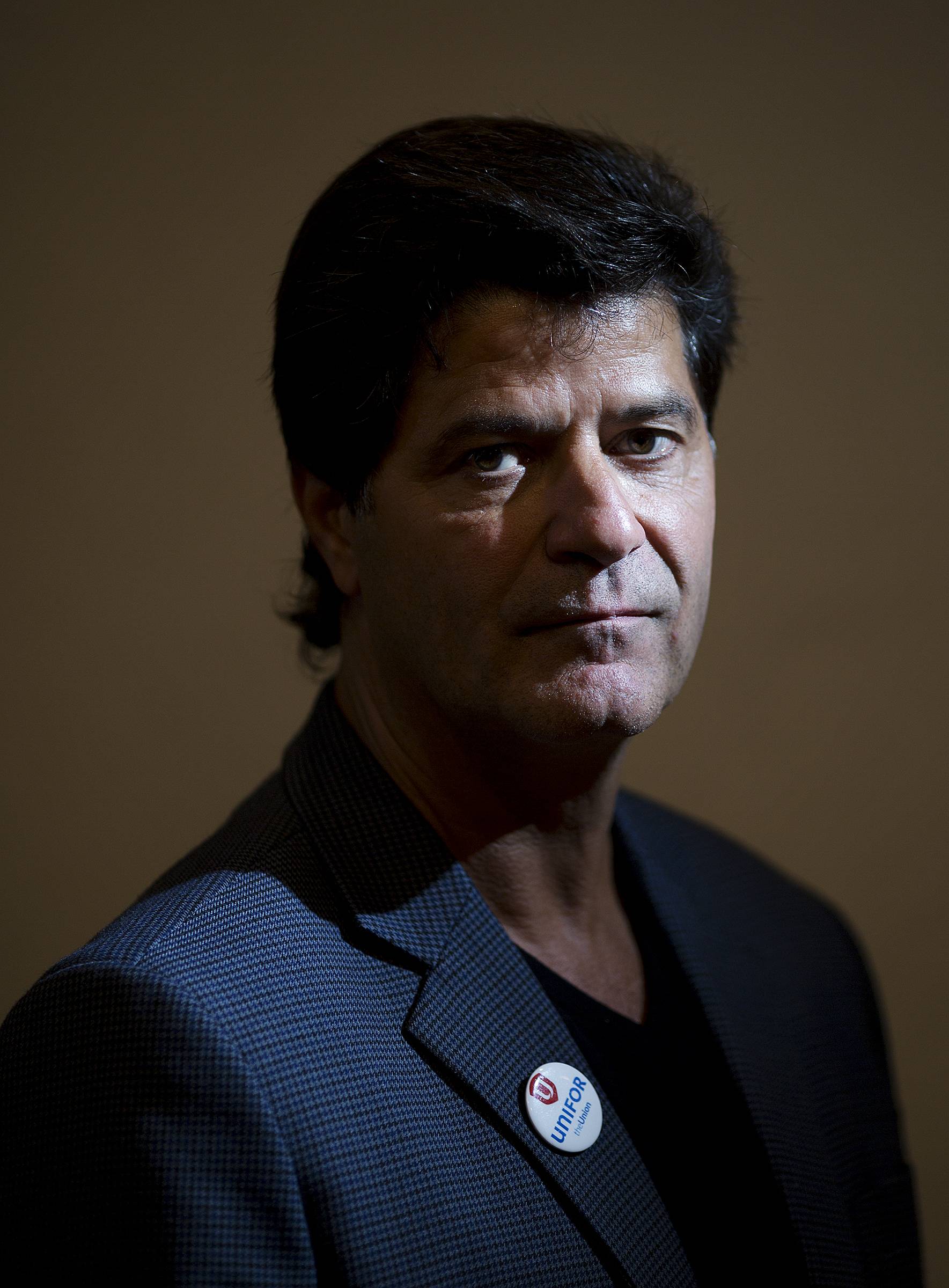
As he sips the first of two glasses of an Argentine malbec – paired with a rogan josh curry that he calls "my comfort food" – he reveals that he grew up in the 1960s and 1970s in the eastern Toronto suburb of Scarborough. To my shock, I realize that it was around the corner from the street where I lived until the age of 7.
"You've got to be freaking kidding me," he says when I mention the name of the street. He responds with the names of families that are still familiar.
We're a year apart in age, but it turns out we attended the same elementary school before my family moved across town.
Mr. Dias was born in Toronto after his parents left Guyana in the 1950s in the classic saga of families from impoverished countries seeking a better life in Canada. His father discovered the working part of that life at what was then de Havilland Aircraft of Canada Ltd. (now a Bombardier Inc. factory) and eventually became the head of Local 112 of the Canadian unit of the United Auto Workers.
It was a natural progression for that generation of workers to have their sons follow them into the factory and the union. Mr. Dias eventually went to work at de Havilland, but he took a detour first. As graduation approached from Toronto's Neil McNeil High School, Mr. Dias decided he wanted to become a physical education teacher and study at the University of Windsor.
That did not go over well with his father. "He's not the world's most diplomatic man and he's not very shy to make his point, so he said to me: 'Have you lost your mind? We don't have any money. You're not going to Windsor and why would you even think about going there?'"
So, he went to York University in Toronto instead, but stayed just one year. After working the following summer at de Havilland, he decided to stay.
He eventually followed in his father's footsteps in the union as well, but that journey also came in fits and starts. He was laid off by de Havilland in 1982 and joined the Metropolitan Toronto Labour Council, setting up unemployment help centres.

His mother was also a labour activist. His parents inspired in him a social conscience that he has extended beyond the union through his membership on the board of directors of Halton Women's Place. Every year, he participates in the shelter's high-heels walk, in which men walk in women's shoes to raise money and increase awareness of violence against women.
While still on layoff from de Havilland, he went to work at the General Motors of Canada Ltd. large van assembly plant in Scarborough and ended up on strike in the 1984 labour dispute that led to the Canadian division of the UAW splitting off and forming the CAW.
"I had the worst job in the plant. I had to put in the two front bucket seats, fasten the shoulder harnesses and put on the rear-view mirror. I busted my ass."
In the middle of the strike, he was recalled by de Havilland. "When I got recalled, I swore that I'd be their best employee ever."
That vow aside, he became the union's plant chairman, then joined the national union and later became an assistant to CAW president Buzz Hargrove. He ran for president of Unifor when CAW president Ken Lewenza, who followed Mr. Hargrove, decided that he didn't want to remain president long enough to manage the merger between the CAW and the CEP.
Following in their footsteps, Mr. Dias fires up union members easily at public events. He laughs hardly at all during our lunch, but he has such a deadpan delivery that it often takes a few seconds to realize that he's joking. At the launch of the new Chrysler Pacifica minivan earlier this year, he got to the podium and told workers to move to the front and take the seats of management personnel who were sitting down. As the managers moved to give up their seats, he had to tell everyone that he was only joking.
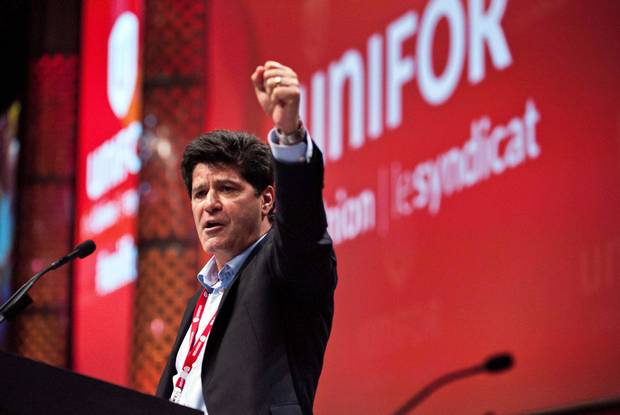
Mr. Dias gives a speech after being declared the first president of Unifor.
Galit Rodan/The Canadian Press
The new union has flexed its muscles under Mr. Dias, encouraging its members last year to vote for anyone but Stephen Harper and the federal Conservatives. Unifor was also central to the campaign to turf Canadian Labour Congress president Ken Georgetti in favour of Hassan Yussuff.
"We're on a roll as an organization," he says.
Perhaps, but can Unifor stop the downsizing of the Detroit Three's Canadian operations? Mr. Dias's job is to convince the companies that investing in this country makes sense even though Mexico offers rock-bottom wages, more than 40 free-trade agreements and a geographic position in the middle of the hemisphere with logistics advantages that Canada cannot match.
The answer to the question will come in September when the agreements with the companies expire and Mr. Dias learns whether Ford has a new engine program for Windsor or GM agrees to allocate vehicles to Oshawa and whether Fiat Chrysler will pony up new investment at its large-car plant in Brampton.
"I believe that Ford, GM and Chrysler are all listening to us very carefully because we are out there saying we need to find a solution or there's going to be a problem," he says. "We're going to have a solution or we're going to have one hell of a fight."
He says he is "completely convinced" that GM is preparing to permanently halt vehicle production in Oshawa, where one plant is scheduled to close next and the other assembly plant has no new or replacement vehicles in the pipeline. He says he is equally convinced that he can change that plan.
It will be an intense two months of negotiations, with Unifor choosing one of the companies as the target for an agreement that will serve as a template for the other two auto makers in a process known as pattern bargaining.
Mr. Dias will manage to get a break from that intensity.
He owns a 13-metre power boat that is moored at a marina on the Toronto Islands. He can reach it in seven minutes via a tender that heads to the island from a spot next to where we're having lunch. The boat will serve as an escape during the talks – as it does now when Mr. Dias needs to get away.
"More than anything else, it's the atmosphere," he says. "I find it very peaceful and it's about as tranquil as you can get. When I'm over there for about half an hour, I completely decompress."
Even if the contracts are settled without a strike, he is likely to need some time for tranquillity once the talks end.