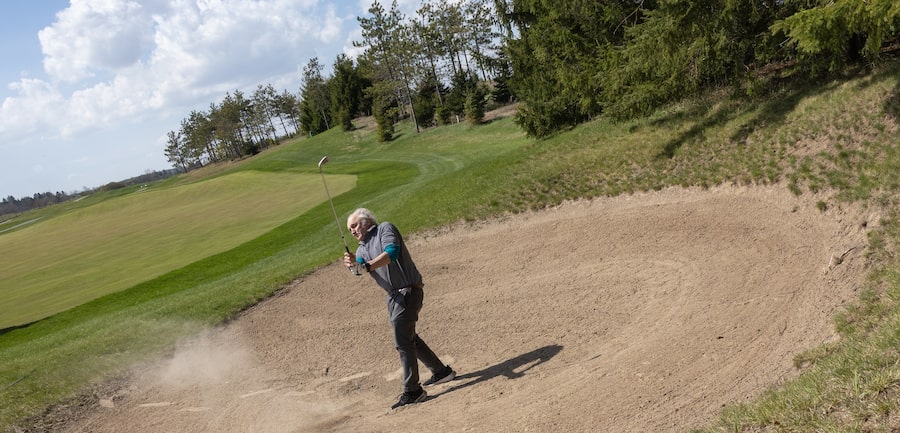

Let’s begin with a short description of the way a very good, near professional-level golfer addresses the ball before a shot. The demonstration takes place at Osprey Valley, the glittering golf course northwest of Toronto where the RBC Canadian Open will be played this week. Brian Decker, the course’s director of marketing – tiny handicap, played golf for McMaster University – steps up to the ball compactly and efficiently, conveying the impression that this is not going to take long.
It does not. Short, focused stillness before coming to rest; measured, unextreme backswing; quick, accelerating swing through the ball to a balanced finish position facing down the fairway. It’s a swing you feel you could package and display on a shelf.
Decker intended to hit the ball 275 yards down the right side of the friendly looking fairway of the 10th hole of Osprey’s North course, the one that is being pampered and shaved and primped and fluffed for the Canadian Open. And 275 yards down the right side of the fairway is exactly where his ball goes.

Golfers will fight for the right to hoist this sterling silver cup at the RBC Canadian Open, which runs from June 10 to June 14.
Let us now examine the address of super-keen but below-average golfer Mr. Duffer, who is pre-playing a smattering of Open holes with Decker and Ian Andrew, the golf course’s renovation architect, to get a sense of what playing a tournament course is like. Mr. Duffer has been playing golf for 30 years to zero avail.
He approaches the ball as if it were radioactive. He sites his target with his club like a 17th century cannoneer aiming an eighteen-pounder at a Spanish galleon half a league away. There is a pause while he tries to incorporate what he has just learned about his grip – none of it good – at his latest golf lesson; there is an adjustment of said grip. There follows more finger-waggling, leg shifting, head tilting, plus bending and re-bending at the waist and then at the knees as he remembers to stand up to the ball, not over it. Mr. Duffer is trying to simultaneously remember and forget everything he has ever learned about the golf swing.
Then he takes a practice swing and repeats the entire rigamarole. He is aware he is taking too long, which only makes him twitch more. Perhaps he has St. Vitus Dance.
A long period of stillness. A deep breath, followed by a paralytically slow backswing. The overall impression is of a rickety edifice as it begins to collapse.
The ball travels twenty two feet sideways to the left – not his intention – and disappears into the rough with a finality that suggests death. Everyone present knows instantly: that ball will never, ever be found.
Why do Mr. Duffer and average golfers even try? Golf costs a lot, requires endless time and practice, and is agony. And how can Mr. Duffer and his ilk play a course meant to challenge a pro? That is Osprey Valley’s promise, after all: a tournament level course that the public can play.
There are, in fact, answers to these questions. Some of them have to do with the complex architecture of golf courses. Some of them have to do with television and the financial juggernaut known as professional golf. The rest is vanity and the utter foolishness of being a golfer.

The 10th hole of the North course, the hole Mr. Duffer is playing with Decker and Andrew, is a sterling example of the way modern golf course design can – allegedly – play to the (very different) strengths and weaknesses of pros and average golfers alike. To understand its cleverness, we first have to inhale a little history.
For a long time, Osprey Valley was the best-kept secret in Canadian golf. The complex’s original Heathlands course, designed in 1991 by Doug Carrick, Canada’s best-known living golf course architect, and opened the following year, was Ontario’s first links-style course, modelled after the rustic, weather-beaten, topography-conforming, spiritually infuriating courses of Ireland and Scotland, golf’s infernal birthplace.
(Carrick learned his trade from C. E. Robbie Robinson, who learned it from Stanley Thompson, the legendary Canadian who professionalized golf course design and laid out the Banff Springs links, among many others.)
Built on a former sand and gravel quarry near Caledon, 40 minutes northwest of Toronto’s Pearson airport, Osprey was not the lush golf oasis it is today. For many years the clubhouse was a trailer. The bathroom was a Port-A-Potty.
In 2001, Carrick created two more legendary Osprey courses, the Hoot (inspired by storied Pine Valley, in New Jersey) and what is now the North course, after the property and hundreds more acres of surrounding land were purchased by Roman and Jerry Humeniuk, two developer brothers from Ukraine.
Carrick’s North layout was in the parkland style, a wide, green, rolling space modelled on New York State’s Winged Foot. “The intent wasn’t to make it a difficult golf course,” Carrick told me recently. “In fact, the North course was to be the easiest of the three. You try and keep in mind all different skill levels of golfers.” You could play all day, on as many of the courses as you could manage, for $120. If there is a Platonic ideal of a public golf course, Osprey Valley was it.

Chris Humeniuk is president of Tournament Players Club Toronto at Osprey Valley, the course purchased in the 1990s by his father and uncle.
But an unknown gem known to a handful of enthusiasts is not a recipe for financial success. By 2017, Roman Humeniuk’s son Chris, a financier who specialized in real estate, had taken over management of the property. He was convinced Osprey Valley had to become an internationally recognized “golf destination.”
His first move was to arrange an endorsement, in 2018, from the Tournament Players Club (TPC), a chain of private and public golf courses run by the PGA Tour to handle large tournaments.
There followed two brand new clubhouses, a smattering of villas, enough extra land for a potential fourth course, a next-generation golf training-and-practise centre, a new national headquarters for Golf Canada and a permanent site for the Canadian Golf Hall of Fame. (Tiger Woods’s shirt! Brooke Henderson’s golf shoes! The human possessions of the golf gods!) By most estimates Humeniuk has spent north of $80-million to make his vision a reality.
Osprey Valley was slated to host the Canadian Open for the first time in 2025. To that end Humeniuk hired golf course architect Andrew to “renovate” the comfy North Course – to make it worthy of the Canadian Open and the world’s best golfers, magically transforming it from a public golf course played by professionals into a tournament-level course the public can also play.
Andrew was an interesting choice as landscape surgeon. He had worked for Doug Carrick for 16 years, designing the greens and bunkers on all three Carrick courses at Osprey. After setting out on his own, Andrew also waited two decades before he laid a finger on any course Carrick had designed, so great was his respect and gratitude toward his mentor. They don’t talk much anymore.
“You know,” Doug Carrick told me, “I would have preferred to have been the one to remodel it, but that didn’t happen. That’s just a fact of life in this business.” Like the fact that however hard he tries, Mr. Duffer is never going to be a good golfer.

The renovation began in August, 2023. “The course overall was very wide, very forgiving for your high handicap golfer,” David Hunter, Osprey Valley’s course superintendent, told me the other day. I found this a pleasing thought. “Like, you couldn’t miss the fairway before.” Even better!
The PGA, alas, prefers precarious 30-foot fairways. So Hunter and his team cut away seven acres of Kentucky bentgrass fairway, resodding it with rolls of thick bluegrass rough, thereby pinching and corseting Carrick’s pleasant idyll. They lengthened the course by about 800 yards, building new tee boxes; let the rough grow from its normal two and a half inches to five and half inches. “I mean, these guys,” Hunter said of the soon-to-arrive pros, “they’re animals when they hit the ball. They can place it anywhere they want. But we’re notorious for wind. And if it gets windy, and it pushes their ball and they get in the rough, they’re gonna be penalized for it.”
“Yeah,” I replied, with more than a little schadenfreude. “Here’s hoping.”

Which brings us back to the 10th hole of the North course at TPC Toronto at Osprey Valley, on a breezy brilliant sunny day a month before the Canadian Open.
The renovated tenth is a 416-yard par 4 – not especially long, given that the average PGA drive is now 302.8 yards. Forty five years ago, in 1980, it was a measly 257 yards, which would have left a mid-iron second shot to the green on the tenth. But new golf ball technology and larger, lighter (hence greater club speed) titanium drivers, to mention just a few technological breakthroughs of the past two decades, have further complicated the golf architect’s job. How do you design a golf course that fully challenges the increasingly adept pros, but isn’t so tricked-up and difficult that they can’t also make great shots – which are what draw the fans (130,000 attended the 2025 Canadian Open) and television viewers (2.4 million watched last year on CBS, up 18 per cent) who fuel the $100-billion-plus global golf business. As the greatest of all golf writers, Herbert Warren Wind, once put it, “penal design can defeat low scoring but it also defeats good golf.”
The golf architect’s other enemy is the percentage golf game pros now play. “The average modern tour player plays a very statistically informed and optimized style of game,” Decker informs me. “You might call it the moneyballification of modern golf.”
Players now practise so assiduously, with such sophisticated measuring technology, that they know “not only how far they hit it but exactly where they’re going to place their ball if they hit a certain club” – their so-called dispersion zone. There are now apps that cast an individual player’s dispersion zones over every hole on a golf course. “So over 72 holes and four days,” Decker says, “the optimal strategy is to avoid risk and take errors off the board.” From there they decide where they can take a calculated risk to score below par. Andrew’s job as course architect is to stymie their calculations by throwing off their decision-making ability.

Ian Andrew, on the green at Osprey during last year's Canadian Open, was hired to make the North Course more challenging.
The 10th hole runs downhill into a valley, with a big pond up its right side and trees on a slope waving at you from the left. The fairway narrows and bends to the left before curving around again slightly uphill to a green on the right. But the first 300 yards are wide open – even inviting. Come hither, big boy, the fairway calls, give me your driver and all you’ve got.
Which is precisely what Andrew wants the pros to think. Because while the fairway veers left, its slope tilts more and more sharply right as it also narrows precipitously (thanks to Hunter’s newly ingrown rough). Even the best professional golfing brain has trouble managing changes in direction on more than one plane at the same time. Also: this is the lowest valley on the course, where the rough grows as thick as yak fur. As a result, hitting too long into the sloping hillside rough on the left is a nightmare to get out of; hit too far into the fairway and you roll into the pond. The smart move is to be modest, lay up and play a longer second.
We tee up. Decker lays up at about 275 yards. Andrew hooks into the long sloping rough to the left. Mr. Duffer shanks his first attempt into the Gulf of Mexico – mulligan! – and then manages a much better drive, almost as long as Decker’s, but in the new extra-long ensnaring rough. (Still, Mr. Duffer thinks: 250 yards! I can play this game! ) At last year’s Open, this hole – to Andrew’s surprise – was the sixth hardest hole on the course.
“Especially among tour players,” Decker says, “the prevailing wisdom is: hit it as far up the hole as you can and figure out the rest later. That’s what they’re conditioned to do. The simplest way to safely play this hole is to do the opposite. Just don’t hit it too far and you can’t go wrong.”
And how is Mr. Duffer supposed to play it? Let me succinctly summarize the advice Brian Decker and Ian Andrew offered over four hours of conversation: Lay up, lay up, lay up, and always play it safe. In golf, especially at the yearning not-so-good level, humility is paramount. “The average player can always find somewhere safe to go,” Andrew says. Just don’t be too proud to go there.

We arrive at the green. Before the 10th was re-sculpted for tournament play, its rough nestled up to the green like an Elizabethan collar, preventing shots from rolling down into the pond. But for this week’s Open the slopeside rough has been “fly-mowed” by something called a hovermower to a billiard-table furze: now there is nothing to stop an ever-so-slightly underhit shot from careening down into the water for a two stroke penalty. Andrew and Decker spend ten minutes tossing balls onto the green, just for the pleasure of seeing them roll off into the drink. They seem to be enjoying themselves. But it’s a chilling sight for Mr. Duffer.
Our sampling takes us next to the 6th hole, another deceptively tilted par 4 that sucks balls into its bunkers like Nature’s personal HVAC system. Mr. Duffer shanks four drives in a row. In a row. Such a tough course! “Now I’m embarrassed,” he says.
“It’s funny,” Andrew says, taking pity. “Expectations not met sometimes can be crushing.”
Decker nods. “Every golfer is far too conscious of their own expectations – and that’s true for 18-handicappers as well as for Tour players. You get this idea, ‘I shot 90 when I played my best round so therefore I should be able to go do that again.’ But that’s not how it works.”
Pros excel at shucking off a bad shot and playing the next one fresh and mentally unshamed. But they have their neuroses. Decker once had a job interviewing Tour players after their rounds. “Invariably they go, ‘Well, I left a couple out there, but it was a good day overall.’ It’s never ‘You know what? Ninety per cent of the time, I hit great shots out there today. I’m really happy with that.’ Only the most self-aware players would say that. If you’ve got expectations, you’re also aware of the shots that didn’t meet those expectations.”
Ergo, fellow hackers: have no expectations. This is harder than it sounds.

We skip the nightmare of the 11th hole – a 225-yard par 3 where Ludvig Aberg, one of the best players in the world, last year needed three tries from the rough to reach the green. But that was just one hole. The 2025 U.S. Open, at Pennsylvania’s Oakmont Country Club, one of the oldest (1903) and most difficult golf courses on the PGA Tour, produced only one player under par over the four-day tournament (J. J. Spaun, the winner). It made for a tedious spectacle. We don’t want the golf gods to be human, like Mr. Duffer. “I’d rather watch them hit a shot close, make the birdie, have a run of birdies,” Andrew says. “That’s more entertaining, and if a disaster happens within the context of that, that’s fine. Generally, we want them to show their skill, because they’re that good.” The mid-twentieth century notion that a tough course was automatically a good course went out of fashion as golf television came into its own. Relentless difficulty is also bad for business. “We’re trying to get 65,000 rounds of golf through here every year, right?’ Decker admits. “We don’t want people to be having a bad time.”
Which is why there’s always a safe, albeit not especially dignified, way out for the average golfer. We were halfway down the North course’s legendary 18th hole – where last year, at the 2025 Open, New Zealander Ryan Fox pulled the cover off his 3-wood, to cheers from the crowd as they realized he was going for it, and whacked his second shot almost 256 yards to within seven feet of the hole to win the tournament – when Decker pointed out that the hole was still playable for an average golfer. All he or she has to do, he said, is “plop it around the water.”
Finally we arrive at the 14th, the famous Rink Hole: a short (144-yard) downhill par 3 whose tee box resembles the boards of a hockey rink, to bring spectators as close as possible to the pros as they swing. Andrew hopes to see several holes-in-one on the 14th this year.
Andrew puts his drive on the green. Decker drops his next to the hole. Mr. Duffer skulls his, with an 8-iron. But he hits it with such force that the ball becomes a ground-hugging cruise missile that slams into the bank of, and rolls up and on and not quite off, the green. To Mr. Duffer’s astonishment, his subsequent 50-foot-putt stops nine inches from the hole, and Andrew declares it a gimme.
Mr. Duffer has made par on a Canadian Open hole. That’s the same score as the 308 pars the Tour pros posted on the 14th at last year’s Open. And just like that, Mr. Duffer loves the game of golf once more. He can’t wait to play again.

The summer in sports: More from The Globe and Mail
The Decibel podcast
Investigative reporter Greg Mercer pored over FIFA’s contracts with Toronto and Vancouver, and told The Decibel what he learned about the division of costs and rewards. Subscribe for more episodes.
The field of play
Basketball: Season ticket holders reflect on what the Tempo mean to Toronto
Baseball: Blue Jays fever leads to boom in Toronto youth baseball league participation
Golf: Older, wiser Ashton McCulloch seeks redemption at Canadian Open