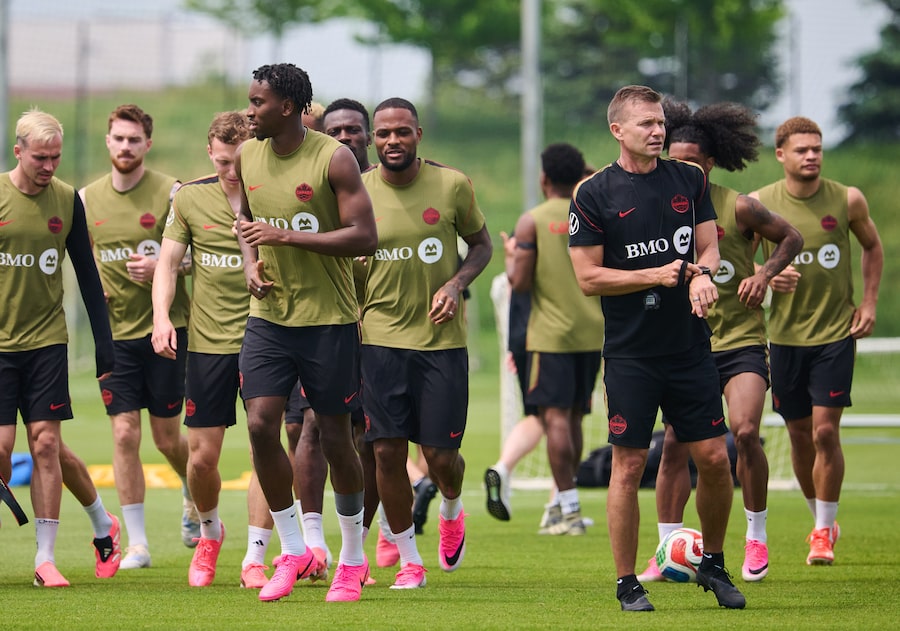
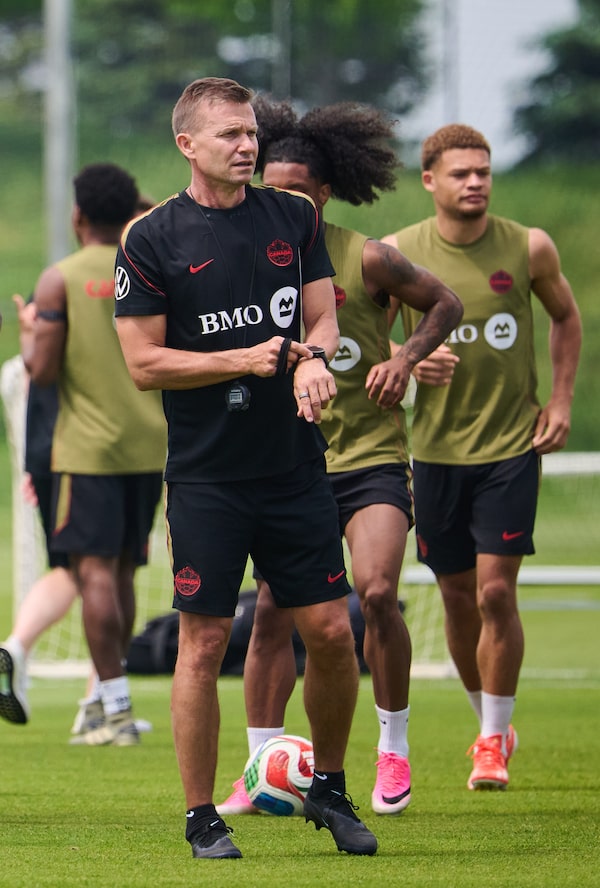
Jesse Marsch has achieved resounding success on the pitch – from reaching the Copa America semi-finals two years ago to guiding the Canadian men’s national soccer team to an all-time high of 26th in the world.
But for all those victories, nothing has resonated more strongly with Canada than when the American-born head coach came to his adopted country’s defence last year.
Ahead of the Nations League Finals tournament in late February, 2025, Marsch famously used a news conference to tell United States President Donald Trump to “lay off the ridiculous rhetoric about Canada being a 51st state.”
The 52-year-old had been in the job for less than a year to that point, but it proved a real litmus test of his credentials – far more than the x’s and o’s and tactical nuances.
“At one level, as coaches we’re only judged by wins and losses, which is a little bit of a shame,” he says more than a year on from the comments that served as his Canadian coming-out party. “But on another level, even a national team coach, it’s a little bit of a political position. You have to do a good job of making sure you represent what the nation is and what the national team should be about.”

Jesse Marsch, with Prime Minister Mark Carney last year, became Canada's head coach before Donald Trump's re-election and the resulting North American trade feud.Christopher Katsarov/The Canadian Press
Marsch the man is very much in sync with Marsch the coach. In both guises, he is unafraid to speak his mind, unapologetic in going after what he wants. “I’m aggressive by nature,” he says. “If I want to do something, I’m going to go out and get it. I’m not going to wait for it to happen. Like, this is who I am.”
For the Canadian men’s team, heading into its third appearance at a World Cup in search of its first victory on that stage, adopting a little of its head coach’s forthright approach to life can only be a net positive.
In fact, it’s one of the reasons he was hired in the first place.
“He said to the team, ‘I don’t want to lose the Canadiana in you, but you got to get a little more’ – he called it ‘more American,’” says Canada Soccer president Peter Augruso.
“I want you to have a bit of an edge, so you don’t say, ‘I’m sorry’ when you get hit. You play hard.”



It’s a little more than 700 kilometres from Marsch’s hometown of Racine, Wis., to the Canadian border, but it’s been a long road to get to where he is now.
Going to games at the 1994 World Cup as a fan opened Marsch’s mind to the possibility of a soccer career. He soon got his chance with the newly formed Major League Soccer. He was drafted out of Princeton University by D.C. United for its inaugural season in 1996.
Looking for minutes and making just US$6,750 a year in the nascent league – Marsch briefly considered taking an advertising job in Chicago for a $45,000 salary instead – he had the good fortune of landing with a dynasty in the making.
“I went from, in a matter of two years, from being a 20-year-old and just, like, being so excited to have my heroes in our own country and playing on our soil, and watching them up close,” he said, “to then actually playing with and against them on a daily basis, and knowing that I belonged.”
It proved to be a double-edged sword: Though D.C. won the first two MLS Cups, Marsch played in just 15 games across those seasons, making one start and getting nary a minute of experience in the playoffs.
But the team’s head coach at the time, Bruce Arena, who has won a record five MLS Cups over the course of his coaching career, recalls him fondly. “He’s a real bright guy,” says Arena, now head coach of the San Jose Earthquakes. “Even coming right out of college in the environment at D.C. United, he was very vocal, had an opinion, and was usually pretty sharp.”

Coach Bruce Arena of the San Jose Earthquakes remembers Marsch as a ‘bright guy’ when they worked together at D.C. United.Dustin Bradford/Getty Images
It wasn’t until Marsch landed with the expansion Chicago Fire in 1998 that his playing career really took off. He got consistent playing time and won a third consecutive MLS Cup – at D.C. United’s expense.
It also introduced him to Chris Armas, a fellow midfielder with whom he would form a lifelong friendship. To describe Marsch, Armas uses words such as unique, witty, rule-breaker, ambitious and, above all, winner.
“He’d find himself on the winning team a lot. ... He was pushing people around him – getting more people to do the work, to do their job, pushing the standards,” Armas says. “So he was coaching long before he was coaching.”
In addition to reuniting with his Princeton coach Bob Bradley in Chicago, Marsch also developed a rapport with longtime American soccer coach Dave Sarachan, who ultimately replaced Bradley as head coach.
Sarachan says that Marsch challenged him as a head coach “in a good way,” and he ultimately came to rely on his veteran midfielder’s input.
“I’ll say this in a nice way,” he says. “He’s a guy that has to have the last word, and so sometimes, as a coach, that can be frustrating. But he had a way of trying to see the game and then clearly articulate it as a player.”

Marsch's last gig as a player was with Chivas USA, where he got into this contretemps with David Beckham in 2007. Marsch had tackled Beckham in the first half of the match.Robyn Beck/Getty Images
Though Marsch only played two matches for the United States, he discovered much of his coaching inspiration in the international arena.
On one trip to South Korea in December, 2001, six months before that country would co-host the World Cup with Japan, he remembers clearly the sweat equity that those players put in on the island of Jeju.
“They trained next to us that whole week, and they were doing beep tests, and they were twice a day training hard,” he says. “The coach was screaming at them, and I remember even before we went to the stadium for the match thinking, these guys are fit and strong and they are coming at us.”
Marsch wasn’t on the field as South Korea beat the U.S. by a solitary goal, before going on to shock the sport the following summer, upsetting Italy and Spain to reach the semi-finals – still the furthest an Asian team has ever gone at the World Cup.
“I was not surprised at all at how they galvanized the nation around them,” Marsch says. “How the nation positively pushed that team on, and how the style of play and the identity of the team gave them the best chance to succeed at the highest level.”
Another seminal moment arrived at the 2010 World Cup in South Africa. Having retired as a player, Marsch was an assistant coach on Bradley’s staff with a U.S. national team that reached the knockout rounds.
“Being on the inside with him and seeing how he managed players, personalities, training demands, and then managed the biggest games – how he saw the game, how he made adjustments – and the attention to detail at that level and in those types of games, and how fast and strong and powerful,” Marsch says. “I mean, it was like a totally new sport.”
In 2011, Marsch made his debut as head coach of Montreal's pro soccer club – then called the Impact – alongside president Joey Saputo.
Long before Marsch had any inkling that the Canadian men’s national team would ultimately take him to the World Cup, this country offered him his first entry point into the head-coaching pool.
Thrown into the deep end, Marsch took over a Montreal franchise that was about to make the jump to Major League Soccer for the 2012 season.
Powered by his signature mix of energy, optimism and bluster, he wasted no time spelling out his expectations for his new squad, which had just missed the playoffs in its final year in the North American Soccer League.
But his take-no-prisoners approach, even for a rookie head coach, showed scant regard for the feelings of the players or their individual ambitions as they prepared to move up a level.
“In that first meeting … he comes in and says, ‘We’re gonna be fucking good next year,’” recalls Evan Bush, one of the team’s goalkeepers. “’And I’m telling you guys, I don’t care if any of you are here, but if you are here, we’re going to be fucking good.’”
True to his word, the team was good – just not quite good enough to make the playoffs. It posted a winning record as it finished 12th overall in the then 19-team league.
The experience was a short one, though, as a disconnect between the club’s desire to bring in higher-profile players and Marsch’s vision for his team led to him quitting after just one season.
He learned lessons, Bush says, and the foundations of a good coach were readily apparent.
“He’s brash, and he can come off as arrogant,” he says. “But I get the sense that every team I’ve watched him coach, the players play for him, and you don’t always see that with coaches.”

Marsch, hugging defender Tyler Adams in 2015, became coach of the New York Red Bulls that year.Rich Schultz/The Associated Press
It wasn’t until Marsch was appointed as head coach of Red Bull New York in 2015 that his coaching philosophy took full flight.
He was flown to Doha, where he watched Red Bull’s two Germanic teams – Austria’s Red Bull Salzburg and RB Leipzig of the German Bundesliga – hold a training camp.
There, Ralf Rangnick and Helmut Gross, part of Leipzig’s coaching team at the time, broke down video sessions with him during a four-hour crash course in the Red Bull style of play, which is heavily based on defensive pressure and fast, aggressive soccer.
“My mind was blown away,” Marsch says. “It was like an explosion in my brain of all the things that are possible. And the best part was, the reason why I love their football is because it’s I feel like it’s me.”
The impression Rangnick made was immediate and lasting. Along with Bradley, Marsch credits the German – who would go on to coach Manchester United and will lead Austria at this summer’s World Cup – for developing his tactical and coaching acumen. And just as importantly, being able to relate it to players.
“I’d never seen anything like it, and I still haven’t seen anything like it,” Marsch says. “Like, this man is a genius in terms of really putting pieces together and building blocks in the game so that it all fits. And then he makes complicated systems and themes incredibly simple for players to understand and execute.”

Leeds United was Marsch's first coaching job in the English Premier League.Jason Cairnduff/Reuters
After moving through the Red Bull system – working with its teams in New York, Salzburg and Leipzig – Marsch was lured to the English Premier League. Stepping into sizeable shoes in succeeding current Uruguay coach Marcelo Bielsa, Marsch took the Leeds United job in 2022, despite projecting that the team had an 84-per-cent chance of getting relegated that season.
“You have self-doubt even in your best moments,” he says. “But I do believe that one of my unique qualities is resiliency and fearlessness, and that in the face of big challenges, that I can be at my best.”
Though he kept the club from being relegated that year, he was fired the following season with Leeds again fighting a relegation battle, one that they ultimately lost.
Armas was part of Marsch’s coaching team and stayed on after his dismissal. Rather than wallow in his misfortune, Marsch suggested they go on a two-day bike tour of Yorkshire, staying at little pubs along the way.
Naturally, for someone who is always seeking a bigger challenge, Marsch wasn’t going to just simply follow the map.
“Of course, we couldn’t stay on the path,” Armas says. “He has to go, ‘No guys, here, I know a little shortcut. Let’s go through here.’ We found ourselves in mud, and it was so much fun. And we’re having a few pints every night, and I’ll always remember it.”

Chris Armas is a long-time friend of Marsch's, and has coached some of the same teams.Steve Luciano/The Associated Press/The Associated Press
Despite his relentless demands on the training pitch, away from the sport, Marsch is a family man devoted to his wife, Kim, and their three children.
Sarachan, his former coach in Chicago, says his protégé “had just sort of a well-rounded perspective of life in a lot of ways. And I think that’s not always the case with a lot of professional footballers. They’re so focused. What he had, I think I would use the word – the right balance.”
That balance became extra important, as shortly after leaving Leeds, Kim was diagnosed with breast cancer. Five years on from that development, Marsch reflects on the importance of living every day to its fullest.
“Life is short, and things can happen, things can change quickly, and the ability to appreciate everything you do every day is massively important,” he says.

In an alternate universe, Marsch might have been leading the U.S. team into this pivotal World Cup. But he was passed over for the job in 2023, and America’s loss is Canada’s gain.
Marsch has forged a team in his own image, uncompromising in its attitude toward the opponent and unwilling to back down from a challenge.
“We adapted very well to his style of play,” says vice-captain Stephen Eustáquio. “I think it really brought us to a certain level that I think we didn’t have the capacity to rise to.”
He’s developed strong bonds with all his players, often visiting them during the season in Europe, helping them find new clubs to get minutes ahead of the tournament, and boosting morale among injured players.
OGC Nice defender Moïse Bombito, who broke his leg last October, said Marsch visited him in France during his rehabilitation to reassure him he was part of his World Cup plans, taking him out for dinner – and “for ice cream too.”
His magnetism has resonated beyond the dressing room. Former Canadian national team captain Julian de Guzman, now head of sport for Red Bull New York, said Canada Soccer consulted with him during its process of appointing a head coach two years ago.
They needed somebody like him, de Guzman says. “He fit the part. Knowing what Canada has gone through, we needed a refreshing look and breath of fresh air for the players. He was exactly that guy.”

Marsch got votes of confidence from many of his peers when Team Canada went looking for a new coach two years ago.Tony Gutierrez/The Associated Press
Clearly, Canada Soccer agrees, extending Marsch through to the 2030 World Cup before a ball has even been kicked at the 2026 tournament.
And while getting out of the group stage would be a welcome development, there are no minimum requirements for Canada Soccer, other than the continued progression of the program and the sport in this country.
“I’m not like your typical European power – results in the tournament, or you’re out,” Augruso, the Canada Soccer president, says.
“He showed us what he can do here in Canada. He’s won over Canadians across the country. ... We’re really happy to sign him to a long-term contract, so we can start developing players and coaches next, like, we do believe the next Canadian men’s national team coach should be Canadian, right? And Jesse’s in line with that.”
Those plans for succession and the long-term health of the sport will unfold in good time, hopefully after a long and exciting run through the tournament that begins for Canadians on Friday at Toronto Stadium with a match against Bosnia-Herzegovina.
Win or lose, Marsch understands the assignment, and as far as the soccer goes, it’s most assuredly Canada first.
“They’re Canadian, right? I’m American,” he says. “I’m just here trying to give them the platform to show what great representation they are of the mentality and the mindset and the kindness and the generosity of what this nation is. That’s the point.”
A World Cup to watch: More from The Globe
Video: Let’s go take a turfin’ safari
Millions of dollars and years of research went into perfecting the grass for this World Cup. The Globe’s Andrea Woo unpacks the science and the preparations at Vancouver’s BC Place.
The Decibel podcast
Investigative reporter Greg Mercer pored over FIFA’s contracts with Toronto and Vancouver, and told The Decibel what he learned about the division of costs and rewards. Subscribe for more episodes.
Team Canada at a glance
Five Canadian players to watch at the 2026 FIFA World Cup
How Team Canada could fare, according to our experts
Why do so many of Canada’s great players come from Brampton?