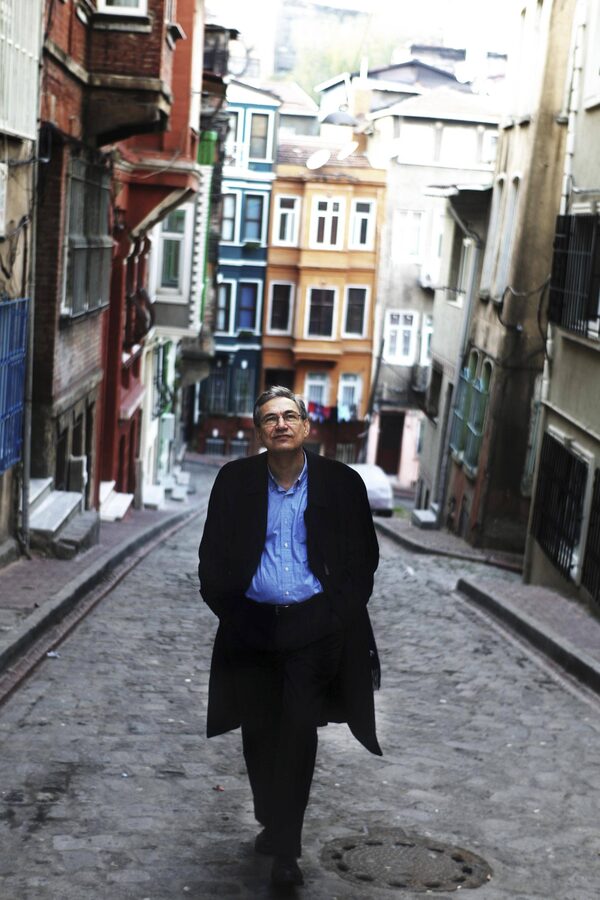
Turkish writer and Nobel Prize-winner Orhan Pamuk walks through the Balat neighbourhood of Istanbul.AYMAN OGHANNA/The New York Times
Winter evenings in Istanbul still echo with the plaintive hollers of streetwalking entrepreneurs, who, from jugs suspended on either end of shoulder-borne poles, sell boza, a thick drink made of fermented wheat and served with roasted chickpeas and cinnamon. Nobel Prize-winner Orhan Pamuk's new novel, A Strangeness in My Mind – just translated from the Turkish original into English by Ekin Oklap – tells the multidecade story of boza-seller and all-around-nice-guy Mevlut Karatas, whom we follow, with a few loops, from 1968 to 2012. Bamboozled into marrying the older sister of the girl he had been wooing, Mevlut's story unfolds against the true-life backdrop of Istanbul's past half-century – the ideological violence, army coups, real estate speculation and mass inward migration. "In the city, you can be alone in a crowd, and in fact what makes the city a city is that it lets you hide the strangeness in your mind inside its teeming multitudes."
Much of A Strangeness rehearses Pamuk's usual repertoire: impersonators, doppelgangers, word and alphabet puzzles, the naming of names and – in signature style – shifting narrators. One voice in A Strangeness apologizes for elbowing in and cutting off another; a later narrator speaks up because he senses the previous narrator talking about him. In this way the novel extends Pamuk's career-long meditation on the clashes and ironies that make up the problems of identity – the theme that should, by virtue of its place at the core of modern Turkish history, anchor any attempt at the Great Turkish Novel. No surprise then that it has formed the heart of the work of a great Turkish novelist.
The disintegration of the Ottoman Empire after the First World War and the founding of the Turkish Republic in 1923 radically ruptured people's sense of who they were – or, perhaps more accurately, their sense of who they were supposed to think they were. The Republic, in contrast to the Empire, was to be "modern," that is, Western and nationalist. Sunni Islam, once practically indistinguishable from the Ottoman state, was harshly subjugated; other religions were marginalized. A Western dress code was enforced by law. A newly articulated Turkish identity was meant to obliterate those of non-Turkish speaking Muslims, especially, but not only, the Kurds. Turkish itself was overhauled – including a script change from Arabic to Latin – in an attempt to cut society's ties to Islam and the "East" (Geoffrey Lewis's authoritative history of Turkish language reform is subtitled "a catastrophic success.") Turks may have wondered at one point whether they had been collectively bamboozled into the wrong marriage, or whether their story was being narrated by an interloper.
This social engineering was radical but it was neither total nor completely novel (as is often presumed). The republican project was an extreme continuation of a century of uneven efforts to Westernize the Ottoman state. And despite republican efforts, Islam, "Kurdishness" and Turkey's "Eastern" identity have all endured (if not exactly thrived). In other words, whose story the "story of Turkey" relates is one of the country's fundamental political questions. The way Pamuk assembles characters, narrators and hidden riddles into a sort of wilderness of mirrors – in A Strangeness and in previous novels – is a literary solution to the political question.
Unfortunately, A Strangeness never quite comes together. Despite a promising cast, a thrilling historical setting and, in the problem of the swapped sisters, an appealing central dilemma, Pamuk never really lights the kindling he so expertly set up. There are a few inspired passages: "Many times at night, on the streets of Istanbul, [Mevlut] had come face to face with the shadows of mythical creatures and demons … looking for all the hopeless sinners and those who had lost their way, whom they would catch and take down to the underworld." But for the most part the writing is flat and the story tedious. "Mevlut had sent love letters addressed to Rayiha but with someone else, a different face, in mind. He didn't even know the name of the pretty sister he had always pictured. He had no clear understanding of how he had been tricked, no memory of how he'd arrived at this moment, and so the strangeness in his mind became a part of the trap he had fallen into."
Ekin Okalp's translation is generally smooth but not without false notes. For example, one character calls another a "redneck" – not a very Turkish sounding put-down; elsewhere Ottoman drunkards are described as getting "absolutely sloshed" on boza – as if they were démodé frat boys. There are also some inexplicable editorial liberties taken with the translation. Istanbul's "Gazi" neighbourhood becomes, for no apparent reason, a more ornate and weirdly inaccurate "Ghaazi" neighbourhood. A more troubling example is found in a passage describing the types of people who had migrated to Istanbul: "…Kultepe was home to a high proportion of Alevis – Alawites – who had come in the 1960s from in and around Bingol, Dersim, Sivas, and Erzican." The problem here is the asserted equivalence of Alevis and Alawites. First, the addition of "Alawite" to this passage does not occur in the original Turkish version of the novel. Second, Alevis and Alawites, despite certain links and affinities, are not the same religion; the terms are not interchangeable. Three, to conflate these two groups is to associate Turkish Alevis with the Syrian regime of Bashar al-Assad (who is Alawite) – an association that the Turkish government has pushed in its polarizing rhetoric of recent years. It seems an especially egregious mistake given the high stakes of identity politics in Turkey – stakes Pamuk has done so much to illuminate for Western readers.
Caleb Lauer is a journalist, based in Turkey from 2006 to 2015, and a PhD student at the Balsillie School of International Affairs in Waterloo, Ont.