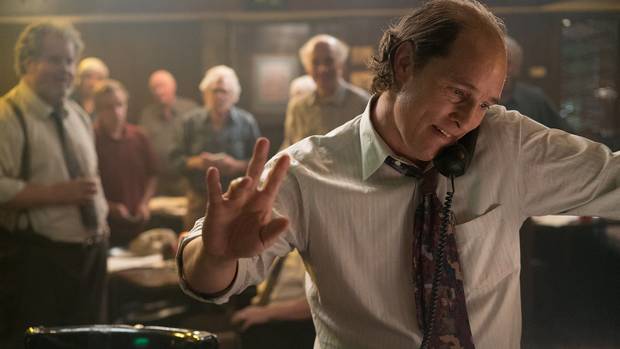
In the new drama Gold, Matthew McConaughey plays Kenny Wells, a Reno businessman who practically sweats desperation as he wades into the sweltering jungles of Indonesia, convinced that a huge payday is simply a quick dig away. But just as Kenny believed that gold was right around the corner, so, too, must have McConaughey – well, a certain type of bullion: Oscar gold. After putting on more than 40 pounds and shaving his trademark curly locks for the role, McConaughey was clearly being positioned for a second Academy Award nomination here (the physical transformation strategy worked so well for him in Dallas Buyers Club, after all).
Alas, as this past Tuesday's Oscar nomination ceremony revealed, Gold would not deliver on its title promises for McConaughey. That doesn't mean that his performance in the Stephen Gaghan film is any less remarkable: His Kenny Wells is a scoundrel, a fiend, a schmuck, but above all, a compellingly scuzzy hero in the way that all McConaughey characters ultimately are. What's more, underneath the actor's aesthetic tricks, his performance heralds what might be the next wave of the fabled McConnaissance, an era in which the actor allows himself to not just be comfortable in his own skin, but to burrow underneath yours. A week before McConaughey's Oscar hopes were dashed, the actor had an in-depth talk with The Globe and Mail about his father, his binges and his next step.
Gold is a loosely fictionalized version of the Canadian Bre-X mining scandal – how familiar were you with the story?
Unfamiliar, completely. I went back and read up on the history, and I started to go through the folklore of it, what got passed down from investor to investor. Then, as a producer here, I decided that this needed to be loosely based, that we can't be beholden or responsible for telling the most-true version of this story. Which allowed me to relax and start to look around at the Kenny Wellses in my own life. Who they were, what they looked like. How they were consumers of life, guys at the bottom of the barrel trying to survive. You know, rolling the dice and taking those one-way tickets to get their dream.
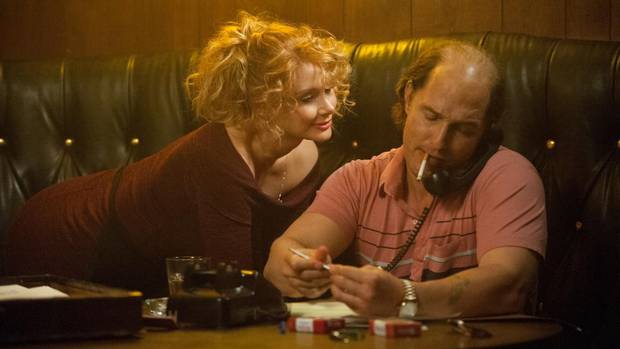
Matthew McConaughey and Bryce Dallas Howard in ‘Gold.’
STUDIO CANAL
From what I've read, it seems you used your own father, 'Big Jim,' as inspiration here.
There was some of my dad. As a kid, he would take me around to go collect from people who owed him money. Bringing a kid along would shame these people into paying him. I remember a few shady, back-alley deals. Now, they weren't dangerous or all that scallywag, but my dad loved the shadiness of it. The fact that he was paying for a "hot" watch that wasn't even worth the money he handed over for it. He didn't care. You know, he invested in diamond mines in Ecuador. There weren't any diamonds, but that didn't stop him from going over there, hacking through the jungle vines with his machete.
He would always say he'd rather do a shady deal with shady people than a good deal with a buncha straight-asses.
That does seem to be Kenny's MO.
Yeah, there was one impression I remember as a 16-year-old, where my dad took me to meet this guy named "Chicago John." And we would meet Chicago John by this abandoned shopping mall, between two Dumpsters and some downed power lines.
And I remember the back of my dad's shoulders when Chicago John showed him what was inside this wrapped-up wad of paper towels – his shoulders went up, a thing my dad did when he loved something, when he got excited.
Then I remember this universal act of an elbow bending and an arm extending – what happens when you're counting off money. In that moment, dealing with this little five-foot-four guy with a bald head and a leather jacket named Chicago John, that, well that's Kenny Wells. That's Kenny Wells right there.
To create Kenny, you went through a pretty radical physical transformation, a beefing up that's the opposite of how you starved yourself for Dallas. But how important is the external appearance for the internal performance?
Well, I got to know the monologue of the internal first. That creates the exterior rather than the outside in.
So I was starting to enjoy Kenny early in my get-ready process. I'm consuming everything: life, the deal, food, smoke, drink, laughter, rage. Yes to all of it. The people I knew growing up who looked like Kenny, these guys aren't looking in the mirror thinking of living till they're 82. They go full-tilt as consumers of life. It was six months of hedonism. Say yes and yes and yes. And if you have second thoughts, Matthew, well, you gotta have a double.
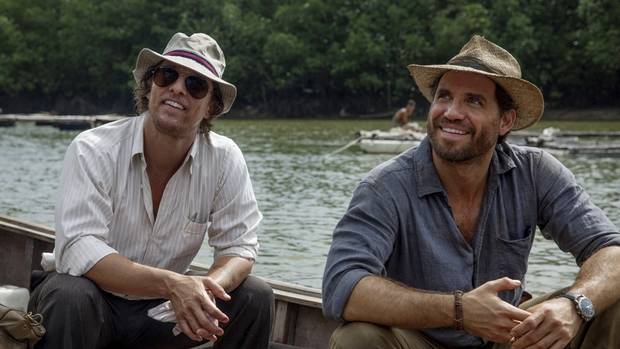
Matthew McConaughey, left, and Edgar Ramirez, right, in a scene from, ‘Gold.’
Patrick Brown/AP/ The Weinstein Company
I'm curious about this film's release pattern, which is being set up for Oscar positioning. What is like to be caught up in that conversation, and speculation?
I was caught up in it with Dallas, and what you do is you have to get ahead of being the salesman. The movie has to become its own living, breathing thing so that other people come to you going, "Whoa, this movie it affected me."
Then you just share the film, and you support it and don't have to sell it too hard in interviews. Whereas certain other films I've done, the success is riding on me selling it. I don't feel like I have to put words in people's mouths here, I'm not doing interviews where people go, "So, what do you want to talk about?" I've done movies where that's the only question.
It is an interesting role in that, well, what does it mean for your career now? In 2008, after Ghosts of Girlfriends Past, you said you made a decision to "unbrand" yourself. Now, after what's been dubbed the "McConnaissance," what is your brand, if anything?
It's probably less clearly defined, which I think is a good thing. I think it's, "Man, this guy really makes some courageous choices in dramatic films, and keeps playing these outsiders, these guys with singular obsession." Making someone who seems odd and weird be connectable, and human. Humanize the oddballs.
Making the connection with larger audiences seems a part of why you signed on as a Lincoln [Motor Co.] spokesman, and now as the creative director for Wild Turkey.
Well, the fact that they're American brands is an incentive to me. And I wanted to be more than a hired face, to see if I can creatively translate a short story in 30 seconds, and be in it and sometimes write and direct. And I don't know why people shy away from saying this, but it pays. This allows me to more easily choose a film role on a creative level that pays much less. A script with a $5-million offer is much better written than the same script with a $1-million offer. It just is. I'm human! This allows me to see projects for what they are and not feel like, ooh, man, the money sure makes it better.
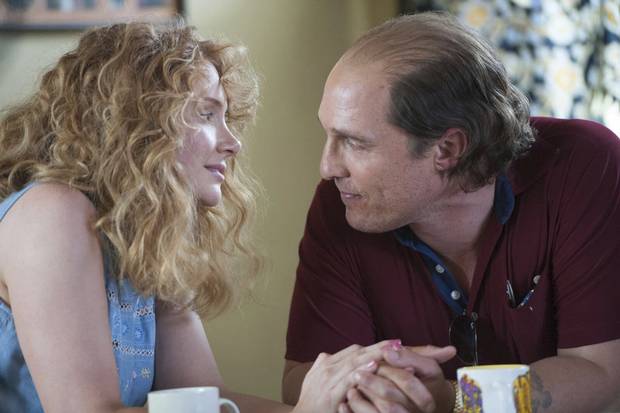
Bryce Dallas Howard and Matthew McConaughey in a scene from, ‘Gold.’
AP/The Weinstein Company
The companies being American is interesting, because often when celebrities do commercials, they're aired in Asia, as if tucked away from Hollywood to prevent embarrassment.
And I didn't want that; I wanted to do more. I also said I wasn't going to be a pitch man telling the camera, drive a Lincoln, or drink Wild Turkey. They needed to be little pieces of art in their own right. Let me be a character in it. Let's cut through the noise. And I think we've succeeded. With Lincoln, we've stuck to our tone long enough that they're funnier, and the audience is finally going, "McConaughey's in on the joke!"
Speaking of money and commitment, you're in the upcoming Dark Tower, which could be a huge franchise. Was there any trepidation signing on to something with such a large commitment?
Oh sure, and I've gotten close to other franchises before. But what's fantastic about this, playing Walter, a.k.a. The Man in Black, a.k.a the Devil, I mean, we can do 60 of these and I'm not going to be at a loss for inspiration. It's endless in: How much is The Devil pure evil, but how much is he simply delivering people from their own hypocrisies, and he's actually a philanthropist? There are so many different approaches on how to be quote/unquote bad.
It's interesting looking at the year ahead, then, compared to the year you've just had. I mean, you had successes with Sing and Kubo and the Two Strings, but there was also Free State of Jones and Sea of Trees. Did you feel any sting over how the latter two were received?
A little bit, yeah. Sea of Trees got slammed at Cannes two years ago, and it's like the movie could never get its head above the dirty water of those reviews. It couldn't have its own life or integrity outside of that, and it worked its way to a place where it was a very small release. That's fair, it was a Gus Van Sant experimental film, but when making it, I thought it had the possibility to translate and have more access.
Free State of Jones, we were behind that with the intent it have a populous appeal. It was always a smaller film, but Jones was built as an important, good drama. A true-life story with a good amount of money behind it, 40-something million dollars. And that came out and just kind of whiffed. That had a pinch. We came out on a weekend when one of the marketing goals was: The world's had popcorn all summer, so let's give them their first non-popcorn serious film because they're going to be hungry for it.
Well, the world was not tired of eating popcorn. But that's a film that will have an interesting afterlife.
And it will be, eventually, a nice feather in my cap.
This interview has been condensed and edited.
Gold opens Jan. 27.