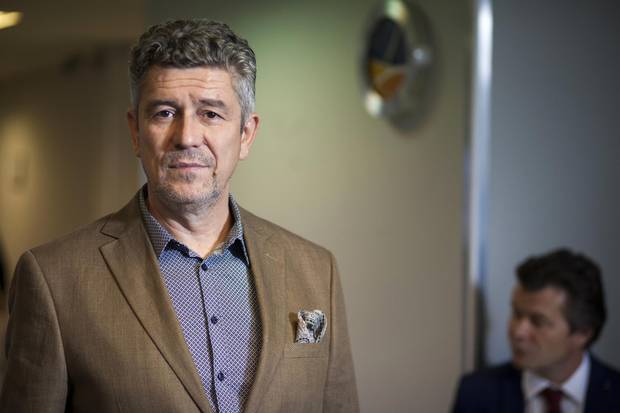
As the European Union battles Brexit, a refugee crisis and resurgent nationalism, it is not hard to understand why Greece might have produced the film Amerika Square. Directed by Yannis Sakaridis, it's a dexterously plotted drama about two friends in Athens; one is a tough-guy tattoo artist who finds himself helping two refugees escape to Italy; the other is his unemployed, racist buddy who concocts a weird scheme to banish the immigrants he believes are ruining his country. With the occasional flash of black wit and a strong cast offering convincing performances in difficult roles, Amerika Square is just the kind of sophisticated fare Canadian cinephiles might expect from a showcase of European film.
On the other hand, a film such as the Polish comedy Volta may come as an amusing surprise to audiences at the 13th annual European Union Film Festival, which opens this week in Toronto: Part caper comedy, part political satire, Juliusz Machulski's Volta skewers narrow nationalism and dog-whistle politics with a story about a lame-brained presidential candidate who wants to restore the monarchy and the arrogant spin doctor who's enabling him. The whole complicated plot turns around the fate of a historic Polish crown that has been lost for centuries, apparently tripping all over Europe in its absence from the motherland. Like much satire, Volta is intensely local – the film is filled with word play that must be funnier in the original Polish – yet it is also eminently European in its sentiments.
"Part of the point is to show that Europe has a raison d'être; it is something that exists," says festival programmer Jérémie Abessira, who works with European consulates and cultural centres in Toronto to pick 28 features for the event, one from each member country. "That with all these countries you can put something together; that despite all the nationalism you can share something."
The festival began 12 years ago as an initiative of the Goethe-Institut, the German cultural centre in Toronto, with 15 countries participating. Gradually, all 28 members have joined in this clever exercise in soft power that annually treats about 8,000 Torontonians to free tickets to films they are unlikely to see anywhere else. Local audiences here may be regularly exposed to French, German or British film, but Abessira points out there are few opportunities to see films from Lithuania, Bulgaria or the Czech Republic. "We are the only festival that depends on 28 countries agreeing. … We try to promote everyone equally," he says. "And we try to reflect what is going on in Europe."
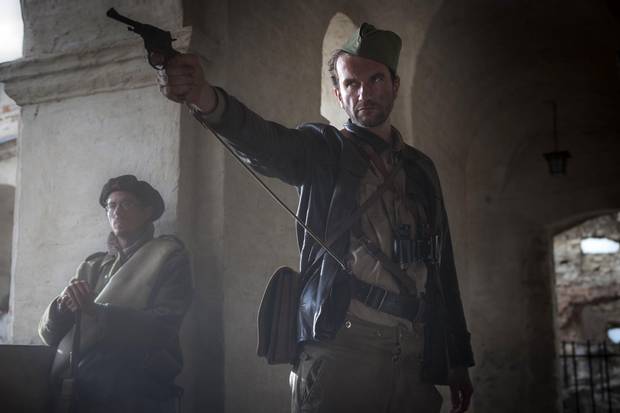
Juliusz Machulski’s Polish comedy Volta skewers narrow nationalism and dog-whistle politics with a story about a lame-brained presidential candidate and the arrogant spin doctor who enables him.
Zebra Film Studio
Of course, this year's festival includes several films that are more personal than political. Felix van Groeningen's Belgica, which won a best director prize at the Sundance Film Festival last year, is about two Belgian brothers struggling to run a bar. The French entry Les ogres is Léa Fehner's autobiographical account of a travelling theatre troupe desperately trying to hold things together as it tours southwestern France.
But there are also several films that return to the theme of Europe and immigration. From Hungary, The Citizen is about an African security guard who is determined to become a good Hungarian while The Dissidents is an Estonian comedy about three Soviet dissidents who arrive in Sweden to a hero's welcome only to discover they do eventually have to work.
That last film, which closes the festival, is a North American premiere, as is Volta, and more than a third of the entries have never been shown in Canada. Abessira helps the various countries select films that he feels can be counted on to resonate with a Toronto audience and cross-cultural themes are writ large.
And yes, there is a British film this year: the British Council has participated for the past five years and for 2017 it presents Adult Life Skills, Rachel Tunnard's prize-winning comedy about an emotionally isolated young woman mourning the loss of her twin brother.
And in 2018? Well, that will be up to Britain – and the 27 other countries.
The European Union Film Festival runs through Nov. 23 at The Royal, 608 College St., Toronto, with free tickets at the door (euffto.com).