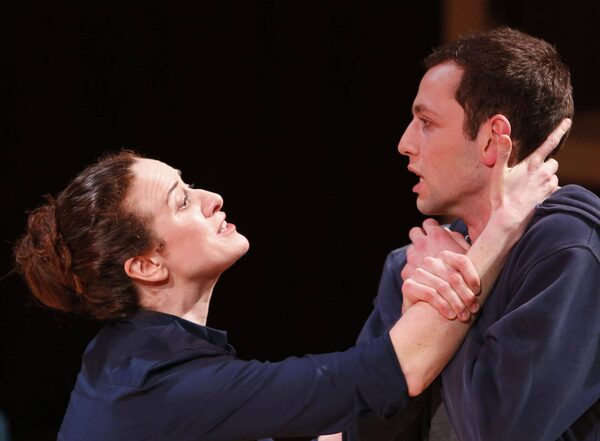
Luisa Jojic and Douglas Ennenberg in the choral play The Events.Tim Matheson
There's no need to go over the horrific details of real-life news stories to explain that a play about a mass shooting and violent anti-immigrant racism has extreme relevance in today's climate. David Greig's The Events, which had its English Canadian premiere at Vancouver's PuSh International Performing Arts Festival this week, was in fact inspired by an unthinkable real-life tragedy: the murder of 77 people, most of them young people attending an island summer camp, in Norway in 2011.Greig takes the mass shooting and moves it to a choir practice, organized by a priest who is hoping to create a sense of community among music enthusiasts, isolated misfits and whoever wants to participate. They sing happy Norwegian songs. Until … the events.
A young man invades this harmonious space with a twisted agenda – and a gun. There is mass carnage, but the priest survives.
The Events was first performed at the Edinburgh Fringe Festival in 2013, a mere two years after the real attack. It has since been performed in various places, including Norway.
The Pi Theatre production, directed by Richard Wolfe, is staged in the perfect venue – East Vancouver's Russian Hall, just the kind of community space one imagines such a choir practice taking place. The setting, however, is ambiguous – Is it Norway? Canada?
The evening begins with a performance by the choir – it will be a different group every night; on opening night it was Lynn Valley Voices. They remain on stage throughout, acting as a sort of Greek chorus, as well as musical accompaniment, and they take part at times in the action.
After the opening choral number, the priest, Claire (Luisa Jojic), emerges to set up some chairs. Will anyone show up? she wonders. Soon, she invites a stranger in a hoodie and sweatpants to come on in and join.
Over the next 90 minutes, Claire is plunged into grief and mired in PTSD and survivor's guilt. She searches for answers – and thus, a way to go on. Why did this happen? Why did she survive? She seeks the help of a psychologist, she seeks out the murderer's father, a right-wing politician who inspired the boy. At home, she treats her kind partner poorly.
All of these roles, including the role of the female partner, are portrayed by Douglas Ennenberg, who also plays The Boy.
As The Boy, Ennenberg embodies evil; his twisted mind spouting justifications for racism: "I don't hate foreigners. I hate foreigners being here."
He thinks back to what the arrival of the Europeans must have looked like to a young Indigenous boy. What the Indigenous boy couldn't have known, seeing those grand ships sailing toward him, was what the colonizers were going to unleash on the land and its people – tyranny, disease, death.
Knowing what the settlers wrought, if you could go back in time, he asks, what would you say to that boy? "Kill them. Kill them all."
Ennenberg's physicality in this role is terrific – his violent dance moves, his punchy push-ups, his angry stance.
But as the counsellor, the politician, the dad, the girlfriend, he was generally flat and unconvincing.
Jojic, on the other hand, was luminescent, pained, alive, fighting the death she had witnessed.
Before the show, we were told that cast had met the choir for the first time that day.
You could tell.
The choir's performance wasn't polished; it was even awkward, at times. At first this rankled me, but the more I thought about it – I spent hours considering it, which is always a good sign – the more I realized that this is exactly how it should be: the community choir, not perfect, but there and enthusiastic. On a stormy night (both in the script and in Vancouver on Thursday night), they left their warm homes to come together to sing. This is a beautiful thing.
Still, I couldn't figure out why I wasn't more moved by this production that should have had me in a puddle – between the choral music, Jojic's tremendous performance and, above all, the subject matter. What kind of unfeeling monster's soul would not be stirred by all that?
I did find the investigation element a little hollow. Going around, asking why when there can be no answer, no explanation for an atrocity of this sort, seems a little too convenient a construct. It's a pointless exercise – this is why they call attacks such as this "senseless," right? – but more to the point, it felt like an exercise. It was missing a sense of authenticity.
Greig, we learn from the director's note, struggled to write this play. He was in Norway and close to giving up on the project because "he couldn't find redemption in the pure evil of the event he was interrogating." But one day, on his way to dinner at his Norwegian dramaturg's house, they stopped by to pick up her mother from choir practice. He sat in and listened and found the inspiration he needed to write this story. "I felt human again," he explained.
I don't want to diminish the importance or the achievements of this play. The subject matter is urgent. The music is often a joy. The script doesn't provide answers – nothing can. Going on a search for answers when there are none can lead to riveting art. But everyone must be on their best game to achieve that.