
The siren call of the trilogy is as tempting to theatre creators as it is to Hollywood studios.
From Aeschylus to Alan Ayckbourn, James Reaney to Wajdi Mouawad, playwrights have long followed up one successful play with others that have the same characters, live in the same world or riff on similar themes.
Sometimes you get it right on the first try, however – and trying to recapture magic can lead to diminishing returns.
Thirteen years ago, Anita Majumdar premiered Fish Eyes in the Factory Theatre Studio during the SummerWorks Festival – and she's now reviving that excellent solo show to open the Factory Theatre mainstage season along with two shorter, newer works that are not quite up to the same standard.
Set in Port Moody, B.C., Fish Eyes concerns the relationship between a teenager named Meena and the Indian classical dance teacher she calls Kalyani Aunty.
With the grad dance looming, Meena becomes more interested in a white guy named Buddy than bharatanatyam – and a rift develops between her and her mentor, Kalyani, who recalls her own doomed romance to a white man back in India.
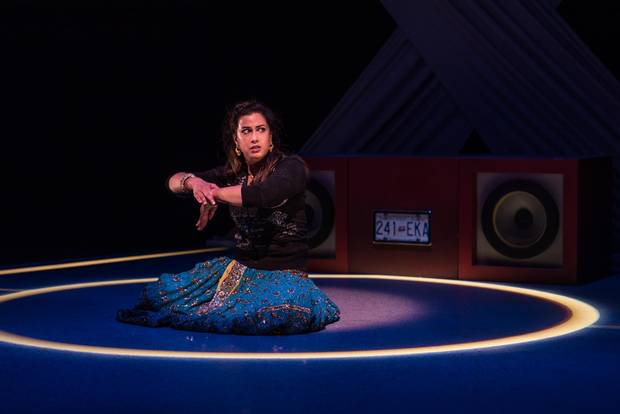
Told through sharply drawn characters and traditional dance used in innovative ways, Fish Eyes remains a touching show about growing up as a South-Asian Canadian – and the many ways racism can subtly and not so subtly affect people’s lives and sense of self. Its folktale ending is perfect solo theatre.
Dahlia Katz
Told through sharply drawn characters and traditional dance used in innovative ways, Fish Eyes remains a touching show about growing up as a South-Asian Canadian – and the many ways racism can subtly and not so subtly affect people's lives and sense of self. Its folktale ending is perfect solo theatre.
The two shows that precede it in an evening titled The Fish Eyes Trilogy are less nuanced. They introduce us to a pair of contemporaries of Meena's at Port Moody Secondary School – and you can sense in the writing that Majumdar has moved away from that teenage milieu and is now looking back on it through a different, darker and also more disconnected lens.
Boys With Cars is a play about sexual assault and victim blaming. Naz, an Ismaili Muslim girl who "dances Slumdog Millionaire's songs for white-people weddings" as a part-time job, falls in with the "cools" at school when she begins to date a British-born bhangra dancer named Lucky Punjabi.
After Lucky's friend Buddy forces Naz's hand onto his crotch under a jacket on the bleachers at school, however, the new network the girl has built up quickly falls apart. Buddy's girlfriend, Candace, and her friends begins to bully her, the adults at school are unsupportive – and even her parents turn on her as rumours spread.
The assault itself is rendered very potently in the show – but the denouement is underdeveloped and Majumdar weakens her drama by treating her character like God treated Job. When Naz's gym teacher tells her students that "Girls who get date raped just rape themselves," it starts to feel like we are watching caricatures rather than characters. I couldn't figure out the tone – or, for that matter, the framing device. Who is Naz telling her story to in a parking lot – and why couldn't it just be us, the audience?
Let Me Borrow that Top, which comes second in the evening, trots out Candace to have her say – and floats the promise of letting us a seeing the oh-my-god-you-guys character from a more complex angle. Framed as a YouTube make-up tutorial, the white teenage girl – who is into henna tattoos and bhangra – tells us about her relationship with Buddy, as we actually watch Majumdar transform herself into a white, blonde woman in front of our eyes.
It's a really clever bit of performance, smartly directed by Brian Quirt – cultural appropriation as form as well as the subject. Unfortunately, we already know how Candace's story will end from Boys with Cars – so it provides little in the way of plot.
Fish Eyes comes after to redeem the evening – last, far from the least.
Lukumi: Part Three of the Orisha Trilogy
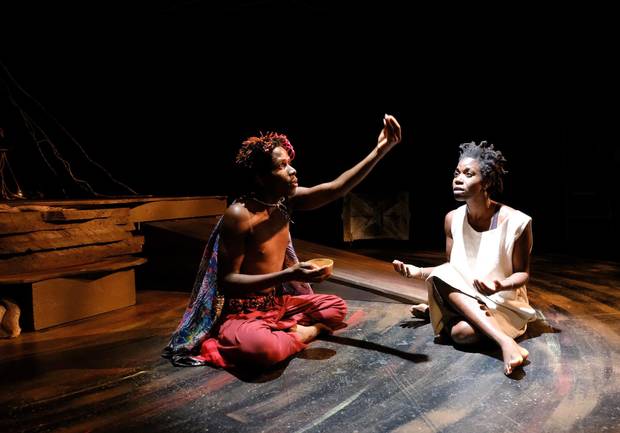
Lukumi is the third in a set of plays that d’bi.young calls The Orisha Trilogy and the most ambitious – an Afro-futurist Dub Opera with a nine-person cast and four-piece band.
Dee Kofri
Over at Tarragon Theatre, in the extra space, d'bi.young anitafrika is also in thrall to the trilogizing impulse.
Lukumi is the third in a set of plays that d'bi.young calls The Orisha Trilogy and the most ambitious – an Afro-futurist Dub Opera with a nine-person cast and four-piece band.
Orishas are spirits from the Yoruba religion – and many of them populate the dystopian future that d'bi.young has imagined in this musical, one where the oceans and skies have been poisoned and only one woman still carries the functioning womb.
That chosen one, Lukumi (played by d'bi.young in a typically magnetic performance), embarks on a quest to defeat the One World Army and bring an end to the Thousand Year War by visiting the Ancestor Tree buried eight layers underground.
I saw an earlier version of this wild show at the SummerWorks Festival – and described the protest-chant lyrics as a cross between Bob Marley and Bertolt Brecht. You're not going to find subtlety here, but the show is still startlingly original.
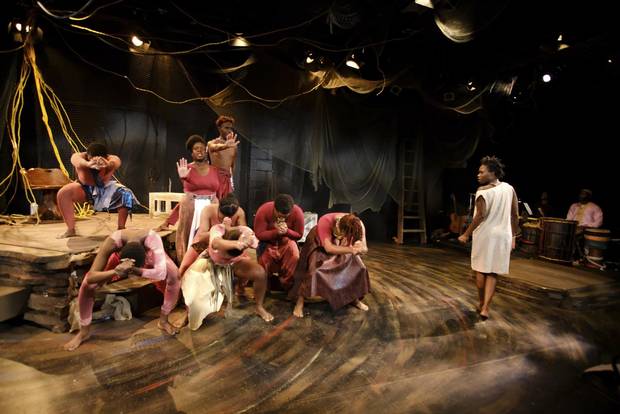
The production values have increased for this revised version, directed by the veteran Caribbean director Eugene Williams in his Canadian debut.
Dee Kofri
The production values have increased for this revised version directed by the veteran Caribbean director Eugene Williams making his Canadian debut. Rachel Forbes set and costumes colorfully conjure a mythical, messed-up future, while the band directed by co-composer Waleed Abdulhamid performs an appealing score that ranges from reggae to gospel.
But Lukumi's story has become more confusing, with the main character frequently falling asleep and waking up in other realms – and there is a certain repetitiveness to the dream structure that gets tiresome. Here comes another animal with a song about humanity's capacity for self-destruction.
That's not to say Lukumi is any more confusing than Pippin or Hair – a couple of musicals to which this feels like a cool, contemporary Caribbean cousin. And I enjoyed both the rhythms and the physically and vocally captivating performances – especially that of the absolutely riveting Sashoya Shoya Oya as Coyote.