
Supplied
When I was diagnosed with type 2 diabetes, my first instinct wasn’t to seek support. It was to hide. I felt an overwhelming wave of shame, convinced I had somehow brought this on myself.
Years later, I’ve learned that my experience wasn’t unique. It’s the lived reality for millions of people across Canada who live with diabetes. New research from a national survey Diabetes Canada commissioned with Nanos reveals just how deeply rooted diabetes stigma and misinformation remain in our country.
Nearly half of Canadians (48 per cent) believe diabetes is caused by consuming too much sugar. And perhaps most troubling: one in three (30 per cent) believe that most people who develop diabetes have only themselves to blame.
When you dig deeper, the picture becomes even more concerning. Sixty-one per cent of Canadians cite lifestyle choices, poor diet or obesity when asked what causes diabetes. And 40 per cent believe that people with type 2 diabetes who use medications like insulin or semaglutides have somehow “failed” to manage their condition properly through diet and exercise.
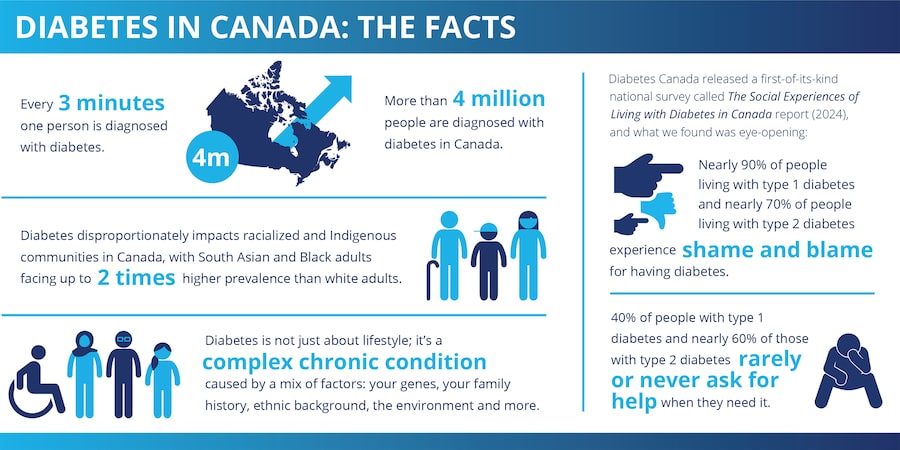
This societal stigma was also evident in a first-of-its-kind survey Diabetes Canada released last year, which revealed that 70 per cent of people living with type 2 diabetes and nearly 90 per cent of people living with type 1 diabetes experience shame and blame when it comes to their condition.
And in multi-country research funded by Diabetes Canada earlier this year, we found that people with diabetes face similar levels of stigma all over the world, highlighting a significant global health issue.
Meaning when you live with diabetes in 2025, you are still inundated with stigma – from society, from your community, and often (and perhaps most tragically) yourself.
So why does this stigma persist?
The answer lies in what I sometimes call the “triple threat”: misinformation, apathy and stigma. They feed off each other in a vicious cycle.
Diabetes is complex, but thanks to outstanding diabetes scientists and clinicians (many of whom are here in Canada), we are expanding our understanding of the condition. There are several types – type 1, type 2, gestational diabetes and several other rarer forms – each with different causes and risk factors. Many of these factors are completely outside a person’s control: genetics, family history, ethnicity, socioeconomic status and environmental factors all play significant roles. Yet the prevailing narrative remains stubbornly simple and wrong: “You ate too much sugar. You didn’t exercise enough. This is your fault.”
This oversimplification is dangerous. It ignores science. It dismisses the reality that diabetes disproportionately impacts Indigenous Peoples, people of African, Arab, Asian, Hispanic and South Asian descent, and those within a lower socioeconomic status. It turns a complex chronic condition into a moral failing.
Laura Syron“ Nearly half of Canadians (48 per cent) believe diabetes is caused by consuming too much sugar. And perhaps most troubling: one in three (30 per cent) believe that most people who develop diabetes have only themselves to blame.
President and CEO, Diabetes Canada
I can tell you from both personal experience and decades of research that when people with diabetes experience stigma, we turn inward. We become less likely to seek support when we desperately need it.
This takes a damaging psychological toll. People with diabetes are two to three times more likely to experience depression. Nearly half of people with type 1 diabetes and one-third with type 2 diabetes experience diabetes distress – an emotional burden that makes it harder for people to stick to diabetes management plans and can lead to burnout. Tragically, this often leads to avoiding the very care we need to stay healthy.
We need to start having more open, honest dialogues about diabetes in Canada. The more we talk about it – the more people like me share our stories – the more we can chip away at the stigma that keeps this condition “invisible” despite affecting more than four million people in Canada (and 589 million people worldwide).
We don’t need to do it alone. There are excellent organizations and leaders who are leading this work on the global stage, such as Dr. Jane Speight, who alongside 51 global experts launched the International Pledge to End Diabetes Stigma (which Diabetes Canada signed onto at the beginning of this month).
We are asking folks to learn the facts, challenge harmful beliefs and stand with the diabetes community. Because the truth is, I can almost guarantee you know someone living with diabetes. They deserve more than tired tropes and sinister stigmas. They deserve understanding, support and access to the care they need to thrive.
Laura Syron is the president & CEO of Diabetes Canada, the country’s largest charitable organization working to improve the quality of life of people living with diabetes.
November is Diabetes Awareness Month, and November 14 is World Diabetes Day. Learn more at diabetes.ca/stopthestigma
Advertising feature produced by Randall Anthony Communications with support from Diabetes Canada. The Globe’s editorial department was not involved.