
Employees at Royal Bank of Canada, Bank of Montreal and Bank of Nova Scotia will soon be required to work four days a week in person.Fred Lum/the Globe and Mail
Bank employees are battling for desks and grappling with limited space in corporate towers, a situation that is likely to become even more heated as four of Canada’s largest lenders barrel ahead with stricter return-to-office requirements.
As employees at Royal Bank of Canada RY-T, Bank of Montreal BMO-T, Bank of Nova Scotia BNS-T and Toronto-Dominion Bank TD-T will soon need to spend four days a week working in person with their teams, the banks could be forced to expand their real estate footprints.
Already, the scramble for space in Toronto has spurred a game of musical chairs at the big banks’ corporate offices. Some employees say they are arriving at the office before 7 a.m. to secure a desk. Those that make it into the office at 9 a.m. either find they are unable to book a desk, or that the spot they secured has been taken over by a colleague, according to sources who work in the financial core.
Those who arrive later are punted into meeting rooms or the cafeteria. In some cases, they are forced to seek out desk space in the bank’s other office buildings or floors, separated from their teams.
The Globe and Mail spoke with 10 sources who are not being identified because they were not authorized to speak publicly about the matter.
How vacant are downtown Toronto’s
major office skyscrapers?
Major lenders covet the new buildings, driving the availability
rates down
Existing building
New building
BAY ST.
0.5% Scotiabank North Tower
40 Temperance St.
Toronto
ADELAIDE ST. W.
6.3% Scotia Plaza
40 King St. W.
KING ST. W.
28.3% Commerce Ct.
15.1% TD Centre
office complex
199 Bay St.
66 Wellington St. W.
14.7% Royal Bank Plaza
200 Bay St.
FRONT ST. W.
0.5% CIBC Square
4.9%TD Terrace
81 Bay St.
160 Front St. W.
100 m
JOHN SOPINSKI/the globe and mail, Source: costar
How vacant are downtown Toronto’s
major office skyscrapers?
Major lenders covet the new buildings, driving the availability
rates down
Existing building
New building
BAY ST.
0.5% Scotiabank North Tower
40 Temperance St.
Toronto
ADELAIDE ST. W.
6.3% Scotia Plaza
40 King St. W.
KING ST. W.
28.3% Commerce Ct.
15.1% TD Centre
office complex
199 Bay St.
66 Wellington St. W.
14.7% Royal Bank Plaza
200 Bay St.
FRONT ST. W.
0.5% CIBC Square
4.9%TD Terrace
81 Bay St.
160 Front St. W.
100 m
JOHN SOPINSKI/the globe and mail, Source: costar
How vacant are downtown Toronto’s major office skyscrapers?
Major lenders covet the new buildings, driving the availability rates down
Existing building
New building
0.5% Scotiabank North Tower
40 Temperance St.
Toronto
ADELAIDE ST. W.
6.3% Scotia Plaza
40 King St. W.
KING ST. W.
28.3% Commerce Ct.
199 Bay St.
15.1% TD Centre
office complex
66 Wellington St. W.
14.7% Royal Bank Plaza
200 Bay St.
FRONT ST. W.
0.5% CIBC Square
4.9%TD Terrace
81 Bay St.
160 Front St. W.
100 m
JOHN SOPINSKI/the globe and mail, Source: costar
In recent months, RBC, BMO and Scotiabank informed staff of the four-day mandate effective Sept. 15 – with Scotiabank levying the requirement on employees specifically in the Greater Toronto Area. On Wednesday, TD told staff they will work from the office four days a week as of Nov. 3.
The four banks are among Canada’s largest employers, and set the tone for expectations around corporate culture and in-office attendance. Other lenders and major companies will likely follow their lead – driving more competition for corporate office buildings.
“The challenge is, if you’re the fifth or the sixth bank to announce a return to the office four days a week, most of the best quality space for your employees will be spoken for at that point,” Colliers Canada senior vice-president Nicholas Kendrew said in an interview. “Then it’s a case of working with what’s left over.”
The problem, though, is that high-quality towers are already nearing capacity of the newer towers with the best amenities, said Carl Gomez, head of market analytics at CoStar, a commercial real estate information provider.
“The brand-new buildings are fully leased, and there is very little availability,” he said.
John Turley-Ewart: Banks, if you want staff back in offices, give them proper offices to go back to
Until more space is leased, staff are warning the space shortages will impede their ability to work efficiently from the office. Some employees are working at desks that do not have monitors, computer mice or keyboards, according to four sources.
In some cases, two different teams share a floor of a building, alternating days in the office each week, according to two sources. Once four-day mandates take effect, one of those teams will need to be moved to a different space.
With the stricter office mandates taking effect on Sept. 15, leaders at RBC and Scotiabank have told staff that they are searching for more office space to help address the lack of workspace, according to three of the sources.
In an internal memo Wednesday, TD said many of its locations will be prepared to accommodate the new rule by November, but it will need to take some time to ensure others are ready.
RBC said it has used a shared desk system in some locations since before the pandemic to provide employees with flexibility and choose a workspace that best suits their needs, depending on the day.
“As we prepare for in-office expectations in September, we’re working closely with teams that may have real estate capacity issues to understand their needs and determine potential solutions,” RBC spokesperson Gillian McArdle said in a statement.
Shortly after Scotiabank notified staff of the new rules, it sent out an additional memo to certain teams informing them that the requirement would not apply to them until the bank secured more office space, according to one of the sources.
“In September, some of our teams who have the space to do so will increase the number of days they work onsite to four days, and others who are currently constrained by real estate availability will evolve to work onsite more as space allows it, with the goal of reaching four days onsite overtime across the bank,” Scotiabank spokesperson Katie Raskina said in a statement.
Canadian employers take an increasingly harder line on returning to the office
BMO spokesperson Jeff Roman said in a statement that employees will work from the office four days a week “where existing real estate capacity permits.”
TD said “when we work together in person, we collaborate more effectively, make better decisions more quickly, learn from each other, and deliver stronger outcomes,” according to the memo.
The banks are not the only companies dealing with the lack of space. A major non-bank financial institution that is bringing employees back to the office three days a week recently discovered that it has one desk for every two employees, Mr. Kendrew said.
Canada’s federal housing agency is also trying to accommodate a requirement to return to the office three days a week at its downtown Toronto office. Staff at Canada Mortgage and Housing Corp. are struggling to find a desk in Toronto, according to one source.
“We are currently reviewing our office space options in Toronto in order to accommodate our return to office directive,” CMHC spokesperson Brie Martin said in a statement.

The challenge for the banks is accessing higher-quality office space near transit hubs, like the first CIBC Square skyscraper. Commercial tenants are less interested in older office towers.Fred Lum/The Globe and Mail
For the banks, the challenge is accessing the highest quality office space: newly built office towers that are close to the city’s major transit hub and offer state-of-the-art infrastructure and amenities. That includes the first CIBC Square skyscraper, which serves as Canadian Imperial Bank of Commerce‘s headquarters, Scotiabank’s new office tower in the Bay Adelaide Centre and Toronto-Dominion Bank’s TD Terrace.
Data from commercial real estate firms such as Colliers, CBRE and CoStar show tenants are shunning older office towers, even if they are close to Toronto’s main train station.
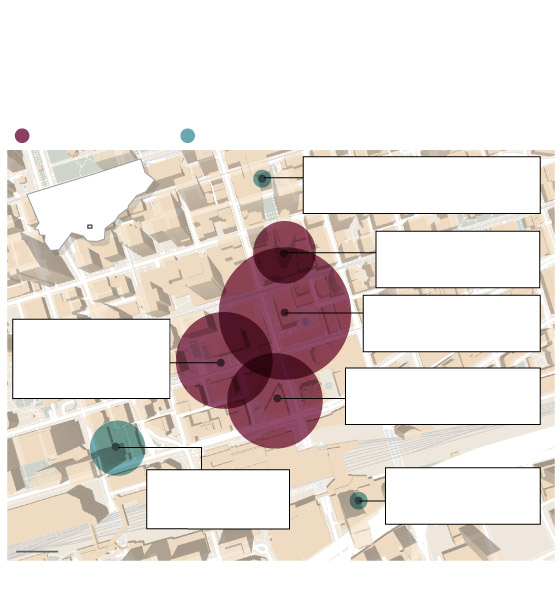
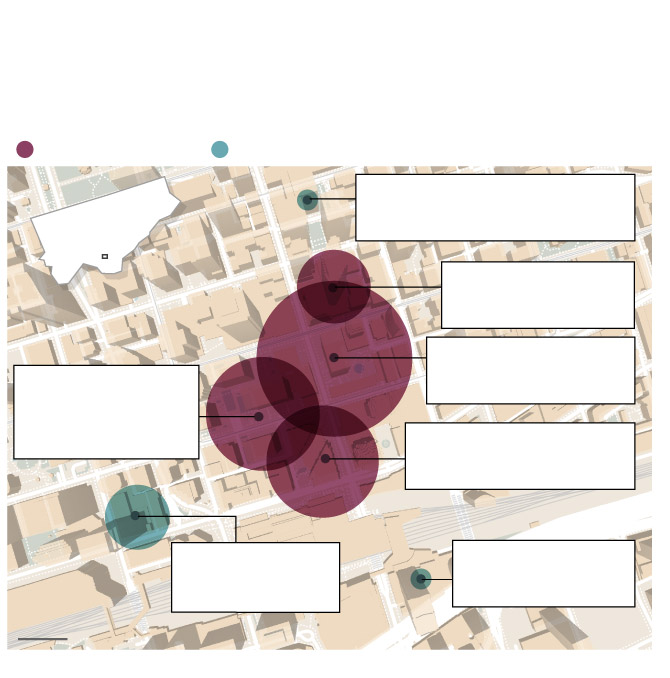
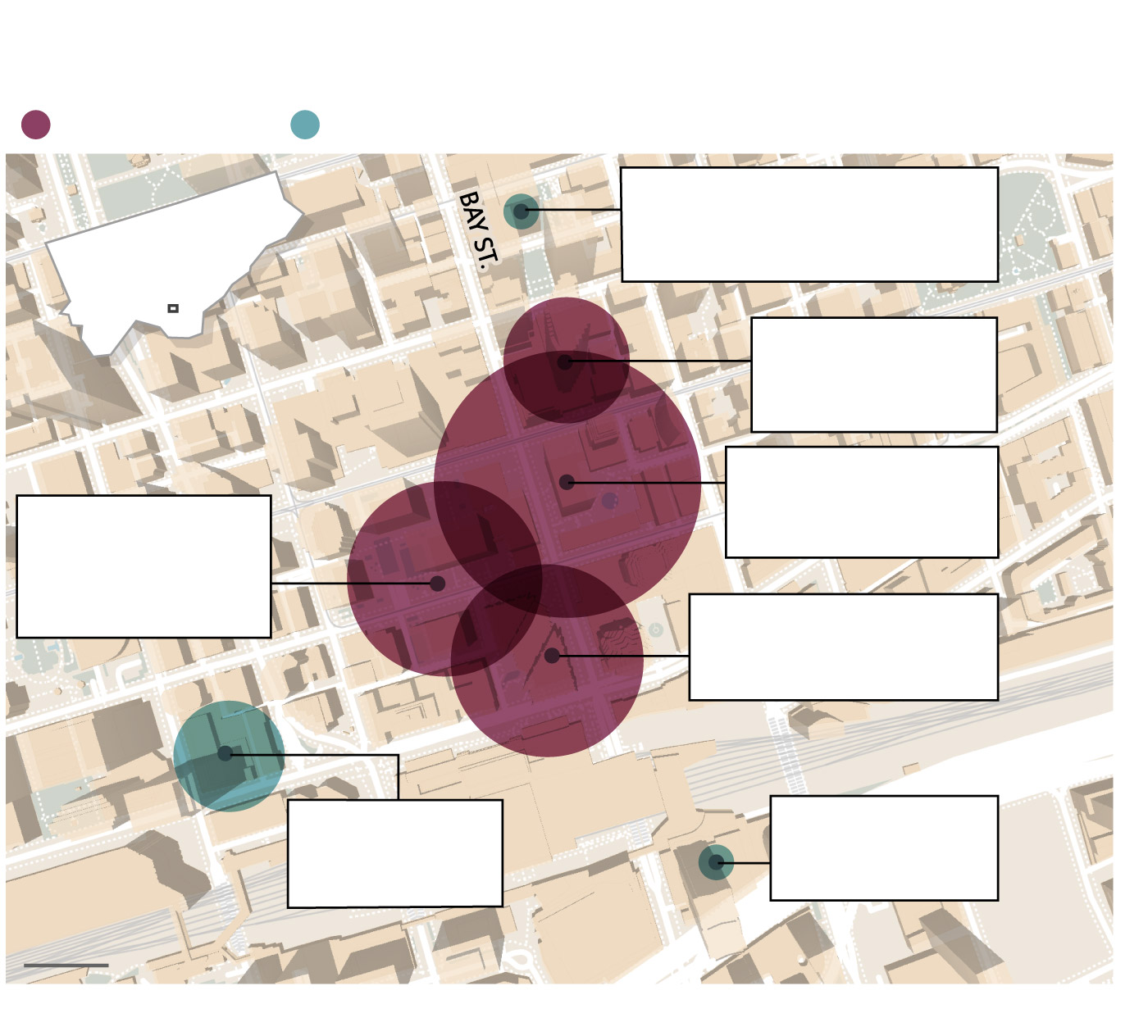
The availability rate – or the amount of space that is being marketed and available for lease – in CIBC’s old headquarters at Commerce Court was 28.3 per cent as of mid-July. The older TD Centre office complex had an availability rate of 15.1 per cent, and Royal Bank Plaza office complex had an availability rate of 14.7 per cent, according to CoStar data. Scotiabank’s previous main office at the red granite Scotia Plaza had an availability rate of 6.3 per cent.
In contrast, the availability rate in the glitzy new buildings at CIBC Square and Scotiabank’s new office tower was 0.5 per cent, according to CoStar data. TD Terrace had an availability rate of 4.9 per cent.
The office vacancy crisis: Can older buildings compete?
Over all, the availability rate for downtown Toronto offices was 14.9 per cent, which is about three times higher than prior to the start of the pandemic.
Banks are now also competing with other large tenants looking for space. Fidelity Investments Canada ULC recently signed a large lease in TD Centre to accommodate a larger work force for the investment fund manager, according to its spokesperson, Chris Pepper. Fidelity will vacate its current space near a major shopping mall and move into seven floors amounting to about 150,000 square feet next year.
Technology has also become an important variable. Tenants now may need more closed-door office space now that video calls have become the norm. As well, office footprints have been shrinking with tech companies and other employers embracing open-concept offices. By 2019, the space asked for could be as small as 75 square feet a person at a co-working office or open concept office compared with 200 square feet a person in previous years.
“To get people back into the office after having been working from home for so long, it’s going to be very tricky to get people to come back from their own workspace, to come in and sit on top of the employee or colleague next to them,” Mr. Kendrew said.
As for new builds, there is little appetite to build more office skyscrapers in downtown Toronto. The cost of construction has increased since the pandemic, and investors are less interested in providing capital for a new tower with space still available to lease.
A slew of new office space has also already flooded the market. Over the past few years, at least 11 downtown office towers have opened, including the 49-storey CIBC Square and the 47-storey TD Terrace.
CIBC CM-T, which does not have a four-day mandate, did not comment on whether it plans to move to one.
CIBC said it plans to start moving into its second tower at CIBC Square near Toronto’s Union Station in 2026.
“We continue to have the space needed for our team and our model is working as evidenced by our business momentum and strong employee feedback,” CIBC spokesperson Tom Wallis said in a statement.
With reports from Clare O’Hara