
Prime Minister Mark Carney and Ontario Premier Doug Ford (not pictured) hold a joint press conference in front of a mock nuclear reactor at the Darlington Energy Complex in Courtice, Ont., on Oct. 23, 2025.Carlos Osorio/Reuters
Canada has never had much appetite for enriched uranium. But that could soon change.
Ontario Power Generation is in the early stages of building four reactors at its Darlington station that require enriched fuel, and there are tentative plans to build more in other provinces. Relying on foreign suppliers for enriched uranium, particularly Russian or American ones, seems increasingly risky.
A growing chorus argues it’s time for Canada to consider enriching uranium. Federal officials quietly began exploring the issue a few years ago, documents obtained under the Access to Information Act reveal. A decision to enrich would have significant implications for Saskatchewan’s uranium industry, power producers and Canada’s international standing.
Most of the arguments against enriching our own uranium remain as potent as ever. And statements by federal officials suggest their concerns have ebbed as foreign enrichers beef up capacity.
What is enriched uranium?
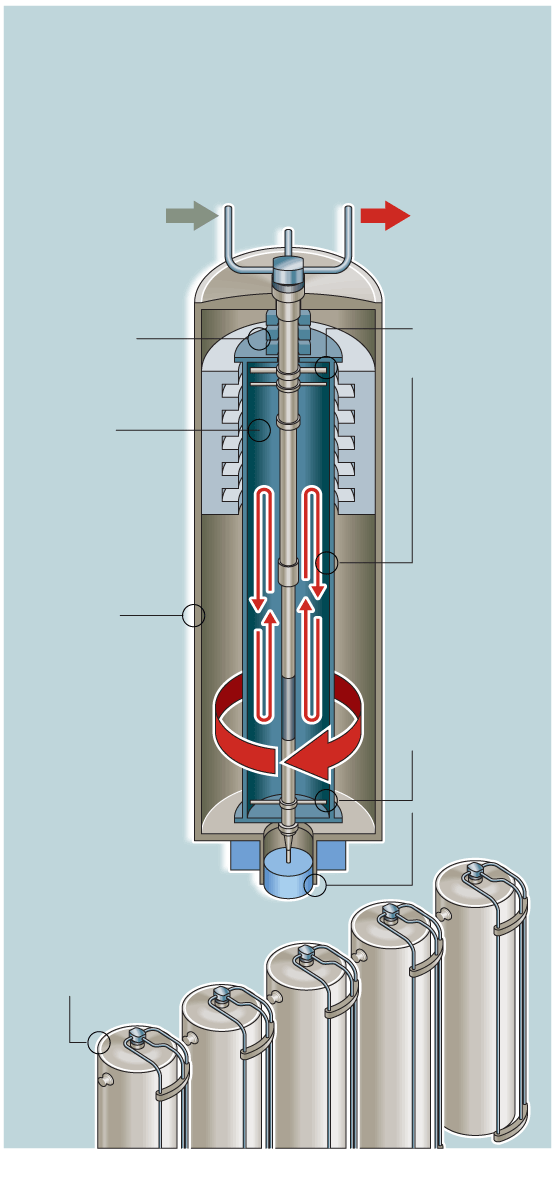
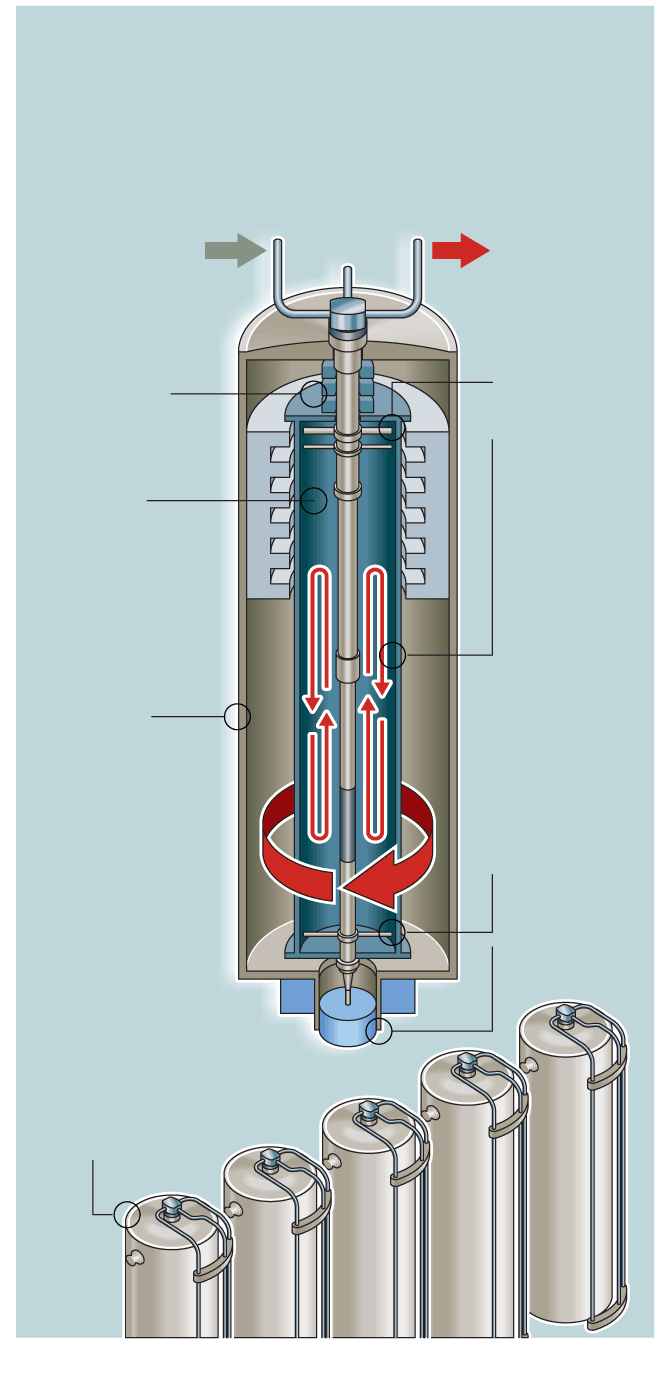
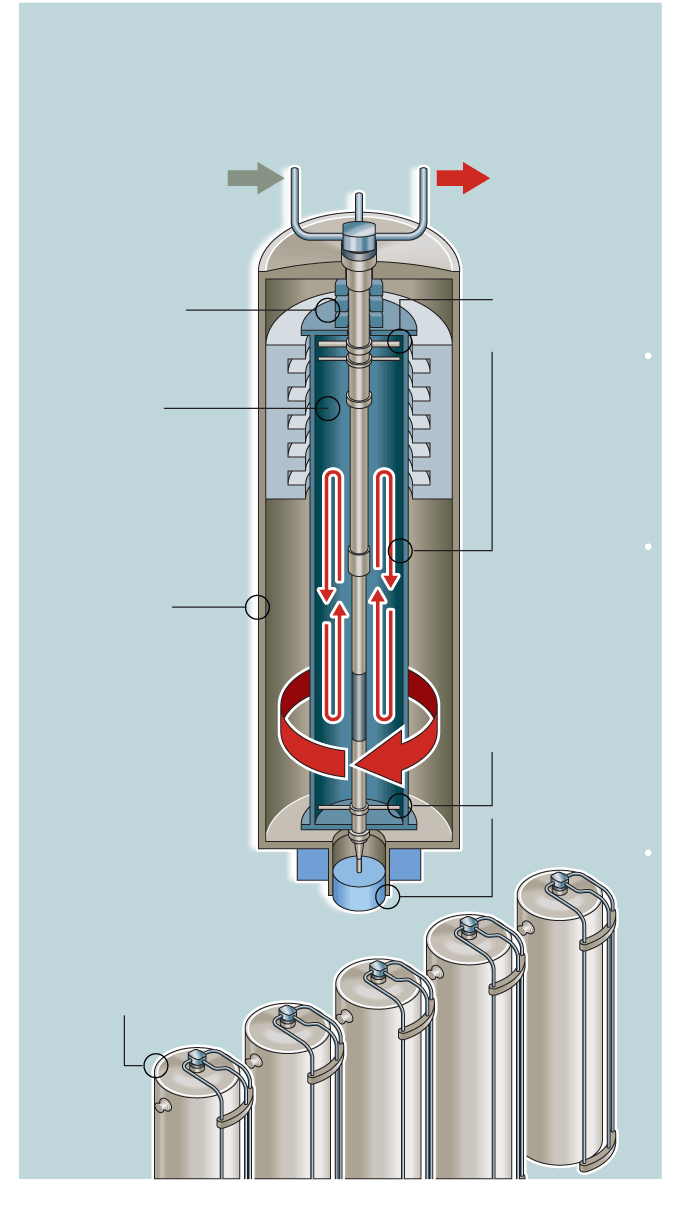
Natural uranium is composed almost entirely of uranium-238; it contains just 0.7 per cent of uranium-235, the isotope crucial for powering nuclear reactors. Enrichment involves boosting U-235 content by removing U-238.
Uranium enriched up to 5 per cent U-235 is known as low-enriched uranium (LEU), used to fuel most of the world’s power reactors. Anything between 5 per cent and 20 per cent is known as high assay low enriched uranium (HALEU), required by some proposed small modular reactors (SMRs). Above the 20-per cent-threshold lies the realm of highly enriched uranium, generally considered beyond the requirements of peaceful purposes.
URANIUM ENRICHMENT
To enrich reactor fuel commercially, gaseous uranium
is run through centrifuges to increase concentrations of lighter,
fissile uranium-235 molecules. This technology is highly
expensive, and tightly controlled to prevent proliferation risk.
Uranium
hexafluoride
gas (UF6) feed
Waste
Enriched
UF6 gas
Top scoop
Magnetic
suspension
bearing
Centrifugal
force:
Heavier
UF6
molecules
move
closer
to wall –
lighter
U-235
molecules
rise and
are drawn
off
Rotor
spins
at high
speed
Casing
Bottom
scoop
Cascade:
Proportion
of U-235
isotope in
UF6 gas
gradually
increased
through succession
of centrifuges
spinning in
unison
Electric
motor
the globe and mail, Source: graphic news
URANIUM ENRICHMENT
To enrich reactor fuel commercially, gaseous uranium
is run through centrifuges to increase concentrations of lighter,
fissile uranium-235 molecules. This technology is highly
expensive, and tightly controlled to prevent proliferation risk.
Uranium
hexafluoride
gas (UF6) feed
Waste
Enriched
UF6 gas
Top scoop
Magnetic
suspension
bearing
Centrifugal
force:
Heavier
UF6
molecules
move
closer
to wall –
lighter
U-235
molecules
rise and
are drawn
off
Rotor
spins
at high
speed
Casing
Bottom
scoop
Cascade:
Proportion
of U-235
isotope in
UF6 gas
gradually
increased
through succession
of centrifuges
spinning in
unison
Electric
motor
the globe and mail, Source: graphic news
URANIUM ENRICHMENT
To enrich reactor fuel commercially, gaseous uranium
is run through centrifuges to increase concentrations of lighter,
fissile uranium-235 molecules. This technology is highly
expensive, and tightly controlled to prevent proliferation risk.
Uranium
hexafluoride
gas (UF6) feed
Waste
Enriched
UF6 gas
Top scoop
Magnetic
suspension
bearing
Centrifugal force:
Heavier UF6
molecules
move closer
to wall –lighter
U-235 molecules
rise and are
drawn off
Rotor
spins
at high
speed
Casing
Bottom
scoop
Electric
motor
Cascade:
Proportion of
U-235 isotope in
UF6 gas gradually
increase through
succession
of centrifuges
spinning in
unison
the globe and mail, Source: graphic news
Enrichment capacity is expressed in separative work units (SWUs), a complex calculation representing the amount of energy required to enrich a given mass of uranium. France’s largest enrichment plant, Georges Besse II, has 7.5 million SWUs.
Where is it enriched?
There are three major enrichers, including Urenco (a multinational operating plants in Germany, the U.K., Netherlands and the U.S.) and France’s Orano. According to the World Nuclear Association, the annual global capacity is around 63 million SWUs, representing a significant surplus. But for Western utilities, the third major supplier has become a major concern: Russia’s Rosatom. It boasts four enrichment plants representing nearly half of the world’s capacity, and is the only commercial supplier of HALEU.
This became uncomfortable after it invaded Ukraine in 2022. Jean-Luc Palayer, CEO of Orano USA, told a recent CIBC conference in Toronto focused on the nuclear industry that customers started calling in search of alternative enrichment capacity, prompting Orano to pursue expansion of Georges Besse II, and construction of a new plant in Oak Ridge, Tenn.
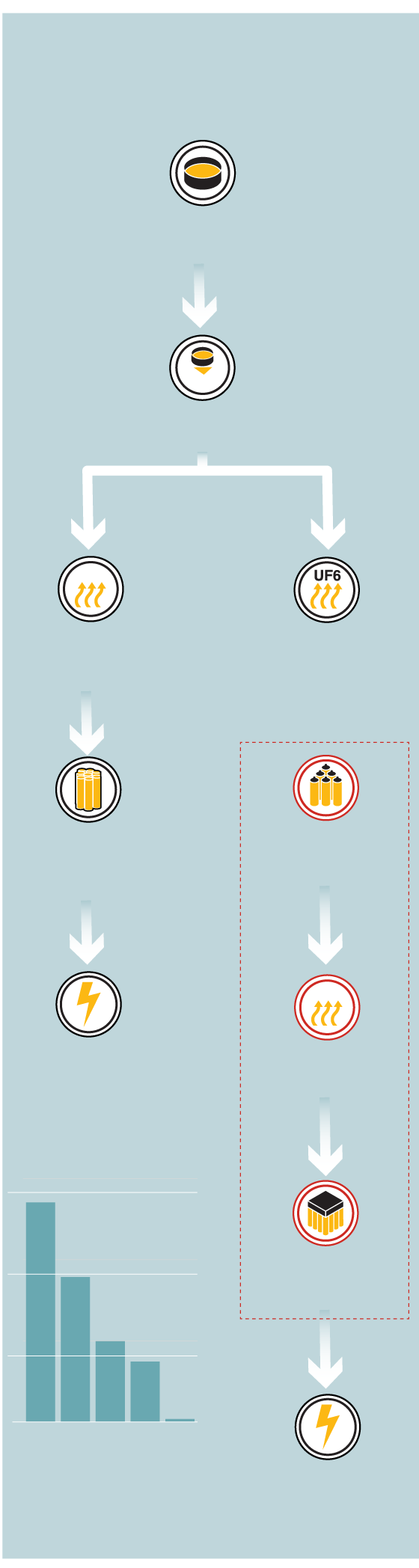
Arguments for domestic enrichment often begin with long-standing concerns that the country isn’t maximizing the value of Saskatchewan’s uranium. It’s a quintessentially Canadian quandary. Canada is rich in natural resources but often exports them in more or less raw form to other countries that have built the infrastructure to process it.
According to a 2022 report prepared by the engineering firm Hatch for the federal government, Canada currently retains 58 per cent of the value of uranium reactor fuel. By adding enrichment capabilities, it could capture an additional 24 per cent. Hatch recommended Canada select a technology for commercial-scale enrichment.
Esam Hussein, an emeritus professor at the University of Regina, has watched as governments in Canada became increasingly enthusiastic about small modular reactors over the past several years. Reactors that are small in volume will necessarily require enriched uranium, he said.
“We are the second largest country in uranium production,” he said. “And we are essentially exporting raw material, we’re at the mercy of foreign suppliers.”
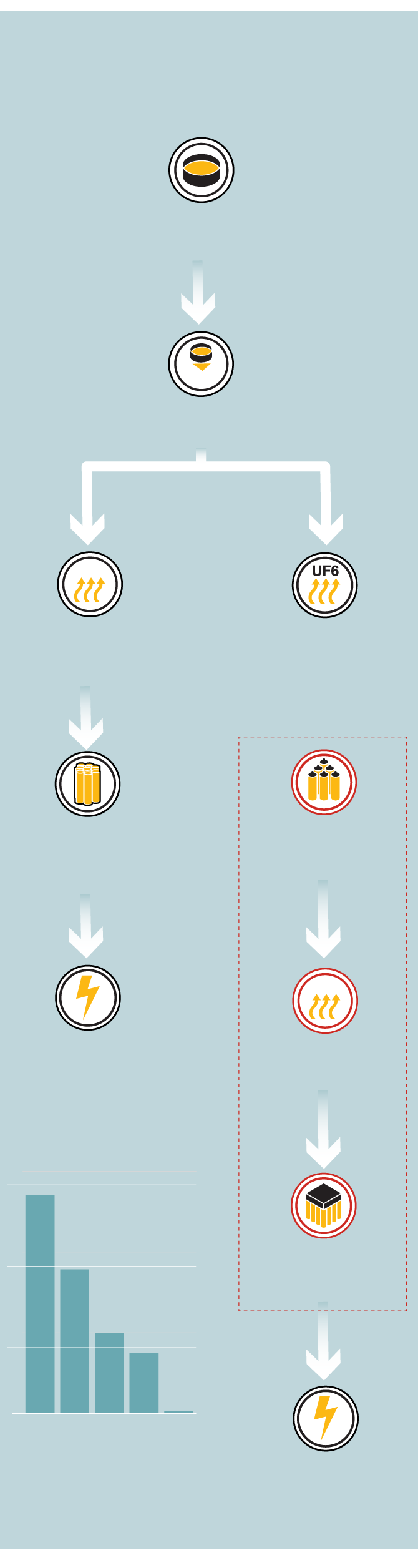
THE PATH NOT TAKEN
Heavy-water Candu reactors have the unique ability to consume natural uranium, thus avoiding the need to enrich their fuel. If Canada continues to build reactors that need enriched uranium, it’ll need to depend on foreign enrichment plants – or consider building its own.
Mining and milling
Uranium extracted from ore, packaged as yellowcake (U3O8). Saskatchewan.
UO3
Refining
Yellowcake purified to uranium trioxide (UO3). Blind River, Ont.
UO2
Conversion
UO3 to powdered
uranium dioxide (UO2).
Port Hope, Ont.
Conversion
UO3 to uranium hexafluoride (UF6) gas.
Port Hope, Ont.
FOREIGN
Fuel Fabrication
U02 pressed into pellets, packed into fuel assemblies. Port Hope and Cobourg, Ont.
Enrichment
Centrifuges raise concentrations of uranium-235.
UO2
Power Generation Assemblies loaded into Candu reactors. Ontario, New Brunswick.
Conversion
Enriched gas converted
to powdered UO2.
The enrichment oligopoly, 2025
Thousand separative work units/year
30,000
Fuel Fabrication
Enriched UO2 pressed into pellets, packed into fuel assemblies.
20,000
10,000
Orano
Rosatom
CNNC*
Urenco
Other
Power Generation Assemblies loaded into light water reactors.
*China National Nuclear Corp.
john sopinski and matt mcclearn/
the globe and mail, Source: cameco;
GRAPHIC NEWS; world nuclear assoc.
THE PATH NOT TAKEN
Heavy-water Candu reactors have the unique ability to consume natural uranium, thus avoiding the need to enrich their fuel. If Canada continues to build reactors that need enriched uranium, it’ll need to depend on foreign enrichment plants – or consider building its own.
Mining and milling
Uranium extracted from ore, packaged as yellowcake (U3O8). Saskatchewan.
UO3
Refining
Yellowcake purified to uranium trioxide (UO3). Blind River, Ont.
UO2
Conversion
UO3 to powdered
uranium dioxide (UO2).
Port Hope, Ont.
Conversion
UO3 to uranium hexafluoride (UF6) gas.
Port Hope, Ont.
FOREIGN
Fuel Fabrication
U02 pressed into pellets, packed into fuel assemblies. Port Hope and Cobourg, Ont.
Enrichment
Centrifuges raise concentrations of uranium-235.
UO2
Power Generation Assemblies loaded into Candu reactors. Ontario, New Brunswick.
Conversion
Enriched gas converted
to powdered UO2.
The enrichment oligopoly, 2025
Thousand separative work units/year
30,000
Fuel Fabrication
Enriched UO2 pressed into pellets, packed into fuel assemblies.
20,000
10,000
Orano
Rosatom
CNNC*
Urenco
Other
Power Generation Assemblies loaded into light water reactors.
*China National Nuclear Corp.
john sopinski and matt mcclearn/
the globe and mail, Source: cameco;
GRAPHIC NEWS; world nuclear assoc.
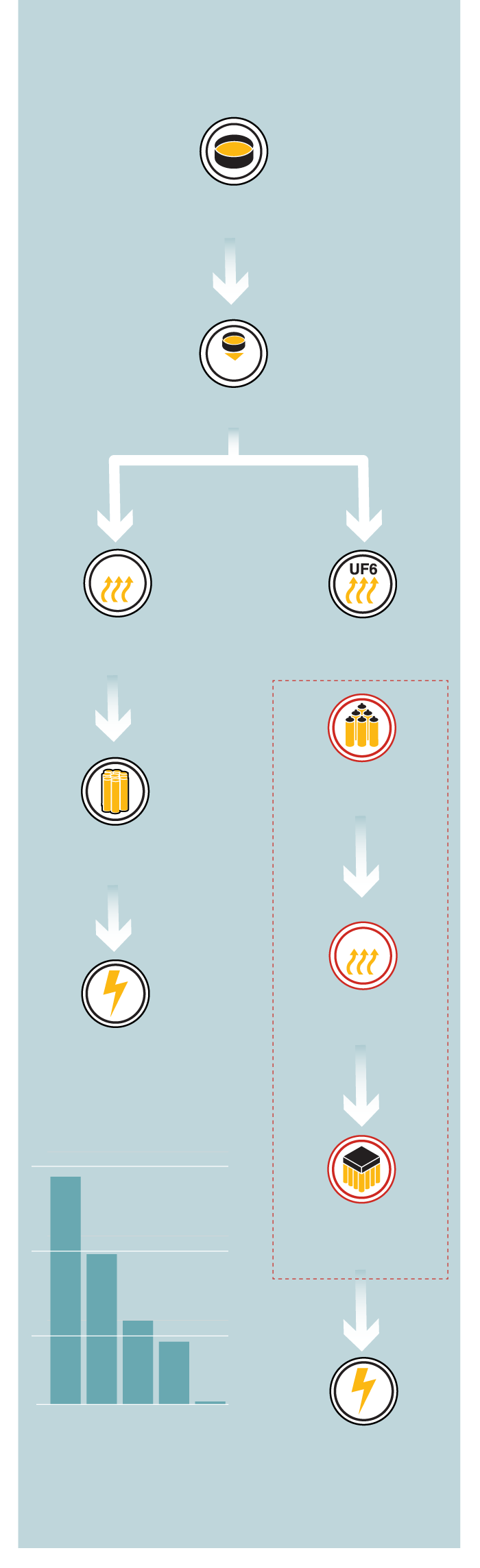
THE PATH NOT TAKEN
Heavy-water Candu reactors have the unique ability to consume natural uranium, thus avoiding the need to enrich their fuel. If Canada continues to build reactors that need enriched uranium, it’ll need to depend on foreign enrichment plants – or consider building its own.
Mining and milling
Uranium extracted from ore, packaged as
yellowcake (U3O8). Saskatchewan.
UO3
Refining
Yellowcake purified to uranium trioxide (UO3). Blind River, Ont.
UO2
Conversion
UO3 to powdered
uranium dioxide (UO2).
Port Hope, Ont.
Conversion
UO3 to uranium hexafluoride (UF6) gas.
Port Hope, Ont.
FOREIGN
Enrichment
Centrifuges raise concentrations of uranium-235.
Fuel Fabrication
U02 pressed into pellets, packed into fuel assemblies. Port Hope and Cobourg, Ont.
UO2
Conversion
Enriched gas converted
to powdered UO2.
Power Generation Assemblies loaded into Candu reactors. Ontario, New Brunswick.
The enrichment oligopoly, 2025
Thousand separative work units/year
30,000
Fuel Fabrication
Enriched UO2 pressed into pellets, packed into fuel assemblies.
20,000
10,000
Rosatom
Urenco
CNNC*
Orano
Other
Power Generation Assemblies loaded into light water reactors.
*China National Nuclear Corp.
john sopinski and matt mcclearn/the globe and mail, Source: cameco;
GRAPHIC NEWS; world nuclear assoc.
How did Canada get here?
There’s a long backstory. By 1973, Canada had already begun building Candu reactors, fuelled by natural uranium. Ottawa reasoned that Canadian-enriched uranium would be exported, so it was hard to argue that enriching was somehow of national importance.
Moreover, it suggested that developing new enrichment technology from scratch would be fearfully expensive. An enrichment plant would likely use foreign-developed technology, which would be under foreign government control and be considered highly classified.
Steve Aplin, a Toronto-based nuclear consultant, said there was yet another reason. “The Americans leaned on us to not do it,” he said. “They said: ‘Whatever need you have for enriched uranium, we’ll provide it.’”
Over the decades, calls periodically arose from think tanks, academics and from within the nuclear industry to reconsider this strategy, particularly in moments where the U.S. moved toward restricting exports of enriched uranium.
Documents released under the federal Access to Information Act show that officials began reconsidering their stance on enrichment a few years ago. Natural Resources Canada and Global Affairs Canada, for example, proposed setting up a working group to study enrichment in 2024. And to prepare to regulate SMRs, the Canadian Nuclear Safety Commission began efforts “to regulate enrichment should it arise,” according to the documents.
A formal working group was never established, wrote NRCan spokesperson Miriam Galipeau in a written response to questions: “Canada has undertaken similar reviews related to uranium and the nuclear fuel cycle going back to the 1970s.”
What is Canada doing now?
Most visibly, in its fall economic statement released in December, 2024, the government announced a $500-million “backstop” to help utilities purchase enriched fuel from the U.S. and elsewhere.
These tepid efforts were underpinned by an assumption that Canada would work shoulder-to-shoulder with American counterparts to shore up North America’s nuclear fuel supply chains. Then-leaders Justin Trudeau and Joe Biden issued a joint statement in 2023 declaring their intent to do precisely that. (The U.S. possesses domestic enrichment capacity, but not nearly enough to meet demand from its own reactor fleet, the world’s largest.)
Since President Donald Trump assumed office, deteriorating relations between the two countries put any such co-operation in jeopardy.
“Given the political and economic threats that Canada now faces from the U.S. administration, a potential disruption in nuclear fuel supplies is a risk that cannot be dismissed,” Jeff Kucharski, a senior fellow at the Macdonald Laurier Institute, wrote last month.
A March report by the Public Policy Forum suggested Canada should continue efforts to secure access to enriched uranium from allies for now; in the longer term, it should “evaluate the business case for the options for domestic enrichment.”
Nuclear consultants Josef Freundorfer, Jeremy Whitlock, Alex MacDonald and Tom McCormack made a similar argument in a paper published in late February. They predicted Canada will build reactors requiring enriched uranium over the next quarter of a century.
Mr. MacDonald said in an interview that if Canada is serious about meeting its commitments to reduce greenhouse-gas emissions, “there will be enough domestic demand for enriching in Canada to justify doing it.” Canada could require as many as seven million SWUs, they wrote, which could be satisfied by building between two and four enrichment plants.
“You’re looking at probably $4-to-$5-billion for a modern centrifuge facility of a moderate size,” Mr. MacDonald said.
That estimate is consistent with a separate one from Frank von Hippel, a professor at Princeton University. He said enrichment capacity costs roughly US$1 billion per million SWUs. One million SWUs is enough to serve demand from roughly eight large reactors, he said.
Consultant Mr. Aplin said Canada could have rapidly developed enrichment capacity even decades ago. Today, he estimated, it would cost less than $5-billion.
“We could figure this out in a month, if we needed to,” he said. “From scratch to a working centrifuge, we could probably have one within six months.”
Mr. Hussein suggested Canada could leverage its status as a major uranium producer to negotiate access to enrichment technology from other countries that already possess it.
Prof. von Hippel, whose research interests include nuclear arms control and nonproliferation, said establishing enrichment capacity in Canada would not contravene any law or international commitment – but would be hard to justify economically.
Most enrichment proponents assume many new non-Candu reactors will be built nationwide. Mr. MacDonald and his colleagues, for example, assumed in their paper that in their “low-case scenario,” all nuclear projects “that are currently discussed” will be built.
That’s a bold assumption. Proposed nuclear plants are frequently abandoned, and one in nine that begin construction globally are never completed.
Opinion: Canada must acknowledge the implications of selling uranium to India
A 2023 draft report produced by NRCan and obtained through the Access to Information Act listed 18 reactors requiring enriched fuel, expected to be deployed in Canada between 2028 and 2040. Vendors for as many as 10 of those reactors have since either run into serious financial difficulties, lost their utility sponsors, or stopped discussing plans to deploy reactors in Canada.
Canada’s largest uranium producer is openly skeptical about arguments that Canada must dominate all aspects of nuclear fuel supply chains.
“Canada’s position cannot be Fortress Canada,” said Grant Isaac, Cameco’s president and COO, at CIBC’s Nuclear Summit in Toronto.
“It’s a little bit incoherent to say: ‘We’ve got to have our own approach and our own technology, but the rest of the world has to buy what we have in excess.’ That’s not the way the nuclear fuel market works.”
Dominic Kieran, global managing director of Cameco UK who previously worked for Urenco for 15 years, told the same conference he was “relaxed” about the risks posed by Canada’s turn to enriched uranium.
“The world has lots of production for enrichment in allied nations: U.K., France, Germany, Netherlands, plenty of supply sources,” he said.
“I’m very confident that the availability of enrichment in this market is neither a risk nor a bottleneck.”
The federal Natural Resources Department seems to have reached a similar conclusion, telling The Globe in a statement that the enrichment “backstop” announced in late 2024 was subsequently deemed unnecessary and never initiated.
“Multiple enrichers such as Germany, the Netherlands, France and the U.K., have announced capacity expansions or plans for new facilities, making potential future enrichment shortages less of a concern,” wrote spokesperson Maria Ladouceur.