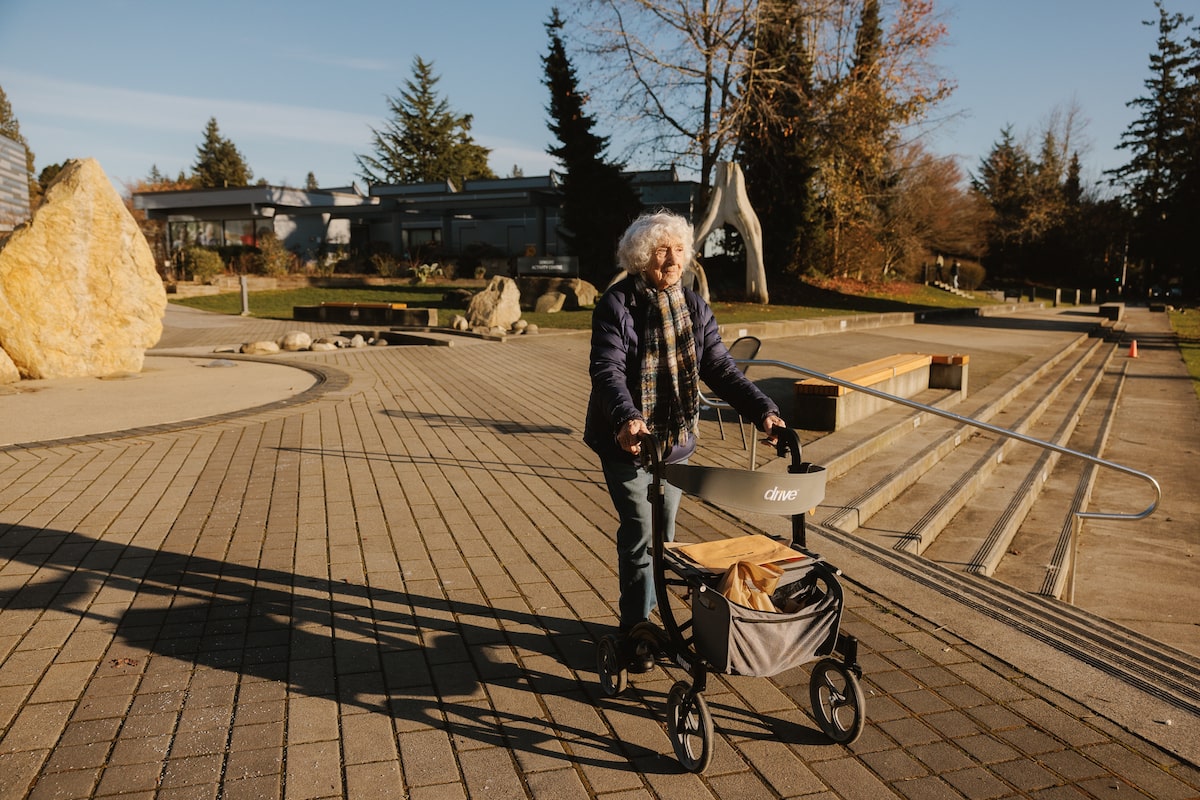
On a brilliant Sunday afternoon in January, West Vancouver resident Shauna Olney is enjoying a coffee outside of the West Vancouver Community Centre.
She and her friends have just finished a yoga class. Nearby, a group of women is practising traditional Chinese fan dancing in the sun.
Meanwhile, Toronto is under half a metre of fresh snow after a record-breaking winter storm.
Ms. Olney grew up on the North Shore, the lands north of Vancouver proper that run from the Burrard Inlet up the North Shore mountains. After working for the United Nations in Geneva for most of her career, she moved back to West Vancouver after the COVID-19 pandemic to take care of her ailing mother. Her Australian husband jumped at the chance.
“There was no question in his mind that we’d live anywhere but West Van,” she said. “Obviously I want to be close to my mom, but for him it was just because ... it’s the green spaces, it’s the water, the sense of community.”


That combination of climate and community helped to lift the District of West Vancouver to the top of The Globe and Mail’s rankings this year as Canada’s most livable medium-sized city.
Mark Sager, West Vancouver’s mayor, said that a recent audit had rated the district’s parks and recreation as “absolutely the best in the country.” A new park on undeveloped land on the district’s mountainside – twice the size of Vancouver’s Stanley Park – is intended to “protect the backdrop of Metro Vancouver forever,” Mr. Sager said.
He also highlighted the district’s efforts over decades to purchase waterfront properties in Ambleside and convert the space for public use. It bought the final home in 2025. “People from all over Metro Vancouver, all around the world, come and enjoy a truly spectacular waterfront,” Mr. Sager said.
While the district council can’t take credit for happy accidents of geography and weather, residents praise it for community amenities that they say help to bring people together. (In fact, it placed in the top 100 cities for amenities overall, at 71).
The community centre and an attached senior centre in particular are “real treasures,” said Ms. Olney’s friend, Tina Schultze, who has lived in West Vancouver for more than 50 years and raised her family here. Both also praised what they called an “unbelievable” library.


Residents acknowledge that the city’s advantages come at a real cost. The Globe and Mail ranked West Vancouver 387th out of 454 cities in housing affordability. Traffic is also a consistent gripe among residents in a place dominated by automobiles: A 2023 survey of transportation on the North Shore showed that 84 per cent of weekday trips in West Vancouver were taken by car.
“Having lived in other places, I feel like we’re missing pedestrian livability,” said Karen Bodie, an engineer who moved to West Vancouver to be closer to grandparents for her six-month-old twins. While she loves the sea wall, Ms. Bodie said that she and her husband, who don’t own a car, have found transit service uneven, and they noted the failure of a planned rapid bus route. “You’re always stuck in traffic with the other cars.”

From Ambleside Park, West Vancouverites can see the Lion's Gate Bridge and the traffic in and out of downtown Vancouver.
Marina Foster, an environmental consultant, acknowledged the traffic issues but said that she had come to appreciate West Vancouver after what she characterized as her husband’s “dare” to find a detached house with a yard and a garage in the city of Vancouver.
“I did not want to live in West Vancouver,” she said, as she kept an eye on her children in the playground at Ambleside’s John Lawson park. After trying and failing for three years to find a suitable home, she looked at a number of properties in Ambleside. “Now I’ve been here for two years and I love it, and I’m never going to move back.”
Despite her concerns that her family would be “moving into old-people-ville,” Ms. Foster said she has found many families with young children. And the district’s aging demographics – in 2021 its median age was a decade older than the regional median of 41 – have provided unique opportunities. Ms. Foster said her two-year-old daughter’s music class at the community centre is organized in connection with the senior centre.
“It’s a huge room of like 40 people, half of them are two and half of them are 92. It’s adorable ... They’ve all got tambourines and jingle bells and they’re all singing songs,” she said. “That is a very quintessential West Vancouver kind of a thing to do.”

Where you live: More from The Globe and Mail
Stress Test podcast
Moving to small towns with inexpensive housing was an attractive option during the pandemic, and while some were thrilled by the results, others were not. Last year, the Stress Test podcast checked in with guests from previous seasons to reflect on their decisions and the effects on their finances.
Greater Vancouver in depth
In Vancouver, planners say it takes a village to grow a city
As immigration shifts away from big cities, Vancouver’s numbers have fallen far
Lasting benefits of World Cup in Vancouver won’t reach level of 2010 Olympics, critics say