
The S&P TSX composite index screen at the TMX Market Centre in Toronto in November, 2022.Tijana Martin/The Canadian Press
To help make sense of 2025, The Globe and Mail asked dozens of experts, including economists, investors, academics and business leaders, to each choose a chart they think will be important to watch this year.
Look out below
David Rosenberg, chief economist, Rosenberg Research
We head into 2025 with the venerable cyclically adjusted price-to-earnings (CAPE) ratio for the S&P 500 Index at a nosebleed level of 38 times earnings, having expanded from 32 a year ago and 28 two years back. (CAPE, popularized by Nobel Prize-winning economist Robert Shiller, measures the index’s current price against the long-term average of S&P 500 company earnings.) The last time we started a year with such a challenging valuation headwind was in 2022 – which presaged a near 30-per-cent, 10-month drawdown in cyclical stocks. Before that, try 2001 (another brutal year, followed by a big leg down in 2002). Prior to that, 2000 (we all know what happened next).
Anyone who’s fully invested now should be aware that in the past century the CAPE has only been this high 3 per cent of the time.
Valuation metrics are not exactly market timing devices, but over time they are key determinants of long-term returns in the stock market. History shows the lower the starting point on the CAPE, the higher the average three-, five- and 10-year future price returns for the S&P 500. When the CAPE multiple breaks above 35 – where we are today – nominal returns from this starting point have been negative across the board. Remember, this is not a tactical assessment, because we know how powerful a momentum-based market can be; rather, this is a message for long-term investors in the public equity space.
Greenback bonanza
Alexander MacDonald, portfolio manager, Davis Rea
The Canadian dollar’s recent depreciation versus the U.S. dollar has made vacations south of the border more costly. Not since the COVID-19 pandemic started has the loonie dropped as low as it did in mid-December, to less than 70 US cents.
But while winter 2025 may be expensive for many Canadian snowbirds, it’s shaping up to be a profitable one for many Canadian investors. Thanks to strong performance from the so-called Magnificent Seven stocks, the S&P 500 Index was up 27 per cent for 2024 as of mid-December. And for Canadian investors, a depreciating loonie meant that this return was even higher: The S&P 500 was up 37 per cent when translated to Canadian dollars.
As the accompanying chart shows, this represents the second-highest return in more than 50 years for the S&P 500 in Canadian-dollar terms. Furthermore, this return is almost four times higher than the average annual return of 10 per cent. With interest-rate differentials between Canada and the United States unlikely to narrow any time soon, 2025 is shaping up to be another rewarding year for Canadians invested in U.S.-dollar-denominated assets.
Back to the grind
Tom Bradley, chair and co-founder of Steadyhand Investment Management
Stock returns come from three sources: dividends, earnings growth and changes in valuation. The first two are reasonably steady over time, but valuations can swing wildly and this is the main reason why markets are so volatile. The overall valuation of the market can be a detractor at times (as in 2022) or a big contributor, as it was over the past two years. The makeup of the 2024 S&P 500 Index return is typical of a good year. Dividends delivered and corporate earnings growth (after inflation) was excellent, but returns were overwhelmingly driven by expanding price-to-earnings multiples.
The makeup of the S&P 500’s 10-year return, however, is more unusual. Normally, periods of multiple expansion are offset by periods of contraction such that change in valuation nets out to zero in the return equation. To have valuation contributing 3.3 per cent per year over a decade indicates that it’s been an unusually good ride. As investors enter 2025, they need to keep expectations in check, particularly when it comes to U.S. stocks. The next decade is unlikely to have the same valuation turbo boost as the last one did.
The dividend is nigh
Benjamin Tal, deputy chief economist, CIBC
Investing was easy in the days of 5- to 6-per-cent interest rates on guaranteed investment certificates. Investors gravitated to GICs at a rate we haven’t seen in decades, with GIC balances reaching an all-time high of $734-billion.
Now, with rates on their way down, GICs are quickly losing their appeal. We estimate that $200-billion to $300-billion of GIC balances are now looking for the exit. That should benefit the closest alternative: high-quality dividend-paying stocks.
Mind the gap
Doug Porter, chief economist, Bank of Montreal
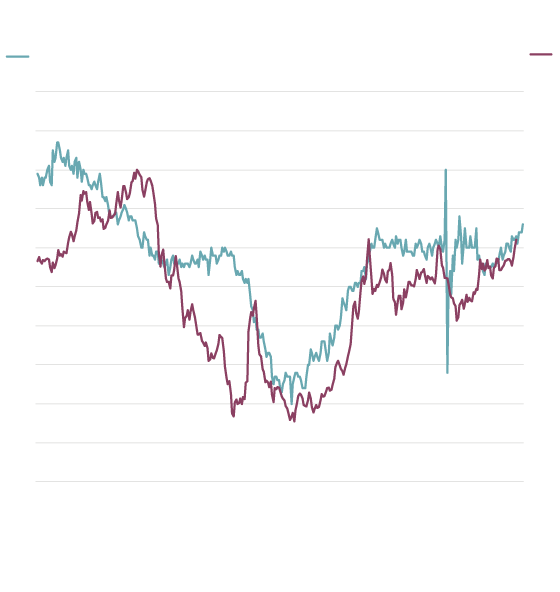
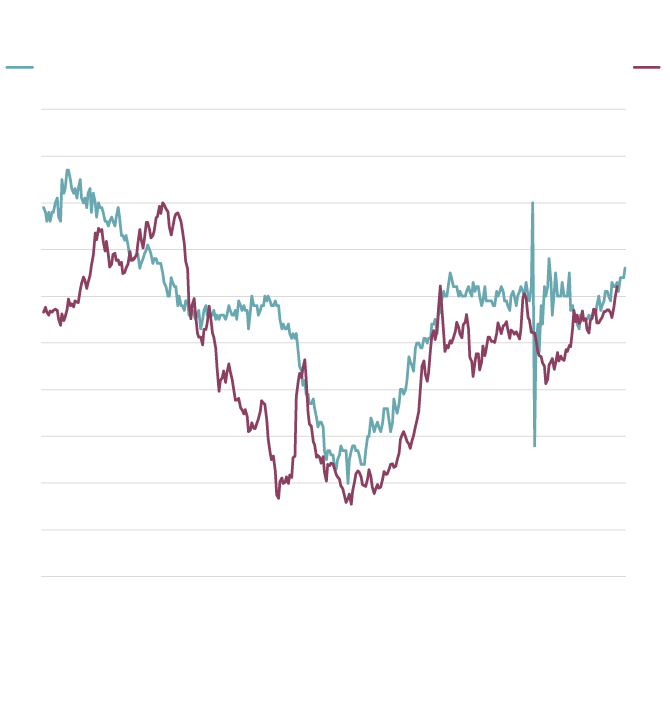
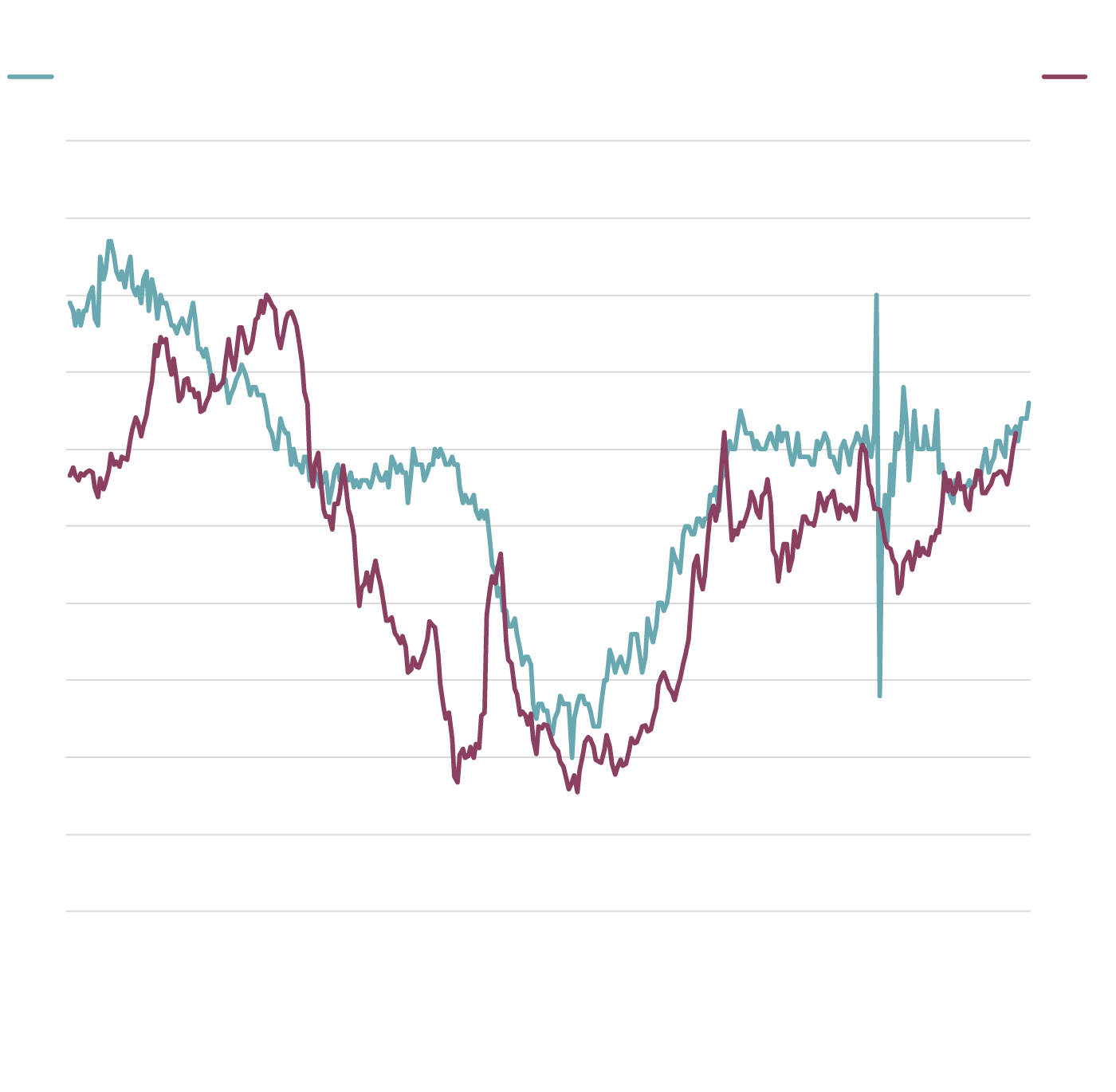
The recent pronounced weakness in the Canadian dollar has been driven by a variety of factors, including a strong U.S. dollar generally, the threat of U.S. tariffs and a big spread between Canadian and U.S. interest rates. But the latter, and the weakness in our currency, are entirely consistent with the relative weakness in the Canadian economy over the past two years. As illustrated in the chart, there’s a long-standing relationship between the currency and the Canada-U.S. unemployment-rate spread.
Jobless rate differential drives Canadian dollar
CAD/USD
Jobless rate gap*
6%
$1.8
5
1.7
4
1.6
3
1.5
2
1.4
1
1.3
0
1.2
-1
1.1
-2
1.0
-3
0.9
-4
0.8
1995
2000
2005
2010
2015
2020
*Canada less U.S., percentage points, advanced 6 months.
the globe and mail, Source: BMO Economics, Haver analytics,
Bank of Canada, BLS
Jobless rate differential drives Canadian dollar
Jobless rate gap*
CAD/USD
6%
$1.8
5
1.7
4
1.6
3
1.5
2
1.4
1
1.3
0
1.2
-1
1.1
-2
1.0
-3
0.9
-4
0.8
1995
2000
2005
2010
2015
2020
*Canada less U.S., percentage points, advanced 6 months.
the globe and mail, Source: BMO Economics, Haver analytics,
Bank of Canada, BLS
Jobless rate differential drives Canadian dollar
Jobless rate gap*
CAD/USD
6%
$1.8
5
1.7
4
1.6
3
1.5
2
1.4
1
1.3
0
1.2
-1
1.1
-2
1.0
-3
0.9
-4
0.8
1995
2000
2005
2010
2015
2020
*Canada less U.S., percentage points, advanced 6 months.
the globe and mail, Source: BMO Economics, Haver analytics, Bank of Canada, BLS
When Canada’s jobless rate is relatively much higher than the U.S. rate, as it has been recently, the loonie is on the defensive (or, as per the chart, the U.S. dollar is strong). And heading into 2025, Canada’s 6.8-per-cent unemployment rate is a full 2.6 percentage points above the U.S. rate (4.2 per cent). That’s the widest spread since 2001, aside from a couple of months during the deep pandemic distortions in 2020-21. Moreover, history suggests that the jobless-rate gap leads the currency by six months or more, suggesting the loonie will remain soggy for some time yet.
The lowly loonie’s rebound
Sébastien Mc Mahon, senior economist, iA Global Asset Management Inc.
Canada-U.S. 5-year bond yield differential
and the loonie
Percentage point difference in 5-year yield
(U.S. minus Canada)
CAD/USD
1.5%
$1.50
1.4
1.00
1.3
0.50
1.2
0.00
1.1
-0.50
1.0
-1.00
0.9
-1.50
2010
2012
2014
2016
2018
2020
2022
2024
the globe and mail, Source: bloomberg
Canada-U.S. 5-year bond yield differential
and the loonie
Percentage point difference in 5-year yield
(U.S. minus Canada)
CAD/USD
1.5%
$1.50
1.4
1.00
1.3
0.50
1.2
0.00
1.1
-0.50
1.0
-1.00
0.9
-1.50
2010
2012
2014
2016
2018
2020
2022
2024
the globe and mail, Source: bloomberg
Canada-U.S. 5-year bond yield differential and the loonie
Percentage point difference in 5-year yield (U.S. minus Canada)
CAD/USD
1.5%
$1.50
1.4
1.00
1.3
0.50
1.2
0.00
1.1
-0.50
1.0
-1.00
0.9
-1.50
2010
2012
2014
2016
2018
2020
2022
2024
the globe and mail, Source: bloomberg
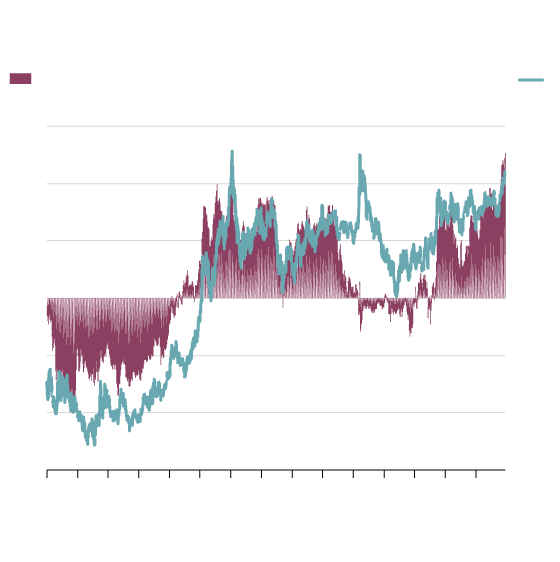
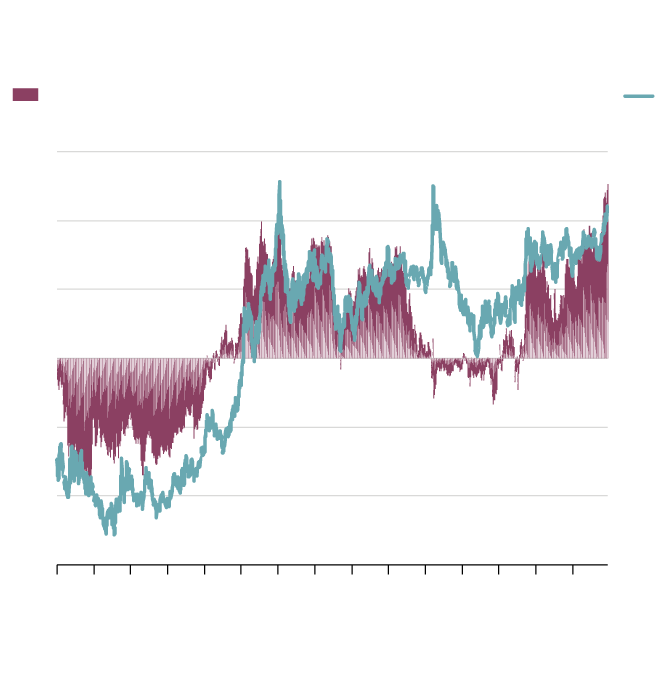
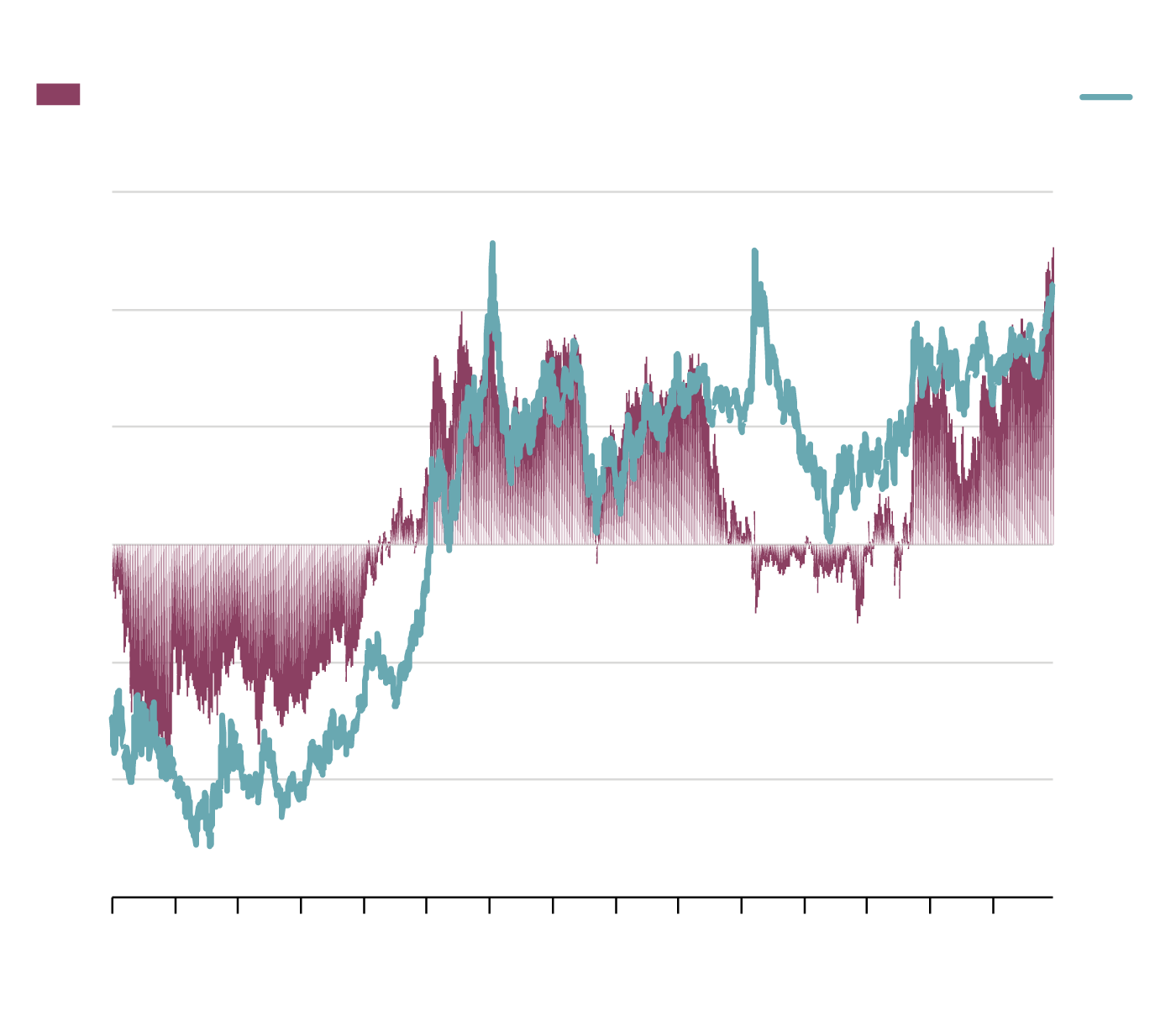
The loonie closed 2024 at its lowest level against the U.S. dollar since the early 2000s (excluding recessions) and the gap between Bank of Canada and Federal Reserve overnight interest rates is pushing many economists to call for more downside ahead for our dollar. While there are ample risk factors looming in 2025, chief among them the threat of a blanket tariff on U.S. imports of Canadian goods and services, our analysis suggests that the Canadian dollar is poised for a comeback in the next 12 months. In fact, we estimate that the current undervaluation reflects a historical gap in economic perception between Canada and the U.S., as measured by the gap in five-year interest rates, which currently stands at the largest in history. In plain English: The economic divide looks already priced in, and the loonie might be ripe for a rebound in 2025.
Private power shift
Jean Boivin, head of BlackRock Investment Institute
Private assets have become a growing share of financial markets. We see private markets playing a critical role in the transformation ahead – sticking to public markets doesn’t fully capture this broadening opportunity set, in our view.
Private markets will play a pivotal role, allowing portfolios to gain unique exposure to the transformation as public markets can only fund some of it. For example, private markets can offer exposure to early-stage growth companies that are driving adoption of artificial intelligence and to vital infrastructure projects. We think the future of finance – a megaforce on its own – will be shaped by non-bank lenders that are increasingly funding such large-scale projects. This highlights why private-market assets under management are expected to roughly double by 2029 from 2023 levels, Preqin data shows.
We think this shows how finance itself is changing and innovating rapidly as activities that were previously bundled together in single institutions, such as banks, are unbundled. Sizeable capital will be needed as the transformation unfolds, and that investment is happening now.