
It’s worth examining the relationships Premier Doug Ford has threatened to disrupt, and what the implications might be should he follow through. Ford attends a news conference at Queen's Park Legislature in Toronto on Dec. 12.Chris Young/The Canadian Press
Trade tensions have been rising between Canada and the U.S. since president-elect Donald Trump’s threat last month to impose stiff tariffs on this country’s goods.
Last week, Ontario Premier Doug Ford threw down his own gauntlet: that he might terminate energy exports to Canada’s largest trading partner.
“We will go to the extent of cutting off their energy, going down to Michigan, going down to New York State and over to Wisconsin,” he declared to reporters.
Mr. Ford said he deemed the proposal a “last resort.” And for now, it seems like he’s on his own, as other premiers signalled they would not follow suit. Mr. Trump, meanwhile, appeared to brush off the threat in public comments.
It’s worth examining the relationships Mr. Ford has threatened to disrupt, and what the implications might be should he follow through.
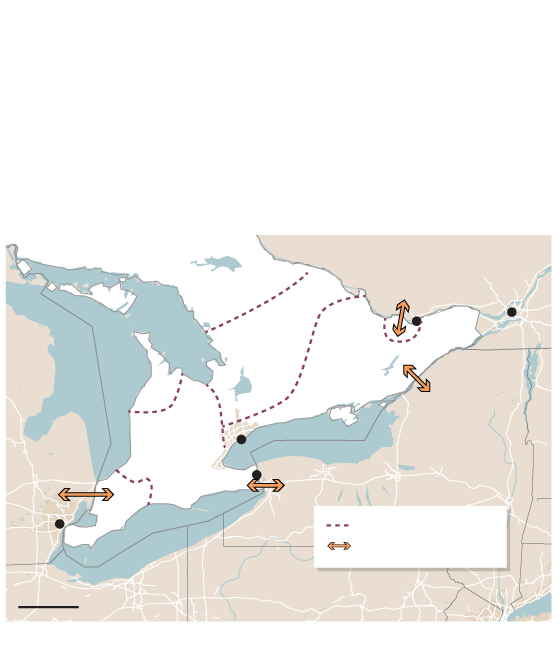
A cog in one of the largest
machines ever built
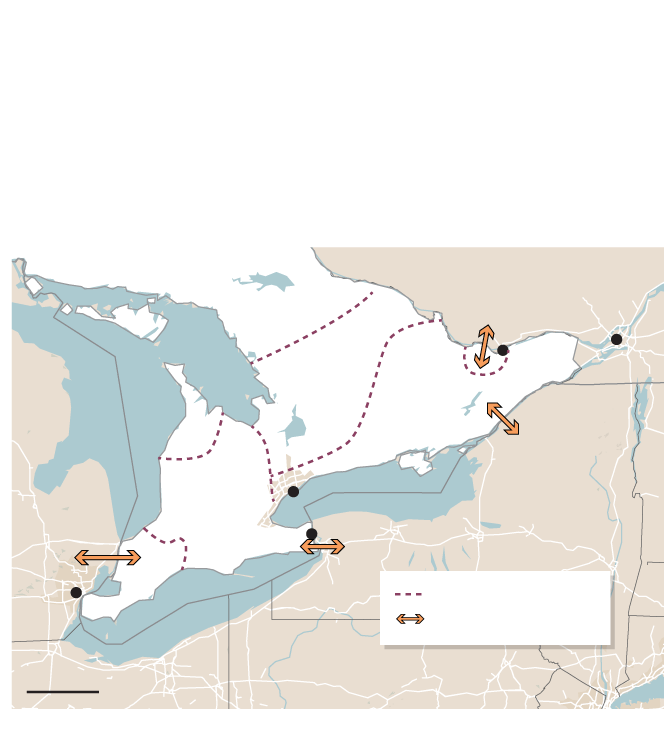
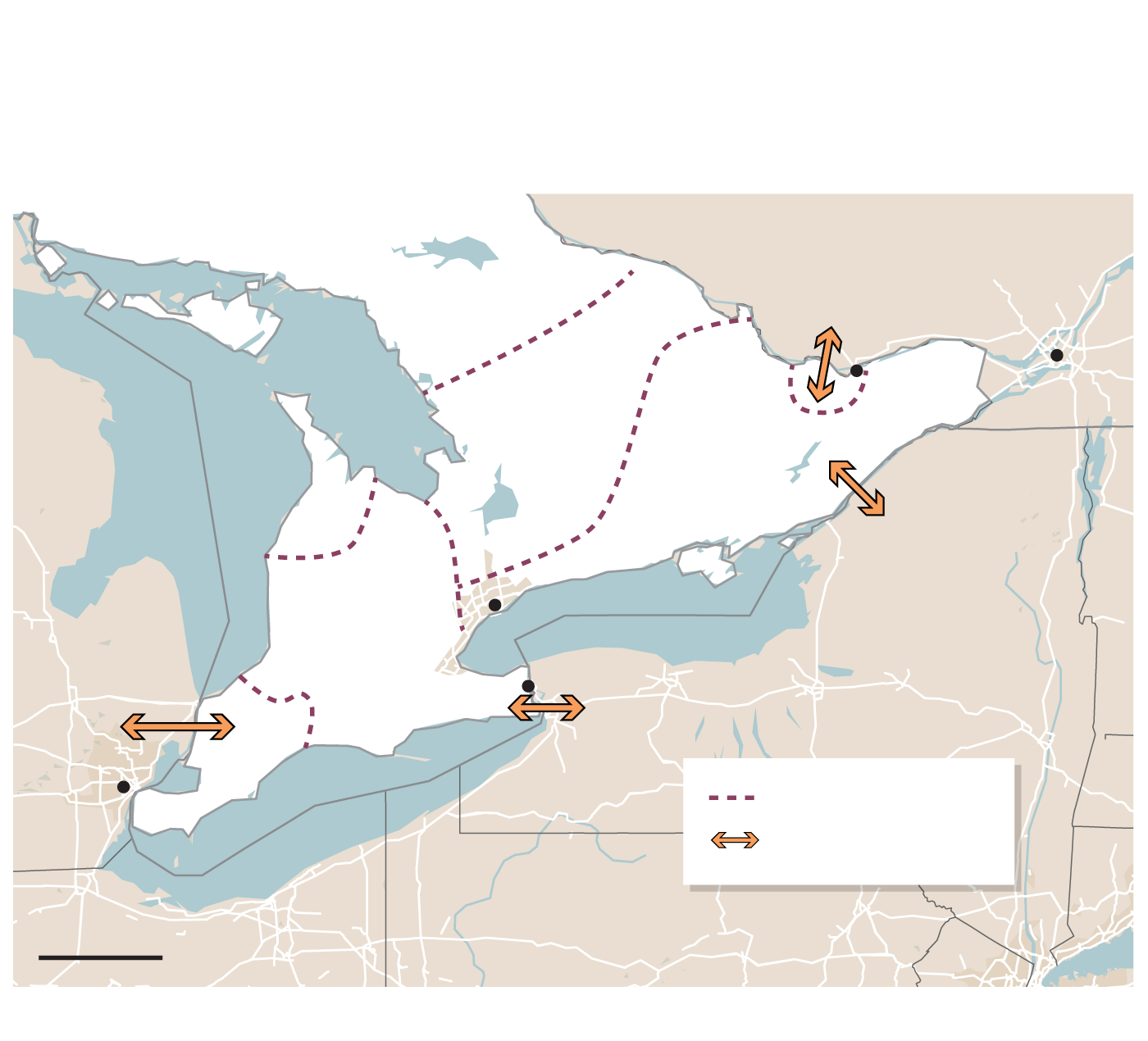
In the North American electricity grid, no Canadian province or U.S. state is an island. Ontario is connected via transmission interties with Michigan, New York and Minnesota, and sends significant volumes of power to the former two. (It’s also joined with Manitoba and Quebec.) The grid has become ever more interconnected over time, which improves efficiency and reliability.
ONTARIO
QUEBEC
Montreal
Ottawa
Essa
East
Bruce
Toronto
Southwest
N.Y.
MICH.
Niagara
West
Transmission zones
Detroit
Interties
100 km
OHIO
PENN.
the globe and mail, source: openstreetmap; ieso
A cog in one of the largest machines ever built
In the North American electricity grid, no Canadian province or U.S. state is an island. Ontario is connected via transmission interties with Michigan, New York and Minnesota, and sends significant volumes of power to the former two. (It’s also joined with Manitoba and Quebec.) The grid has become ever more interconnected over time, which improves efficiency and reliability.
ONTARIO
QUEBEC
Montreal
Ottawa
Essa
East
Bruce
Toronto
Southwest
N.Y.
MICH.
Niagara
West
Transmission zones
Detroit
Interties
100 km
OHIO
PENN.
the globe and mail, source: openstreetmap; ieso
A cog in one of the largest machines ever built
In the North American electricity grid, no Canadian province or U.S. state is an island. Ontario is connected via transmission interties with Michigan, New York and Minnesota, and sends significant volumes of power to the former two. (It’s also joined with Manitoba and Quebec.) The grid has become ever more interconnected over time, which improves efficiency and reliability.
ONTARIO
QUEBEC
Montreal
Ottawa
Essa
East
Bruce
Toronto
Southwest
N.Y.
MICH.
Niagara
West
Transmission zones
Detroit
Interties
100 km
OHIO
PENN.
the globe and mail, source: openstreetmap; ieso
What exactly is the Premier threatening, and why?
That’s not entirely clear. His use of the generic term “energy” implies halting trade in a variety of commodities, including petroleum, natural gas and electricity. But he seems to be speaking primarily about the latter.
Perhaps the Premier’s real intent is to remind the U.S. of the benefits it receives from energy trade, rather than deter Mr. Trump with a retaliatory threat.
Ontario Energy Minister Stephen Lecce said during a stump speech in Scarborough earlier this month that, while Trump’s tariffs would be “highly problematic,” his government regards energy as a strong bargaining chip.
“We want to believe that energy will be excluded because the U.S. needs our energy,” he said. “That’s what we’re trying to do, persuade them that it’s against their economic interest to not accept our petroleum or natural gas or nuclear energy or technology.”
When it comes to hydrocarbons, the U.S. probably has more leverage than Ontario. The province has four refineries for petroleum products representing about one-fifth of Canada’s refining capacity. But they get most of their crude from Western Canada, as well as from North Dakota. Ontario barely produces any crude oil or natural gas; it has long been a net importer of American gas.
The picture is different with electricity. With a diverse fleet of nuclear power, hydroelectric and natural gas-fired plants, Ontario is a major power producer and net exporter.
How much electricity are we talking?
Ontario has seven interties with New York, four with Michigan and one with Minnesota. According to data from the Canada Energy Regulator, the province’s main export customer for electricity last year was Michigan, to which it sent more than 7.1 million megawatt hours, while New York received 4.1 million MWh. The two states have consistently been Ontario’s largest foreign buyers for years.
The province exported 11 per cent of all electricity it generated last year to neighbouring states and provinces; it exported more MWh to the U.S. than did any other province. (Quebec, the traditional leader, was hobbled by drought.)
Before 2005, Ontario had a relatively balanced electricity swapping arrangement with its American neighbours. It subsequently became a substantial net exporter, but its international transfers peaked around 2015 and have been on a gradual downward trend since then.
The Ford government places little value in those exports. Ontario’s nuclear power plants and hydro dams often produce more power than the province needs, typically overnight during the spring and fall. This forces the Independent Electricity System Operator (IESO) to export some of that surplus power, typically at low or even negative prices.
“The former government set up a process where we do a lot of exporting at a loss,” Mr. Lecce said last week.
Last month, he unveiled a plan for meeting what it forecasts will be a 75-per-cent increase in demand for electricity by 2050, while at the same time lowering energy costs. It envisioned building more generating assets than the province requires, and exporting the surplus.
“We’re reimagining how we sign long-term purchase agreements with the U.S., and we get a much higher cost per-megawatt, so we can deliver billions of dollars in revenue to Ontarians,” Mr. Lecce said earlier this month.
How might Mr. Ford make good on this threat?
It’s tempting to envision the Premier strutting toward one of the interties with an axe, with TV cameramen and photographers in tow. But that would be rash.
The IESO, which administers the interties, would likely be involved in any termination of exports. Spokesperson Andrew Dow declined to answer questions about how it would act.
“There are active discussions underway with government about this matter, and the IESO is not in a position to comment at this point in time,” he wrote in an e-mail.
Thomas Timmins, leader of Gowling WLG’s energy practice, said the actual act of disconnecting Ontario from the U.S. grid would be relatively straightforward.
“There’s literally a big switch – a gigantic switch – that would shut off the interties,” he said.
How strong is Ontario’s bargaining position?
The Premier has asserted that Ontario powers 1.5 million American homes, but this might create a false impression. The province has no firm, long-term arrangements to supply power into the U.S. that would give Mr. Ford decisive leverage.
“The lights are not going to go out in Ann Arbor, or Westport, New York,” Mr. Timmins said. New York and Michigan could easily replace Ontario’s power by importing from other neighbours.
But he emphasized that North America’s grid is a complex system within which all participants are highly interdependent. Should Ontario isolate itself, it would cost all participants more money and make the system less reliable.
Furthermore, the province’s grid emits less greenhouse gases than do those in Michigan and New York, so more carbon would end up in the atmosphere. Grid operators will likely care more about Mr. Ford’s threat than Mr. Trump does.
“The northeast of North America is all one grid, effectively,” Mr. Timmins said. “It’s like a room full of chandeliers that are all tied together. If you touch one chandelier, another on the other side of the room shakes.”
Mr. Ford has also made his threat at a moment when his province’s generation capacity is declining, largely owing to reactors at its Pickering station coming offline between now and 2026.
(Historically, Pickering supplied more than one-tenth of the province’s electricity. The Ford government announced in January plans to refurbish the four newest reactors, but that could take many years.)
More reactors at other stations are under refurbishment. The IESO sees an “energy gap” beginning to grow by 2029. It has lately announced large procurements for new natural gas-fired capacity, wind farms and battery storage facilities, which are intended to fill the gap. But these will take time.
The upshot: Ontario might have greater need for electricity from neighbours than it has in the past.