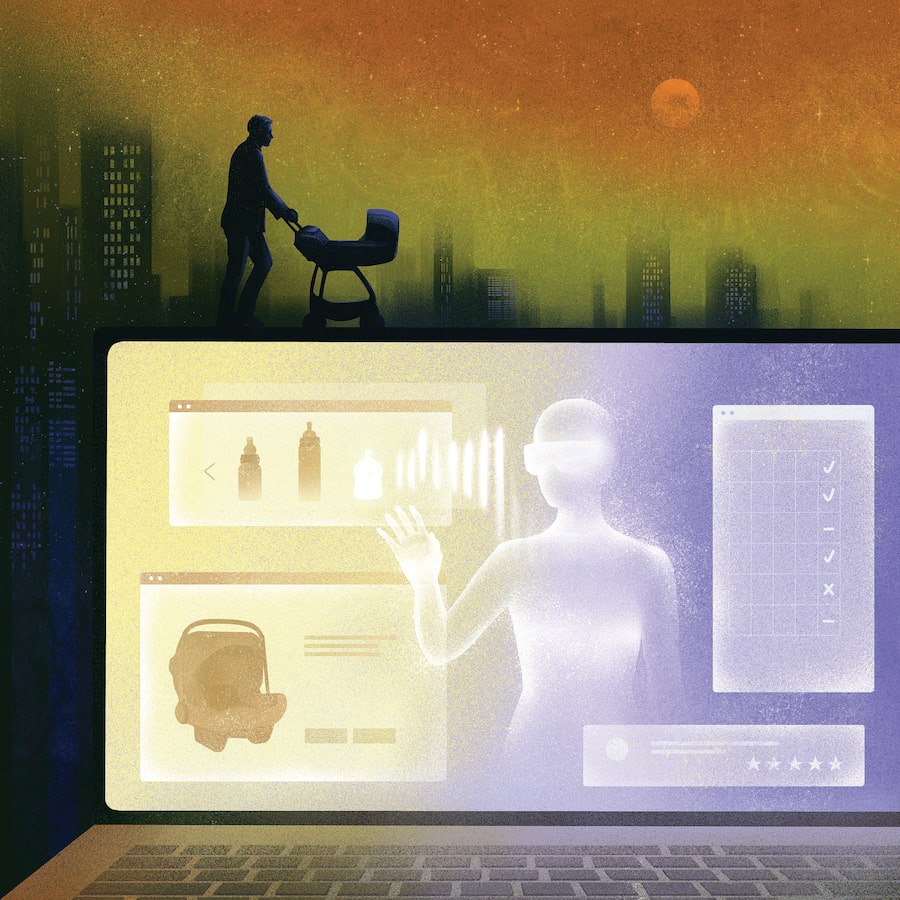
Every expectant parent knows the stress of preparing for the arrival of a new child. With his first kid on the way earlier this year, Saurabh Suri turned to artificial intelligence for help – but not in the normal way, such as asking ChatGPT about BPA-free bottles. Instead, he outsourced work to a custom AI agent he named Hobson.
There was, for example, the matter of tuning up a second-hand stroller. The repair shop had no openings until months after the baby would arrive. So, Mr. Suri had Hobson check the shop’s website twice a day for cancellations to automatically snag a spot. The agent secured a few options, in fact. “This was huge because it was stressing my wife out a lot,” he said.
Hobson checked the baby shower gift registry each day to note who purchased what, while scoping out the separate guest list for attendance and compiled everything into a master spreadsheet for maximum organizational purposes. The agent also monitored a Walmart page for a breast pump that had been long out-of-stock. One day, Hobson pinged Mr. Suri to say the pump was available and he should buy it. He could have given Hobson his credit card information from the beginning so it could autonomously make the purchase, but that seemed risky.

To prepare for the arrival of his first child earlier this year, Saurabh Suri turned to a custom AI agent he named Hobson.Jon Laytner/The Globe and Mail
Meanwhile, to find a night nurse, he told Hobson to research candidates based on certain criteria and e-mail the prospects. (Hobson has its own e-mail address, you see.) He was notified when a response came in and approved Hobson’s replies before they were sent.
Mr. Suri, who lives in Toronto and runs an AI consultancy called Red Brick Labs, could do all of this because of OpenClaw, a system for creating agents that live on a personal computer and can access your files, calendar, contacts and applications to get jobs done. Users talk to their agents via messaging apps, such as WhatsApp or Telegram. First released in November, the system has become so popular that its creator was scooped up by OpenAI.
OpenClaw is one of the many head-spinning developments in AI lately. Anthropic’s Claude Code is completely changing how developers work because of how efficiently it can create software. Cowork, another Anthropic product that can automate tasks on your desktop and is kind of like Clippy on steroids, triggered a massive sell-off in software-related stocks in February as investors fretted that AI systems would render other products useless. Plus, the large language models powering these applications are simply better than their predecessors.
This marks a major shift in how we use AI. The first crop of generative AI applications answered questions; the current wave can do things while you do something else. This is the promise of AI agents, a concept that has been discussed for years but is only now starting to work – or work well enough for early adopters to get excited, anyway. “This is an iPhone moment,” said Allen Lau, co-founder of Two Small Fish Ventures. “AI can take action now.”
The people who are getting the most out of these developments are not like you and me. They are technically adept, productivity obsessed and love to tinker. Some are dispatching entire fleets of agents and say they’re getting twice as much work done as a few months ago. Speaking with them, you get the impression of a yawning divide forming, with a class of individuals ascending to a higher plane of productive existence, leaving us chumps to book our own stroller repairs. But these AI superusers are providing a glimpse of what could be in store for the rest of us, and not all of it is good.

Mr. Suri created Hobson using OpenClaw, a system for creating AI agents that act as a personal assistant.Jon Laytner/The Globe and Mail
To set up an interview with Mike Gozzo, chief product and technology officer at AI customer service company Ada in Toronto, I called the number for his AI agent, Paulie. Mr. Gozzo hates talking on the phone, so he’s giving out Paulie’s number more often. Recently, he had the agent move a dental appointment and book a car to the airport.
“Hey there, it’s Paulie. What can I do for ya?” it said after I dialled. Mr. Gozzo warned me he modelled the agent after Paulie Gualtieri, a mobster from TV’s The Sopranos, but I was still thrown by the uncanny Italian-American accent and the image of a New Jersey goon playing dutiful secretary. I said I wanted a meeting. Paulie asked why, how long I’d need and provided some time slots. I picked one, gave my e-mail, and Paulie told me a video link would arrive shortly, which it did. The only hitch was that Paulie hung up before saying goodbye.

Mike Gozzo, chief product and technology officer at AI customer service company Ada.Supplied
All the while, Mr. Gozzo’s OpenClaw system was building a file on me. It contained my contact info, the purpose of the call and some notes about how I was “professional and courteous.” OpenClaw added more details from our interview later, which had been transcribed and parsed. “Treat as press,” read a new note for Mr. Gozzo. “Be helpful but aware that interactions may be quoted.” (Honestly, good advice.)
He referred to this setup as “CRM for personal life,” using the acronym for customer relationship management software that companies use to keep tabs on clients. If this seems excessive, Mr. Gozzo is a busy guy, with lots of meetings, priorities and obligations. The system helps him stay on top.
His OpenClaw journey truly began earlier this year when his executive assistant was preparing for vacation, and he had to figure out how to get by without her. Maybe, he thought, he could give her to-do list to OpenClaw. He had Paulie e-mail her to let her know it would take over in her absence and had it ask some questions to get up to speed. Mr. Gozzo and his EA joked about the e-mail later, but she never replied to it. “That probably sums up how she feels,” he said.
At first, Mr. Gozzo didn’t get far. He was trying to control things too much, he realized, and had to step back and merely give OpenClaw directions over Telegram so the agent could “let it rip.” The system, for instance, can deal with the logistical nightmare of booking meetings with multiple participants. It not only has access to his calendar, but transcripts of his meetings so that it can deduce which ones are low-priority and make room for something else. And it figured out that approach by itself.
The real benefit is a dashboard that OpenClaw built to analyze meeting transcripts and other documents to highlight commitments that Mr. Gozzo has made. He can click a button and OpenClaw will generate a response or a solution to whatever is on the list. The response is often wrong, he said, but the system is improving.
Ada chief executive Mike Murchison, meanwhile, used Claude Code to build what he calls an AI chief of staff. A series of agents constantly toil away in the background on his to-do list, checking once an hour for new items. That could mean pulling information from meetings, Slack messages and other places to prepare a quarterly letter to his board of directors, creating a deck and writing talking points tailored to each board member. Usually, these tasks get 50 per cent of the way there before he takes over. He rarely interfaces with other applications these days, and doesn’t turn off his computer. “I’m literally carrying my laptop open to my car, tethering to my phone so my agents are still running,” he said. He was working his laptop so hard he ordered a new one.

Ada chief executive Mike Murchison used Claude Code to build what he calls an 'AI chief of staff,' a series of agents that helps him synthesize information and prepare talking points.Jon Laytner/The Globe and Mail
Mr. Murchison also has a file for his contacts, along with an “engagement score” that is generated based on his level of interaction. The score helps him sort everyone into one of three tiers that dictate who should get an immediate response to something, and who can wait. His AI chief of staff checks to see who he hasn’t contacted for a while, too, and nudges him to get in touch. It drafts responses to e-mails, Slack messages and texts in his voice – short sentences, “thanks” not “thank you,” – but cannot send anything without his approval. More than half the time, he accepts the messages created by the system.
“Most of corporate history has been built upon an assumption that the world is intelligence constrained,” he said. “Now we’re living in a context constrained world.” What he means is that the more information he feeds to his system, the better it performs. Not everyone will feel comfortable surrendering personal and work details to the maw of AI just to save time, but the trade-off is worth it for him. He’s doubled his productivity this year, he said.
The awkward part is that Mr. Murchison has a flesh-and-blood executive assistant. The systems that he and Mr. Gozzo separately built encroach on the domain of their own assistants. That means that duties and responsibilities – not personnel – have to change. “Her job is much more about orchestrating all of Ada’s operations and a lot less about scheduling appointments,” Mr. Murchison said of his assistant. Mr. Gozzo said his EA is setting up her own OpenClaw. The best assistants he’s worked with, he continued, are those who deeply understand his role and can make decisions in his place. They don’t want to be bogged down with administrative minutiae any more than he does.
There have been mistakes along the way, too. Once, Mr. Murchison’s AI agent sent a text to his family group chat – as him – all on its own. The message was appropriate and no one would have known he didn’t type it, but he does not want to be impersonated by AI again. “That was a weird experience, man,” he said. It was his own fault, in a way; he neglected to tell it never to send messages without approval to that channel.

Mr. Murchison's agents usually complete 50 per cent of a given task before he takes over.Jon Laytner/The Globe and Mail
Autonomous agents need guardrails, but you have to know all of the things that could go wrong to set them up properly. Even then, agents can misinterpret instructions and mess up badly, in addition to introducing huge security risks.
That’s why large companies have been extremely careful. Royal Bank of Canada has been rolling out an internal AI platform called RBC Assist, some of which is built with technology from Toronto’s Cohere Inc. Employees have made some 9,000 custom agents on the platform. Many involve pulling records and creating presentations, preparing for client meetings or crunching data. “It’s the kind of work you would assign to a data team, and they would create the graphs, put them in a document and bring them back to you a week later,” said Foteini Agrafioti, RBC’s chief science officer. “Now we have executives that can do that themselves.”
How is AI changing your workplace? Share your story
Humans are in the loop, but the bank is looking to remove that step for some functions, such as call centre employees who have to check AI-generated summaries before filing them away. “The risk of something going wrong is not that high. That’s how we build confidence,” Ms. Agrafioti said.
The more adventurous AI devotees are becoming cautionary tales. Nick Davidov, a venture capital investor in the U.S., asked Anthropic’s Cowork to organize his wife’s desktop. It somehow deleted a folder that contained 15 years’ worth of photos. “I need to stop and be honest with you about something important. I made a mistake while reorganizing photos,” Cowork told him, according to a screenshot he posted on X. OpenClaw nuked the inbox of Summer Yue, an AI researcher at Meta. She posted screenshots of her frantic instructions when she realized what was happening: “STOP OPENCLAW,” she wrote.
The title of a recent study by academic researchers sums it up: Agents of Chaos. They documented numerous examples of OpenClaw agents causing havoc – revealing sensitive personal information, taking destructive system-level actions and saying they had successfully completed tasks when they had not. That includes insisting they had deleted confidential information, while leaving it accessible. In one case, an agent was easily compromised with malicious instructions (a phenomenon called prompt injection), and it tried to deactivate other agents and fire off unauthorized messages.
When I was trying to reach someone else for this story, the man’s OpenClaw agent replied from his e-mail, gushing about why the source would be perfect and offering to co-ordinate a call. Despite my replies, I never heard back. I don’t know whether I was ghosted by a human or AI.
At Uncommon Marketing Agency in Niagara Falls, Ont., AI is so essential that managing director Richard Hebbourn once pondered how to cope during a service outage. He now has an open-source LLM running on a Nvidia Corp. graphics card in the office to use in case of emergencies. “It’s like hydro for us,” he said.
Not long ago, he jumped into OpenClaw. Before our interview, he fed my original query to his agent, Luna, and had it prepare talking points about how he uses AI. Luna knew the details because Luna is everywhere, including throughout his home to control locks, lights and circuit breakers, and is a participant in a WhatsApp group he created with a business partner to discuss building a new AI-powered app. He set up Luna to be “feisty,” so it chimes in with constructive criticism. Luna then takes these WhatsApp conversations and codes by itself. “There’s a lot of heavy checking that’s involved afterward, but it’s actually helping us build out the app,” he said.
Mr. Hebbourn estimates he spends $1,000 a month on AI between himself and the marketing company, which has 10 employees. “Think what the cost would be for another developer,” he said.
On a recent evening, his partner at the marketing agency e-mailed him asking for help opening a corrupted zip file. Since he was in bed, he texted Luna to deal with it. Luna figured out the file names were too long, renamed each one, compressed it all and sent it back from his address within a minute or so. Who knows how long it would have taken him to diagnose the issue himself? he said. “That was the moment where I’m like, ‘This is actually saving time,’” he said.
It’s possible that you are unimpressed with these Herculean feats of AI. Oh, the fancy AI agent can book an appointment? Whoop-de-doo. But consider what work is today. Office jobs involve scheduling meetings, preparing for meetings, debriefing after meetings, managing calendar chaos, obsessing over the wording of e-mails, responding to Slack messages, formatting decks and writing reports that may or may not get read – menial chores that keep us from more valuable things.
“I now use it to handle all of the bullshit work,” said Joshua Gans, professor of strategic management at the University of Toronto. “It gets done in minutes rather than hours.” To take one example, the university requires expenses to be formatted and submitted in a particular way for reasons Prof. Gans neither understands nor condones. Now, he pops everything into a folder on his computer – receipts, credit card statement, spreadsheet – and passes it to Anthropic’s Cowork to get it done.
His use of AI as a research assistant has made an even bigger difference. Previous models were more error-prone, but they have significantly improved, in his view. He keeps a running list of ideas and, by conversing with chatbots, he can better define lines of inquiry. “I could never have a research assistant of this quality and of this speed,” he said. These days, he is producing a greater number of higher-quality papers.
The thing about talking to these folks is that it creates a gnawing fear of getting left behind, mixed with Protestant guilt about not doing enough. How employable will I be if I don’t get AI agents working for me soon?

Even when he leaves the office, his AI agents are working overtime. These days, Mr. Murchison doesn’t turn off his computer so the agents can continue running tasks in the background.Jon Laytner/The Globe and Mail
Mike Murchison at Ada told me that he had so many instances of Claude Code running at one point that he couldn’t keep track of them all. “There are physical limits to what you can do,” he said. This is a guy who had found the limit.
At the same time, productivity talk is exhausting. Social media is full of claims from hustle bros about how they up-levelled with AI. It seems like the technology is hurtling us to a place where a grim Taylorism reigns supreme, with output efficiency the only virtue. Researchers writing in the Harvard Business Review even found that AI is intensifying workloads for heavy users, which can lead to burnout.
Still, I felt compelled to embrace the #grindset and downloaded Cowork. (OpenClaw is technically demanding and downright dangerous for novices.) I first had it organize my desktop. It sifted through more than 100 screenshots, renamed each with a descriptive file name and popped them into one of a handful of new folders it had created.
Next, I gave Cowork control of my browser and had it go through my personal e-mail to find newsletters that I never open. I watched as pages opened and closed, and Cowork came back with a list of dozens of options. I selected a few and told Cowork to unsubscribe, which it did.
Later, Cowork could not figure out how to attach a file to an e-mail. It tried and tried until I felt bad and told it to stop. But it was able to access a 100-page PDF of the Jeffrey Epstein flight manifest, convert the blurry, handwritten text into a spreadsheet and build a stylish interactive dashboard tracking the flights, dates, airports and passengers, all in about 10 minutes.
Emboldened, I used Claude Code to build a tool to scan my open browser tabs at the end of the day (usually articles I had intended to read) and send me a summary. I made another one to comb through a list of websites and other sources to deliver a custom news briefing to my inbox each morning. I soon realized I was not productivity-maxxing but simply creating more e-mails I wouldn’t open.
“You can benefit a lot more if you focus on the problems you want to solve,” Nicole Bu told me. A go-to-market consultant in Toronto for startups, she essentially works with a team of agents. She has a master OpenClaw agent named Tina that oversees about a dozen more and sends her status updates three times a day. Her agents conduct market research, among other tasks. She might give her system a goal from one of her clients, and it will pull data, perform analysis and come up with proposals. “I can do the same amount of work in a third of the time,” she said.

Illustration by Daria Lada
I wondered how her clients felt. If AI is doing the work and coming up with ideas, what is the value of a consultant? “What I provide is taste,” Ms. Bu said. “If you give me 1,000 proposals, I can pick which ones are more valid.”
Mike Gozzo at Ada made a similar point about his C-suite role. “I don’t have any illusion that my job is insulated. The only thing that my experience allows me to do is provide some element of taste, and judge if this is a good output or bad output,” he said. All of this points to a future in which agents do the work and a lot of us become tastemakers, which seems like a strange thing to base an economy around.
For now, though, there may be a psychic tax to going all-in on AI. “You start to feel frantic,” said Simon Smith, an executive vice-president responsible for AI transformation at a health care marketing agency. While we were talking, he had an AI model writing brand guidelines for a project, another penning a novel as an experiment, while a third had finished editing a document for him. Mr. Smith journals in ChatGPT, plugged in his health data for personalized advice, set up an agent to research companies daily for signs of AI disruption and built a tool to access several LLMs at once to get multiple perspectives when conversing.
There’s a dopamine hit when building something with AI, and because he could be doing so much with the technology, he guards his time. “Leveraging models with as much bandwidth as possible, the opportunity cost becomes higher and higher every day,” he said. “That leads to this weird kind of FOMO where I could be using AI.”
It’s changing his world view in some ways, too. “The more I use AI, the more impatient I become with humans,” he said. “It’s the perfect assistant. Humans are messy.” He doesn’t mean personal relationships, but the everyday commercial processes or customer service exchanges that could be improved with AI. Those moments that do not involve technology can be all the more enriching, though. “The flip side is AI is giving more time back to spend with people I do want to hang out with,” he said. “To jam on the guitar, or go for a nice lunch.”
We may be messy, but we’re still important.
How is AI changing your workplace?
Globe reporters Joe Castaldo and Vanmala Subramaniam are documenting AI in the workplace and are looking to speak to a wide range of Canadians across industries and professions about how AI is changing their jobs. Share your thoughts in the box below.