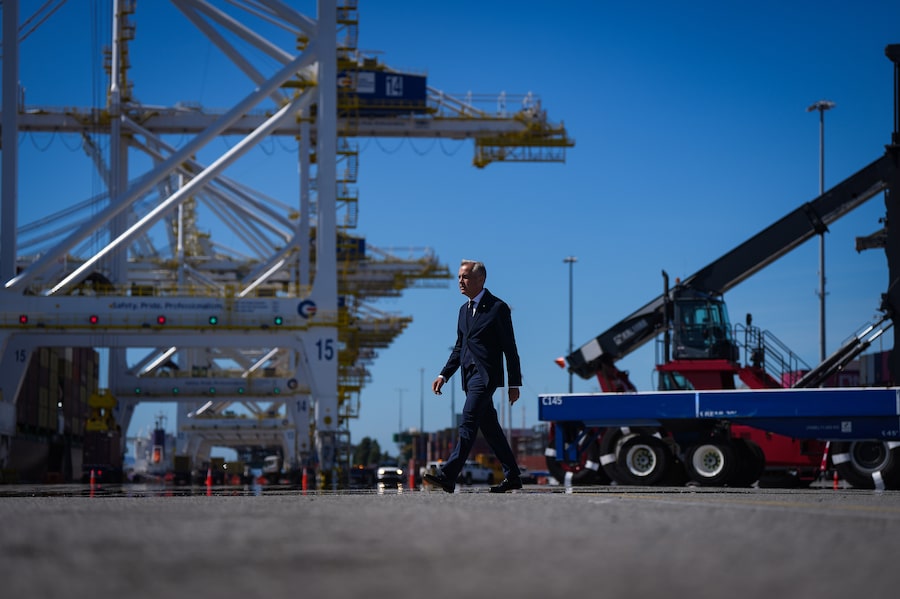
Prime Minister Mark Carney set up the Major Projects Office as the centrepiece of his strategy to ignite a national construction boom, giving the Calgary-based agency the clout to clear away regulatory roadblocks and help arrange tens of billions of dollars in funding for “nation-building” development.
Nearly 12 months in, the MPO, led by veteran energy executive Dawn Farrell, is evaluating a slew of multibillion-dollar proposals for the vaunted listing of “projects of national interest” – golden tickets to accelerated treatment in the regulatory process. None has the formal designation yet, but the government has expressed its intention to have four of them listed by this fall.
But the MPO is also facing criticism from the business community for a lack of transparency about how it operates, echoing a frequent rap about the Prime Minister’s style. To some, including opposition politicians, it also represents a new layer of bureaucracy when industry has called for less, and they argue it is taking too long to deliver on its mandate.

Dawn Farrell, head of the MPO, joins Prime Minister Carney in Edmonton last September to announce five major projects.AMBER BRACKEN/The Canadian Press
Ms. Farrell is known to describe the agency as the execution arm of Mr. Carney’s Building Canada strategy, and now it is diving into the test of whether it can deliver.
The province of Alberta’s plan for a one-million-barrel-a-day oil pipeline to the West Coast has been referred for listing as a national interest project, with consultations now under way. Both the provincial and federal governments have said they expect the listing by Oct. 1; the project could help diversify markets for Canadian crude and tamp down separatist sentiment ahead of an Oct. 19 referendum.
Meanwhile, port, northern road and nuclear waste repository projects are also being considered for national interest designation, and there are dozens of other projects the office is trying to help along in other ways.
Editorial: The national interest in a new bitumen pipeline must be accommodated
The Globe and Mail spoke to more than a dozen business and Ottawa insiders and reviewed hours of parliamentary testimony and dozens of pages of documentation to take the measure of this central element of Mr. Carney’s agenda as it heads into a crucial period.
Some top industry executives compliment Ms. Farrell as being responsive to their queries as they mull investments, but other project proponents and their representatives describe difficulties getting in front of MPO decision-makers, sometimes being told to deal with other federal departments first.
Another beef is that some projects are taken up by the MPO without appearing to meet all the government’s stated criteria, which include such factors as whether the project has a high likelihood of execution, furthers Indigenous interests and meets climate-change objectives. The West Coast Oil Pipeline, for example, is dividing First Nations and the extent to which it will meet climate-change goals is linked to a second major carbon capture project whose prospects are unclear.
Many industry players declined to speak on the record, or at all, about their dealings with the agency out of concern it would hamper the relationships they are trying to build or projects they are trying to advance.

Flanked by Dawn Farrell, CEO of the Major Projects Office, right, and Minister of Housing and Infrastructure Gregor Robertson, Prime Minister Mark Carney makes an announcement at the Skeena Substation in Terrace, B.C., last November.ETHAN CAIRNS/The Canadian Press
Though the MPO is headquartered in Calgary, it is part of the Privy Council Office (also known as the PCO), the bureaucratic arm of the Prime Minister’s Office.
The Globe sent a list of questions about the MPO and its operations, including a request for a response to the criticisms about a lack of transparency, to the PCO on July 21. As of publication time, the PCO had yet to respond.
The office was established through the Building Canada Act, so on paper, the minister responsible is Dominic LeBlanc, as he’s the minister for the Act.
But in practical terms, Ms. Farrell is understood to report directly to Mr. Carney. The two of them, along with his chief of staff Marc-André Blanchard and Clerk of the Privy Council Michael Sabia, have regular check-in meetings to review the office’s works, two of the sources told The Globe.

On paper, Canada-U.S. Trade Minister Dominic LeBlanc is the minister responsible for the MPO. Mr. Leblanc introduced and sponsored Bill C-5, the legislation that enacted the Building Canada Act.Darren Calabrese/The Canadian Press
MPO staff are scattered throughout the country – nearly 150 to date. Some are seconded from the energy and banking industries that deal with the agency; others have been pulled in from across the public service in fields as disparate as oceans management and Indigenous consultation.
Since its creation, the MPO office has received more than 275 proposals and taken on 18 projects – including the four now recommended for fast-tracking – and eight larger “transformative strategies” aimed at achieving a number of federal objectives across wide regions.
These objectives include reversing lagging productivity, helping blunt the impact of U.S. President Donald Trump’s trade war and showing the business community that the Liberals under Mr. Carney are now pro-development. The government aims to counter years of derision from investors who said they would not put capital into projects almost certain to get stalled by regulatory delays and court challenges.
Jeremy Barretto, regulatory partner in the infrastructure, energy and resources group at the law firm Torys LLP, said he sees the MPO taking a low-profile private-sector approach to what have previously been open bureaucratic processes.
“It remains to be seen whether this approach with significant leaders in the private sector working there will result in quicker approvals and more projects built,” he said.

Workers constructing a modular home in Ottawa watch Mr. Carney deliver remarks last September. Build Canada Homes is one of several offices set up by the Prime Minister in an effort to streamline the bureaucratic workings of government.Justin Tang/The Canadian Press
The office is one of several of its kind set up by the Prime Minister in an effort to reshape the bureaucratic workings of government. The others are the Defence Investment Agency and Build Canada Homes – the heads of both were brought in from outside government by Mr. Carney to oversee the implementation of key elements of his agenda.
David McLaughlin, who has worked for provincial premiers and governments and served as Prime Minister Brian Mulroney’s chief of staff, said the idea of an MPO makes sense, given the siloed nature of how government operates – departments often struggle to communicate with each other on shared files.
The MPO is a way to ensure a single point of accountability, he said.
But transparency is crucial, he said. If investors and project proponents are to back the projects the MPO is trying to get across the line, they need to know how decisions are being made.

Mr. Carney shakes hands with Ana Bailão, CEO of Build Canada Homes, during an announcement about the creation of the new federal agency in Ottawa last September.Justin Tang/The Canadian Press
“Transparency leads to certainty. Project proponents need to know if not just that they’re going to get a yes, or they could get a yes. They need to know if they’re getting a no,” he said.
With limited disclosure, the MPO operates in sharp contrast to other federal agencies that deal with major projects. The Impact Assessment Agency of Canada, for instance, maintains a public registry where anyone can look up a project and see what’s going on with the plans to get it under way.
Brendan Bell is CEO of Inuit-owned West Kitikmeot Resources Corp., which is proposing the Grays Bay Road and Port Project in Nunavut in partnership with ATCO Ltd. In June, Ottawa announced its project as one it intends to fast-track under the Building Canada Act.
The MPO has provided support in the areas of regulation, financing and even introductions to potential outside investors, Mr. Bell said. He described it as a business-focused agency that has the potential to turn around Canada’s record of projects being halted. It can do that by employing its staff’s experience in financing, engineering, construction readiness and the law.
Being focused on execution rather than publicity is the correct strategy, he said. “This is not a collection of huge egos that are demanding applause and attention. This is a group of people trying to get things built. I think that’s the right approach.”
Just being referred to the MPO doesn’t guarantee a project will be fast-tracked.
That means a proponent can spend significant time and resources that do not necessarily result in their project getting advanced, a would-be applicant said.

An upgrade to the Port of Vancouver was referred to the MPO for possible fast-tracking, Minister of Transport Steven MacKinnon announced in Delta, B.C., in mid-July.DARRYL DYCK/The Canadian Press
In addition, the person said, the mandates of the MPO and the Canada Infrastructure Bank, for example, are strikingly similar, with the exception that the CIB provides funding, but the MPO does not. The Globe is not naming the person as they did not want to be excluded from consideration.
For projects that don’t merit or require a national-interest designation, the MPO can still help in its role as a concierge – as many describe it – helping proponents find funding and navigate Indigenous consultations or provincial roadblocks.
Natural Resources Minister Tim Hodgson says the office’s purpose is to add predictability to project development, not act as a superagency that has a hand in all projects with federal funding.

Tim Hodgson, Minister of Energy and Natural Resources, takes to the stage at the Global Energy Show in Calgary on June 9.Jeff McIntosh/The Canadian Press
“The MPO looks at it and says, can we make a difference? Can our coordinating function – or if it’s complex and there’s relatively complicated financing around it – can we bring a coordinating function which moves the project back faster?” Mr. Hodgson said in a recent interview.
“If so, the MPO can decide to take it on. If not it doesn’t go to the MPO – it just follows its normal course.”
The MPO is expected to have a place at Mr. Carney’s upcoming Invest in Canada summit in September; a briefing note prepared for a meeting Mr. Carney had in relation to the summit noted it will be an opportunity for projects before the office to potentially find investors.
The 24 hours that could change Canada’s economic trajectory
That said, confusion over the MPO’s role appears to also be reaching overseas, with the Financial Times recently reporting that investors from the United Arab Emirates were stymied in getting the MPO’s assistance to direct their cash.
Adam Waterous, executive chair of Calgary-based oil producer Strathcona Resources Ltd., was one of numerous energy-sector leaders who signed a 2025 letter to Mr. Carney calling for several measures to attract private capital. The CEOs urged the government to overhaul pieces of legislation they say turn foreign investors away, including the West Coast tanker ban and the Impact Assessment Act.
Rather than following all their advice, Mr. Carney created the MPO, which Mr. Waterous called an “extremely clunky” solution that has resulted in the West Coast Oil Pipeline being led not by private-sector backers, but government-owned entities, including Trans Mountain Corp. and the Alberta Petroleum Marketing Commission.
Still, the potential economic windfall for the country from a project that could allow a doubling of oil production is so large that the ends should justify the means, Mr. Waterous said. “The government building the pipeline is a bona fide alternative to how to get a pipeline built. It doesn’t have to be built by the private sector,” he said.

Ms. Farrell listens to a major projects announcement in Edmonton. Federal lobbying records show she's met executives from major oil, gas and mining firms, telecommunications companies and at least one bank.AMBER BRACKEN/The Canadian Press
The MPO is in many ways a reflection of its leader, appointed by a prime minister who is frequently criticized for doing too much of the government’s business behind closed doors.
Ms. Farrell, the former CEO of TransAlta Corp. and Trans Mountain Corp., is known for a blunt, no-nonsense management style, and a philosophy that, to get big things done, Canadians need to stop dwelling on past mistakes and use those experiences to make better decisions. Many prominent business leaders note privately that she is responsive to their queries.
Records in the federal lobbying registry show she’s met executives from major oil, gas and mining firms, telecommunications companies and at least one bank.
However, some of the criticism that the MPO functions as a black box stems from Ms. Farrell’s strict avoidance of the public eye.
Since stepping into the job on Sept. 1, she has eschewed speaking appearances, deferring to Mr. Carney and top ministers to be spokespeople for the office’s work. Time spent in front of audiences, she is known to say, is time not focusing on the tasks at hand – she may be more vocal when there are results to trumpet. She has declined multiple requests for an interview with The Globe, including for this piece.
When Mr. Carney and Alberta Premier Danielle Smith announced Alberta’s West Coast pipeline submission to the MPO in Calgary in early July, Ms. Farrell attended, but stayed off to the side without taking questions as the political leaders addressed the media.

Mr. Carney and Alberta Premier Danielle Smith hold a press conference regarding Alberta’s proposed west coast oil pipeline, in Calgary on July 2, and MPO head Ms. Farrell looks on.Ahmed Zakot/Reuters
During testimony on April 28 before a joint House of Commons and Senate committee set up to monitor the Building Canada Act, Ms. Farrell laid out her view of her role and that of the MPO. There, comments she made in 2019 that were critical of how long the government takes to get projects approved were put to her in the context of the fact that no major projects had been completed yet on her watch.
“Stepping up to do this job was to put my money where my mouth was,” she said. “How can I contribute as a Canadian to changing that outcome?”
The MPO took flak early on when it announced a tranche of projects in September, 2025, that already appeared to be close to advancing without its help, a criticism that was also put to Ms. Farrell at the committee.
She pointed to the Montreal port expansion project of Contrecoeur as an example of a difference her office made.
“The project was not going to happen. There was no money for it. Then my first month on the job was working with the Contrecoeur team, or the Port of Montreal team, to try to figure out how to get some financing so that they could start doing the waterworks, and then we could keep going on the project and get finished there,” she said.

Mr. Carney announces the start of construction on the $2.4-billion Contrecoeur terminal expansion at the Port of Montreal in April.Graham Hughes/The Canadian Press
The Montreal Port Authority broke ground on the $2.4-billion project in April, with Mr. Carney on hand to also announce the Canada Infrastructure Bank was providing it with a $1.16-billion loan.
In April, Ms. Farrell said the work her office has been able to do on other projects and how they have been accelerated will be clearer “in the fullness of time.”
Shannon Stubbs, the Conservative critic for infrastructure, said in an interview that a process the Prime Minister promised would improve clarity on getting projects built is doing the opposite. “Everybody is still waiting for the legislative and fiscal reform to make Canada have competitive and attractive investment conditions,” she said.
“With all of these layers, it is totally fair and right for Canadians to be saying, ‘What is the point of this entire process or this big, expensive office, which so far is just about announcements and process, not about results and outcomes?’”

Eva Clayton, Nisga'a Nation President, speaks during a Ksi Lisims LNG environmental certificate announcement in Vancouver last September. The MPO is currently reviewing the project for potential fast-tracking.ETHAN CAIRNS/The Canadian Press
Projects under consideration
In addition to the Alberta pipeline, the MPO is currently reviewing the Mackenzie Valley Highway project in the Northwest Territories, the Grays Bay Road and Port project in Nunavut and the Nuclear Waste Management Organization’s Deep Geological Repository in Northwestern Ontario as potential projects for the national interest list.
It is also looking at major projects such as the Arctic Economic and Security Corridor, Red Chris Mine Expansion, Canada Nickel’s Crawford project and Ksi Lisims LNG project.
Also on their desks are what the government deems transformative strategies, which comprise a number of related projects, such as the Port of Vancouver Gateway Strategy – which has been referred for listing – as well the Port of Churchill Plus in northern Manitoba and the Transmission InterConnect Investment Strategy.
Together, these developments and others like them represent $192-billion of new investment and the creation of 337,000 jobs, the MPO says on its website.