
A tralier full of cars leaves Honda's automotive assembly plant in Alliston, Ont., on April 1.Carlos Osorio/Reuters
U.S. President Donald Trump’s stated objective for imposing new 25-per-cent tariffs on imported automobiles is that he wants automakers to establish more factories in his country. He seems bent on making America self-sufficient at all costs, and has vowed to permanently shut down Canada’s auto manufacturing sector.
To understand the complex industry Mr. Trump seeks to disrupt, it’s worth reflecting on the foreign content in vehicles currently sold in the United States. Fortunately, automakers have to report this.
Introduced in 1992, the American Automobile Labeling Act requires car makers to affix a label to every vehicle they sell in the U.S. Among other things, this label shows the percentage (by value) of parts and components incorporated in the car that originated in the U.S. Manufacturers must also disclose any other countries in which at least one-third of equipment (again by value) originated. They must calculate these percentages prior to the start of each model year, and the National Highway Traffic Safety Administration reports some of the data annually.
The data have limitations, one being that certain models made in Canada seem to be missing. Toyota Motor Manufacturing Canada assembles RAV4s in Canada and exports more than 80 per cent of them to the U.S., according to spokesperson Philippe Crowe. For unclear reasons, this is not reflected in the NHTSA’s data for the 2025 model year. The NHTSA did not respond to questions from The Globe and Mail this week about its data.
The data are instructive, nonetheless. For one thing, they’re a reminder of the crucial role Canada has long played in the U.S. auto industry. Tellingly, the data make no distinction between components from the two countries, which are combined in a single column. (That’s no small inconvenience for those seeking answers about Canadian content in American cars.) Every other country is reported separately.
Important though Canada may have been historically, few vehicles assembled here appear in recent model years. The 2025 data list only the Honda Civic and CR-V, the Lexus RX 350 and variants of these vehicles – plus a dark horse, the Ford Mustang GTD, a limited-production 815-horsepower sportscar.
Among those vehicles, the maximum U.S./Canada content is 60 per cent (for front-wheel-drive CR-Vs.) At least 15 per cent of the content for Honda and Lexus models is from Japan. The engines and transmissions are either Japanese- or American-built.
For comparison, the NHTSA data show 143 models (including variants) for 2025 for which final assembly occurs in the U.S., not only from American brands such as Chevrolet, Ford and Tesla, but also Subaru, Mazda, Toyota, BMW, Mercedes-Benz, Volkswagen, Volvo and Hyundai.
No car is an island
Data published by the U.S. government list roughly 360
vehicles for sale from the 2025 model year. Every single one
contains some proportion of its components (by value)
originating outside North America, varying from one-fifth
to the entire vehicle. President Donald Trump argues the
decline in U.S.-manufactured vehicles “jeopardizes our
domestic industrial base and national security.”
Per cent content of select cars:
U.S./Canada
Japan
S. Korea
Mexico
Other countries
Germany
25%
55%
20%
Lexus RX 350
Final assembly: Canada, Japan
45%
55%
Honda Civic
(four door)
Final assembly: Canada
60%
15%
25%
Honda CR-V
(FW drive)
Final assembly: Canada
45%
55%
Ford F150
Final assembly: U.S.
80%
15%
5%
Kia EV6
Final assembly: U.S.
33%
19%
7%
41%
Volkswagen
Jetta GLI
(auto. trans.)
Final assembly: Mexico
Matt Mcclearn and john sopinski/the globe and mail
Source: National Highway Traffic Safety Administration
photos: manufacturers
No car is an island
Data published by the U.S. government list roughly 360
vehicles for sale from the 2025 model year. Every single one
contains some proportion of its components (by value)
originating outside North America, varying from one-fifth
to the entire vehicle. President Donald Trump argues the
decline in U.S.-manufactured vehicles “jeopardizes our
domestic industrial base and national security.”
Per cent content of select cars:
U.S./Canada
Japan
S. Korea
Mexico
Other countries
Germany
25%
55%
20%
Lexus RX 350
Final assembly: Canada, Japan
45%
55%
Honda Civic
(four door)
Final assembly: Canada
60%
15%
25%
Honda CR-V
(FW drive)
Final assembly: Canada
45%
55%
Ford F150
Final assembly: U.S.
80%
15%
5%
Kia EV6
Final assembly: U.S.
33%
19%
7%
41%
Volkswagen
Jetta GLI
(auto. trans.)
Final assembly: Mexico
Matt Mcclearn and john sopinski/the globe and mail
Source: National Highway Traffic Safety Administration
photos: manufacturers
No car is an island
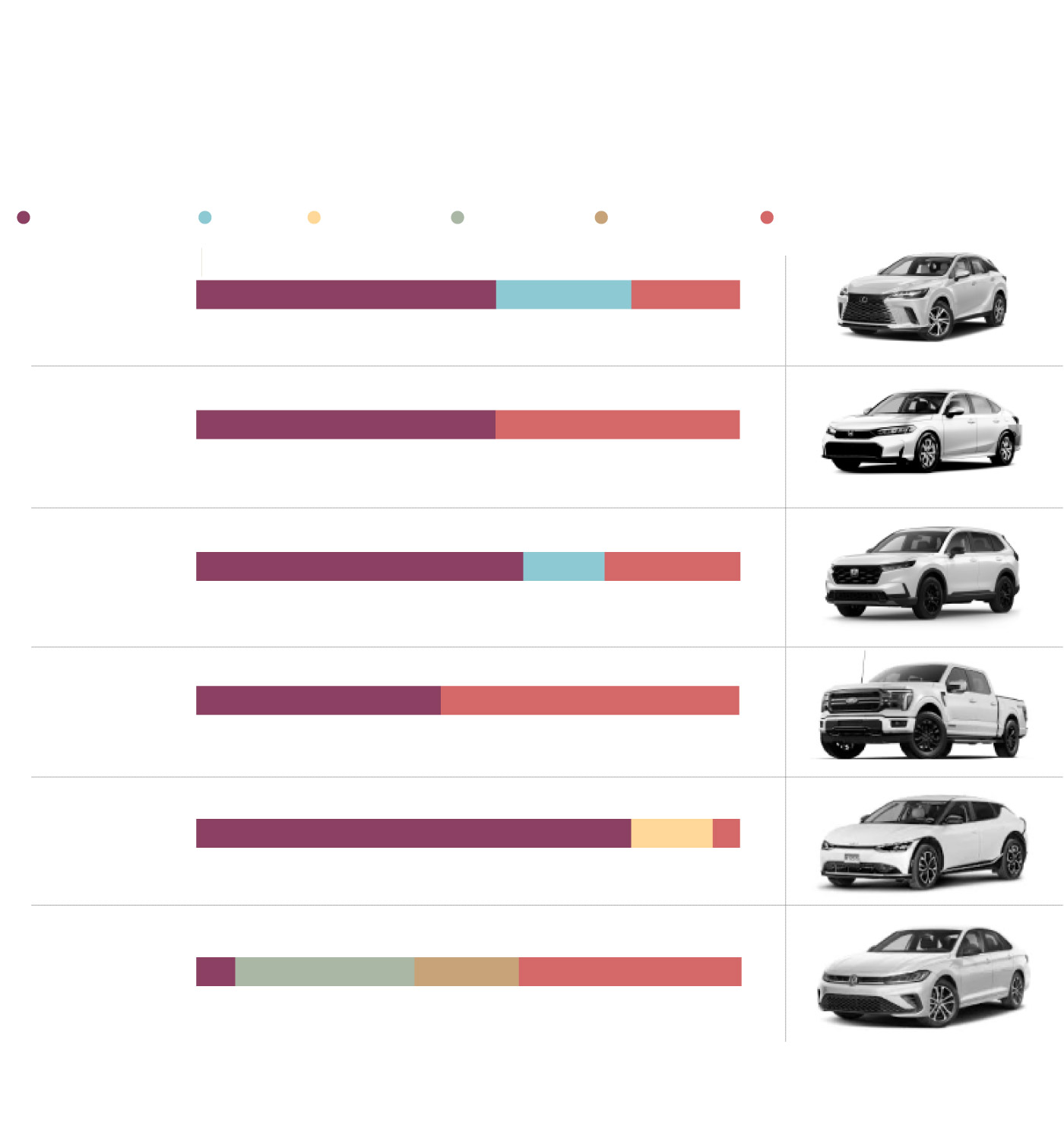
Data published by the U.S. government list roughly 360 vehicles for sale from the 2025 model year. Every single one contains some proportion of its components (by value) originating outside North America, varying from one-fifth to the entire vehicle. President Donald Trump argues the decline in U.S.-manufactured vehicles “jeopardizes our domestic industrial base and national security.”
Per cent content of select cars:
U.S./Canada
Japan
S. Korea
Mexico
Germany
Other countries
55%
25%
20%
Lexus RX 350
Final assembly: Canada, Japan
55%
45%
Honda Civic
(four door)
Final assembly: Canada
60%
15%
25%
Honda CR-V
(FW drive)
Final assembly: Canada
45%
55%
Ford F150
Final assembly: U.S.
5%
80%
15%
Kia EV6
Final assembly: U.S.
33%
7%
19%
41%
Volkswagen
Jetta GLI
(auto. trans.)
Final assembly: Mexico
Matt Mcclearn and john sopinski/the globe and mail
Source: National Highway Traffic Safety Administration photos: manufacturers
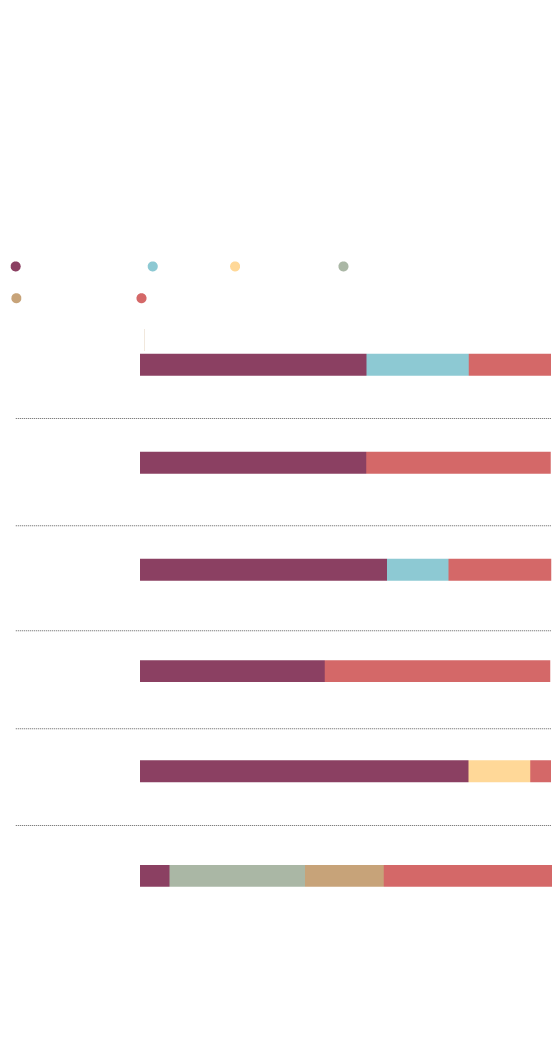
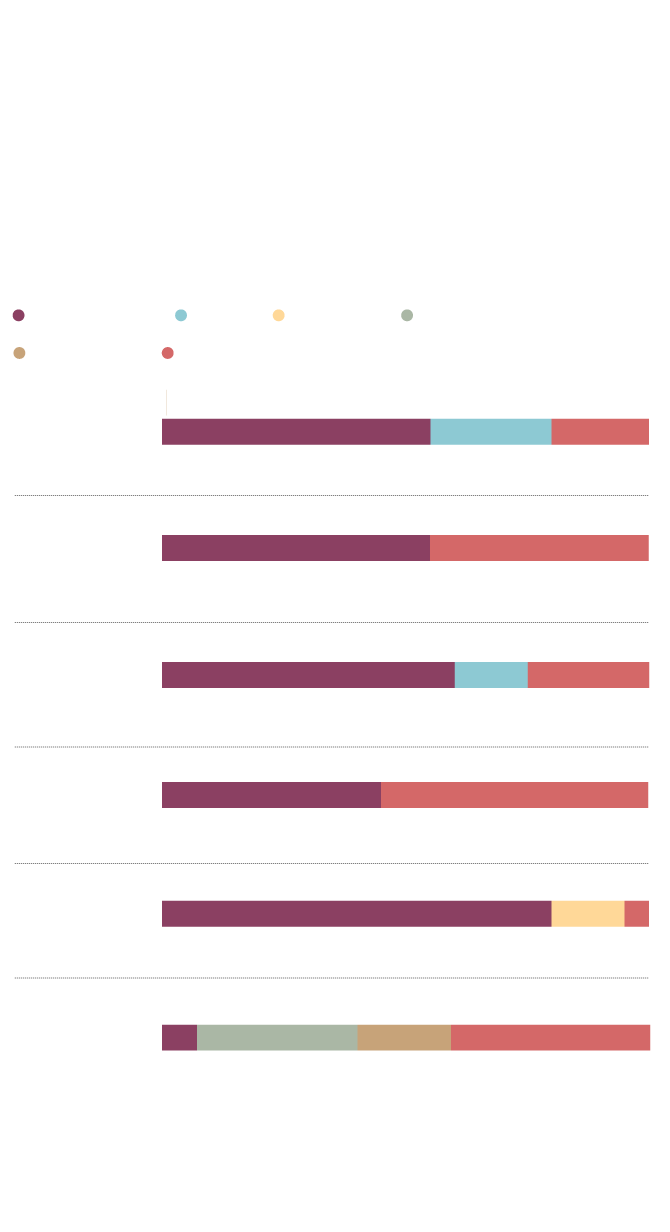
The data contain some surprises. The car with the highest U.S./Canada content, at 80 per cent, is Kia’s EV6, a fully electric sport utility vehicle. (Its South Korea-based manufacturer incorporates just 15 per cent of content from its home country in this model.) An American-assembled Ford F150 pickup truck, meanwhile, has only 45 per cent U.S./Canada content – highlighting the international origins of what might appear to be a quintessentially American vehicle.
The data also highlight the fact that vehicles assembled in Canada or Mexico tend to have far more U.S. content than those made further afield. For example, of 45 Mercedes-Benz and Porsche models assembled in Germany and sold in the U.S., the data suggest there is no U.S./Canada content in them whatsoever. Of 70 models assembled in Japan, four have between 25 per cent and 50 per cent U.S./Canada content; the vast majority have none.
Owing to Mr. Trump’s actions, the balance of U.S. and foreign content in vehicles sold in the United States has suddenly assumed greater importance.
The White House issued a proclamation from Mr. Trump implementing 25-per-cent tariffs on March 26. It stipulated that they might not be applied to the whole value of all vehicles. For vehicles qualifying for preferential treatment under the United States-Mexico-Canada Agreement, the U.S. Secretary of Commerce might decide to apply the 25-per-cent tariff only to the vehicle’s non-U.S. content.
But there’s a big catch: If U.S. Customs and Border Protection determines that the importer’s declared value of non-U.S. content is inaccurate, a 25-per-cent tariff will apply to the whole vehicle.
U.S. Customs and Border Protection’s public affairs department did not answer questions from The Globe about what documentation it expects from importers, how it will verify importers’ claims, or what recourse importers will have in case of disputes.
Greig Mordue, an engineering professor at McMaster University, said questions of national content bedeviled automakers and government officials even when the stakes were far lower.
“There are people, generally within the finance department, who have expertise in documenting regional content,” he explained.
“Because if it’s 75 per cent North American content, it goes into the U.S. free of the U.S. [most favoured nation] rate on completed vehicles, which is only 2.5 per cent. But the question is, how do you define the 2.5 per cent? Is it on that car model? Is it on that particular car? Is it on that model year? Is it on that model year with this type of option package? Or is it on this calendar year? There’s some ambiguity there.”
Prof. Mordue added that despite efforts to document supply chains, occasionally auto assembly plants have been caught off-guard when a minor supplier suffered a natural disaster or other mishap, forcing them to shut down temporarily.
“Theoretically, the assemblers have good visibility of the supply chain, of all of their suppliers. But in reality, they don’t.”
Mr. Trump’s proclamation asserted that free-trade agreements, including the United States-Mexico-Canada Agreement, “have not yielded sufficient positive outcomes” and claimed that imported automobiles and parts posed “a threat to national security.”
In 2018, in a report examining proposed changes to the North American free-trade agreement during Mr. Trump’s first term, the Center for Automotive Research noted that Americans demanded several million more light vehicles than domestic producers could make. “The U.S. cannot self-supply,” it concluded. At the time, Canada and Mexico each manufactured 11 per cent of all U.S. vehicles.
“NAFTA makes North American vehicle production internationally competitive,” the report added.
“Low- and high-wage jobs are distributed to optimal regional locations based on cost, capability and proximity to critical assets.”
Prof. Mordue predicted tariffs, coupled with a lack of R&D directed to electric vehicles, will ultimately harm the U.S. auto industry.
“The U.S. market is about 16 million vehicles – it’s big, but it’s not the world,” he said.
“The world market for vehicles is about 95 million. What the U.S. industry has done, and what the U.S. administration is perpetuating, is putting a wall up around the U.S. industry. And that will not serve the U.S. industry well over the longer term.”
Where are Ontario's auto plants, and how many people do they employ?
GM – Oshawa
Vehicle: Chevrolet Silverado pick-up truck
Annual production: 149,000
Employees: 3,000 hourly
GM CAMI Assembly – Ingersoll
Vehicle: Chevrolet BrightDrop electric delivery van, battery modules
Employees: 1,300 hourly
GM – St. Catharines
Product: V-8 engines, transmissions
Annual production: 149,000
Employees: 1,100 hourly
Toyota – Cambridge and Woodstock
Cambridge North products: Rav4, Lexus NX
Cambridge South products: Lexus RX 350, RX 350h, 500h
Woodstock products: Rav 4, Rav 4 hybrid, Hino commercial trucks
Annual production: 533,000
Employees: 8,500
Honda – Alliston
Vehicles: Civic, CR-V
Annual production: 420,550
Employees: 4,200
Ford – Oakville
Status: Closed for retooling. Expected to open in 2026 to make F250 pick-up trucks
Employees: 3,600 hourly
Ford – Windsor
Product: 7.3-litre V-8 engines
Employees: 950
Ford – Essex
Product: 5-litre V-8 engines
Employees: 930 hourly
Stellantis – Brampton
Status: Closed for retooling end of 2023. Retooling paused in February, 2025. Expected to reopen by 2026 to make the Jeep Compass.
Employees: 3,000 hourly
Stellantis – Windsor
Vehicles: Chrysler Pacifica, Chrysler Pacifica Hybrid, Chrysler Grand Caravan and electric Dodge Charger Daytona
Annual production: 135,000
Employees: 3,600 hourly