
Canada doesn’t have to trade with other countries.
We trade because we benefit from the exchange. We gain from exports and imports.
But in a world where “great powers” are “using economic integration as weapons,” as Prime Minister Mark Carney put it this week at the World Economic Forum, there’s a danger for middle powers such as Canada that “integration becomes the source of your subordination.”
Carney, Trump and the week at Davos that marked the decline of the West
Economists are almost always in favour of greater openness to trade, because of the obvious upsides. It tends to increase economic efficiency and raise living standards in a smaller economy like Canada’s.
But Mr. Carney pointed out that in the current environment, greater global economic integration can bring downsides, and even existential dangers, for smaller countries.
The great powers – he was careful not to name the United States, and even more careful not to name China – are threatening to weaponize the benefits of economic integration for smaller states to undermine their sovereignty.
Call it the Carney Paradox.
More integration may bring economic benefits, but it could threaten national security. However, preserving national autonomy by foregoing integration will come with economic costs.
The paradox was on display this week as U.S. President Donald Trump threatened to slap escalating tariffs on several European countries unless they agreed to a U.S. takeover of Greenland. He backed down, but what he initially demanded, in return for trade access and the preservation of the NATO alliance, was an outright surrender of sovereignty.
What to do?

Prime Minister Carney was careful not to name the U.S. in his Davos speech, in which he warned of 'great powers' using economic integration as weapons.FABRICE COFFRINI/AFP/Getty Images
Mr. Carney’s speech, calling for an acknowledgment of these new realities, was rhetorically soaring, widely quoted and almost universally praised, at least outside the White House.
He had many memorable turns of phrase, with words that were persuasive because they ring true. But: The speech was also scarce on details of exactly what Ottawa will do, and how it will do it.
One possible response is to build what Mr. Carney called “a world of fortresses.” To address the threat to our security from too much integration with one or more threatening hegemons, we could pre-emptively de-integrate. We could throw up trade walls of our own.
That’s what Canada did in the decades after Confederation. Fearful that too much economic integration with the U.S. would lead to political absorption, the new country’s first prime minister, Sir John A. Macdonald, implemented the National Policy in 1879. Its centrepiece was high tariffs to protect Canadian industry against competition from imports.
Could Canada pursue something similar today? Yes. Should we?
Let’s do a thought experiment. To make it clear, let’s make it extreme. Imagine what it would be like if Canada did not trade with the rest of the world.
Instead of the more than $170-billion dollars in merchandise and service imports and exports recorded last October, let’s say that figure was zero. No imports, no exports.
Imagine if everything we have and everything we consume – every piece of clothing, every morsel of food, every vehicle on the road, and everything in our workplaces and our homes, from TV screens and smartphones down to the paint and the nails – had to be stamped “Made in Canada.”

An auto worker works on the assembly line at the GM plant in Oshawa. Most vehicles assembled in Canada are destined for the U.S., and they contain lots of American parts and labour.Chris Young/The Canadian Press
Consider the automobile industry.
Canadians could produce every car and truck for sale here, including every one of the thousands of parts in each vehicle, and the machines used to make the parts, and the raw materials in the parts, and the machines that dig the raw materials out of the ground and process them – and the machines used to make those machines. Instead of continental and global production chains, we could onshore it all, down to the last nut, bolt and semiconductor.
But if no cars or car parts could be imported, that would make for a very inefficient industry. If 41 million Canadians could only buy cars made here, the cost of the average vehicle would be higher, while the variety of vehicles on the market would be much smaller.
And if our auto industry could not export – if every car and car part made in Canada had to stay in Canada – that would also make the industry, and the Canadian economy, less efficient.

Crude oil from the expanded Trans Mountain Pipeline is loaded onto tankers at the Westridge Marine Terminal in Burnaby, B.C. Canada exports about two-thirds of its oil production, with the majority going to the U.S.DARRYL DYCK/The Canadian Press
It would be the same story for the country’s other export sectors.
For example, Canada exports about two-thirds of its oil production; in a world without trade, two-thirds of Canada’s oil industry would disappear. If our farmers could not sell outside our borders, a huge amount of Prairie farmland currently producing everything from wheat to canola would have to be left fallow. Far less potash would need to be mined, much of the export-focused aluminum industry would shut down, and manufacturers such as Bombardier Aerospace and Pratt & Whitney Canada would have to significantly downsize, since the Canadian market for executive jets and aircraft engines is a tiny fraction of the global market.
The idea of a Canadian auto market without imports or exports, and with all cars made here, is not just a thought experiment. Until the 1965 Auto Pact between Canada and the U.S., this country had tariffs on U.S.-made cars, with our local assembly industry protected by a trade wall. Imports were limited. Canadians paid higher prices and had less selection, and the Canadian auto industry’s small production runs for a small market made it inefficient.

Prime Minister Lester B. Pearson (centre left) and U.S. President Lyndon Johnson (centre right) sign the Auto Pact on Jan. 16, 1965, which integrated the North American car market.Library and Archives Canada/Supplied
The Auto Pact replaced that with a North American car market, the first step toward an integrated continental economy that arrived with the signing of the Canada-U.S. Free Trade Agreement in 1988.
Canada went from a stand-alone Canadian auto industry to one that is part of a wider North American and global industry, with long and interconnected supply chains. Most vehicles assembled in Canada are destined for the U.S., and they contain lots of American parts and labour.
Creating a larger market by integrating our economy with the superpower next door has benefits for Canadian consumers and producers. On balance, it should tend to lead to more competition, more efficiencies of scale, more choice and lower prices.
But what if mutually beneficial continental integration is no longer on offer? Or no longer mutually beneficial?
Mr. Trump has repeatedly questioned the continued existence of the United States-Mexico-Canada Agreement (USMCA). He has frequently asked why Canadian cars, steel and other manufactured goods are exported to the U.S. He’s suggested, more than once, that Canada’s economic connections to the U.S. could be leveraged to undermine our sovereignty.

U.S. President Donald Trump announced that he would cancel planned tariffs on his country's allies in Europe, which he threatened when leaders rejected U.S. control of Greenland, after he and NATO Secretary General Mark Rutte met on the sidelines of the World Economic Forum in Davos on Wednesday.Evan Vucci/The Associated Press
In Mr. Trump’s Davos speech, he demanded that Canada “be grateful,” and said that “Canada lives because of the United States.”
Mr. Carney has said that the dangers of being dependent on one suddenly unreliable partner – in October, the U.S. accounted for 59 per cent of our merchandise imports and 66 per cent of our exports – mean Canada must diversify.
That is not likely to involve pre-emptively limiting trade with the U.S., as happened in the era of the National Policy. (The U.S., of course, is limiting some imports from Canada, with sectoral tariffs on steel, aluminum and lumber, and more possibly to come, depending on what happens to the USMCA.)
The Carney government appears to be aiming to diversity not by closing the U.S. door, but by opening up more trade opportunities with other countries, and more opportunities for foreign money to invest in Canadian infrastructure, factories and other productive assets.
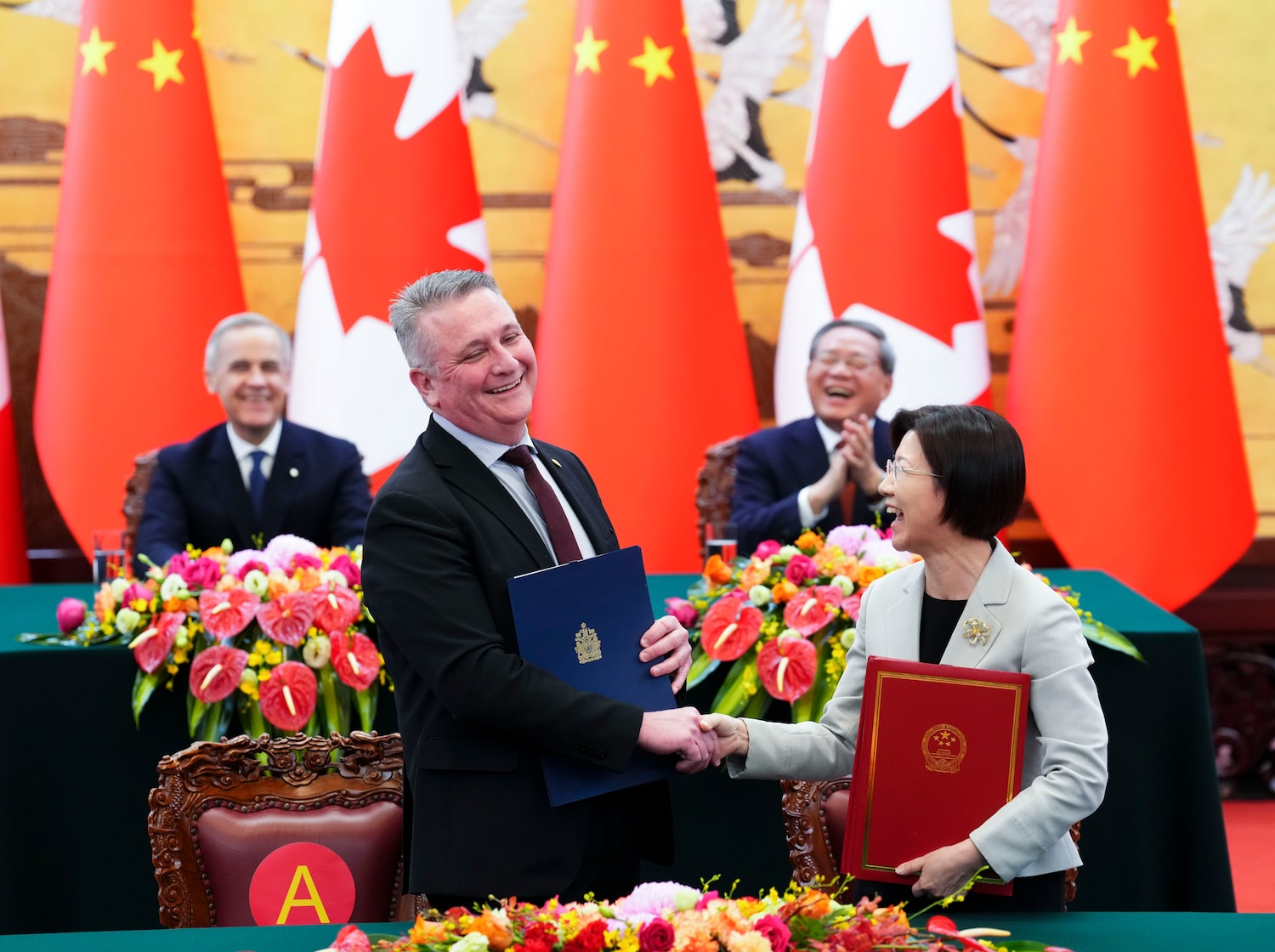
Mr. Carney’s sudden strengthening of the relationship with China – which until recently was the great power most likely to be accused of using economic integration as a weapon – may be another Carney Paradox.
China has an industrial policy of protectionism, currency suppression and state support that takes advantage of the rest of the world’s openness to trade. The country has become the world’s biggest manufacturer – almost overnight. China is now far ahead of the U.S. Last year, it ran a record US$1.2-trillion trade surplus with the rest of the world – because it exports more and more manufactured goods, while striving to import less and less.
Growing dependence on China’s factories is dangerous, and not just because it’s a totalitarian dictatorship. Beijing is not afraid to use economic weapons against weaker partners, as even Mr. Trump discovered when China weaponized its dominance of rare earths.
Canada, the U.S. and Europe were working toward common strategies to push back against growing Chinese industrial dominance. That included Canada copying a 100-per-cent U.S. tariff on Chinese electric vehicles, to prevent them from flooding the North American market.

Mr. Trump’s hostility to allies blew up these plans. But it doesn’t change the fact that Western governments have reason to worry about the growing outsourcing of their industrial bases to China.
One reason is that we live in an era when hard power – military power – is suddenly a concern for countries that previously sheltered under the American defence umbrella. As Mr. Carney said at Davos, a country that cannot defend itself has few options.
What he didn’t say, because he didn’t have to, is that without an industrial base, you can’t build the weapons to defend yourself.
Too much integration with a Trump-led U.S. is a threat to our security – but less trade will bring economic costs. Too much integration with China is a threat to our sovereignty and our industrial base – even though low-cost and below-cost Chinese goods mean lower consumer prices.
There is, perhaps, another option. Mr. Carney suggested it in his Davos speech. He said that to avoid having to choose between subordination to a great power or costly and possibly futile resistance, “middle powers must act together.”
“Great powers can afford to go it alone,” he said. Everyone else needs other plans.

In his Davos speech, Mr. Carney suggested 'middle powers must act together,' by strengthening diplomatic co-operation, economic integration and defence partnerships, rather than compete for the favour of a fickle great power.Sean Kilpatrick/The Canadian Press
We aren’t going to build a Canada-only car industry, or a Canada-only defence sector. It would not be impossible, but given economies of scale, it would likely bring more economic negatives than positives.
That leaves the “countries in between” with a choice: “to compete with each other for favour” with the superpowers, said Mr. Carney, “or to combine to create a third path with impact.”
Canada could aim for more trade ties, economic integration, diplomatic co-operation and defence industry partnerships with other non-superpowers.
That sort of diversification is a long-standing Canadian goal. It’s been talked about for decades, though pursued with little enthusiasm and less success.
What’s new is the urgency.
Getting closer to the superpower next door made sense. Continental integration with our best friend and ally, who just happens to be the world’s largest economy, was logical and profitable. But Mr. Trump’s threats and roadblocks changed the game.
The U.S. turn against free trade and allies, and the Chinese practice of unfair managed trade, should spur Canada to double down on beefing up trade with other markets. And there are other markets out there – places that can buy our exports, places to source imports, and places to partner with on integrated supply chains that involve a symbiosis of imports and exports.
The U.S. remains the biggest economy, at least when gross domestic product is measured at current exchange rates, but Europe is more populous and has an economy roughly the same size. The European manufacturing sector is larger than that of the U.S., and four of the world’s 10 most advanced manufacturing countries are in Europe, according to the United Nations Industrial Development Organization (UNIDO).
Germany ranks No. 1 in manufacturing competitiveness, ahead of China. Ireland is ahead of the fifth-place U.S., with Switzerland and the Netherlands not far behind.
South Korea has an economy roughly the size of Canada’s, but its industrial sector is three times as large, and UNIDO ranks it as the world’s fourth most competitive manufacturer. Japan is an even larger manufacturing power, with an economy twice the size of Canada’s.
The 11-country ASEAN bloc is growing fast. And the countries of the Middle East and Central Asia, led by Turkey and Saudi Arabia, constitute an economy several times the size of Canada’s.
There are opportunities here not only for buying and selling, but for industrial co-operation, particularly with other advanced economies.

National Defence Minister David McGuinty and Prime Minister Carney tour a submarine at the Hanwha Ocean Shipyard. The South Korean company is on the shortlist to supply Canada's navy with a new fleet of submarines.Adrian Wyld/The Canadian Press
There’s a reason why Sweden’s Saab AB is pitching a partnership to build fighter jets in Canada, and surveillance aircraft based on a Bombardier Inc. aircraft. There’s a reason why the South Koreans are proposing a partnering to build new submarines for the Royal Canadian Navy, and a German-Norwegian consortium is doing the same.
And in this new world of more managed trade, Ottawa is reportedly trying to tie the award of a submarine contract to future investments in the Canadian auto industry.
Great powers can go it alone. Other countries have to combine.
A generation ago, several European aircraft manufacturers, each headquartered in a mid-sized country, and each too small to compete with U.S.-based Boeing Co., came together to form Airbus SE. Today, it holds a larger share of the global passenger jet market than Boeing.
Maybe there’s a lesson there for Canada.