John Rapley is a contributing columnist for The Globe and Mail. He is an author and academic whose books include Why Empires Fall and Twilight of the Money Gods.
Prime Minister Mark Carney’s speech at Davos this week, which won a standing ovation, has begun circulating widely among political leaders, scholars and journalists as a manifesto for a new age.
As one British commentator put it, “by common consent it’s the best speech at Davos this year; perhaps the best speech ever at Davos.”
Offering both a diagnosis and a prescription – the old regime is dead, long live the new regime – the speech thrust Canada into a role it hasn’t occupied in a very long time, that of shaping world events.
Read and watch Mark Carney's Davos speech at the World Economic Forum
As the United States turns to imperialism, Mr. Carney has proposed a new order built by mid-sized powers – Canada, European countries and leading states of the developing world – that would aim to preserve an international system in the face of superpower conflicts.
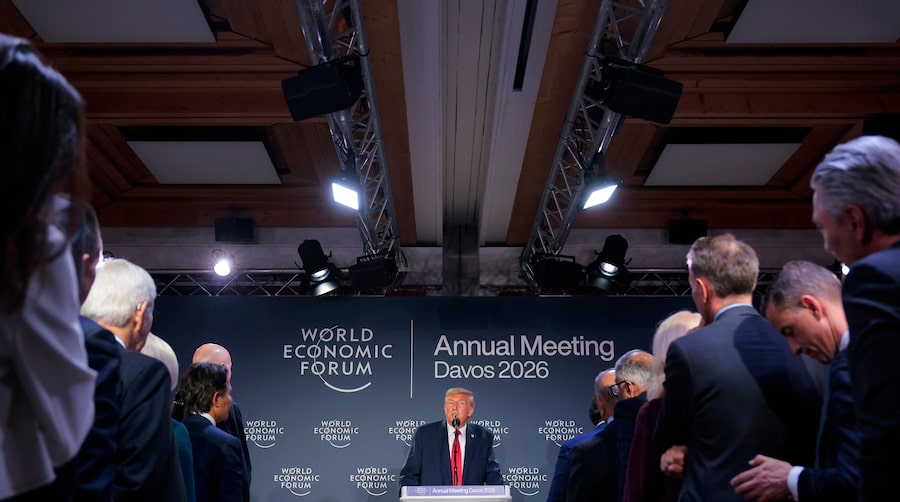
Arguably, the first test run of this model for a global order took place amid the gathering in Davos. When Donald Trump threatened tariffs and hinted at force to seize Greenland, Europe banded together – with Canadian backing – to threaten economic retaliation.

A trader works at the New York Stock Exchange, as a TV shows President Donald Trump speaking in Davos.Richard Drew/The Associated Press
It was that which panicked markets. The New York Stock Exchange fell by 2 per cent on Tuesday and the 10-year Treasury yield rose by nearly a tenth of a per cent, forcing Mr. Trump to back down (bond yields move inversely with prices).
The story won’t end there, though. This was merely the start to what will be a long and bumpy course ahead, because it’s just one of the plotlines in an even bigger story: the relative decline of the West.
This process began around the turn of the millennium, as the former global periphery began to rise faster than the Western economies, and then gained speed after the 2008 global financial crisis. To then maintain their public services amid slowing economic growth, Western governments resorted to borrowing, using the creditworthiness they’d built over two centuries of global dominance.
Leading this pack, in recent years, has been the United States.

A ticker announces the stock market plunging in New York, on Oct. 6, 2008. Since the 2008 financial crisis, the U.S. has borrowed, seemingly endlessly, to sustain its growth.EMMANUEL DUNAND/AFP/Getty Images
As we always hear, the U.S. economy powered past other Western economies since the 2008 crisis, giving rise to talk of an American exceptionalism supposedly rooted in the country’s technological superiority and more dynamic economy.
But the most extraordinary thing about the U.S. was its ability to borrow, seemingly endlessly, to sustain its growth. In recent years, the U.S. has run annual budget deficits of US$1-trillion to US$2-trillion and trade deficits of more than US$1-trillion; it funded both through debt.
This obscures a critical American weakness of which Mr. Trump and his minions evince no awareness. If one subtracts added debt from the U.S.’s annual growth rate, its economy would now be contracting. Deprived of credit, U.S. markets would crash. The most exceptional thing about the U.S. might then become the depth of the recession that resulted.
Opinion: Mark Carney calls on Canada to wake up to ‘the world as it is’
Nevertheless, if not always to the same degree – not everyone has a fiscal deficit as apparently out of control as the U.S.’s – virtually all Western economies have the same vulnerability.
Right across the West, in even the most prudent of countries, both public and private debt have been rising. And when faced with debts that keep rising faster than economies, creditors begin demanding higher interest rates on their loans, to hedge against the rising risks of default or the possibility that governments and central banks inflate away the debt.
This has shown up in the interest rates fund managers demand on Western bonds. After decades of declines to historic lows, the yields Western governments paid on their bonds bottomed a decade ago, and since then have been rising steadily (with a brief interruption amid the height of the COVID crisis, which however did not reverse the trend). A decade ago, the interest rate on a 10-year U.S. bond was well under 2 per cent; today it’s above 4 per cent; in Canada it was around 1 per cent; today it’s more than triple that.

Japan is the most heavily indebted Western economy and could be the first developed country to confront a debt crisis.Issei Kato/Reuters
This bear market in government bonds may now be entering a critical phase. The most heavily indebted Western economy is Japan, and in the past year, its bond yields have begun rising sharply. Ten-year yields jumped nearly 19 basis points in two days this week, the sharpest increment since 2022 (a basis point is one-hundredth of a percentage point); 30-year yields had their biggest daily surge in more than 20 years.
On the current trend, the rate Japan must pay to borrow is rising by more than a per cent each year. If this continues much longer, either the government will face a fiscal crisis, or the central bank will have to intervene to push down interest rates, which would cause the yen to collapse.
In short, Japan could be the first developed country to confront a debt crisis. But should that problem arise, it won’t be confined there. That’s because Japanese investors had for years been taking advantage of the carry trade, borrowing yen cheaply and converting them into the currencies of other countries, to then buy their bonds, which pay higher rates, pocketing the profit.
But with interest rates rising at home, they’ll cut back their bond-buying elsewhere. That loss of Japanese demand is helping drive up interest rates everywhere, including Canada, where the current 10-year bond pays 3.4 per cent, about the highest in the past decade.

Demonstrators protest against Mr. Trump's demand that the island be ceded to the U.S., outside the American consulate in Nuuk, Greenland, on Jan. 17.Marko Djurica/Reuters
So, this was the backdrop to this week’s showdown over Greenland – a tinderbox awaiting a spark, which took the form of Donald Trump’s threats. Briefly during the crisis, there was talk of European governments weaponizing their Treasury bond holdings, selling them off to drive down their value, thereby forcing up U.S. interest rates.
This was never a realistic danger – most European governments have only limited leverage over the U.S. bond holdings in their banks. Nevertheless, the Danish pension fund AkademikerPension did say it would get rid of US$100-million of Treasuries by the end of the month, citing “poor U.S. government finances” and saying that Mr. Trump’s Greenland desires “didn’t make it more difficult to take the decision” to divest.
America the predator: Trump wants to show the world he can take what he wants
Amid this game of Russian roulette, an even greater threat to the U.S. surfaced: that its global creditors, already troubled by the profligacy of American governments, now faced the risk that the country was run by a madman willing to try anything.
As a result, during the brief bond selloff of the past week, we saw something truly extraordinary. Throughout the U.S.-led Western age, one rule of thumb always prevailed: in a moment of crisis, even one precipitated by the U.S., investors around the world fled to the safety of the U.S., where they parked their money in Treasury paper.
But this time around, the reverse happened. The dollar fell and Treasury yields rose more than those of almost all other major markets. Over two trading days this week, U.S. 30-year Treasury yields were up by 12 basis points, the biggest jump over such a period since China-U.S tensions flared last year. Investors were fleeing the U.S.
This shift away from the U.S. had already begun organically. Over the past year, while bond yields have risen across the Western world, they’ve risen most of all in the U.S. and Japan. Those are the countries in which the world’s creditors are most losing faith. If Mr. Trump keeps testing his luck, he could end up ultimately precipitating the mother of all crises one of these days.

In a blunt speech at the World Economic Forum in Davos, Mr. Carney said that middle powers must stop pretending the rules-based international order is still functioning.FABRICE COFFRINI/AFP/Getty Images
So, the old world has died but a new one has yet to be born – how do we navigate this entirely new terrain? Mr. Carney’s Davos speech offered a map to which many countries are now thinking of turning to, to the point of following him in planning trips to Beijing where they can, like him, start “engaging broadly, strategically, with open eyes.”
We can forge partnerships with like-minded middle powers, including rising states of the former periphery – and also, one might add, forge an alliance with the many, possibly most, Americans, who reject MAGA’s neo-imperialism. We can diversify our trade ties, which will require sacrifice by vested interests that benefit from existing deals that may not last, and that make new agreements difficult.
We must make internal adjustments, because rising interest rates are here to stay and will upend government finances in Western countries. Social contracts we thought eternal will thus have to be renegotiated.
The changes involved will, if they succeed, be epochal – both exciting and frightening. Because as Mr. Carney declared in his speech, “We are in the midst of a rupture, not a transition” and “nostalgia isn’t a strategy.”
Do this right, and we could end up in a better world, one where we retain the best of the Western legacy and discard the abuses and hypocrisy that frequently characterized the Western order.
But first we must navigate the course there, and that will involve hardship. The possibility of a market crash during this transition period can’t be ruled out (watch Japan closely).
The past year has been humbling for Western countries, including Canada. Happy as they were to free ride on American power over the past decades, they had it coming.