Perrin Beatty is the former chief executive officer of the Canadian Chamber of Commerce and a former minister of defence and foreign affairs.
Fen Osler Hampson is a professor of international affairs and Chancellor’s Professor at Carleton University.
They are co-authors of Canada Rising: From Crisis to Renewal to be published later this year.
This essay is part of the Prosperity’s Path series. In a time of geopolitical instability and a shifting world order, the challenges facing Canada's economy have only gotten more visible, numerous and intense. This series surveys the path forward.
The conflict in the Persian Gulf and Iran’s missile and drone strikes on key oil and gas facilities in Qatar, Saudi Arabia, the UAE and Kuwait have caused fires, shutdowns, and extensive damage at major energy export hubs. Global oil and gas prices have surged. In addition to its impact on Canadian consumers, the crisis has driven up fuel and heating costs for our European and Asian allies, who are much more exposed to seaborne energy imports from the region than we are. Like us, they were not properly consulted before the hostilities began, but they are being forced to pay a heavy price.
This is the moment when Prime Minister Mark Carney can lead to turn a crisis into a strategic response. Given Canada’s vast but still underdeveloped hydrocarbon resources, it is well placed to help allies manage some of the fallout from this conflict. And even if U.S. President Donald Trump backs off the U.S. campaign in the region and seeks an accommodation with Iran, as he said he is pursuing, the region’s underlying instability will remain; more disruptions are likely.
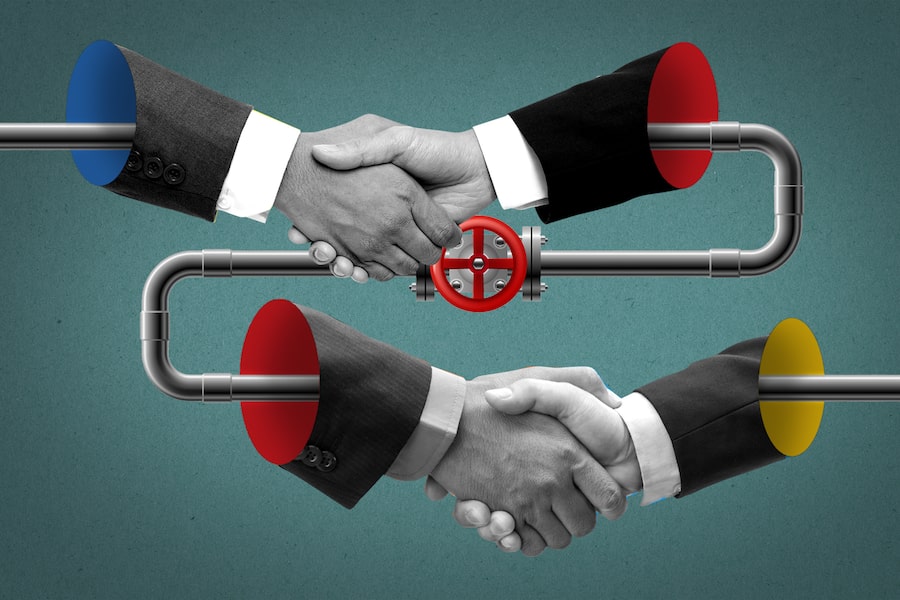
That is why Canada should take the lead in forging a new global energy security pact. This pact would marry European and Asian investment in Canada’s energy sector in exchange for a long-term commitment to provide assured supplies. It would be an alliance among trustworthy partners that would help insulate them against future disruptions. It would make Canada wealthier and stronger.

The Westridge Marine Terminal, the terminus of the Trans Mountain pipeline expansion project in Burnaby, B.C. LNG shipped from British Columbia’s coast can reach Northeast Asia in roughly 10 days.Chris Helgren/Reuters
Canada has become a major growth supplier of oil as Alberta’s producers have increased output for the expanded Trans Mountain Pipeline, which began commercial operations in May, 2024. Newfoundland, responsible for roughly 4 per cent of Canada’s oil production, can now boost their output with the restart of oil production at the offshore Terra Nova oil field.
In addition to the security premium from our energy exports, we have a geographical advantage. LNG shipped from British Columbia’s coast can reach Northeast Asia in roughly 10 days, compared with twice as long as it takes for shipments from the Middle East and the U.S. Gulf Coast. The shorter route reduces transportation and emission costs. Middle East oil and LNG shipments must also navigate the Strait of Hormuz and the Strait of Malacca, both of which are critical chokepoints during conflict.
This new pact should have three goals.
First, it would involve European and Asian investment to fast-track Canada’s LNG export capacity, including Indigenous-led projects like the Ksi Lisims LNG project within Nisga’a treaty lands on B.C.’s northwest coast. Because new LNG capacity takes years, not months, to build, such a pact would need to lock in long‑term purchase contracts and co‑financing now to bring additional Canadian export terminals online before the decade’s end.

An offshore oil rig support vessel leaves St John's harbour in February, 2025. Newfoundland currently is responsible for roughly 4 per cent of Canada’s oil production.Greg Locke/Reuters
Second, a pact should focus on developing Newfoundland’s offshore oil fields as surge capacity for Europe, along with a co-funded strategic petroleum reserve, which could also be located in Canada to be ready for use in an emergency.
Third, such a pact should revisit LNG options along the St. Lawrence River and the Atlantic coast, including the previously proposed Baie-Comeau LNG export facility, which would send gas from Western production basins (and potentially from other geologically identified but currently undeveloped reserves) to European markets, with rigorous safeguards for Indigenous rights and environmental protection.
Potential sales are huge. For example, the Ksi Lisims LNG project is expected to produce 12 million tonnes per annum (mpta) and is well positioned to supply Asian markets. On the East Coast, the proposed Énergie Saguenay project in Quebec was estimated before its cancellation to provide between 10.5 mtpa and 11 mtpa to European buyers. Together, these projects would strengthen Canada’s role as a reliable energy supplier while advancing Indigenous equity and economic reconciliation.
For its part, Canada would need to accelerate regulatory approvals by treating these projects as national priorities and by setting a clear and ambitious goal like the end of this decade for project completion. Our history shows this can be done. The original TransCanada pipeline, which was built in the 1950s across roughly 3,500 kilometres, was completed in just three years.

A section of the TransCanada pipeline under construction in 1956.Gilbert Milne
Given the opposition these projects would encounter from some Indigenous groups, provincial politicians, and environmental groups, allied leaders should be given the opportunity to make their case directly to Canadians. Canada should host an Energy Security Summit in Ottawa, chaired by the Prime Minister. It would be a venue for Canada and our allies to explain how a co-ownership model coupled with long-term contracts would turn these resource projects into a shared, middle-power asset to heat homes and keep economies running.
Because these partners are already heavily invested in renewable energy development like offshore wind, floating solar, and green hydrogen, the pact should be paired with binding commitments to accelerate investment in renewables and energy efficiency alongside hydrocarbon investments. All countries would collectively pledge to deploy Canadian LNG as a bridge fuel while co‑financing tidal energy, offshore wind, and grid upgrades, thus aligning a new energy security pact with the goals of the Paris Agreement on climate change.
In a world where roughly one-fifth of the world’s oil and natural gas passes through a narrow strait that is now an active conflict zone, the world’s like-minded middle democracies cannot afford to treat energy security as someone else’s problem. Canada has the resources, political stability and geography to offer some of our closest friends a better deal where we can share the risks and rewards together. What we need is the will and the skill to make it happen.
There is always the risk that Mr. Trump will object to this deal and view it as Canada aligning with Asia and Europe against the United States. Our response should be that there is still a pipeline waiting to be built in Southern Alberta – Keystone XL – which he is welcome to approve and help finance.
At the same time, we should make clear that any such agreement must also include the removal of U.S. tariffs on steel, aluminum, and softwood lumber. We should remain open to genuine partnership with the United States, but we should reject “deals” that are based on intimidation.
The Prime Minister‘s priority now should be to pick up the phone and call his counterparts in Tokyo, Seoul, Berlin, Paris, Warsaw and London and invite them to Ottawa, not to talk about the current crisis in the Gulf but to build a fresh and effective means to deal with future challenges