
When François Legault and Andrew Furey met in St. John’s in early 2023 in a bid to reboot talks on a massive energy deal, the odds were stacked overwhelmingly against them.
Plenty of previous premiers of Quebec and Newfoundland and Labrador had tried and failed to overcome the decades of bitterness between their provinces to launch new hydroelectric developments on the mighty Churchill River. Though geography made them neighbours, the vicissitudes of history had precluded any friendship between them.
The enmity between Newfoundland and Quebec was initially rooted in an early 20th century dispute over the Labrador border. It intensified in the wake of a 1969 contract that saw Hydro-Québec buy electricity from the massive Churchill Falls generating station in Labrador at a tiny fraction of its market value.
From the moment the contract took effect in 1976, Newfoundland had sought to renegotiate its terms to secure a better deal. Quebec had always refused to reopen the contract, twice winning its case at the Supreme Court of Canada.
Instead, it held out the prospect of future deals with Newfoundland to harness the remaining hydro potential along the lower Churchill River. But no Newfoundland premier could dare do business again with Quebec without first righting the wrongs of the past.
Mr. Legault and Mr. Furey were both determined to break that pattern. The two leaders struck up a genuine rapport that included double dates with their respective wives. Yet, though each came to believe he could trust the other, their discussions on Churchill Falls had failed to move beyond generalities until Mr. Legault’s February, 2023, trip to St. John’s.

Quebec Premier Francois Legault and then-Newfoundland and Labrador Premier Andrew Furey arrive at a joint news conference in St. John's to discuss the future of the Churchill Falls agreement on Feb. 24, 2023.Paul Daly/The Canadian Press
There, he made the one concession that every other Quebec premier since the 1970s had refused to make. He publicly admitted that Newfoundland had gotten the short end of the stick in 1969. Despite the political risk, Mr. Legault felt he had to make that concession or watch the negotiations to develop new projects in Labrador end like all the others – in tears and recrimination.
“I would like to say a few words to the citizens of Newfoundland and Labrador,” Mr. Legault began by saying, in English, with Mr. Furey at his side at the provincial legislature in St. John’s. “I fully understand the frustration and the anger that you feel about the Churchill Falls contract. I think that this contract became a bad deal for Newfoundland and Labrador. You are a proud people, like Quebeckers. I had been in business for a long time before [entering] politics, and I learned that it is better to have a win-win contract for the long term … We cannot rewrite the history, but we can shape the future together.”
Mr. Legault’s words reverberated far beyond the Confederation Building, sending a signal to Quebeckers and Newfoundlanders alike that he was willing to reconsider the terms of the 1969 contract before its expiry date in 2041 as part of a comprehensive deal that would see Hydro-Québec gain access to thousands of additional megawatts from new power developments on the Churchill River.
“I give full credit to François. He understood the political and social consequences of the old deal. He made a very powerful statement to the people of this province. That took courage,” Mr. Furey said in an interview in his St. John’s office shortly before he stepped down as premier in May. “He owned it and communicated it in a way that was well received in the province.”
In the nearly 20 months that followed the Quebec Premier’s 2023 declaration, Mr. Furey and Mr. Legault would meet several times in person – including a rendez-vous at a Canadiens match in Montreal early in 2024 – to ensure that the negotiations moved forward despite the endless stumbling blocks that their respective negotiating teams, led by Hydro-Québec CEO Michael Sabia and his counterpart at Newfoundland and Labrador Hydro, Jennifer Williams, encountered along the way. (Mr. Sabia was tapped last week by Prime Minister Mark Carney to lead the federal public service as Clerk of the Privy Council.)
Ms. Williams, seconded by former Fortis Inc. chief financial officer Karl Smith and Newfoundland deputy justice minister Denis Mahoney, met repeatedly with Mr. Sabia and Hydro-Québec executive vice-president Dave Rhéaume in St. John’s and Montreal, to hammer out one of Canada’s biggest energy deals in years, one that’s projected to generate an estimated $225-billion in cash for Newfoundland by 2085.
Crucially, under a memorandum of understanding between Hydro-Québec and NL Hydro signed in December, the Quebec utility would pay significantly more for power from Churchill Falls between now and 2041, with the price ramping up further until 2075. The new deal would enable the Newfoundland government to pocket an average of $1-billion annually between 2025 and 2041, compared to a small fraction of that amount under the 1969 contract, and a total of $33.8-billion (in 2025 dollars) over the next 50 years.
In exchange, Hydro-Québec would have the exclusive right to take the lead on $25-billion worth of new hydro developments on the Churchill River, totalling 3,900 mw of additional electricity by 2035, providing it with a low-cost source of renewable power to fuel the electrification of the Quebec economy and export surplus power. A second 1,100-mw-generating facility at Churchill Falls and a new 2,250-mw plant downriver at Gull Island would produce electricity for far less than alternative sources in Quebec or elsewhere in North America, providing Quebec with major energy-cost savings.
Hydro-Québec and NL Hydro are aiming to reach a definitive agreement by next April, or sooner if possible. Mr. Legault and Mr. Furey’s successor as Newfoundland Premier, John Hogan, are both committed to reaching a final deal. But an election in Newfoundland, which must be held by mid-October, could complicate matters.
A final deal between Quebec and Newfoundland would mark a significant milestone. As Mr. Carney aims to make Canada an “energy superpower,” the new partnership between Quebec and Newfoundland would serve as an example of what’s achievable with political will and compromise.
“This is nation building,” Mr. Furey said. “It is a game changer for the people of this province.”
Mr. Legault is equally keen to reach a definitive agreement. “For sure, this is the biggest legacy I want, as Premier, to leave the next generations,” he said in an interview in his Montreal office. “This is something I hold dear. I spent a lot – a lot – of time on this. I think it is going to change the face of the Quebec economy … It’s going to be extraordinary.”
The bad blood that Mr. Legault and Mr. Furey sought to overcome has its roots in King George III’s Royal Proclamation of 1763. It placed the “coast of Labrador” under the “care and inspection” of the governor of Newfoundland.
Conflict erupted in 1902, when Newfoundland, then still a British colony, awarded timber-cutting rights in Labrador. The governments of Quebec and Canada, which laid claim to the territory, challenged the move. It wasn’t until 1927 that Britain’s Judicial Committee of the Privy Council, then Canada’s highest court of appeal, settled the dispute in Newfoundland’s favour.
The implications of the JCPC decision were far-reaching. As The Globe and Mail noted in a front-page story at the time, Canada lost the “rich prize” of Labrador and its vast forestry and water resources because of “a London decision.”
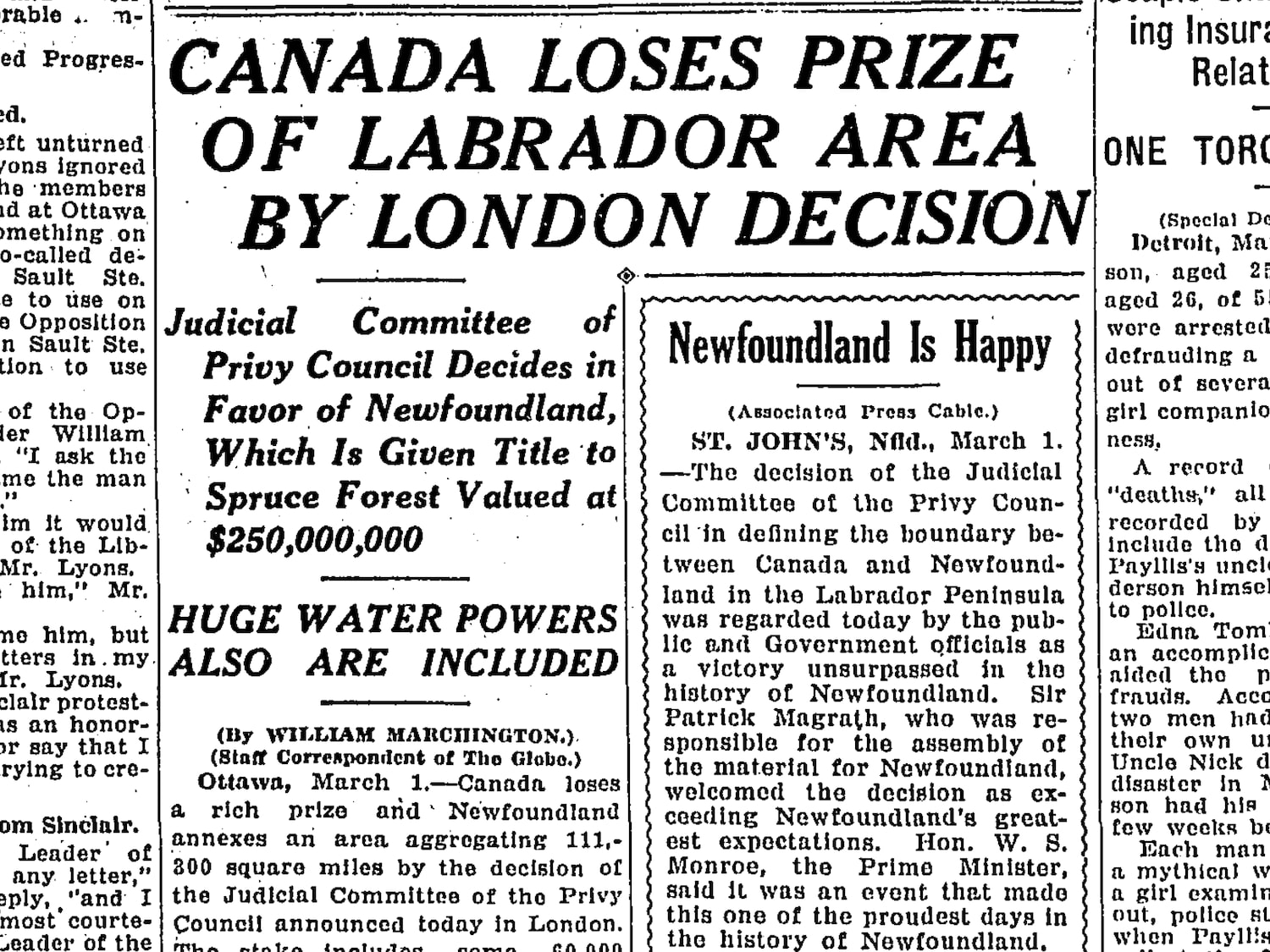
The disputed territory included Grand Falls – renamed Churchill Falls in 1965 – “with which the mighty Niagara takes second place.” The Globe article said “it is estimated that the available waterpower in the disputed area [amounted] … to half the total available in the whole province of Quebec.”
Unsurprisingly, Quebec refused to recognize the JCPC ruling, even after Newfoundland joined Canada in 1949. Tensions over the boundary grew during the 1950s as then-Newfoundland premier Joey Smallwood courted British and American investors to develop the hydroelectric potential on the Churchill River, then known as the Hamilton River.
In 1953, an investor syndicate led by British-based investment banker NM Rothschild & Sons created the British Newfoundland Corp. (Brinco). It was awarded exclusive development rights on the Labrador river by Mr. Smallwood’s government under a 99-year renewable water lease.
Brinco, in turn, formed the Churchill Falls (Labrador) Corp. Ltd (CF(L)Co), selling a 20-per-cent stake to the Shawinigan Water and Power Co. With Quebec’s nationalization of the electricity sector in 1963, SWPC’s shares were transferred to Hydro-Québec.
From the outset, the development of Churchill Falls’ vast hydro potential hinged on making a deal with the Quebec utility. At the time, transporting electricity over long distances was both hugely expensive and inefficient. But by 1965, Hydro-Québec had built the world’s first 735-kilovolt high-voltage transmission line, allowing it to reduce substantially the amount of power “leakage” over long distances.
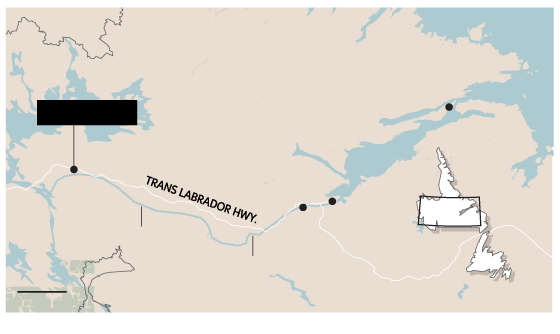
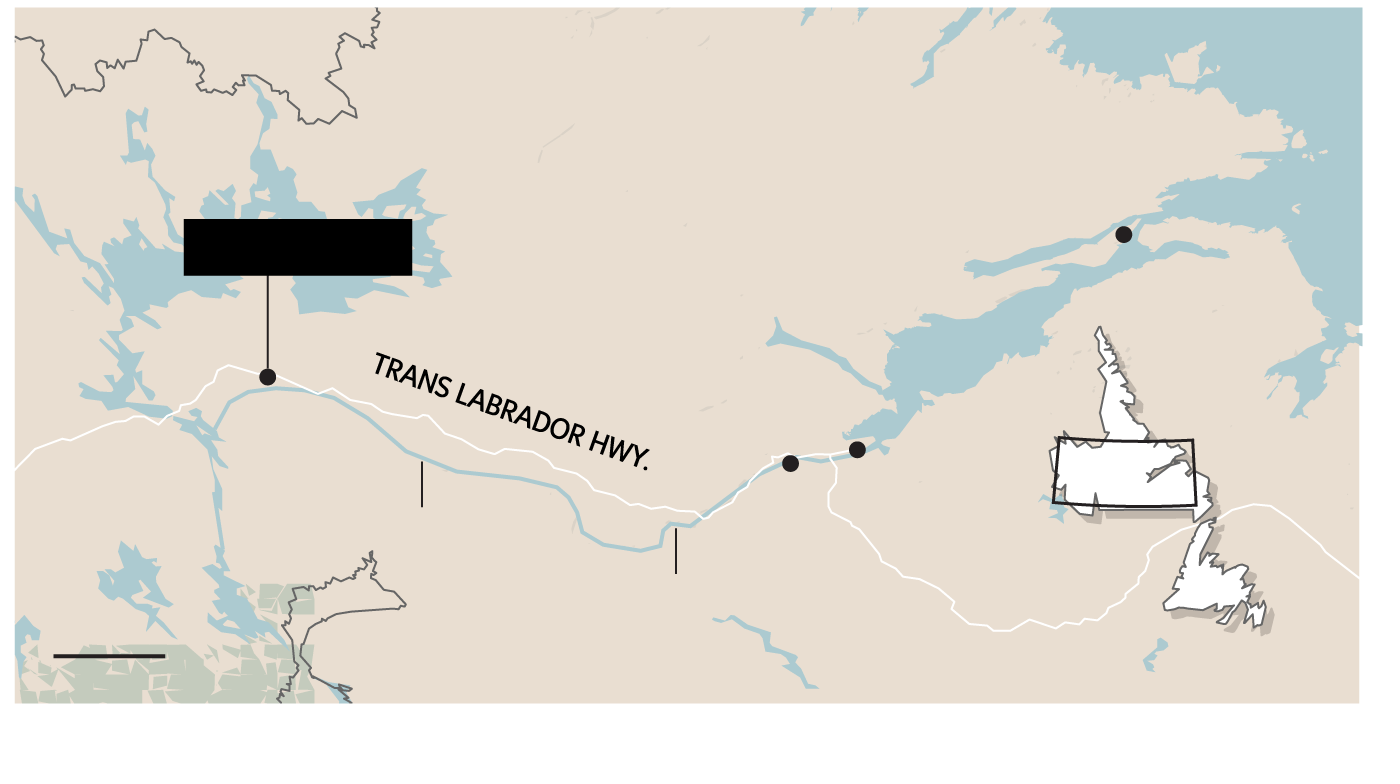
QUE.
Labrador
Sea
NEWFOUNDLAND AND LABRADOR
Rigolet
Churchill Falls
Lake
Melville
Happy Valley-
Goose Bay
Detail
Muskrat Falls
Churchill River
Gull Island
50 km
john sopinski/the globe and mail, Source: openstreetmap
QUE.
Labrador
Sea
NEWFOUNDLAND AND LABRADOR
Rigolet
Churchill Falls
Lake
Melville
Happy Valley-
TRANS LABRADOR HWY.
Goose Bay
Detail
Muskrat Falls
Churchill River
Gull Island
50 km
john sopinski/the globe and mail, Source: openstreetmap
QUE.
Labrador
Sea
NEWFOUNDLAND AND LABRADOR
Rigolet
Churchill Falls
Lake
Melville
Happy Valley-
Goose Bay
Detail
Muskrat Falls
Churchill River
Gull Island
50 km
john sopinski/the globe and mail, Source: openstreetmap
What’s more, the U.S. lenders Brinco had lined up to finance the estimated $900-million cost of Churchill Falls insisted it secure buyers for the project’s 5,400 mw of power in advance. With demand for electricity surging in Quebec as the province moved to attract energy-intensive industry, Hydro-Québec was both the most logical and most motivated partner. But the resentments built up between Newfoundland and Quebec made Mr. Smallwood reluctant to do a deal with Quebec premier Jean Lesage.
Mr. Smallwood instead commissioned studies on an alternative transmission route using underwater cables to carry power from Labrador to Newfoundland and on to U.S. markets. The idea proved both technologically iffy and hugely uneconomical. Newfoundland needed to do a deal with Quebec or see Churchill Falls go undeveloped. And Quebec drove a hard bargain.
“Under no condition will we permit anyone else to build a transmission line through Quebec,” Mr. Lesage declared in early 1965. “The absolute first condition since the beginning of negotiations ... is that Hydro-Québec shall become the owner of all electricity from Churchill Falls that travels through the province of Quebec.”
This is where sorting through myths surrounding Churchill Falls can be difficult. According to one version of the story, Mr. Smallwood put pressure on then-prime minister Lester Pearson to invoke the federal government’s declaratory power under the Constitution and deem the Churchill Falls project to be in the “national interest.”
That would have allowed for Ottawa to designate a power corridor through Quebec, overriding provincial control over electricity transmission. Mr. Smallwood drafted a formal letter to Mr. Pearson requesting that Ottawa invoke Section 92 of the Constitution, which allows the federal government to declare certain public works to be “for the general advantage of Canada or for the advantage of two or more provinces.” The letter was never sent.

Newfoundland Premier Joey Smallwood, left, speaks to Prime Minister Lester Pearson on the first day of a federal-provincial conference on the constitution in Ottawa on Feb. 7, 1968.John McNeill/The Globe and Mail
Whether Mr. Smallwood personally asked Mr. Pearson to intervene on Newfoundland’s behalf is unknown. Mr. Pearson may have pre-empted such a request by invoking the importance of national unity at a time when separatist sentiment was on the rise in Quebec.
Without Ottawa’s intervention, Brinco had no choice but to strike a deal with Hydro-Québec. A final agreement was reached in 1969. The 40-year deal called for Hydro-Québec to purchase nearly all the power from Churchill Falls (about 4,700 mw of the 5,400-mw total) for 0.3 cents per kilowatt-hour, with the price dropping to 0.25 cents in 2001. Under a 25-year extension clause included in the 1969 deal, the price further fell to 0.2 cents per kwh in 2016. The declining rate reflected the widespread belief, in 1969, that electricity prices would decline with the rapid expansion of nuclear power in North America.
In exchange for agreeing to cover cost overruns on Churchill Falls, Hydro-Québec saw its stake in CF(L)Co rise to 34.2 per cent. The Quebec utility also undertook to build a $400-million high-voltage transmission line through the province to connect Churchill Falls to its grid in southern Quebec.
Reaching the deal left indelible scars on Mr. Smallwood, who would later describe negotiating with Quebec as the “most maddening, most infuriating, most exasperating, most unendurable experience a Premier of a sovereign province can have in Canada … You are up against a complete stone wall – impervious, immovable, thoroughly selfish, no Canadian patriotism.”
Doubts about the Churchill Falls contract arose before the ink was dry. As oil prices and inflation spiked in the early 1970s, so did the market value of electricity. By 1974, then-Newfoundland finance minister John Crosbie estimated his province was losing out on as much as $200-million a year (or more than $500-million in current dollars) because of the fixed price Hydro-Québec was paying for power from Churchill Falls. Then premier Frank Moores threatened to nationalize Brinco to get a better deal.
In the end, the Newfoundland government bought Brinco’s stake in CF(L)Co, making it a direct partner with Hydro-Québec in Churchill Falls. But Mr. Moores still wasn’t able to get the Quebec utility to pay more, leaving a festering wound.
In 1980, Mr. Moores’s successor, Brian Peckford, decided to play hard ball. His government passed legislation repealing the water lease on the Churchill River, in effect cancelling the 1969 contract. “Newfoundland is not willing to lie down and play dead for the next 61 years of the upper Churchill contract while energy difficulties of unconscionable proportions ensue,” Mr. Peckford said at the time. But his gambit failed. In 1984, the Supreme Court of Canada unanimously struck down the Newfoundland law.
As a result, Hydro-Québec continued to rack up massive profits from reselling power from Churchill Falls in Quebec and northeastern U.S. markets at 10 times or more the price it paid CF(L)Co.
A 1996 report by Dominion Bond Rating Service (now Morningstar DBRS) estimated that Hydro-Québec made a profit of $536-million on the Churchill contract in 1994 alone and that the utility’s profits on the contract exceeded its overall earnings in most of the preceding years. Newfoundland, which was then Canada’s poorest province, was pocketing less than $20-million a year on the contract.

Former Newfoundland Premier Brian Tobin in 1998. In 1996, Mr. Tobin threatened to cut off power to Hydro-Québec. Two years later he was able to reach a tentative agreement on a $12-billion hydroelectric project deal with then-Quebec premier Lucien Bouchard.Fred Lum/The Globe and Mail
In late 1996, then-Newfoundland premier Brian Tobin seized on the DBRS report and threatened to cut off power to Hydro-Québec. “There is nothing decent about this,” Mr. Tobin told The Globe then. “And fundamental decency requires that the circumstances be adjusted to provide a fair return for Hydro-Québec and a fair return for the people of Newfoundland … And it will occur in one fashion or another.”
Ottawa viewed Mr. Tobin’s threat, a year after Quebeckers had only narrowly rejected sovereignty in referendum, with trepidation. Then-Quebec premier Lucien Bouchard had been seeking to create the “winning conditions” for a do-over vote on separation. Federalists feared Mr. Tobin’s belligerence would play into Mr. Bouchard’s hands.
Mr. Tobin eventually backed down, and Mr. Bouchard agreed to hold talks with Newfoundland on the joint development of new hydroelectric projects in Labrador. In 1998, the two premiers reached a tentative agreement on a $12-billion deal, including new transmission lines, to build a second 1,000-mw-generating station at Churchill Falls and a 2,200-mw facility downriver at Gull Island.
But the deal began to fall apart even before it was officially announced. Innu protestors blocked the premiers from holding a press conference at Churchill Falls. Before long, the tentative deal was scrapped altogether.
When Danny Williams became premier in 2003, he vowed never to do a deal with Quebec. His decision to bypass Quebec and go it alone on the construction of an 824-mw hydro generating station downriver from Gull Island, at Muskrat Falls, and an underwater transmission line to Newfoundland, would end up almost bankrupting the province.
The project, initially estimated at $6.2-billion, ended up costing more than $13.5-billion. Ottawa was forced to bail out the province, first by guaranteeing more than $9-billion in Muskrat Falls debt, and again in 2021, by putting up $5.2-billion to subsidize electricity rates in Newfoundland.

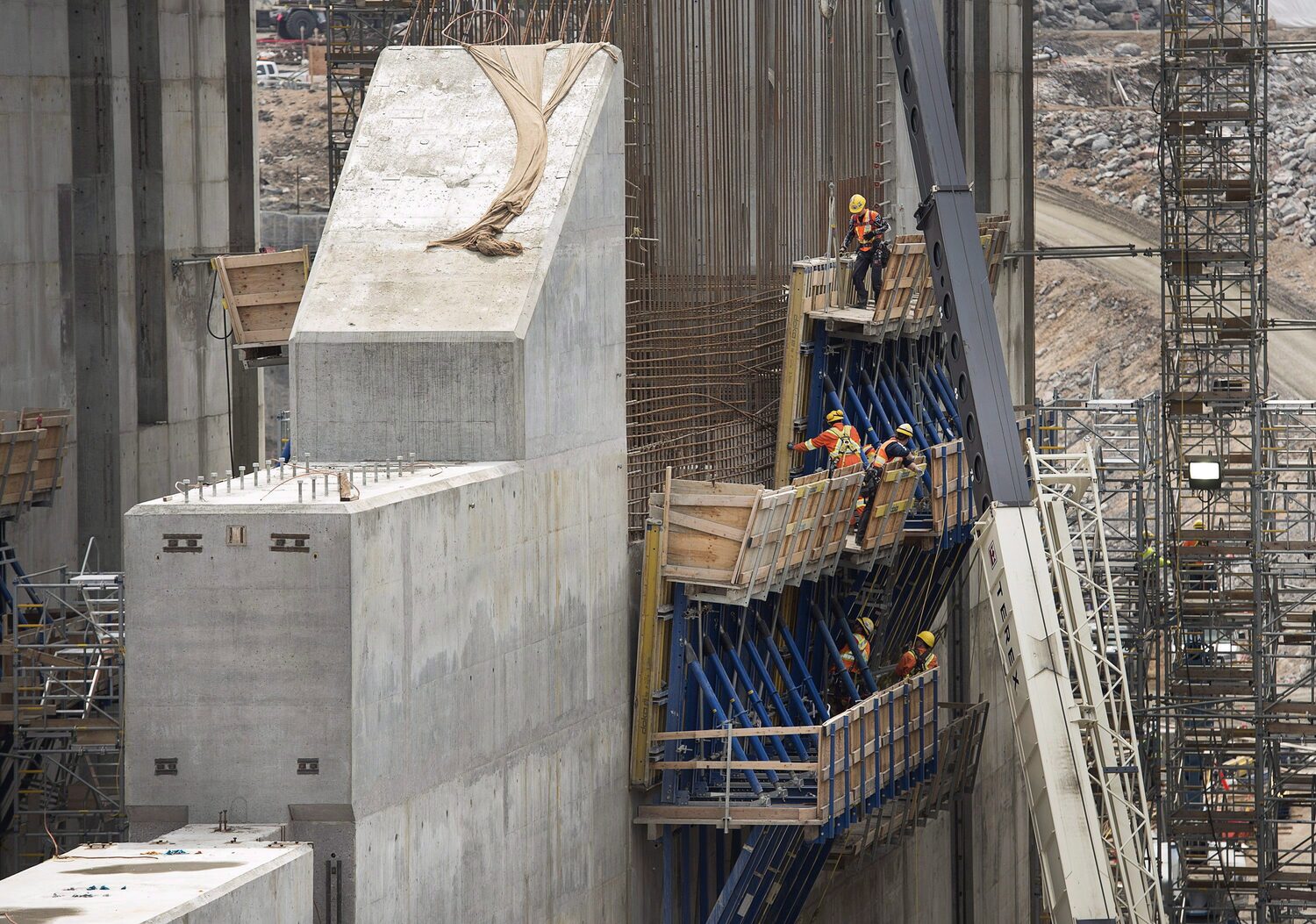
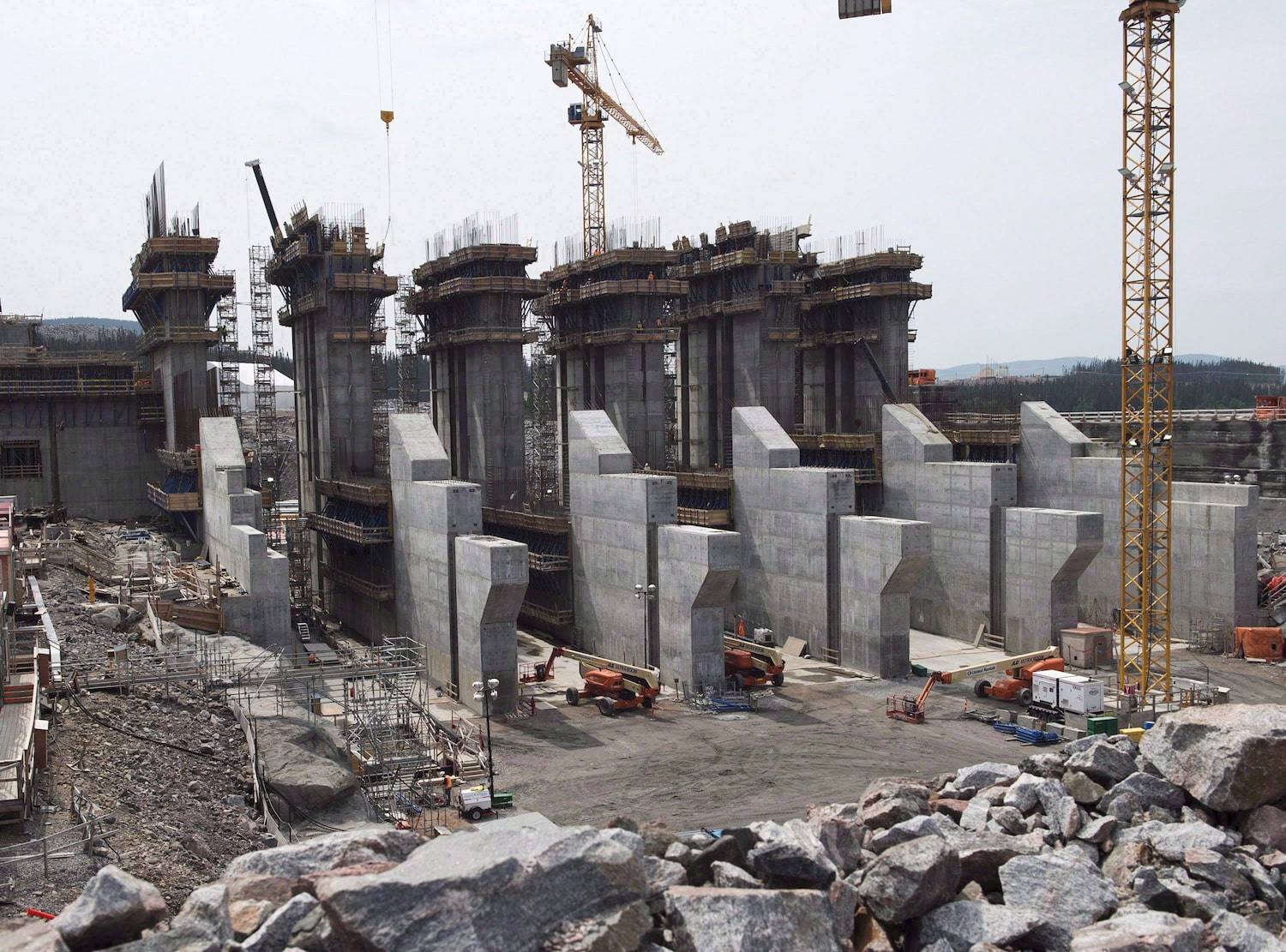
When Andrew Furey became premier, taking over from fellow Liberal Dwight Ball in the summer of 2020, the province was teetering on the precipice. The previous March, as the COVID-19 pandemic sparked lockdowns and rattled investors, Newfoundland found itself unable to borrow on financial markets. Low crude prices sapped royalties from the province’s offshore oil industry. Newfoundland’s ratio of net debt to gross domestic product soared to nearly 50 per cent, the highest of any province. Investors shunned Newfoundland treasury bills and bonds. Mr. Ball turned to Ottawa for help, warning his province had “run out of time.”
Four days later, the Bank of Canada announced that it would purchase up to 40 per cent of provincial money market securities, or more if needed. The move bought Newfoundland precious time. But it couldn’t fix the province’s longer-term fiscal problems. Mr. Furey came to office with the goal of doing that based on a two-pronged approach. First, by reaching a deal with Ottawa to offset the potentially devastating impact of debt from Muskrat Falls on electricity rates in the province; and second, by starting negotiations to extract more cash from Hydro-Québec.
“Any leader in Newfoundland and Labrador has to consider the Churchill River and what role they will play in its history,” Mr. Furey said. “I thought my role would be to reset the relationship with Quebec. That’s no easy feat given the anger we have felt towards Quebec because of this unbalanced and unfair deal, albeit legal.”
Newfoundland’s bargaining position had been weakened when, in 2018, the Supreme Court once again ruled in Hydro-Québec’s favour in a 2010 lawsuit filed in Quebec Superior Court by CF(L)Co. It had argued that Hydro-Québec breached its “general duty of good faith” by refusing to renegotiate the 1969 deal. In a seven-to-one ruling, the top court demurred. “There is no legal basis on which a judge could impose a new bargain on Hydro Quebec to which it had not agreed.”
Justice Malcolm Rowe, a former Newfoundland Supreme Court judge, issued a dissenting opinion, insisting Hydro-Québec had an “obligation to co-operate,” considering the unforeseen market conditions that had enabled it to reap “extraordinary profits.”
Another potential stumbling block to negotiations with Quebec involved Ottawa’s mid-2021 move to provide $5.2-billion to Newfoundland to subsidize Muskrat Falls electricity rates.
The agreement involved transferring $3.2-billion in future federal revenue from the Hibernia offshore oil development to the province. Ottawa also invested $1-billion in the Labrador-Island Link and provided a $1-billion loan guarantee on the project. The federal deputy minister of finance who finalized the deal was Michael Sabia, who, two years later, would be tapped by Mr. Legault to take the reins at Hydro-Québec.
The rate mitigation agreement was loudly criticized by opposition politicians in Quebec, who objected to the use of federal tax dollars to bail out Muskrat Falls and argued it undermined Hydro-Québec’s bargaining position.

Former Newfoundland and Labrador Premier Andrew Furey holds his first meeting with Quebec Premier Francois Legault in Montreal in August, 2021.Graham Hughes/The Canadian Press
Two months later, when Mr. Furey held his first meeting with Mr. Legault in Montreal, the Quebec Premier was under intense pressure at home to denounce the bailout. Instead, he held his tongue.
“The federal aid to Newfoundland did not help me,” Mr. Legault conceded. “But I did not want to oppose it because I had established a friendship with Andrew, and I knew Andrew needed this aid.”
Despite the goodwill between them, Mr. Furey and Mr. Legault started out from vastly different negotiating positions. The Newfoundland premier’s top priority was reaching a new deal on Churchill Falls that would enable his province to pocket significantly more cash before the contract’s 2041 expiry date. But Mr. Legault was unwilling to renegotiate the 1969 Churchill Falls deal in isolation. He would only agree to reopen the contract as part of a comprehensive deal that included new hydro projects on the Labrador river.
“I told him: ‘For me to be able to give you what you want in the short term, you need to give me more in the medium and long term,’” Mr. Legault said. “I’m an accountant, and I tried to balance the gains for each of us.”
The talks moved slowly at first. Mr. Furey continued to insist on renegotiating the Churchill Falls contract first before considering future developments. In early 2022, he appointed an expert panel with a mandate to recommend “potential approaches for the government to ensure maximum long-term benefits for the Churchill Falls assets.” He tapped Mr. Smith, the former Fortis executive, to lead the group.
Mr. Legault, meanwhile, began publicly touting the construction of new hydro dams in Quebec as part of an electrification strategy aimed at making his province “the battery of North America.” Quebec had long dangled cheap electricity rates to lure industry to the province. Mr. Legault, campaigning for re-election in 2022, vowed to intensify this approach if he won a second term.

Electrical transmission cables connect Quebec to the Churchill Falls hydroelectric project. Mr. Legault says Quebec needs to prioritize new hydro projects to ensure the province meets its growing energy needs, even without power from Churchill Falls after 2041.Greg Locke/Reuters
Given the long timelines involved in building new hydro developments, Mr. Legault insisted Quebec needed to fast-track new projects to ensure the province could meet its growing energy needs even without power from Churchill Falls after 2041.
“I don’t want to have my hands tied behind my back negotiating with Newfoundland, obliged to sign no matter the price,” Mr. Legault said in 2022.
He later told Radio-Canada: “I don’t want to negotiate with Newfoundland saying, ‘I absolutely need your electricity.’ I want to have a Plan B.” He said his government aimed to build “four or five” new hydro dams in Quebec.
Such talk was, in part, aimed at putting pressure on Mr. Furey. But it drew skepticism from an unlikely source: then-Hydro-Québec CEO Sophie Brochu, who had been appointed to the job in 2020 by Mr. Legault himself.
In a late-2022 radio interview, Ms. Brochu said Quebec should avoid seeking to become “the world’s dollar store of electricity.” She questioned the wisdom of an industrial strategy that involved selling power for less than Hydro-Québec’s marginal cost of production on new projects. Her comments did not sit well with Mr. Legault and his then-powerful economy minster, Pierre Fitzgibbon. In January, 2023, Ms. Brochu announced her resignation.
A month later, Mr. Legault travelled to St. John’s to meet Mr. Furey. It was there that he publicly acknowledged for the first time that the 1969 contract had become “a bad deal” for Newfoundland. He made it clear that he was prepared to renegotiate it – if Mr. Furey was willing to include the development of Gull Island in the talks.
Mr. Legault knew exactly who he wanted to get the job done. No executive search was conducted to find a replacement for Ms. Brochu at Hydro-Québec. Instead, Mr. Legault and his chief of staff, Martin Koskinen, reached out to Mr. Sabia, whom the Premier had come to know during the decade that the former BCE head had spent as CEO of Caisse de dépôt et placement du Québec.
As Parti Québécois finance critic in 2009, Mr. Legault had been critical of then-Liberal premier Jean Charest’s appointment of Mr. Sabia. As an Ontario-born anglophone, Mr. Sabia did not fit the mould of a Caisse chief.
The public-sector pension fund manager had been created in 1965 in part to symbolize French-Canadian economic prowess. Its previous CEOs had all been Quebec nationalists and staunch defenders of the Caisse’s unique mandate, which included leveraging pensioners’ savings to contribute to Quebec’s economic development. In opposition, Mr. Legault had complained that, under Mr. Sabia, the Caisse was not investing enough in Quebec-based companies.
By the time he became Premier, however, Mr. Legault had been won over by the Caisse’s consistently strong performance on Mr. Sabia’s watch. The pension fund manager had suffered far steeper losses than its peers after the 2008 financial crisis, shaking public confidence in the institution referred to locally as “Quebeckers’ nest egg.” Mr. Sabia had restored the Caisse’s reputation and financial health.
In early 2023, Mr. Legault asked him to take the reins at Hydro-Québec at a critical inflection point.

From left, Hydro-Québec CEO Michael Sabia, former Quebec premier Jean Charest, and Quebec Premier Francois Legault at the inauguration of the La Romaine hydroelectric plant in Havre Saint-Pierre, Que., in October, 2023.Jacques Boissinot/The Canadian Press
After spending much of the previous decade sitting on huge energy surpluses, Hydro-Québec was suddenly facing looming electricity shortages as the province aimed to become net zero by 2050. The new Hydro-Québec CEO would not only have to engineer a paradigm shift at the utility, he or she would need to develop a plan to meet an anticipated doubling of electricity consumption in the province by mid-century.
For Mr. Sabia, who had just spent more than two years as then-finance minister Chrystia Freeland’s deputy, the chance to lead infrastructure developments was too tempting to turn down.
“The issue about Canada needing to step up on energy projects was obvious, and Hydro-Québec was an opportunity to actually make something happen,” Mr. Sabia said in an interview at the utility’s Montreal head office before the announcement of his July 7 return to Ottawa as Mr. Carney’s top bureaucrat. “If you’re going to deal with climate change, you’ve got to electrify. And Hydro-Québec was in a good position to do it.”
In November, 2023, barely three months into Mr. Sabia’s tenure as CEO, Hydro-Québec unveiled an ambitious plan to add up to 9,000 mw of power to the Quebec grid by 2035. The plan, which included building new hydro developments, came with an eye-popping price tag of between $155-billion and $185-billion. But it was silent on the locations for new dams in Quebec. There was a reason for that.
For all his talk of launching new hydro projects in Quebec, Mr. Legault’s preferred option remained reaching a deal with Newfoundland, expanding the capacity of Churchill Falls and building a new generating station at Gull Island.
Energy experts had long considered Gull Island the most attractive undeveloped hydro site in North America. It was too big of a project for Newfoundland to undertake on its own. That was the main reason the province made the fateful mistake of developing Muskrat Falls instead.
Gull Island had also undergone a previous environmental review and was covered by an impact benefits agreement between the Newfoundland government and the Innu Nation of Labrador, which meant it could be built much faster than any greenfield hydro project in Quebec.
Negotitators for the Quebec utility and NL Hydro held an initial meeting in March, 2023, at The Mercantile Social, a swanky Halifax restaurant. The tab, which was split equally between Hydro-Québec and NL Hydro, came to $2,035, including tip.
In a note released under Newfoundland’s access to information law, NL Hydro described the meeting as “preliminary discussions with executives, deputy ministers and senior support teams of Hydro Quebec and Newfoundland and Labrador Hydro concerning Churchill Falls … in an effort for the teams to get to know each other better, thereby enhancing each team’s ability to have the most constructive discussions possible.”
Still, the meeting served to accomplish little more than breaking the ice as the two utilities pursued different priorities.

Hydro‑Québec CEO Michael Sabia and NL Hydro CEO Jennifer Williams at an energy conference in St. John's, N.L., on June 3, 2025. Mr. Sabia and Ms. Williams were key figures in reaching a deal between their two provincial utilities.The Canadian Press
“What had been a thorn in the side of Newfoundland was the 1969 contract, so [renegotiating] that was our primary goal,” NL Hydro CEO Jennifer Williams explained in an interview at the utility’s St. John’s headquarters. “Their primary and secondary goals were the opposite of our primary and secondary goals. There was a fundamental goal that we had to achieve, or we would not bring this forward to the people of this province. We could no longer have this asset, Churchill Falls, not reflect what it’s worth.”
Instead of the 0.2 cents per kwh that Hydro-Québec was paying for Churchill Falls power, NL Hydro maintained that a new deal would need to take into account not just the spot market price for electricity in the U.S. northeast – an important benchmark, but one whose level had stagnated in recent years – but the cost of new energy projects in Quebec, or Hydro-Québec’s replacement cost. The latter was estimated at between 11 cents and 13 cents per kwh.
“That figure is what Churchill Falls was worth to Quebec,” Ms. Williams said.
Mr. Furey drove that point home at a September, 2023, meeting of eastern premiers and New England governors in Quebec City. “We’d like to see what Mr. Legault has to offer … It will have to be a good deal for Newfoundland and Labrador for us to entertain any further developments,” he said. “Show us the money.”
Once Mr. Sabia took over at Hydro-Québec, the talks accelerated rapidly. Mr. Sabia and Mr. Rhéaume held several in-person meetings with Ms. Williams, Mr. Smith and Mr. Mahoney at Hydro-Québec’s Montreal headquarters and in the office’s of NL Hydro’s law firms in Montreal and St. John’s.
The Newfoundland utility was respresented by Gregory Connors and Doug Skinner of McInnes Cooper in St. John’s; Éric Mongeau and Dominique Rolland of Stikeman Elliott were NL Hydro’s lead lawyers in Montreal. Hydro-Québec was represented by former Alcan chief counsel David McAusland of McCarthy Tétreault.
“The talks were more focused with Michael,” Ms. Williams said. “We wouldn’t spend a whole lot of time socially over dinner. There was not a minute wasted when I was in his presence.”
A breakthrough came in March, 2024, in a one-on-one meeting between Mr. Sabia and Mr. Smith at the Halifax Club. “The first time I felt there were prospects of getting to a deal was after that conversation with Karl,” Mr. Sabia recalled. “I reported back to the Premier and Martin [Koskinen] that I thought there was a framework [for an agreement]. After that, the frequency of meetings really picked up in the spring and summer.”

In December of 2024, Quebec Premier Francois Legault and former Premier of Newfoundland and Labrador Andrew Furey officially signed a memorandum of understanding between Hydro-Québec and NL Hydro, whereby the Quebec utility would pay significantly more for power from Churchill Falls between now and 2041, with the price ramping up further until 2075.Paul Daly/The Canadian Press
The drafting of a memorandum of understanding between Hydro-Québec and NL Hydro took several weeks as lawyers went back and forth over the legal text of the agreement.
But on the morning of Dec. 12, Mr. Legault and Mr. Furey held a press conference at The Rooms, a landmark on the St. John’s skyline and home to the provincial art gallery and archives, to unveil a deal few present at the event had thought possible only a few years earlier.
More than five decades after the Churchill Falls contract poisoned Quebec-Newfoundland relations, the two premiers announced new terms for that contract and plans to build $25-billion worth of new hydro projects in Labrador. “This changes everything,” a beaming Mr. Furey said.
With that, he proceeded to rip a copy of the 1969 contract in two, as a smiling Mr. Legault looked on approvingly. The deal, the Newfoundland premier insisted, would “unlock the true potential of the Churchill River for generations to come.”
Mr. Legault was equally enthusiastic. “This allows us to secure a major energy block for several generations while ensuring a price far lower than the alternatives,” Mr. Legault said. “It’s win-win.”
Unlike in 1969, Labrador Innu communities were consulted throughout the negotiations this time around. “Finally we, the Innu, are being included in [the] partnership,” Innu Nation Grand Chief Simon Pokue told CBC News. Mr. Pokue did not respond to interview requests from The Globe.
There are still several details Hydro-Québec and NL Hydro will need to work out before a definitive agreement is signed. Among them is the formula for calculating the exact price Hydro-Québec will pay for Churchill Falls power.
Hydro-Québec maintains that its overall payments over the 50-year term of the new Churchill Falls contract – $33.8-billion in current dollars – will not change regardless of what formula is adopted. The net cost for Hydro-Québec would amount to $26-billion in current dollars once the utility’s 34.2-per-cent stake in CF(L)Co is accounted for. The average price Hydro-Québec would pay for power from Churchill Falls would rise 20-fold, to 4 cents per kwh, from 0.2 cents now.
The price the Quebec utility would pay for power from Gull Island would be based on the cost of production, estimated at 11 cents per kwh, over 50 years beginning in 2035. Hydro-Québec would oversee construction of Gull Island, which would be 60-per-cent owned by NL Hydro and 40-per-cent owned by the Quebec utility. It would assume any cost overruns.
Hydro-Québec would also need to build a new transmission line to connect Gull Island to the Quebec grid. Mr. Legault has called on Ottawa to help fund the estimated $3-billion cost of the project. The line will cross traditional Innu territory in Quebec; Hydro-Québec is open to Indigenous ownership of the line.
Indeed, Mr. Legault and Mr. Furey remain keenly aware that any final deal will need to pass muster with Indigenous communities and voters in their respective provinces.
Newfoundlanders are deeply distrustful of Hydro-Québec and fear their province could again be outmanoeuvred. Mr. Legault faces criticism at home, too. Parti Québécois Leader Paul St-Pierre Plamondon called the Premier’s move to reopen the 1969 contract “humiliating for Quebec” and slammed Mr. Legault for “remaining silent about the theft of Labrador.”

Despite criticism within the province, Quebec Premier Francois Legault, who has said he intends to seek a third term in office, defends the deal and touts its long-term saving for Quebec.Jacques Boissinot/The Canadian Press
Mr. Legault has not let the criticism get to him. His pride is evident in the enthusiasm with which he defends the deal.
“I tried to equalize the gains for both parties – around $200-billion for Newfoundland and $200-billion for Quebec,” the Premier explained to the Globe. “Obviously, it’s not the same $200-billion for each of each. Andrew’s $200-billion is additional revenue for Newfoundland. For me, the $200-billion is the savings for Québec compared to the alternatives. Where there is a risk for me is in the fact that Newfoundland’s $200-billion will start flowing right away.”
Quebec’s savings will be realized much further down the road, as power from Gull Island begins to flow.
In the interim, Hydro-Québec’s bottom line is expected to take an annual hit of about $300-million, and industrial customers in Quebec will see their electricity rates increase by an additional 0.4 per cent a year to cover the higher price the utility has agreed to pay for power from Churchill Falls before 2041.
“We get elected every four years,” Mr. Legault said. “To say that I have a very good agreement for Quebec through to 2085 is not necessarily a big seller in politics.”
The Quebec Premier, who has said he intends to seek a third term in office, still has more than a year left in his second mandate. Newfoundlanders will go to the polls much sooner. Mr. Furey’s successor, Mr. Hogan, must call an election by early September. The deal with Quebec promises to figure prominently in the campaign.
The Newfoundland House of Assembly approved the MOU with Hydro-Québec in January after holding four days of hearings on the deal. But the province’s 14 Progressive Conservative MHAs walked out of the legislature before the vote, calling for an independent review of the MOU by the province’s Public Utilities Board (PUB) or another neutral body.
Other critics have also called for more scrutiny of the MOU, including David Vardy, an ex-PUB chairman and former senior bureaucrat.
“I am of the view that the [larger] payments from Churchill Falls up to 2041 [included in the MOU] are borrowed from future payments,” Mr. Vardy said. “The government wanted to get a short-term flow of cash. They were driven by the exigencies of our desperate financial situation to come up with something.”
Mr. Vardy, who sat on Mr. Furey’s 2022 expert panel on Churchill Falls, said NL Hydro should have sought private-sector bids for Churchill Falls power, post-2041, and the development of Gull Island, instead of entering exclusive negotiations with Hydro-Québec. “I would have preferred a more market-oriented approach with preference given to people who were going to do things in the province.”
Newfoundland held talks in the past with multinational mining companies to attract an aluminum smelter to Labrador. No deal was ever reached. That could change in the future. Under the MOU with Hydro-Québec, Newfoundland would see its share of electricity generated from Churchill Falls and Gull Island quadruple to almost 2,000 mw. The province aims to use that power to lure new industry to Labrador.
“We’re open for business for these really big projects to come,” Ms. Williams said. “There are a lot of additional economic benefits that will flow to provincial and federal coffers.”
There are still big hurdles to overcome, of course. In late May, PC Leader Tony Wakeham called for the MOU with Hydro-Québec to be put on hold until the completion of federal-provincial negotiations aimed at creating a “national trade corridor.”
Mr. Carney and the premiers have agreed to advance discussions to build infrastructure projects “that connect the country from coast to coast,” including transmission lines. Mr. Wakeham insisted that a national electricity grid would enable Newfoundland to wheel power from Churchill Falls through Quebec, bypassing Hydro-Québec.
“It seems we’re being driven by Quebec and their agenda and their deadline,” he said in an interview. “We ought to be making sure it is the best deal for Newfoundland and Labrador, and that it can survive the test of time.”
As a native Newfoundlander, NL Hydro’s Ms. Williams understands such skepticism. “Because of the history of this file, we know there are going to be folks in Newfoundland and Labrador who are really nervous about whether this is the right deal,” she said. “Everyone working on this felt the weight of history. There are times when you’re doing the math, and the math says this can work. Then you lift your head up from the math and look at history and say, ‘Gosh, this is really going to happen.’ I truly believe this is going to bring life-changing opportunities to this province.”
Mr. Sabia is equally bullish. “If you look at Canada’s circumstances today, we have got to get serious as a country in terms of investment and resource development. We need to take on big things, finance big things and do things faster. That is what I see here,” the Hydro-Québec chief opined. “Here is an example of Canada working constructively on an east-west basis. We absolutely, as Canadians, need more of these.”