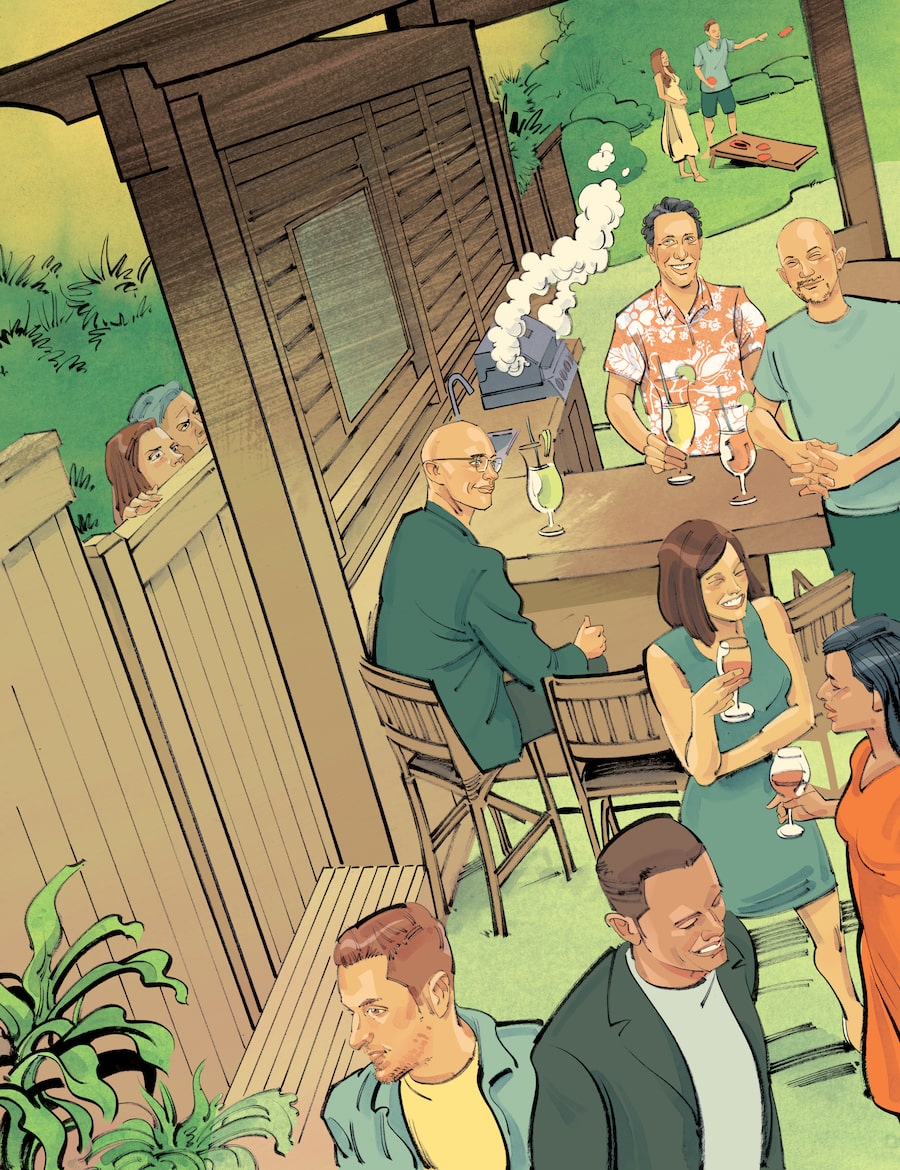
On Nov. 27, Wychwood Park, an unusual private community in Toronto just northwest of Bathurst and Davenport, held its annual general meeting. The evening proceeded pleasantly, with discussions about a full year of events and maintenance. The neighbours talked water-flow issues and the revival of May Day celebrations, as well as a plan for replacing a historical plaque that had recently been stolen from the north entrance, one of two sets of gates. The Tree, Pond & Ravine Committee reported on its battle against invasive goutweed. And new neighbours were formally welcomed, including Bonnie Brooks, former vice-chair of Hudson’s Bay Co.; Nicholas Zimmel, a vice-president of Mastercard; and Peter Smaluck, the founder of a research platform for sports fans and gamblers.
Near the end of the program, Daniel Debow, a Stanford-trained lawyer and former Shopify vice-president, stood to address the crowd. He hadn’t served on any of the committees that had proffered their reports, and he was relatively new to “the Park.” But Debow did have something he wanted to get off his chest: The way the Park had been doing things for over 130 years was wrong—and Debow had a plan to disrupt the governance of the enclave of 60-odd homes.
As his neighbours shifted uncomfortably in their chairs, anxious about a potential delay to cocktail hour, Debow told them that the present system of appointed trustees urgently needed to be updated. Under a deed enshrined in 1891, three trustees oversee the governance of Wychwood Park, taking on a list of mostly tedious tasks that includes ensuring the shared road was plowed and tennis court swept and pond de-scummed. There were no term limits. When a trustee dies or decides they’ve had enough (or, in theory, are removed by community vote if proving troublesome), they discreetly tap someone on the shoulder to assume his or her role. Most neighbours I spoke to weren’t troubled by this structure; they were just happy to have someone else—anyone else—do the work.
But to Debow, it was anti-democratic. Trustees should be subject to term limits of three years, he said. They should be elected on a revolving basis, an election every year for one trustee. It was a sizeable change, but there are other elected bodies in the Park, including the Heritage Advisory Committee, the Historical Society and the Residents’ Association. And Debow noted that most residential communities in Canada (though I suspect it’s hard to find many direct peers to the Park) involve some kind of resident input into leadership—especially for what could functionally be lifetime appointments. He wanted to strike a committee to explore all of this. When he sat down, Batori Group realtor Bobby Pasternak and former private equity guy turned Mejuri jewelry co-founder Majed Masad, both also relatively new to the Park, congratulated him, and one reportedly fist-bumped him in approval.
One neighbour later referred to Debow’s comments as a “hijack attempt.” Others described it as a solution in search of a problem. Perhaps Debow, who has been on a sabbatical from work since January 2025, just has too much time on his hands? Spirited debate, as they say, ensued. The present model, while imperfect, reflects the historical commitment to heritage preservation, some noted; after all, Wychwood Park isn’t some generic condo building. And why three years instead of six? It must have presented a bit of cognitive dissonance—arguing against the virtues of representative democracy with a guy who was once referred to as “the Forrest Gump of Canadian tech.” Seán O’Neill, a partner at McCarthy Tétrault, moved to amend Debow’s motion to broaden the proposed committee’s mandate to examine all possible ways of selecting trustees and the creation of trustee terms of reference. That motion carried, supported by Debow. The meeting was adjourned at 9:55 p.m. Refreshments followed.
A committee was indeed formed, with Debow seemingly leading the charge, but that was only the beginning of an increasingly contentious debate. Many neighbours are taking a wait-and-see approach to any proposed changes, but some feathers have clearly been ruffled. In the aftermath of the AGM, one trustee, Roger Dent, CEO of Quinsam Capital Corp., resigned after roughly 10 years in the position. He told me that he’s worried about an erosion of the common good that unifies the Park. “Everyone’s played together in the same sandbox, knowing that we may disagree, but we’re better off to have little compromises than to have the whole character of the neighbourhood fundamentally change,” he said. But it wouldn’t take much to tip things in a different, less-enchanted direction. “We’re still living in the 1960s here.”

Richard Drew/The Associated Press

Tobias Lutke, co-founder and CEO of Shopify (top), and Wealthsimple CEO Michael Katchen, are among the new residents of Wychwood Park.Cole Burston/The Canadian Press
While many of the Park’s inhabitants have lived there for decades, sometimes even generations, the past five years or so has seen a new contingent of residents—younger, ultrawealthy, more ostentatious. In other words, the Park, established over a century ago as an upscale arts colony and magical repository of cultural and architectural preservation, has been experiencing an influx of mostly 40-something business bros. In addition to Debow, Pasternak and Masad, the list includes Shopify’s Tobias Lütke and Wealthsimple’s Michael Katchen. This new constituency, members of Toronto’s exploding wealth club, was described to me by other residents with the same detached and slightly disturbed fascination one might use to describe a nest of raccoons that had taken up residence in your yard. It wasn’t clear that they meant any harm, and they also needed somewhere to live. They were just…different. And it was a bit weird having them on your property.
Both rules and norms have preserved the Park, which in 1985 became one of Ontario’s first Heritage Conservation Districts, as an oasis unlike anything else in Toronto. When Douglas Goold, a senior fellow at Massey College and former vice-president of policy at the Toronto Region Board of Trade and a Park resident since 1991, and his wife, journalist Libby Znaimer, wanted to put a new shed in their backyard, they sent the proposal to the Park’s Heritage Committee to ensure it was simpatico. “You think this is all ridiculous, but look at the results,” Goold told me, gesturing to the enviable expanse. He described evenings drinking vintage port on neighbours’ verandas, the sounds of the city muffled by ancient oak trees. The newer crop of owners might have seemingly limitless funds, but some residents worry they have less reverence for the quirks of the community. Instead of feeling protected by the rules, they feel stymied. “They seem to want things to be a little different and are surprised by how difficult it is to effect change,” said a former resident.
Many of the houses in Wychwood Park have long been expensive, even for Toronto. (In 2018, 82 Wychwood Park sold for $5.9 million.) But until very recently, there were almost no tear-downs or even gut renos. That’s starting to change. The mantra among the newest additions, a former resident told me, is “buy for five and then spend 10”—as in, pay $5 million to buy a property and another $10 million to renovate it, with all the ancillary neighbourhood disruptions that flow from there.
Debow’s own five-odd-year renovation (his large black-stucco home was listed for $5 million in 2020, and has three woodburning fireplaces, a modern eat-in kitchen and original wood accents) is rumoured to have cost upward of $20 million. Investment manager David Dattels flipped a home to Lütke in 2023. And a very contentious place on Wychwood Park, an incongruous 4,500-square-foot boxy grey brick supposedly inspired by Frank Lloyd Wright, was built after a lengthy battle with developer Tsur Moses, who bought the lot in 2007 for $1.5 million. Moses initially wanted to sever a lot, demolish a heritage home and build two modern houses; he went to Ontario’s quasi-judicial land tribunal but later struck what has been described to me as a compromise—though neighbours still grumble about it. The house was later purchased by Mejuri co-founders Noura Sakkijha and her husband, Masad.
And it’s not just the massive renos. Debow wanted to permanently open the neighbourhood’s south gate—usually kept closed to minimize through traffic and looky-loos—and when the trustees didn’t immediately acquiesce, he hired a blue-chip consultant to produce a report that made his point. (One resident told me Debow wanted it open so he could save five minutes when driving his kids to a nearby private school.) Debow lost that battle, at least for now, but a new precedent of throwing around that kind of money to get one’s way was unnerving to some. To be fair, he’s not the only one. I also heard from one resident that when Lütke’s neighbour complained about the brightness of his outdoor lights, he bought her home. Another resident told me that private security details now regularly cruise the Park.
The history of Wychwood Park reads a bit like a fairytale. It was founded by Marmaduke Matthews, a landscape painter who emigrated to Toronto in 1860 from England. Matthews was hired by Canadian Pacific Railway to travel cross-country and paint both the Prairies and Rocky Mountains. His works are in the permanent collections of the National Gallery of Canada and Art Gallery of Ontario. But he fell in love with a plot of land near the growing city of Toronto. At the time, the intersection of Bathurst and Davenport was rural and bucolic, and the massive oak trees reminded Matthews of home. In 1874, he built a handsome two-storey brick house on the land, which he named after Wychwood Forest in Oxfordshire.

Artist Marmaduke Matthews (second from left) among fellow members of the Ontario Society of Artists circa 1889. Matthews founded Wychwood Park in 1874 when he built his house on the land.Archives of Ontario
Matthews wanted to build an artists’ colony, a place of both inspiration and conservation. In 1891, Wychwood Park was registered as a subdivision and a “park reserve,” and the area included part of Taddle Creek and its pond. Soon, more tasteful homes were built, many designed by the architect Eden Smith in traditional Arts and Crafts style. Wychwood Park was never an enclave for starving artists; it has always served as a romanticized community for cultural leaders with high taste. Marshall McLuhan lived there, as did artist and architect George Agnew Reid, entrepreneur Sir William Gage and University of Toronto mathematics and psychology professor Anatol Rapoport, who co-founded Science for Peace. But while much of the architecture is quietly grand—Wychwood Park’s largest home, inhabited by Michael Hirsh, former head of children’s entertainment companies Nelvana and Cookie Jar, and Elaine Waisglass, a photographer, has a ballroom—the philosophy of the Park has always been to foreground the natural environment. It was a tastefully utopian if undeniably bourgeois vision.
When I reached out to Susan Hoyle-Howieson, president of the Wychwood Park Residents’ Association and a member of Debow’s new committee, in January, she declined to speak but sent me a statement. “Wychwood Park is beloved precisely because it feels unchanged. It is a rare and carefully preserved community whose physical character, landscape and atmosphere evoke another time and place,” she wrote. “Walking along its road feels like stepping back in history—and that sense of continuity is deeply valued by residents and visitors alike. But the Park’s distinctiveness is not only architectural or historical. It is sustained by an unusually engaged community of residents who invest significant time and care in maintaining strong neighbourly relationships and stewarding the common lands. Conflicts are rare, and governance has traditionally been collaborative and volunteer-driven.” She added that the mandate of the trustee review committee is to explore the idea of modernizing governance but also described it as “exploratory and consultative.”
Debow’s espoused principles of democracy and transparency were hard to argue with—in theory. But in practice, with a now-open spot for trustee, some Park residents were hard pressed to understand why, if he felt so passionate about the issue of governance, Debow didn’t just volunteer to fill it and wield lifelong power there instead of trying to overhaul more than a century of precedent. But Debow, perhaps bolstered by his fellow masters of the universe, seemed convinced that a move-fast-and-break-things approach to the Park would yield the best results.
It wouldn’t be the first time. “I hear that Wychwood Park is fighting the heritage vs. money battle again,” wrote Annabel Vaughan, an architect based in Vancouver (and sister to former Toronto city councillor Adam Vaughan), in an email after Report on Business first reached out to her. When Vaughan was growing up in Wychwood Park in the 1970s and ’80s, she remembers it as solidly upper middle class. But even then, there were starting to be concerns about wealthier people hoping to throw their financial heft around. “They created issues because they wanted things their way,” says Vaughan. “And it puts enormous pressure on the collective.”

The collective terms of the Park are outlined in a unique 1891 deed that governs how common assets are managed. It requires residents to pay levies on a sliding scale, based on assessed land value, for things like road and tennis court maintenance. Historically, fees have been collected with minimal fuss. But a relatively recent neighbourhood dust-up, referred to me by more than one resident as “the Owen case,” raised questions about how many of the Park’s rules are simply unenforceable norms.
Around 2008, Ivon Owen, one of the founding editors of the now-defunct literary magazine Tamarack Review—the Owen family has owned a property on Alcina Ave., which backs onto Wychwood Park, since 1911—stopped making levy payments. Alcina is a public road, and thus all the home’s plowing and road maintenance are managed by the city. The family balked at paying for services they didn’t need. When they started withholding dues, the Park trustees successfully sued Owen in small claims court for $4,000. Ivon Owen died in 2010, and his son Gerald Owen (then a Globe and Mail editorial writer) and his partner, Katherine Anderson (also a journalist), continued the family’s refusal to pay. Ultimately, in 2017, the Court of Appeal for Ontario sided with Owen and Anderson because they were not party to the original 1891 agreement. (Gerald Owen died in 2023.)
The Owen decision felt to some trustees like a slippery slope. In 2011, Jennifer Lofft, then only the second female trustee in Park history, resigned, along with another trustee, Marvin Green. In a letter, they lamented that the annual levy was under attack, and they had no enforcement mechanism to raise funds for major projects as things were degrading. (The letter also noted that a cab driver once remarked that Wychwood Park’s road was in such bad shape that it reminded him of his home country, Afghanistan.) Lofft and Green suggested that a “super-minority” of foot draggers were holding things up. I was told that there is currently one resident who hasn’t paid dues, but the speculation is that it’s a financial hardship case best left alone. And it’s worth noting that, amid the faded grandeur and expensively renovated mansions, there are a handful of much more modest homes, including multigeneration and multifamily duplexes. In a 2012 Toronto Star story, some residents noted that an influx of younger and richer buyers more worried about property values than historic precedent were starting to shift the vibe by demanding, for example, proper paving.
Occasionally, management of the Park has taken an even darker turn. Beginning in late 2006, Laura Shuttleworth and Matthew Swarney woke up repeatedly to find the tires of their vehicle slashed while it was parked in front of their Wychwood Park house. Over several months, they had to replace 30 tires. The culprit was Albert Fulton, head of the Park’s neighbourhood watch committee. The Shuttleworth-Swarneys had broken the informal rule about parking on the street, and rather than sending a polite note or rapping on the door, Fulton decided to express his displeasure in other ways.
A former resident told me that trustees figured out it was Fulton shortly before the 90th birthday party for a resident, so they decided not to confront him until after the party, even as Fulton circulated, asking residents if they knew who the slasher was. When his dark secret was ultimately revealed, Fulton, who was clearly not well, moved to his other home on Toronto Island in disgrace. He later died by suicide. One resident said he walked into Lake Ontario attached by a chain to cinder blocks.
On an exceptionally cold and bright January day, I walked for the first time through the south gate of Wychwood Park. I was accompanied by Marilyn Spearin, a no-nonsense retired high school physics teacher who now leads local historic walks for the nearby Tollkeeper’s Cottage, a community museum located in an 1835 structure that used to house the keeper who collected tolls on the then private road. Spearin, a force of nature in a crocheted blue cap and wire-rim glasses, powered along the half-plowed sidewalks of Davenport in sturdy winter boots as she shot off historical facts (starting 12,000 years ago) and I struggled to keep up while performing the near-impossible task of taking notes while wearing mittens. A few minutes later, we arrived at the Park.
I lived in Toronto, including in the nearby Annex, for more than 15 years, and I had never once entered the gates of Wychwood Park. It was like wandering into a storybook, even in peak bitter winter. The grounds are expansive and the homes stately, with massive trees and generous individual lots organized around a tennis court and pond that hosts blue herons and formerly a pair of swans, and turtles that hibernate in the muddy banks. The meandering (and admittedly rough) road is meant to evoke a country drive, and there are generally no fences between lots for fear of destroying the park-like vibe. Every year, the historical society prints calendars in one of three flavours: home interiors, historic photos or nature scenes. It indeed feels like a special place.
As Spearin continued to walk at a brisk clip, she pointed out moments of historic drama, including the massive four-storey limestone home (that might pass for a medium-density apartment building in Montreal) where lore has it that amid an acrimonious divorce many years ago, the wife stripped the place clean of marble, including the fireplaces. I asked Spearin about the present-day inhabitants, and she shrugged. But my interest was shared by a rotation of gawkers, strolling the neighbourhood and sucking up the genteel majesty. It’s hardly overrun by selfie-stick-brandishing hordes, but Goold (who was once editor of this magazine) told me that it can be hard in June to leave the house without tripping over dog walkers and baby carriages. Once, Spearin encountered a resident while she was guiding a small group, and he told her that the Park doesn’t encourage walking tours. Spearin told him the road was public access. (“It’s private property but public access because we provide it,” Goold later told me.)
As I wandered the grounds, admiring the large and elegant homes, I kept thinking about the meaning of Wychwood Park and its role among the city’s handful of exclusive neighbourhoods. The emphasis on conservation and heritage, the folklore and living history and remarkable architecture and association with McLuhan and similarly high-minded luminaries has long provided the Park’s affluent residents with a certain cultural cover. As caretakers of a grand legacy, wealth was easily converted to purpose, and habitation part of a broader social mission. For generations, the Park has been a place where people could be privileged, could luxuriate in the fact, even, without feeling vulgar. Now, the ultrarich and their appetites are moving in, and rules are being exposed as mere norms vulnerable to change. And the community is once again revisiting what it is and who might belong there.

As Debow’s Trustee Selection Review Committee began its work in early January, the sense I got from residents was that the committee seemed almost like an academic exercise or possibly even something to humour Debow, who has proven unusually vigorous. “Nobody is in a big hurry to do it,” Znaimer told me. “Dan made a suggestion, and people said, ‘Okay, we’ll have a look at it because he’s a smart guy, and maybe we need this.’ And a lot of people are very wary that it comes from someone who’s a bro, frankly. So there is no push.” But Debow’s own timeline suggested he did want changes in a hurry; he was looking for a new community consensus by spring.
Most Park residents I spoke with seem to like Debow personally. But he perhaps felt a slight chill from his neighbours, because on Jan. 28, he sent what seemed like a peace offering. In an email to the community listserv and forwarded to me by a resident, Debow wrote, “hello friends – We have wonderful resources for grown-ups to learn about Wychwood Park History…but not so much for the many kids living and moving here. So – I asked Claude AI to generate a little story book that you can use to tell your kids and grandkids about the cool place they live in.” (The unusual dashes in his sentence structure made me wonder if he also asked AI to compose the email.) It was not a work of art, acknowledged Debow, but he thought it was worth sharing. The illustrated 14-page e-book, entitled The Secrets of Wychwood Park, is about a little girl named Willow who moves to the Park with her cat, Taddle, and who learns about the neighbourhood’s history and former residents.
There’s an amusing irony in using AI to generate a pedestrian e-book that pays tribute to the cultural heritage of a historic artists’ colony that has included many writers and deep thinkers. I found myself scanning the book’s content for agenda-driven subtext. I think I found it on page 12: “‘Wychwood Park became a protected heritage site in 1985,’ her mother explained one evening. ‘The first residential area in all of Ontario to receive that protection. But you know what? Laws only do so much. The real protection comes from the people who live here.’ The neighbors maintained their own private roads. They cared for the pond and planted new trees when old ones fell. They kept the traditions alive—like preparing the skating ice together—while still welcoming new families and new ideas.” (Emphasis mine.)
In mid-February, a draft document with new ideas from the trustee selection review committee was circulated in an email from Debow. It included two proposals: a ballot model, with residents voting on and formally selecting trustees after the results have been tallied; and a search committee model, which delegates the selection of new trustees to a representative group. (One resident later complained in an email to the listserv that there was no third option: the status quo.)
The document also included a curious statement: “One central feature of both proposals is that the Trustees retain the final authority to appoint new members. This is not meant to limit the community’s voice, but is a legal necessity; under the Trust Deed, Trustees bear a fiduciary duty that they cannot legally delegate to a popular vote. However, this convention creates a structure where that discretion is exercised only after the community has clearly spoken.” The statement seemed to run counter to Debow’s initial sentiment that the Park was being run in an archaic and anti-democratic fashion. It was being run by fiduciaries, who were recruited in a careful manner to ensure the smooth functioning of the Park and its finances.
Shortly after Debow circulated the document, two members of the seven-member trustee selection review committee suddenly quit, each sending terse emails to the community listserv. Present and former residents described the two departed members, Tom King, a former managing director at Boston Consulting, and veteran McMillan lawyer Robert McDermott, as level-headed and principled long-time Park residents. “I venture to say they wouldn’t have quit because they thought things were going so well on the committee that their contributions were superfluous,” one said drily.
I reached out to Debow multiple times for comment, but he politely declined. For a guy pushing democracy and transparency, I was a bit surprised that he wasn’t keen to explain his position. But my sense of many of the residents of Wychwood Park was that while they were happy to embrace the role of guardians to one of the city’s greatest treasures, what goes on behind the scenes in the Park is in fact a private matter, and many would prefer that I just butt out. “The press is always interested in the lives of the rich and famous,” wrote (I suspect tongue-in-cheek) Marc Giacomelli, a former SCTV producer, on Feb. 20, in a discussion on the listserv that was later shared with me. “It’s a relief from tariffs, Trump, wars and cheating at curling. Not to be indelicate, but there’s a conduit to the press from within the Park somewhere - they’ve been poking around since the AGM.” (To be fair, the press may have had a few conduits.)
In late February, the trustee selection review committee sent out a survey for feedback on its draft proposal. The committee’s next steps include small group meetings, leading up to a late-April community vote on a final proposal—though it’s unclear what that proposal might be if the residents of the Park prove, for now, overwhelmingly in favour of keeping things the same. It’s also unclear whether anyone other than Debow and a small group of like-minded new residents actually wants any of this. Over the past couple of months, communications over the listserv have grown more pointed, with one resident noting that the committee formed to explore representative democracy was itself not the product of representative democracy; she also obliquely suggested one or more committee members might have a conflict of interest.
Debow certainly doesn’t seem fazed by the resignations or what appears to be growing displeasure from his neighbours. If anything, he’s got even more suggestions for how to improve the community. On Feb. 23, Debow sent a message to the two remaining trustees to express concerns about winter conditions and potential liability: “Given that we know many non-residents walk through daily - and that it is slippery and not salted - is a reasonable idea to limit non-resident access for now? Or to put more explicit signage up?” Bernard Watt, an architect and trustee, responded to Debow—and cc’ed the community listserv. Watt attached pictures of an existing sign warning about slippery conditions, encouraging Debow to “take a walk” and see it for himself. He added that the sign had been there for years, “installed by previous unelected Trustees.”