

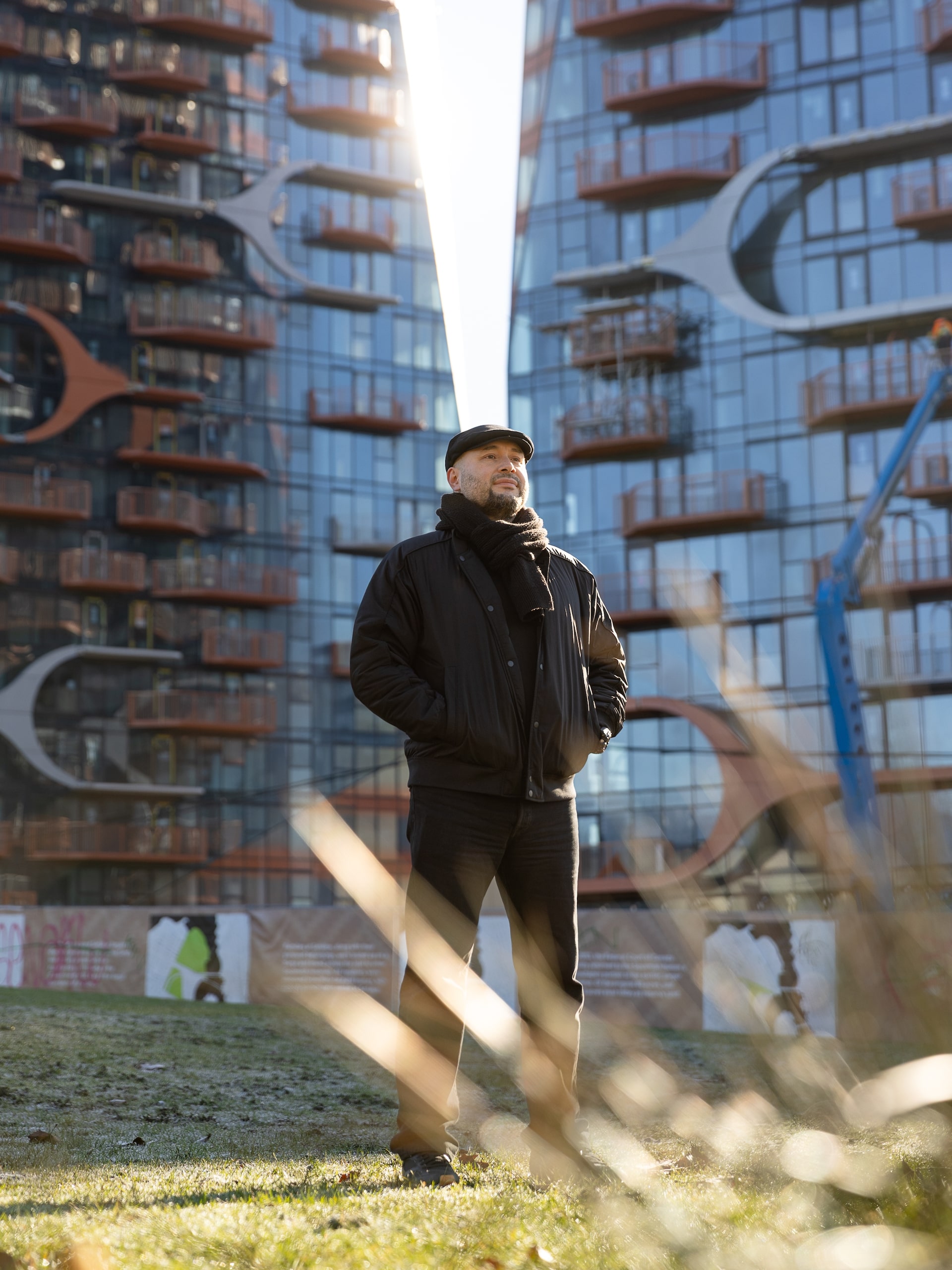
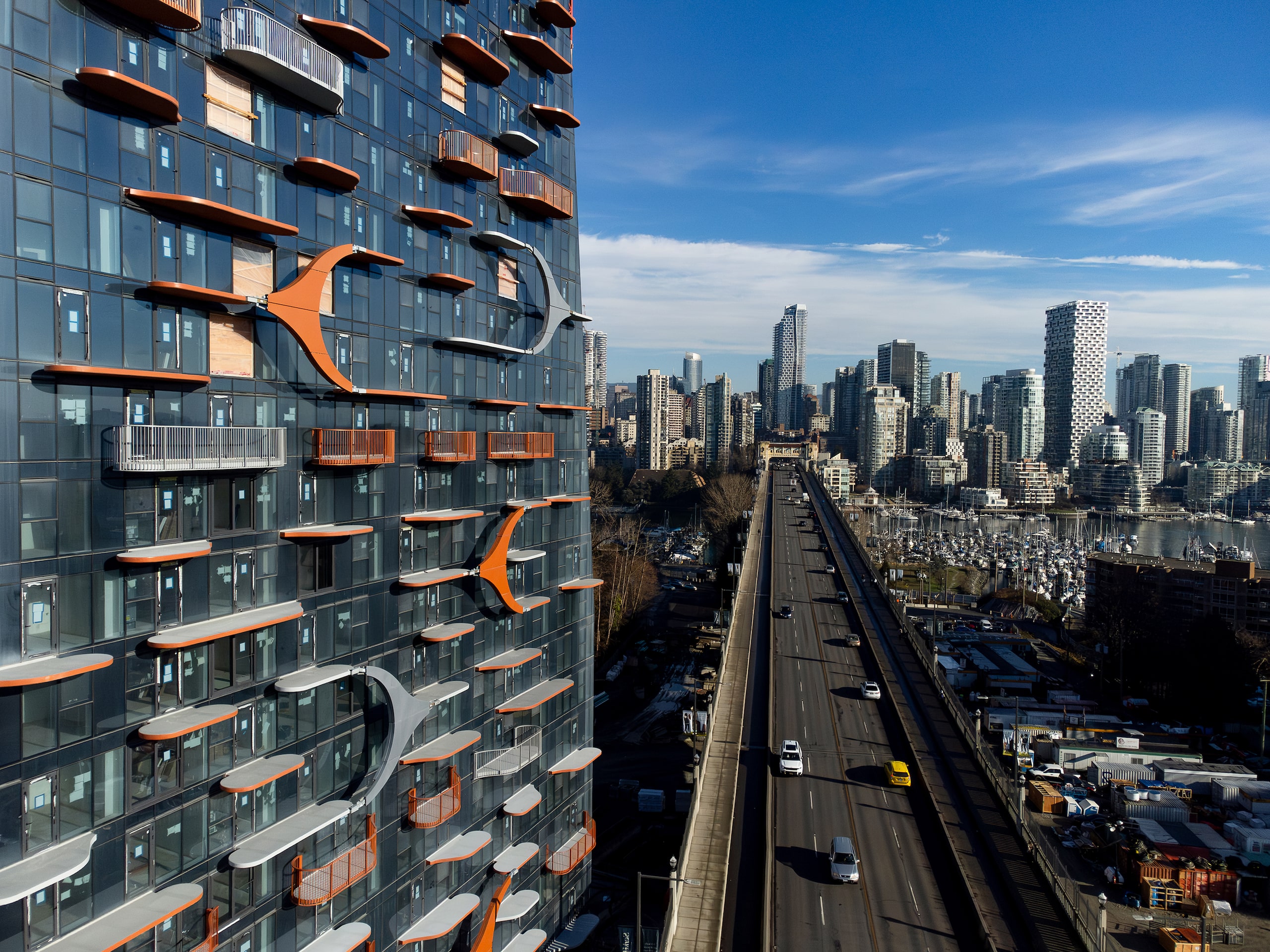
The three towers rise like muscular sentries from the south end of the Burrard Street Bridge, which connects downtown Vancouver to Kitsilano. They stand out sharply because of their imposing size—26, 31 and 39 storeys—and because of their unique appearance. The glass skins are tinted cobalt blue and coppery orange, and marked with bold flourishes, including wishbone-shaped projections that link the rounded balconies.
“Those are trigons—they’re a symbol used in Squamish Nation art,” says Jacob Lewis III, shouting to be heard over screaming saws and thudding hammers.
These towers, with sweeping views of English Bay, Stanley Park and the North Shore Mountains, represent Phase I of an estimated $3-billion mixed-use development that will establish the Squamish Nation as a major player in shaping the Vancouver skyline. And Lewis has a unique role on the project: He chairs a panel whose mandate is to ensure Squamish Nation identity remains at the heart of the development. In line with that directive, a dozen Squamish artists have been retained so far to enhance parts of it using traditional Coast Salish art forms.

The first three towers of the Senákw development under construction in March, 2025. The project is being built on 10.5 acres of reserve land that was returned to the Squamish Nation in a landmark court case in 2003.Chris Helgren/Reuters
The designs are daring. That’s intentional. “We’ve dealt with cultural erasure for so long, with not having a presence and not being recognized in the territory,” says Lewis. “So when people come across this bridge and see a trigon, they’re going to find out that this a Squamish development.”
The project is being built on 10.5 acres of reserve land that was returned to the Squamish Nation in a landmark court case in 2003. It’s called Senákw (pronounced Sin-auk), after the Squamish village that once stood here. The name can be translated as “inside the head of False Creek”—and the development is most definitely now percolating inside the heads of Vancouverites.
The first three towers will include more than 1,400 purpose-built rental units, plus a three-storey wellness centre with a gym, a pool and a social lounge. The site will also feature retail, public spaces highlighting Squamish cultural identity and art, green space, a bike station (Canada’s largest, with 4,477 stalls) and a new transit hub.
And these three sentries are merely the vanguard: Eight more towers will follow, ranging up to 58 storeys, just shy of the tallest in town. When all four phases are completed (the goal is 2033), Senákw will comprise 6,000 rental units ranging from studios to four-bedrooms—1,200 of them below market prices—and four million square feet of floor space, making this the largest First Nations–led residential development in Canadian history.
That point is emphasized by Mindy Wight, CEO of Nch’kaý Development Corp., the economic group formed in 2018 to develop, manage and grow businesses that generate sustainable wealth and opportunity for the Squamish people.
“We have brought this development forward to meet the housing needs of Vancouver, while still advancing the economic interests of the Squamish Nation,” says Wight, a chartered professional accountant who became CEO of Nch’kaý in 2022.
She believes this project and other real estate ventures will set the Nation and its roughly 4,000 members—whose ancestral territory encompasses parts of Vancouver and Burnaby, plus North and West Vancouver, the district of Squamish and the municipality of Whistler—on a path to economic independence. It’s estimated that Senákw could generate as much as $20 billion in cash flow for the Nation and its partner, the Ontario pension fund manager OPTrust, over the life of the project.
“We’ve dealt with cultural erasure for so long, with not having a presence and not being recognized in the territory. So when people come across this bridge and see a trigon, they’re going to find out that this a Squamish development.”
– Jacob Lewis III, Director of Community Development, Nch’kaý Development Corp.
Senákw was made possible by a $1.4-billion loan from the Canada Mortgage and Housing Corp., the largest CMHC loan ever, approved by the Trudeau government in 2022. And once it’s in operation, it will be one of just a few large-scale net-zero housing developments in the world, with all of its heating and cooling produced by a new 10-megawatt district energy system, fed by wastewater from Vancouver’s adjacent sewer infrastructure. It’s expected to eliminate 120,000 tonnes of greenhouse gas emissions over 30 years compared to natural gas heating.
Predictably, the project has stirred plenty of controversy, from its polarizing design to its sheer density—at full capacity, Senákw will inject 9,000-plus residents into the area. And because it’s on reserve land, the developers didn’t have to consult the public about its plans or abide by City of Vancouver regulations that would normally apply to a project of this scope.
For instance, the first three towers will include just 107 car-park stalls, far below the 845 that would typically be required for a project this size—saving an estimated $10 million in construction costs. (Vancouver eliminated most parking minimums in 2024.)
Gordon Price, who served six terms on city council, from 1986 to 2002, was among the project’s earliest and most vocal critics. In a 2022 CBC interview, the urban-issues commentator lambasted Senákw for lowering the bar on amenities that he believes are necessary for a project of this scope. Speaking on the lack of public consultation, Price said: “It’s basically, ‘You f—ked us, now we f—k you.’ That’s no basis for reconciliation. That’s not gonna work. That’s awful.”
These days, his tone is far more measured. “If you’re going to have increased density, you have to have those amenities, because those are the things that determine livability,” says Price, who was director of the city program at Simon Fraser University until 2016. “This project wouldn’t even get in the front door of City Hall if it was a private sector development.”
Even so, he admits that Senákw will provide a huge stock of badly needed affordable housing—though the city’s overall vacancy rate for purpose-built rentals is the highest it’s been in 30 years.
“There’s a lot riding on this,” Price says. “If they can pull it off, if there’s a way we can deal with the pressures of housing in a more adventuresome way that we never would have entertained if it hadn’t been for Senákw, it will be a story with international significance.”
It’s hard to gauge how much support there is for Price’s perspective. I asked half a dozen prominent former city planners and consultants to share their views on Senákw, and all declined to comment. When informed of this, Price chuckles and says, “White guilt.”

Artist’s rendering of what the Senákw development will look like when it’s finished.Revery Architecture
In the late 1800s, roughly two dozen Squamish families lived in Senákw, on 80 acres the federal government designated as “Kitsilano Indian Reserve No. 6.” The area was rich with wildlife and other food sources, and the village was a hub for culture, commerce and connection, a place where neighbouring peoples gathered for potlatches.
At the time, the settlement that would become Vancouver had a population of about 1,000. In 1886, the Canadian Pacific Railway had initiated expropriation of portions of Reserve No. 6 to develop a port and rail yards. The CPR’s valuation for the entire chunk of land was $1,800, or $22.50 an acre. I.W. Powell, B.C.’s superintendent of Indian Affairs, rejected the offer, stating that these “loyal and exceedingly well-disposed [Aboriginal people]” had claims “for a proper protection of their rights.” Powell’s valuation was $750 an acre. The CPR called the price exorbitant and only agreed to pay compensation for its right-of-way and to acquire land to build a wye, a triangular junction that allows locomotives and trains to reverse direction.
Although their numbers were small, the presence of the Squamish people disturbed the settlers. A 1908 editorial in the Vancouver Daily World depicted Senákw as a “fire-hazard created by the presence of Indians and degenerate whites…a city of refuge for characters who carry their moral infection into the rancheries.”
By 1911, thanks to regular train service, Vancouver’s population had surged to 120,000. Two years later, B.C.’s premier, Richard McBride, left for London and asked his attorney general, William John Bowser, to deal with the Senákw situation in his absence. According to researcher Mayana Slobodian, who pieced together an account from news clips, Bowser and a squad of police held a meeting at the chambers of the local magistrate, where he strong-armed a group of 20 “illiterate” Squamish men into accepting $11,250 each (more than $300,000 today) in exchange for surrendering their land. They were told that if they didn’t accept the deal, they’d be turfed out with nothing.

Land the federal government designated as “Kitsilano Indian Reserve No. 6., circa 1907.City of Vancouver Archives
A few days later, the villagers were loaded onto barges with their belongings and set adrift. That night, all the buildings were looted and burned to the ground.
Local media expressed sympathy for their plight, but the underlying theme was that the result had been inevitable. A Vancouver Sun article concluded, “The move today was another evidence of the passing of a race before the onward sweep of progress.”
The province launched an inquiry in 1916, but it concluded that neither Bowser, by then B.C.’s premier, nor his law firm had directly benefited from the sale of the land, which it declared to have been fair and of great public advantage.
For decades, the expropriated land remained largely undeveloped. And though Squamish leaders never forgot the injustice, a legal remedy was out of reach. Until 1951, a provision in the Indian Act prevented them from even hiring a lawyer to pursue their claim.
By 1977, however, a small North Vancouver law firm, Ratcliff LLP, had taken up the Squamish cause and initiated legal proceedings. John Rich, who became lead counsel in the suit, says preparing the case took nearly 20 years. “We were a small firm, and there was a vast amount of historical research,” says Rich. “We collected 10,000 documents. It was a very complicated case.” The actual trial consumed 200 days of court time and lasted three years. “At the time, I believe it was the longest trial in Canadian history,” Rich says.
The Squamish claimed that the Crown had failed its fiduciary duties under the Indian Act by permitting the forced sale of their land, and they sought financial compensation and restoration of the reserve. In addition to pursuing their claim with the Crown, the lawyers also had to contend with a legal challenge from the neighbouring Musqueam Indian Band and Tsleil-Waututh Nation, both of which claimed an interest in the reserve land.
The case was a grind. “The government talks about reconciliation, but there is no reconciliation in the litigation process,” says Rich. “Their lawyers fought like hell.” In the end, the Squamish prevailed. A negotiated settlement in 2000 handed the Nation $92.5 million in compensation for surrendering their claim to roughly 70 acres of the site, which now encompasses Vanier Park, the Museum of Vancouver and Planetarium, the Vancouver Maritime Museum, the city archives, a bike track and two marinas. In a separate provincial case over the 10.5-acre parcel where the development now stands, the Squamish also prevailed. The decision was upheld in a 2003 appeal.
Senákw holds special significance for Wilson Williams, the recently elected chair of the Squamish Nation’s governing council. His great-grandfather, Andrew Paull, born in 1892, lived in the seaside village for a time with his mother, Caroline, and they were part of the group who was evicted. Paull would eventually be sent to residential school, where Williams says he inexplicably thrived; he went on to receive legal training, though he couldn’t practise as a lawyer unless he gave up his Indian status, which he did not.
For Williams, Senákw is a living example of reconciliation. “I have been flying back and forth to Ottawa on a regular basis,” he says. “I’m being let into rooms I would never have been allowed into before.”
“We have brought this development forward to meet the housing needs of Vancouver, while still advancing the economic interests of the Squamish Nation.”
– Mindy Wight, CEO of Nch’kaý Development Corp.

Nch’kaý’s offices are inside the Park Royal complex in West Vancouver, which includes an upscale shopping emporium and sits partly on Squamish land. Mindy Wight was raised off-reserve, nearly 800 kilometres north of Vancouver, in Prince George. When appointed to Nch’kaý’s top post in 2022, she’d already been serving as the group’s CFO since the fall of 2021 and was a full-time partner at the accounting firm MNP, and national leader of Indigenous Tax Services. Her five-person leadership team currently manages more than $300 million in assets that it owns directly (including a pair of marinas, an RV park, a gas bar, and International Plaza in North Vancouver, whose two towers hold 471 rental units and 65,000 square feet of commercial space), plus another $1 billion in assets for the Squamish Nation.
Her staff is young; just over half are Indigenous. “We don’t have a quota—we hire the best qualified,” says Wight. “However, we do want Squamish people to be in these seats eventually. The qualified applicants just aren’t there yet.” Her style, she says, is open and collaborative. “They’re the same values that Squamish embody in leadership, and that’s what we aspire to do at Nch’kaý, as well.”
Nch’k-¯aý is developing the first two phases of Senákw through a 50-50 partnership with OPTrust, which manages the $26-billion OPSEU Pension Plan. OPTrust wasn’t Nch’kaý’s original partner, however. That was Westbank Corp., one of North America’s leading luxury residential and mixed-use real estate developers.
Established in 1992, Westbank’s Vancouver portfolio includes the Shangri-La Hotel; the Fairmont Pacific Rim; Vancouver House, a honeycombed skyscraper that twists upward like an Escher drawing; and Oakridge Park, a huge mixed-use development with roughly 3,000 units in 10 buildings. Its hard-driving CEO, Ian Gillespie, is a polarizing figure in Vancouver, admired in some quarters for his ambition and creativity, and detested in others for marketing his condos to wealthy overseas buyers and driving up prices amid a housing crisis.
Love Gillespie or hate him, there’s no doubt that teaming up with Westbank would ensure Senákw made a splash. The deal was approved in December 2019 by 81% of voting Squamish Nation members.
But by mid-2022, soon to be mired in lawsuits over unpaid work on the Mirvish Village project in Toronto, Westbank had cut its 50% Senákw investment to 30%. In August 2025, it pulled out entirely. Westbank gave no reason for the move, but popular speculation held that the firm was overextended, hit hard by both rising interest rates and residential construction costs.
Williams says Westbank’s withdrawal created a lot of worry—and unpaid bills. “Our reputation was on the line,” he says. “The anxiety we had was like, are we sinking with them? The fear of us not being successful on the first phase was there. It was raw. You have those old feelings back, like someone else has taken something away from you.”
OPTrust eventually agreed to buy Westbank’s shares, boosting its investment from 20% to 50% in 2025. “This is one of the largest First Nations, non-resource economic development projects in Canadian history,” OPTrust’s president, Peter Lindley, said in a statement. “We’re proud to deepen our partnership with the Squamish Nation, whose vision and values are highly aligned with ours.”
Despite the unusual circumstances behind Senákw’s creation, Vancouver’s city government has backed the project from the start. In 2022, the city finalized an agreement with the Squamish Nation that covered police and fire services, utilities and public works. The Squamish Nation will pay for these services at a similar annual rate as other Vancouver property owners. The Nation also agreed to provide at least $49 million to fund transportation and utilities costs associated with supporting Senákw. Of that, $15 million will go toward building a transit hub on the bridge.
Kennedy Stewart, Vancouver’s mayor at the time, emphasized the importance of reconciliation in securing the agreement. “I’m here today as the head of a colonial institution that for years passed laws and policies that were racist and oppressive,” Stewart said. “When I first learned of the project, I knew I would do everything I could to support it.”
Not everyone felt that way. In 2022, a group representing residents of Kitsilano took the city to court, asking a judge to cancel the services agreement. The Kits Point Residents’ Association (KPRA) was concerned primarily about the size and density of Senákw, the height of the towers, and the impact on neighbouring communities.
The KPRA argued that the city hadn’t given residents a fair chance to offer feedback on the project. (Because the Squamish Nation remains under the federal Indian Act, the development doesn’t fall under the jurisdiction of Vancouver City Council.) The services negotiations were also kept secret, and the details weren’t published until July 2022, two months after the agreement was signed.

Squamish Nation councillors Wilson Williams and Khelsilem are joined by then Prime Minister Justin Trudeau at a groundbreaking ceremony for the Senakw housing development site, in September, 2022.DARRYL DYCK/The Canadian Press
The KPRA felt the city should have used its ability to refuse services as a bargaining tool to exert control over the development’s density and composition. Justice Carla Forth of the B.C. Supreme Court dismissed the lawsuit in September 2023, however, concluding that council was justified in holding meetings in private and not consulting the public about the commercial agreement. In her 73-page judgment, Forth noted that the Squamish Nation had wanted the accord to remain confidential, but the city insisted it be disclosed.
Forth’s summary also referred to an issue that arose during the negotiations regarding the Burrard Bridge, which carries up to 46,000 vehicles each day. The city’s position was that it has a valid right-of-way for the bridge. The Nation argued that the Court of Appeal’s 2003 decision to return the property to the Squamish invalidated that right-of-way, since it was created three decades after the land was expropriated, and that the bridge therefore trespasses on Squamish land.
Had the Squamish dug in on bridge access, it would have created a monumental headache and cost the city a stack of money to fight. But the Nation agreed to put the issue aside, though without relinquishing its right to take the matter up again at a later date.
As part of the new deal with OPTrust, the Squamish Nation owns 100% of Phases 3 and 4. “Full ownership gives us greater freedom to shape the project’s future on our terms, rooted in our priorities, values and vision,” says Williams. Although it has withdrawn its money, Westbank is still managing the first phase in concert with Vancouver-based Revery Architecture.
Revery design principal Venelin Kokalov says Senákw has been a complex undertaking, requiring close communication with the Squamish Nation and a large number of stakeholders. The physical challenges include working with a small, Y-shaped piece of property—the footprint of the CPR wye—bisected by a 95-year-old bridge whose structural integrity must be maintained.
The first three towers have a mountain motif, says Kokalov. The Long Towers in Phase 2 are inspired by the longhouses that once stood in the village and will include “rippling screens rising through the glazed facade like salmon leaping and twisting in a stream,” according to Revery’s website.
“Full ownership [of phases three and four] gives us greater freedom to shape the project’s future on our terms, rooted in our priorities, values and vision.”
– Wilson Williams, chair of the Squamish Nation’s governing council

As more towers go up, Senákw’s impact on the skyline will become more evident, and Ginger Gosnell-Myers, who was the City of Vancouver’s first Indigenous relations manager until 2018, believes it will alter people’s view of the Squamish Nation and Indigenous people in general. “People tend to view First Nations as being extremely impoverished and marginalized, and not having a lot of hope,” says Gosnell-Myers, a member of the Nisga’a and Kwakwaka’wakw Nations who’s now an Indigenous Fellow at SFU studying urban Indigenous policy and planning. “But we’re finally reaching a moment where First Nations, through urban development, are seeing that narrative completely change.”
It’s hard to imagine any one project changing long-held perceptions, she admits. But anything that breaks down the notion of First Nations being on the outside is an important step toward reconciliation. “We’re still trying to communicate who we are, what we aspire to and how we can get there, and how we can’t get there on our own,” she says. “Projects like Sen’ák-¯w can help bridge that gap.”
And it’s not the only development in the queue. In 2023, the Squamish Nation announced it intends to develop 350 acres in North and West Vancouver, in the town of Squamish and on the Sunshine Coast. Another massive undertaking is the Jericho Lands Project. In 2014, a consortium of the Musqueam, Squamish and Tsleil-Waututh Nations—known as MST—teamed up with Canada Lands Co., a federal Crown corporation, to buy 52 acres in Vancouver’s West Point Grey neighbourhood from the federal government, later going solo to buy a 38-acre parcel from the province, for a total of $717 million. The plan, which was strongly opposed by some area residents, envisions 13,000 new units housing 24,000 people, an influx that would more than double the surrounding area’s current population, with construction stretching up to 30 years.
Residents argued that the proposal was too large, too dense and at odds with the neighbourhood’s character. They pitched an alternative design that included low- and medium-rise buildings using wood, as well as steel and glass. The developers held public meetings to hear out opponents, but in the end, the proposal went nowhere.
MST could soon become a major force in the local real estate game. The three Nations are full or co-owners of six prime properties throughout Vancouver that total more than 160 acres of developable land, with a valuation in the billions. MST’s goal is to reclaim traditional lands and foster economic independence. As Wendy Grant-John, a former Musqueam chief, has noted, “We were a city before there was a city.”

The Senákw towers have sweeping views of Vancouver's North Shore Mountains, its twin peaks known as the "Two Sisters" to the Squamish. Many Squamish people believe this land was destined to be returned to them, and the development is the delivery of delayed justice.DARRYL DYCK/The Globe and Mail
The rooftops of Senákw’s first three towers tilt toward the North Shore Mountains and a pair of pointed peaks known to Vancouverites as the Lions (hence the Lions Gate Bridge and BC Lions). To the Squamish, they’re known as the Two Sisters, honoured for their mythic role in bringing together warring nations to create a lasting peace.
Nearby is the Museum of Vancouver building, opened in 1968. From 30 storeys up, its white roof resembles the woven cedar hats worn by some First Nations people—a design feature that’s not entirely evident from the ground. Architect Gerald Hamilton clearly added it as a nod to the people who lived here long before the arrival of European settlers, though he could never have imagined it being admired from this vantage point. It’s another sign of the connectedness of things, a merging of past and future. Signs of this can be seen everywhere, if you know where to look. As Jacob Lewis III notes, the forked shape of the Senákw property itself looks like a trigon.
Many Squamish people believe this land was destined to be returned to them. For them, the glass and steel of the Senákw development is simply the delivery of delayed justice, a reversal of historic tides. Wilson Williams addressed that notion while standing before a scale model of the project. “It was always talked about how we’re going to be back here, what’s going to be here. Those are no longer whispers in the wind.”
Senákw, he says, “is a call back to the ancestors and an announcement to the people of Vancouver: We were invisible. People didn’t know who we were. The towers have changed all that. Now people will know.”