Canadians waiting for new transit could be forgiven for feeling like Charlie Brown having the football snatched away. The opening dates for major projects slip repeatedly, and sometimes disappear entirely. When will the $13-billion Eglinton Crosstown LRT line in Toronto open? No one knows.
These difficulties are not unique to Canada. The English-speaking world is rife with examples of hugely expensive and delayed transit projects. But the problems pose a challenge to political leaders as cities grow rapidly, straining already clogged roads.
Building more roads doesn’t reduce congestion, decades of research shows. The only way to do that is to give people options that don’t require driving. Transit is far more efficient at moving people than personal automobiles. But first it has to get built, and people have to have enough confidence that will happen to be willing to support the disruption and cost of construction.

Ontario Premier Doug Ford's government is committed to an array of long-delayed transit megaprojects, as are several of his counterparts in other provinces.Nathan Denette/The Canadian Press
As Ontario Premier Doug Ford’s Progressive Conservative government touts Toronto’s new Ontario Line subway project, part of the biggest transit-building effort in provincial history, the government is undermined by the awkward fact that it has opened no Toronto-area transit lines during the party’s more than six years in power.
The provincial government announced in early December that Phil Verster, the embattled chief executive officer of Ontario’s public transit agency, Metrolinx, would be resigning. However, he will be replaced by the CEO of a Crown agency that has worked closely already with Metrolinx on transit delivery, suggesting that the switch does not portend a radical change in direction.
Also in December, a report from four researchers at the University of Toronto’s School of Cities shows that the cost per kilometre to build rail transit in Canada is more than 60 per cent higher than the global average. The authors, who blame this on factors including designs that are overbuilt and the heavy use of consultants, warn that soaring costs are undercutting efforts to create meaningful transit capacity.
They note that Canadian officials have reacted to cost increases by shrinking transit projects to make them cheaper, rather than by tackling the reasons for price inflation. “If construction costs can be meaningfully reduced, more ambitious projects with greater benefit and larger scope can be built at lower costs,” they wrote.

A worker emerges triumphantly from a tunnel-boring machine beneath Vancouver in 2008, a milestone for the new Canada Line.Richard Lam/The Canadian Press

Montreal has had a comparatively smooth ride opening its REM light-rail system, which soft-launched in July of 2023.Andrej Ivanov/The Globe and Mail
Not all Canadian transit projects go sideways. The Canada Line SkyTrain project in Vancouver was completed on time in 2009, albeit under the looming deadline of the city hosting the 2010 Winter Olympics. Montreal’s 16-kilometre Réseau express métropolitain had a few teething problems when it opened last year, but nothing like the issues seen on other projects. And other transit expansions have begun to look better as they recede in the rear-view mirror. Although the extension of Toronto’s subway to the suburb of Vaughan, Ont., that opened in 2017 went over budget, and was one reason Queen’s Park took responsibility for transit construction away from the Toronto Transit Commission, its price per kilometre was far lower than for the Ontario Line now being built by the province.
But there is also a long list of projects that have limped into service late, been delayed indefinitely and seen their budgets surge. While the problems with each one are different, there are some common themes.
Experts say that transit approvals and design are highly politicized. There’s also been so little transit built in the last generation in Canada that governments have lost the knowledge needed to oversee a project, even one built by the private sector. And methods used on some early projects held up as success stories would no longer fly politically. Toronto transit watcher and blogger Steve Munro notes that much of the city’s east-west subway line was built in the 1960s using a method called cut and cover. This involves digging a trench, building subway infrastructure in it and then capping it. “The entire Bloor line was built north of Bloor [Street] and demolished everything in its path,” he said. “You can’t do that any more.”


Here's what cut-and-cover looked like from the Cedarvale Ravine in 1975, another phase of expansion to a north-south subway route.Dennis Robinson/The Globe and Mail
Another development is that city transit agencies no longer do their own expansion work. In recent decades, governments in Canada and elsewhere have relied heavily on arrangements known as public-private partnerships. These were once lauded, but in the public transit world, they have now fallen from favour, for governments and the private sector.
A recent Canadian project that showed off problems with the P3 model was in Ottawa. The public inquiry into that city’s troubled light-rail project found the approach contributed to an adversarial relationship between the city and the companies building the line, leading to litigation. This poisoning of the well may have long-term effects, inquiry commissioner William Hourigan noted, with the same private partners contracted to maintain the line for 30 years.
“The people of Ottawa now face the prospect of a rail system being maintained in circumstances where the relationship between the City and the maintainer is largely dysfunctional (and bearing the costs of any disputes that result),” he wrote.

Ottawa's LRT suffered so many malfunctions that a public inquiry looked into what went wrong, which uncovered strife between the city and private contractors.Adrian Wyld/The Canadian Press
Before the age of the P3, transit agencies generally designed projects (either in house or with a hired firm) and then picked construction companies to build them. The new P3 model was meant to rein in costs while also transferring more of the risks of a project to a contractor, which is often tasked not just with building a transit line, but with designing it, borrowing the money required up front, and even operating and maintaining it for decades. Vancouver’s Canada Line was the first major transit project in the country to embrace this P3 model.
Matti Siemiatycki, a geography and planning professor who heads the Infrastructure Institute at U of T, said P3s swept Canada as an unassailable orthodoxy for governments for all sorts of building in recent decades, and remain common. But the model faltered as it ran up against the sheer size and unpredictable complexity of large public transit projects.
“It started with hospitals, and it moved into other types of social infrastructure, and in those instances worked generally okay. And then it came over to transit, and it just hit a wall,” Prof. Siemiatycki said. “And you can see it right across the country.”

Governments here and in other places, including once-P3-happy Australia and Britain, have started to back away from this approach for large transit projects, at least as they used to be conceived. So have big companies in the private sector that used to bid on them.
P3s generally have fixed prices, with financial penalties for contractors that miss deadlines, but would leave most of the details of construction up to the private sector. This has led, in some cases, to bitter legal disputes between governments and companies hired to build transit when things have gone awry.
Toronto’s Eglinton Crosstown LRT is among the projects that have ended up in court. It remains in limbo without an opening date, long after its proposed 2020 opening day came and went, and is among the botched projects that have forced a P3 rethink. Andrew Hope, the chief capital officer for rapid transit with Metrolinx said lessons have been learned from the Eglinton Crosstown experience and put into practice with the Ontario Line subway now under construction. Instead of a massive, risky P3 contract – in which private-sector bidders were no longer interested – the latest line was broken up into several more manageable pieces.
Parts of the Ontario Line, including its main operations and maintenance contract, are conventional P3s. Other chunks, however, use what the industry calls a “progressive” or “negotiated” model, which sees governments and contractors collaborate in the early design phases to iron out problems and anticipate cost overruns before a final price tag is set. This avoids a key issue with P3s, which generally force contractors to lock in pricing before they are able to do a fully costed design – a situation that set the stage for delays and lawsuits.
“The world has changed pretty dramatically,” Mr. Hope said. “We’ve learned a lot. Contractors have learned a lot.”
These lessons have not kept a lid on price increases. In 2019, Ontario Line construction was pegged at $11-billion. Three years later and the cost, now including trains, signalling and 30 years of operations, was up to $19-billion. In 2024, it was up again, according to Global News, to $27-billion.


While workers keep building Calgary's Green Line, buses currently used for the MAX Orange service wait to be redeployed for that service.Jude Brocke/The Globe and Mail
Although eager to offload risk through the P3 model, politicians have remained keen to insert themselves into transit planning – which doesn’t help keep prices down or projects on time.
In Calgary, the planned Green Line has changed scope repeatedly and nearly died after the province pulled its funding. Only after recent talks was there an agreement to preserve the provincial investment and find a new way to move forward with a shorter version of the light-rail project. But its fate still remains unclear.
In Toronto, residents with long memories remember that the Eglinton Crosstown LRT was not the first time the need for underground transit in midtown was recognized. A subway there was part of a plan called Network 2011, and was approved by Bob Rae, Ontario’s NDP premier in the early 1990s. But it was killed by his PC successor, Mike Harris. It wasn’t until 2011 – the year the original subway would in theory have opened – that construction began on the Eglinton Crosstown, a partly buried light-rail line.
Politicians also throw sand in the gears by micromanaging aspects of design, said Marco Chitti, a fellow in the transportation and land use program at New York University who has studied Canadian transit.
He noted that elected officials can be susceptible to hyperlocal concerns that complicate a project.
Drivers might want a transit line buried, so as not to interfere with traffic, increasing the price tag by billions. Residents might then complain about plans for an exhaust outlet for that line near their property, forcing a cascading series of design changes that add cost. And then homeowners might raise concerns about vibration, forcing very deep construction that costs massively more.
Mr. Chitti said that a loss of transit-building knowledge exacerbates these issues, as leaders make political decisions with little sense of the impact on a project.
“The people who are making choices are not fully aware of the cost and the implication,” he said.

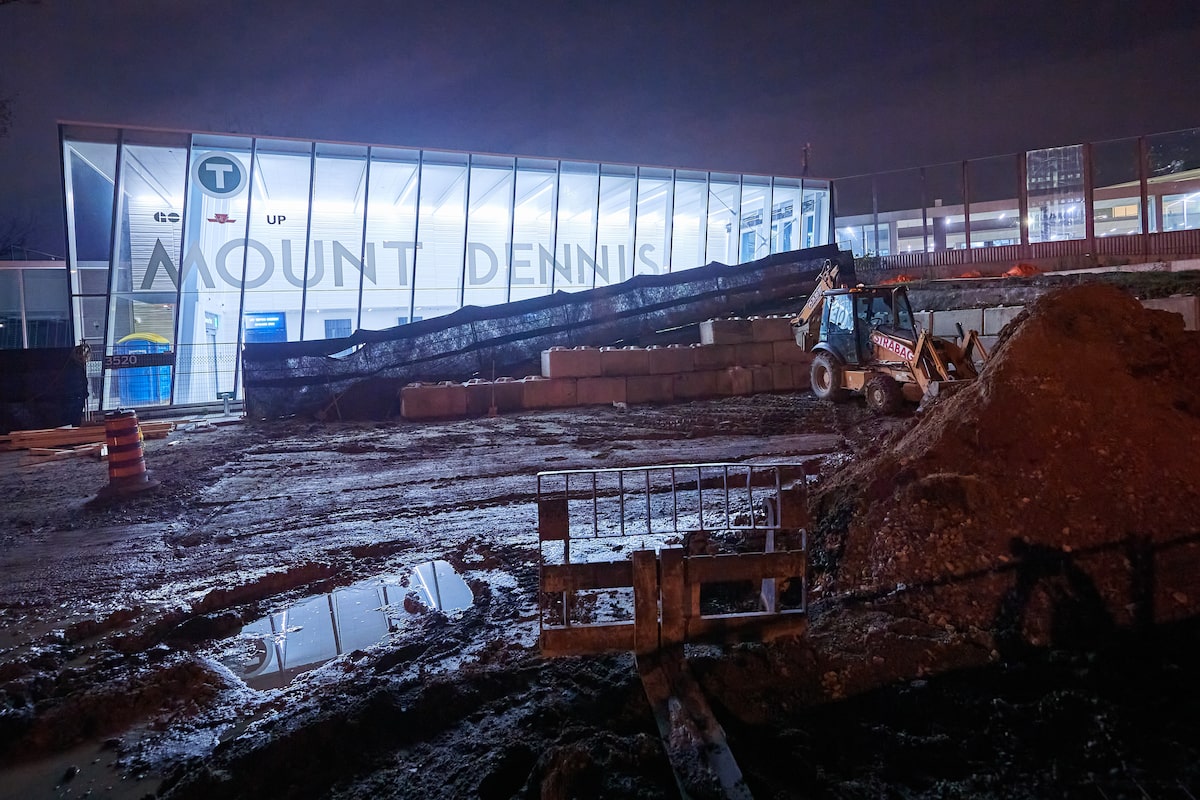
Six transit projects that went off the rails
Eglinton Crosstown LRT, Toronto
When construction on the 19-kilometre light-rail project across midtown began in 2011, the project was budgeted at $11-billion for building it and a generation of operations, and expected to be complete in nine years. However, just over 13 years in, estimated costs have risen to $12.8-billion and the date it will enter service remains elusive.
What went wrong? The list is lengthy and includes some huge issues, such as the COVID-19 pandemic and attendant supply chain shortages and labour constraints, as well as small ones, such as fixing work that wasn’t done properly. Throughout, a fractious relationship between Metrolinx and the consortium of international companies that are actually building the line has brought the two parties to court repeatedly.

The San Romanoway apartment towers at Jane and Finch overlook a busy construction zone for a Metrolinx LRT from Keele Street.Yader Guzman/The Globe and Mail
Finch LRT, Toronto
A surface light-rail line on Finch Avenue, running about 10 kilometres west from a subway station at Keele Street, began construction in 2019 and appeared to be on track to open in 2023.
However, Metrolinx announced in 2023 that the opening for the $3.4-billion project had been pushed to the first half of 2024, and then the second half of the year.
Then, in August, 2024, the companies building the line filed suit against Ontario Infrastructure and Lands Corp. and Metrolinx. The suit has spawned a flurry of counteractions and Metrolinx does not currently have a public target date for the line opening.

The Hazel McCallion LRT is named for a former mayor of Mississauga, which will one day use this line to reach Brampton in the north and the Port Credit GO station in the south.Sammy Kogan/The Globe and Mail
Hazel McCallion LRT, Peel Region
The Hurontario-Main LRT became the 18-kilometre long Hurontario LRT when city council in Brampton, Ont., voted in 2015 to keep it out of downtown. Instead, the line will end more than three kilometres south of the city-centre GO train station.
A project originally described as costing $1.2-billion to build was by 2019 expected to run $5.6-billion, including 30 years of operations and maintenance. It was later renamed after former Mississauga mayor Hazel McCallion and was scheduled to open in 2024.
But in June, the builders reported delays owing to track procurement and construction issues. And then S&P Global Ratings warned in October the builders risked being downgraded over the prospect of the project not finishing this year.
There is no official opening date.

These Calgary transit stations at 16th Avenue and Centre Street are meant to service the Green Line when it is finally up and running.Jude Brocke/The Globe and Mail
Green Line LRT, Calgary
In 2021, the city, Alberta and Ottawa agreed to fund the first part of an LRT line eventually planned to stretch 46 kilometres. But this past summer, facing growing costs, city council voted to reduce the length of the line and boost its budget by $700-million, to about $6.2-billion.
The province, which had earlier promised its $1.53-billion funding commitment was secure, dismissed the short version as too expensive and serving too few people. It pulled its money, effectively killing the project.
But then, early in October, the province and the city announced a new deal. The scope of the project scope has changed again and there is no longer an opening date. The two levels of government were still haggling over the route, and who would handle cost overruns, with a January provincial deadline looming for city council to approve the plan.

Workers test the piles at Langley City Centre station, terminus of a new branch of the Vancouver SkyTrain system.Tijana Martin/The Globe and Mail
Surrey Langley SkyTrain, British Columbia
This project would extend the subway-like Expo Line 16 kilometres past Surrey, through a fast-growing area of suburban Vancouver, to terminate in Langley. The elevated route was intended to open in 2028 and cost $4-billion.
The extension has been formally on the books since 2014, but its business case was not approved until 2022, when the pandemic was still front of mind and inflation rising. Despite that, the provincial government blamed unforeseen circumstances for a 50-per-cent cost increase revealed last year.
In the same release, the B.C. government announced that the project, as well as costing nearly $6-billion, would also open a year late.

The wheels on this OC Transpo train went off the tracks near Tremblay station in 2021, one of several mishaps that Ottawa's light-rail line has suffered over the years.Justin Tang/The Canadian Press
Confederation Line LRT, Ottawa
The line was budgeted at $2.1-billion, including 30 years of maintenance. It was a fixed-price contract, putting the builders on the hook for cost overruns. The line was expected to open in May, 2018, a promise that was modified four times before the line began operating in late 2019.
After a public inquiry, Justice William Hourigan issued a scathing report in 2022 that called out serious failures by the builders and city government.
He blamed the city for choosing “an essentially new vehicle based on unproven technology.” He found deadlines were unrealistic, that problems with testing were hushed up and that political pressure pushed the line into service.
Editor’s note: The caption below the photo of subway workers in 1969 has been updated to clarify that, while the image does not depict “cut and cover,” these techniques were used in the construction of the Yonge line.