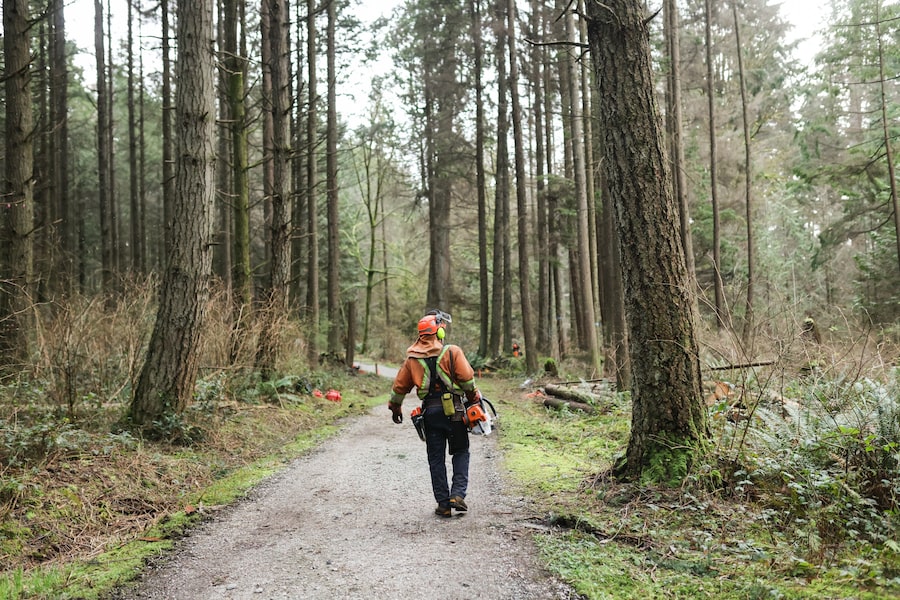
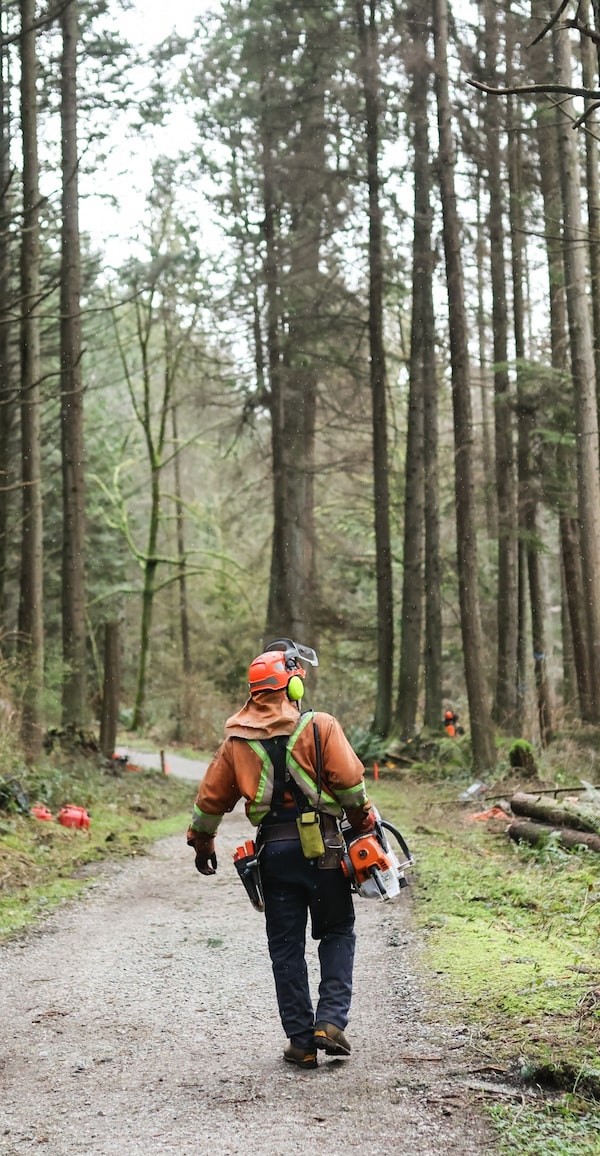
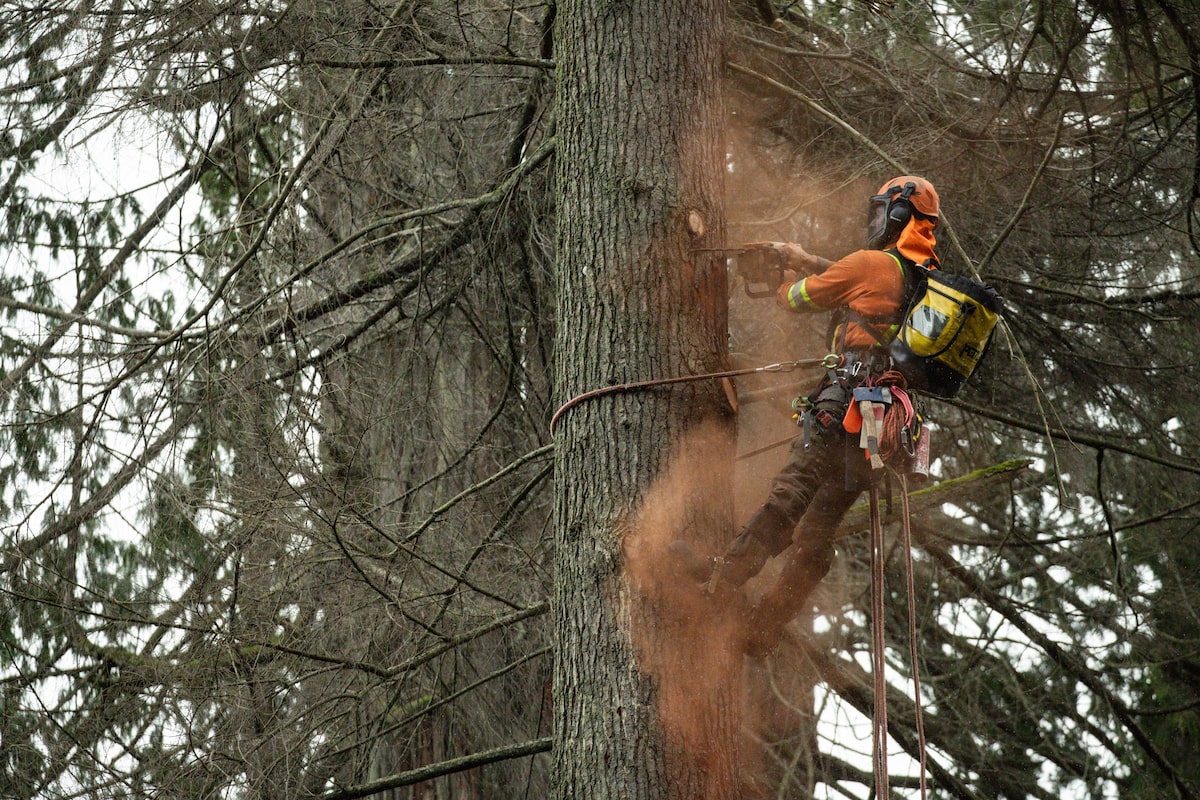
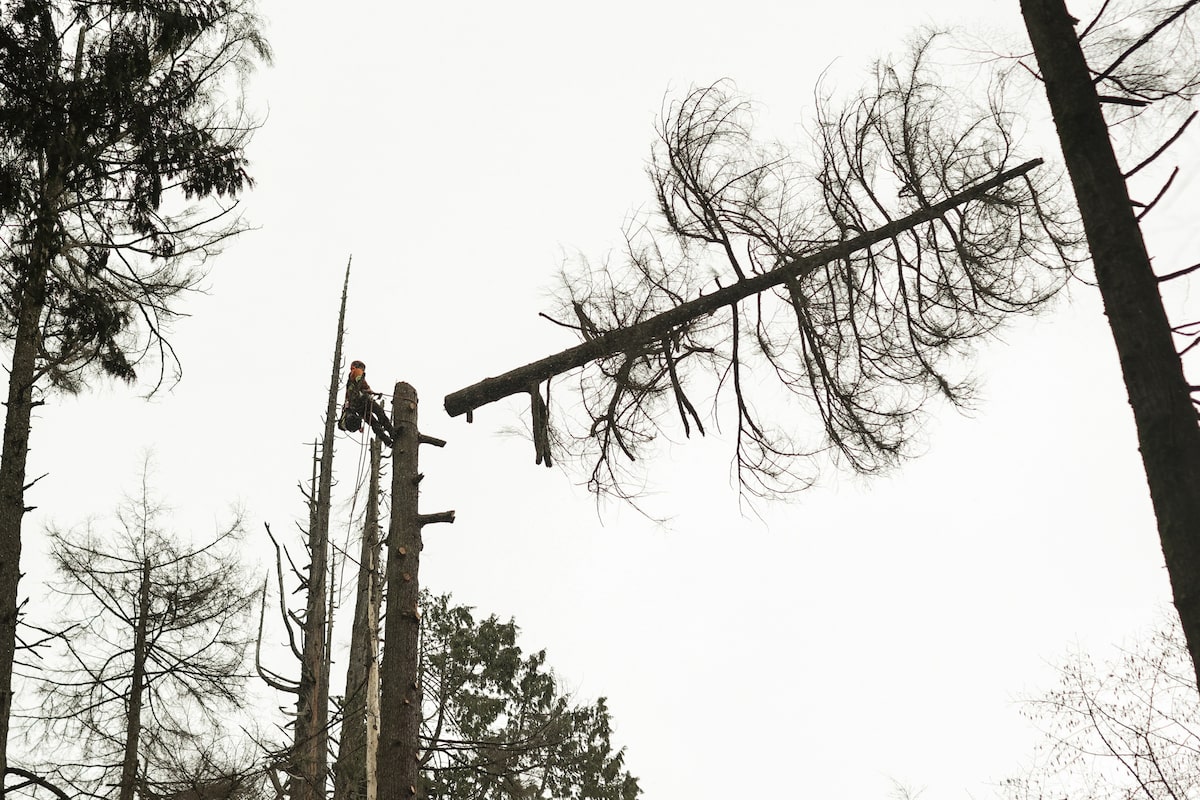
High in a tree in Vancouver’s Stanley Park, an arborist dangles from a climbing harness with a chainsaw and lops off the dead crown of a hemlock. It takes more than a full second for it to crash to the forest floor below.
When he’s finished, the debris is removed. Little will be left but a dead standing tree, a towering wooden spire known as a snag. Elsewhere in the park, pockets of whole trees have been removed, leaving large holes in the once-thriving green canopy.
The work is part of a significant – and, to some, distressing – intervention to address a moth outbreak that killed almost a third of the public park’s 600,000 trees between 2020 and 2023. The moths swept through the park and nearby coastal mountain forests, devouring the needles of the park’s famously giant trees.
The city says removing some of the dead trees is necessary to protect people from falling trees and branches, and the area itself from wildfire as debris from dead trees could become fuel in dry conditions. But as the snarl of saws rises above the park’s famous Lover’s Walk trail, a small but vocal group of park devotees challenge the science behind removing the trees, which they say amounts to “logging” a national crown jewel.
Beyond arguments over which trees should be cut or saved, what’s happening in one of Canada’s most iconic urban parks underscores the broader challenges of managing city green spaces in the era of climate change.


Though it’s often described in loving terms as a temperate rain forest, Stanley Park is not the same as the vanishingly rare old-growth forests of Vancouver Island. In the mid-to-late 1800s, much of the park peninsula was logged; the stumps of once-proud giants – some the size of a small living room – still dot the forest in some places.
Today, there are roads and pathways and sewer pipes and fire hydrants. There’s a miniature train railway, a horse riding stable and a sprawling aquarium complex. The park is a managed forest that’s seen nearly 200 years of human interventions.
In 2020, the Hemlock looper, a type of native moth, began one of its once-every-15-years cyclical outbreaks, which typically last around three to four years. This most recent outbreak was particularly significant, the city says. Every summer from 2020 to 2022, the moths in their larval form swarmed over the park, rappelling from the trees on barely visible threads. Runners and cyclists on the park’s narrower trails often finished their workouts covered in silky strands, picking the little green inchworms from their hair.
As the outbreak progressed, the larvae eventually killed around 160,000 trees before subsiding in late 2022 and early 2023. Whole stands of hemlocks and other trees were stripped of their needles, standing like grey phantoms.
The city says those dead trees pose many risks, and the only way to deal with them is with saws. Joe McLeod, the city’s associate director of urban forestry, called it a “risk mitigation project for public safety.”

Joe McLeod is Vancouver’s associate director of urban forestry.
The most obvious risk, city staff say, is the chance that dead branches or whole trees could fall, risking injury to more than 18 million people who use the park every year.
In high winds, the dead tree crowns have a tendency to snap off and come crashing down. They can also get hung up in the branches of other nearby trees, dangling dangerously and able to fall without warning.
But there is a second, less obvious risk: As all those dead branches and snags come down, they accumulate on the forest floor, in some cases piling up more than a metre high.
Under dry, windy conditions, if an errant marijuana joint landed in one of those piles or a car crash on the park’s causeway threw sparks, that dead brush could go up like a bonfire.
Around 60,000 to 80,000 cars go through Stanley Park every day, over the Lions Gate Bridge, Mr. McLeod said.
“If there was ever a fire in Stanley Park that, God forbid, damaged one of the steel girders on the bridge and resulted in that bridge being closed for weeks or months or longer, that would have just a shocking effect, I think, on the economy of the region,” he said.

The Lions Gate Bridge connects Stanley Park to the North Shore. City officials say they’re conscious of the risk if the park catches fire and damages that route.Rachel Pick/The Globe and Mail
To better understand the twin risks of wildfire and falling trees, the city hired veteran wildfire ecologist and forester Bruce Blackwell.
His firm is behind wildfire protection plans for cities across British Columbia. He also contributed to a seminal 2004 report on the devastating 2003 Kelowna wildfires, one that argued for sweeping changes to how cities and towns manage their bordering forests.
Mr. Blackwell’s Stanley Park analysis described a significant rise in the park’s wildfire risk from all that dead tree material – what wildfire experts refer to as fuel. In the early post-moth-outbreak phase, many trees would remain standing with their crowns and upper branches dead.
If a fire were to start in a densely wooded section of the park, it could climb the branches of nearby trees and reach into the canopy, causing one of the most dangerous and fast-moving types of wildfire: a crown fire.
As the dead material began falling to the ground, it would continue to accumulate, his report found. As it dries out, downed woody debris like this can make a surface fire hotter and harder to control.
The other contributing factor is drought. During the looper outbreak, Stanley Park was in a years-long drought that weakened the trees’ natural defences, the city says.

A larval hemlock looper is smaller than the tip of a finger. The adult moth is about 35 millimetres wide.Ethan Cairns/The Canadian Press
To address the risks, Mr. Blackwell suggested a series of significant tree removals across high-traffic areas of the park.
The proposal called for work in three phases. The first, an initial emergency phase that was executed quickly, removed what the city says were dangerous trees in some high-traffic eastern sections of the park, and along the Stanley Park causeway, a highway cutting through the heart of the park that provides one of only two routes across Burrard Inlet to the North Shore Mountains and onward to Squamish and Whistler. This work began in October, 2023.
Phase 2 took place in 2024, and focused on tourist hot spots near the Stanley Park Aquarium, Brockton Point and along the famous seawall.
Phase 3 began in January, 2025, and is expected to wrap up this coming fall, though work has now paused until September to account for bird-nesting season and to allow Vancouverites full access to the park over the summer. It started with areas near the iconic Prospect Point lookout, the popular Hollow Tree and other interior trails. In total, the city says around 11,000 trees (roughly 2 per cent of trees in the park) have been removed so far, and 50,000 new seedlings have been planted to replace them, including Douglas fir, cedar and Sitka spruce.

Forestry operations specialist Jeff Fisher points out a two-year-old cedar in the park, part of the reforestation work.
None of this has sat well with Michael Robert Caditz. He’s the founder of the Stanley Park Preservation Society, a group that formed in 2023 specifically to oppose the tree removals. The registered non-profit has around 200 members, he says, with a core group of 20 or so volunteers regularly involved in its operations.
Mr. Caditz, an avid cyclist, was riding his bike through the park that spring when he encountered work crews removing trees along a popular cycling path.
“At first I thought, maybe it’s just a few trees in this local area,” he said.
The more he learned about the planned cuts, the more concerned he became.
In 2024, Mr. Caditz and his group took the city and the parks board to court, seeking an injunction to stop the tree removals. They were unsuccessful, so they went back to court again in February, 2025, this time challenging the city’s procurement process.
In December, 2025, a B.C. Supreme Court judge found that while the city did not have the authority to sole-source a contract for the first phase of removals, the city and parks board otherwise acted reasonably in moving ahead with phases 2 and 3 of the project.
“This entire narrative about a looper moth killing trees and the trees are dangerous and they need to be removed, is a complete false narrative,” Mr. Caditz said.
In an affidavit filed as part of Mr. Caditz’s lawsuits, ecologist Rhonda Millikin alleged the tree thinning would unnecessarily ventilate the forest and actually increase wildfire risk, not lower it.
Ms. Millikin has fought against wildfire fuel-thinning projects for years, including in Whistler, two hours north.
She published a peer-reviewed paper in 2024 based on self-funded research that found fuel thinning can reduce the humidity and moisture in the plots she studied. The paper also found that, at the height of wildfire risk in late summer, the differences in dryness between thinned and unthinned forests were “less pronounced.”

This area near Third Beach was thinned significantly two years ago. At the same time, ecologist Rhonda Millikin published findings that argued fuel thinning would make wildfires more likely, not less.
Mr. Blackwell said in an interview that similar arguments against fuel thinning miss two key points. First, even if forest thinning does sometimes increase the dryness of a forest, it does so with much less available fuel to burn. Second, he said fuel mitigation isn’t about stopping fires from happening; it’s about changing how they burn when they do.
A wildfire under typical summer conditions in Stanley Park would likely be one that firefighters could effectively fight. Between 2023 and March, 2026, the Vancouver Fire Rescue Service said it responded to more than 120 fires in the park, including at least 34 that were intentionally set. None of them turned into the kind of destructive monster that many people fear.
But fuel mitigation isn’t about preventing the most common fires; it’s about protecting against the worst possible ones, the kind of fires that occur on the most extreme weather days, when high temperatures, low humidity and strong winds combine to drive the wildfire risk into the red.
Mr. Blackwell’s report found that the likelihood of a devastating fire happening in Stanley Park remains low. The City of North Vancouver’s most recent wildfire protection plan, also written by Mr. Blackwell, shows that between 2002 and 2018 there was an average of around 20 days at “high” risk, and two to three days of “extreme” wildfire danger each year.
But while coastal western hemlock forests such as these were once considered low risk for a fire, that’s no longer true. A wildfire last June caught residents in Squamish off guard, and the 2025 Mount Underwood wildfire on Vancouver Island displayed such unusually aggressive behaviour that it prompted the B.C. Wildfire Service to issue a warning about worrying changes to the wildfire regimes in these once-reliably damp ecosystems.

Last year’s Mount Underwood blaze near Port Alberni left the B.C. Wildfire Service questioning whether damp forests were as fire-safe as previously believed.Colby Rex O'Neill/AFP via Getty Images
“The number of danger-class days of high and extreme … has doubled," Mr. Blackwell said in an interview. “So the chances of an ignition that could be a damaging fire are going up.”
Still, Mr. Blackwell acknowledges that the mitigation work carries an emotional toll. Losing 11,000 trees from a beloved urban park was never going to be easy.
“I’ve learned over 38 years that people are emotional about trees. They have a personal attraction to trees, and you can’t tell them to not have an emotional response,” Mr. Blackwell said.
“It does look destructive,” he said. “Many people in the public have come to believe this is a static forest, that it doesn’t change. But ultimately, this grows from seedlings into big trees over very long time spans that people don’t experience. So it’s very hard for them to visualize that the forest will become the same forest again. It’s just a matter of time.”
The state of nature: More from The Globe and Mail
The Decibel podcast
From Stanley Park to Cape Spear, birds in Canada have had to adapt their habits to human activity. The spring migration in Point Pelee National Park is an ideal time to see that. Two years ago, a team from The Decibel went to Point Pelee to hear as many kinds of birdsong as they could. Subscribe for more episodes.
Solutions in the wilderness
Indigenous program to protect Canadian wilderness aims to bolster First Nations’ economies
A novel bond fund bets that rain forests are worth more alive than dead
Jasper welcomes visitors again by embracing its fire-scarred landscape