The farmer
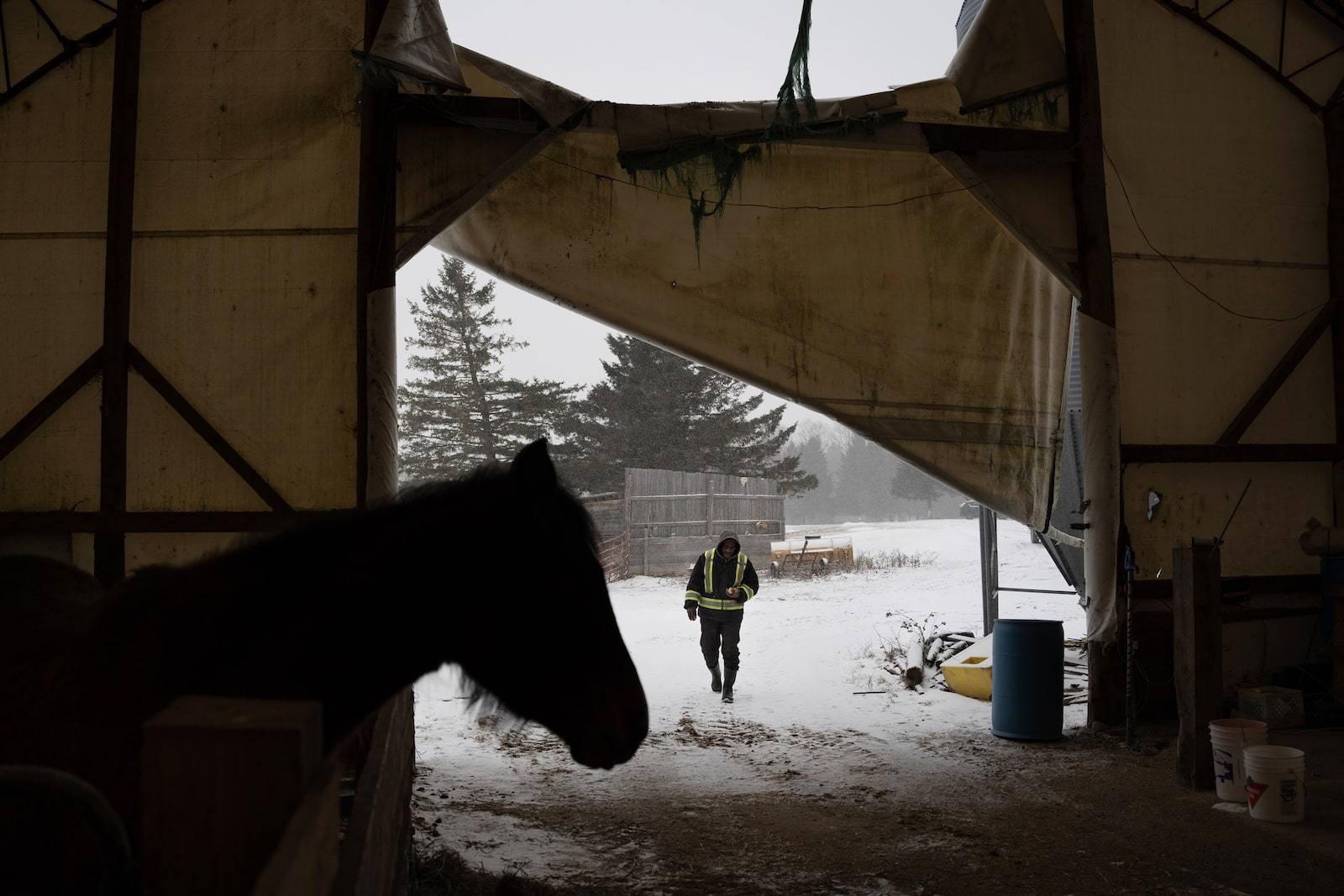
The muffled maaahs started up as Al Ferron approached the barn, his rubber boots crunching through the late March snow. When the door opened, a three-week-old goat kid – the youngest in the herd – began excitedly weaving herself between Mr. Ferron’s legs, chin heavenward, anticipating her next meal.
Mr. Ferron held up his blue plastic pail of feed and, as though he was a conductor waving his baton, a cacophony of bleating rose from the altos, the tenors and one baritone, which roughly translated to “I want some!” “I’m hungry!” “GIVE ME!!!”
The herd of 65 goats in Long Settlement, N.B., has grown and shrunk and grown again since Al and his wife, Karen, both Jamaican-born, started the farm a few years ago. Spring is a busy time for the couple, as it means processing all their Easter orders. The requests came in months ago from African and Caribbean immigrants, all Christians, who want goat meat for their holiday dinners.
The last decade of immigration-fuelled population growth in Canada has created an unprecedented demand for goat meat – and the fledgling domestic industry is struggling to keep up. Newcomers from the global south who were once used to buying fresh, locally raised meat to make Jamaican curry goat, Kashmiri rogan josh, Congolese goat stew and Yemeni goat mandi want to carry on their culinary traditions, but often have to resort to buying frozen meat shipped halfway around the world.

In Ontario, the provincially-run abattoirs can get so busy that spots sometimes need to be booked a year in advance, but it’s hard for farmers to know how many goats they’ll have ready to slaughter that far out.
In 2021, there were just 253,278 goats (including ones raised for milk or fibre) on Canadian farms. Compare that with 4.28 million beef cattle and 14.1 million pigs the same year (the most recent for which comparable figures are available). And while the number of goats slaughtered here rose by 74 per cent from 2016 to 2024, it still falls far short of satisfying the market. In that same period, the amount of imported goat meat – primarily from New Zealand and Australia – doubled, and now accounts for two-thirds of the robust, gamey protein eaten in Canada.
The small numbers mean that goat farmers don’t have the scale or the marketing muscle of the beef, chicken or pork industries to make the case for their product, or to effectively lobby the government for funding to expand their operations. And despite the fact that goat meat now commands premium prices – a survey of retailers across Canada found goat leg was selling for about $40 a kilogram this spring – extra support is sorely needed if the local market wants to be a significant player.
“People think goat farming is easy and it’s not,” says Cecilia Green, the executive director of the Canadian National Goat Federation. Between the high rate of disease, the time it takes to raise goats compared with other livestock and the cost of processing, lots of farmers enter and then exit the industry after just a few years, she explains.

At Eid, some Muslim customers want to come right into the barn to select which goat they want slaughtered but because of biosecurity, the Ferrons don't allow it. Instead, they bring eligible goats out like pageant contestants to a part of the barn where visitors can observe them from outside.
The Ferrons learned some hard lessons after they moved to the Maritimes from Newcastle, east of Toronto, in 2021.
Al had gotten to know the farmers he bought goats from in Ontario and thought he might be able to do what they did out East. He was new to farming and learned what to do mostly from reading and watching YouTube videos, since farmers in the area were reluctant to share their knowledge.
In their first year, the Ferrons made many mistakes. They lost goats and money. Karen cried a lot and Al told her to suck it up. Their friends in Toronto often asked when they were going to quit and move back. But they’d invested so much and Al knew there was a solid and growing customer base. They needed to build their herd, but that would take time.
In the fall, the Ferrons breed goats and in the spring the kids are born. While a lamb can get to 100 pounds in six months, it takes a goat about a year to reach that size. Females are ready for breeding at about 15 months.


The average meat goat herd size is 60 goats, says Catherine Michaud, the general manager of of the Canadian Meat Goat Association, and the average goat has two healthy kids annually. 'Do the math. It’s not a lot of kids,' she said.
A few newborns are usually rejected by their mothers each kidding season. The youngest in the Ferrons’ herd right now – a little carob-coloured kid with two mocha stripes streaking down her face – is one of those unlucky ones. Three times a day, Al pours fresh goat milk or substitute mixed with water into a Heineken beer bottle fitted with a black synthetic nipple. He discovered baby bottles were too small and plastic Pepsi bottles collapsed inward when the kids sucked vigorously from them.
Delivering this level of care is critical. Goats, which have a gestation period of five months, typically birth two or three kids at once. The Ferrons have come to expect that one of the newborns will probably die within the first few weeks.
Last year, the Ferrons slaughtered 59 goats and sold more than 3,600 pounds of meat. By the end of this year, they want to grow their herd from its current size of 65 to 200, not counting the ones that will be slaughtered.
It won’t be easy. Between the abattoir bills, feed and equipment, their margins are thin. The Ferrons sell meat from a small shop on their farm and once a month they deliver to customers in Fredericton, Saint John and Moncton.

At the small farm store they have on site, the Ferrons stock goat heart, testicles, tail and other organ meats in the fridge that many African, Caribbean and Indian immigrants drive up to purchase.
The couple is raising money through GoFundMe to open up their own on-site meat processing facility so they can butcher the animals to meet customers’ cultural and religious needs – and cut out the middleman to save costs.
A Muslim customer visited the farm once and told Karen how impressed she was with how the operation was halal in its truest form. The term halal doesn’t just mean that animals are butchered according to Islamic law, but that they are raised humanely. To see how happy the goats were when alive made her feel more at peace when eating them.
But there are also times when they have let customers down. The Ferrons’ herd was supposed to grow by another 20 that week, just in time for Easter, but the deal with another farmer fell through. And so all that’s available for buyers this year are two bucks.
The butcher

Khaled Al-Hilal, owner of Al-Hilal Meats in Halifax says he usually leaves whole goats intact and butchers them on demand, because the requests he gets are so varied.
Khaled Al-Hilal entered the walk-in cooler and appraised the four goat carcasses suspended on hooks and sheathed loosely in plastic. It was early April, and their arrival the previous day had caused a frenzy among customers of Al-Hilal Meat Shop in Halifax, who had been waiting weeks for them.
He lifted one off its hook and carried it to his band saw. With the help of an employee, Mr. Al-Hilal sliced the goat cleanly in half. One piece was returned to the cooler and the other was cut further: the leg and shoulder set aside, the ribs reduced to smaller pieces to be sold as “goat chops,” a popular choice in the summer for families who grill them, along with thin slices of goat sirloin, on portable barbecues at the beach.
The requests of customers are so varied that Mr. Al-Hilal, a Syrian refugee who arrived here in 2016, usually leaves whole goats intact and butchers them on demand. Shoppers from Saudi Arabia and Syria typically ask for “apple-sized pieces” that will be used in rice dishes such as kabsa or maqluba. The ones from Yemen often ask for the meat plus all the organs to fry, stew and cook with rice. Indians want small cubes for curries. Big spenders want the whole animal to prepare as a showy centrepiece at a party.

Even with lamb sometimes selling for about two-thirds the price of goat per pound, many customers will pass when offered it – goat is much leaner and sometimes the only red meat they want to cook with.
Goat is popular in the global south because it’s leaner than other red meats, its flavour pairs well with robust spices and it can be eaten by many different religious groups. Every December the Canadian Meat Goat Association publishes a calendar that highlights religious holidays and cultural celebrations and what type of goat is preferred for each: Males with tender meat are desired for the Hindu festival of Navaratri, Easter calls for fleshy milk-fed kids and the ideal goat for Eid-al-Adha, the Muslim holiday when an animal is sacrificed, is an intact male at least a year old.
Mr. Al-Hilal’s goats come from a fourth-generation farm in Windsor, N.S., a 45-minute drive from Halifax. The busiest time of year is Eid al-Adha and though that isn’t until early June, requests have already come in.
“You tell them months ahead, ‘We’re going to have goats for you,’ and you don’t end up having them. That’s just disappointing. So now we don’t take goat orders unless we’re confirmed we’ll have enough,” says Nourah, Mr. Al-Hilal’s teenage daughter who works at the shop.
Mr. Al-Hilal has struggled to find additional suppliers. Most farmers take their meat goats to auction barns where they are purchased by a big buyer who owns an abattoir. After the goats are processed, they’re distributed to butchers, farmers’ markets and stores.
Ideally, Mr. Al-Hilal would receive 15 goats a week, or about 1,000 pounds of meat. But these days, it’s a good week when he gets four. When it was Eid al-Fitr this spring, marking the end of Ramadan, he had none.
The cook

Eche-Nwosu regularly calls George, her favourite local butcher, to inquire if he has any mature goat in stock, which is the kind she bought in Nigeria. “I’m always on George’s neck,” she said. 'I call him all the time. "Is my type of goat available?"'
As a teenager, Ijeoma Eche-Nwosu would walk the short distance to the market in Lagos, Nigeria, to get goat meat for that night’s dinner. Now she sometimes sends her husband 100 kilometres from their home in Halifax to a farm in Middle Stewiacke, N.S., to secure the family’s favourite meat directly from the source.
Soon after the couple moved here from Nigeria in 2019, other immigrants – Nigerians, Cameroonians, Ghanaians – tipped them off on where to find goat: the small butcher shops, the halal grocers, the family farms.
On a recent Sunday night, Ms. Eche-Nwosu was preparing her signature Nigerian red stew, a dish she’d learned to make as a child. But the goat was younger than what she was used to buying back home and she worried it might not taste right
While the French prize fall-off-the-bone tenderness when braising meat for stews, that was not the final product Ms. Eche-Nwosu was seeking. She wanted some of the connective tissue to remain in the meat after it was cooked, to give it a more sinewy texture.


Using mature goat “is like an extra spice to the stew,” her husband Chiechezonam Nwosu explained. “You can’t miss it.”
Beggars can’t be choosers, though, and Ms. Eche-Nwosu is happy to find goat in any form near her Halifax neighbourhood.
Considering goat is so widely eaten by Halifax’s growing immigrant population, she finds it puzzling that it isn’t at her local Sobeys or Atlantic Superstore.
“I wasn’t shocked that goat was expensive. What I was shocked about is the scarcity. That it’s not available even when I have the money to buy,” she said.
On this day, to make up for its less-than-ideal texture, Ms. Eche-Nwosu par-cooked the meat on the stove with a host of seasonings including broth, oyster sauce, garlic and ginger, and then air fried it for 15 minutes.

The final stage of cooking was simmering the shrunken and burnished meat in a rich tomato and pepper-based stew.
Before the final stage of cooking – simmering the shrunken and burnished meat in a rich tomato and pepper-based stew – Ms. Eche-Nwosu offered her eldest, Chimamanda, 15, a piece to try. A smile crept across the teen’s face as she chewed.
“What about me?” called out Akuabata, 13, from the living room before coming into the kitchen for her own sample.
At Easter, Ms. Eche-Nwosu usually prepares asun, a mix of grilled goat, onions, garlic and peppers tossed in a spicy sauce as an appetizer. She’ll often make jollof rice with bite-sized pieces of goat, too. And the centrepiece is isi ewu, a goat head soup – guests sometimes fight over the eyeballs.
She also whips up Nigerian dishes in a commercial kitchen for her catering company, Prestigious Apron Gourmet. She’s reluctant to put goat on her regular menu, however, because there’s no telling when she’ll get it. Recently someone called to order goat pepper stew when Ms. Eche-Nwosu’s freezer reserves had run dry and she was forced to use cow intestine instead.

The end result for Eche-Nwosu's family was her signature Nigerian red stew, a dish she learned to make as a child.
Just after 6 p.m., Ms. Eche-Nwosu’s family sat around the dining table while she scooped rice onto each plate and then followed it with a hearty serving of the stew: pieces of thrice-cooked goat bathed in a thick, rust-coloured broth.
The family made polite attempts at eating the goat with silverware, but eventually those with craggy bones on their plates set down their spoons and went in with their hands: tearing the meat from the bone with their teeth, pushing the gelatinous marrow out with their fingertips.
A few minutes after he finished his second plate and left the table, Kobi, Ms. Eche-Nwosu’s 10-year-old son, returned to his mother’s side.
“Mom, that was absolutely delicious,” he whispered in her ear. His infectious smile transferred onto his mother’s face, and she offered him another serving.