
The Globe is visiting communities across the country to hear from Canadians about the issues affecting their lives, their futures and their votes in this federal election.
On the drive into Sudbury, a nine-metre-high piece of pocket change appears on the horizon. Built in the 1960s, the Big Nickel is a symbol of the city’s past as a booming mining town.
But if you continue along the old route into downtown, it’s apparent that the wealth extracted from beneath the hills has long since faded from the city’s core. Many of the boutiques that once lined the main streets are gone. The old shopping mall is being converted into warehouses and self-storage. Empty lots now sit where landmark hotels and restaurants used to be.
And at the southern edge of downtown, on a patch of grass across the street from City Hall, an expanse of crosses has sprung up – a sobering monument that speaks to Sudbury’s current challenges.
On a grey day in late March, flurries swirl around Denise Sandul as she picks up litter from between the rows of white markers. She planted the first of them in 2020 when her son, Myles Keaney, died of a fentanyl overdose at the age of 22. Then, as others did the same for their loved ones, the “Crosses for Change” memorial was born.
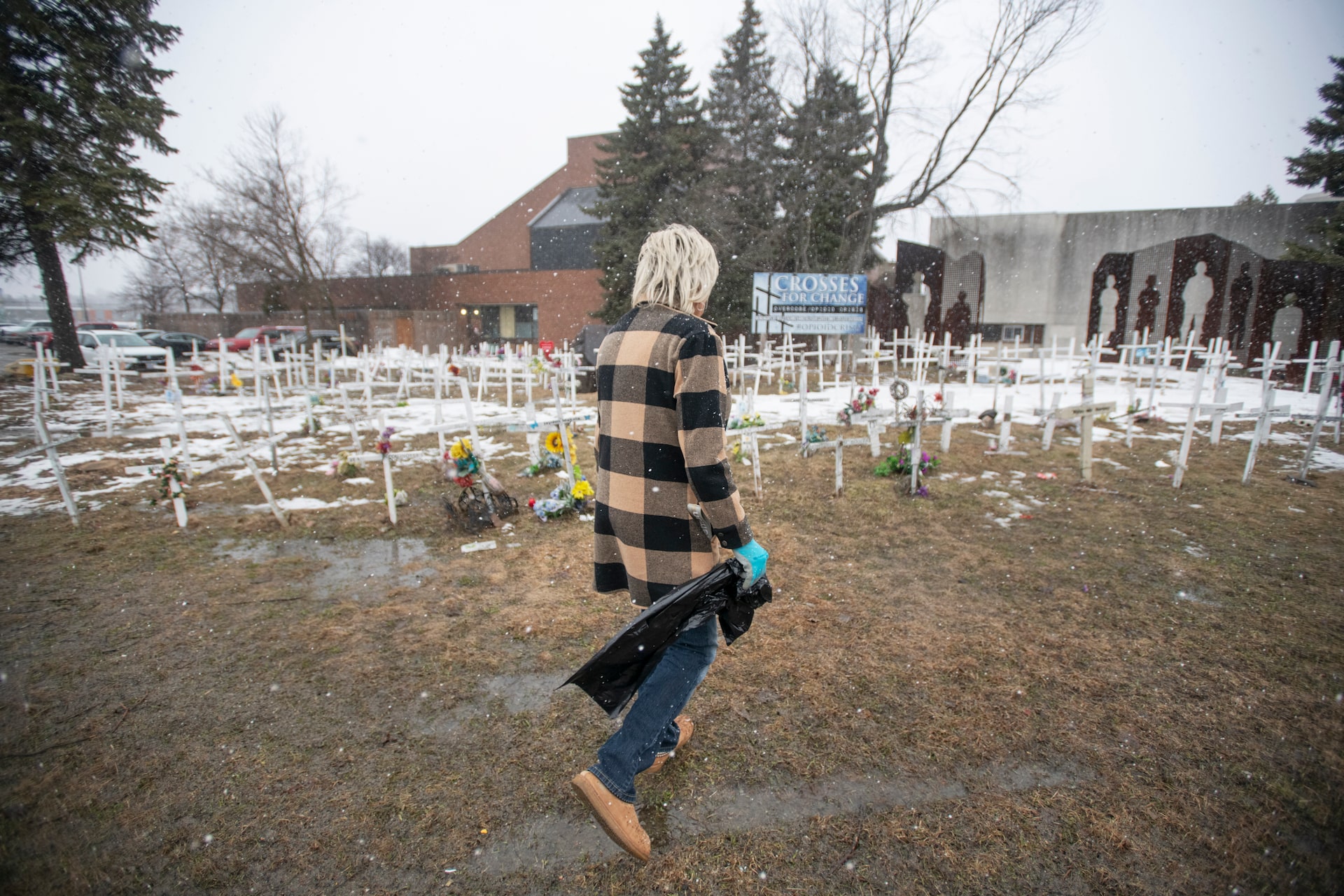


The makeshift graveyard has grown to include more than 250 crosses for local victims of the opioid crisis – people of all ages. “I didn’t know anyone who lost their child to overdose until my son died,” Ms. Sandul says. “Now, I know of hundreds.”
Ms. Sandul says she can sense people’s economic anxiety, and understands why the issues she cares about most are taking a backseat during a federal election campaign that is unfolding during U.S. President Donald Trump’s escalating tariff war.
“Are people really concerned whether a candidate is talking about the opioid crisis? We’re all just trying to keep our heads above water,” she says.
But she insists that addressing opioids in her community, and across Canada, must become a greater priority. “I have fear for my own young grandchildren who are going to be exposed to, and living in, this world of toxic drugs that kill.”
Opioid-overdose death rates in Sudbury are more than twice the provincial average. Fentanyl, a synthetic opioid that can be fatal in minute doses, is a growing concern.


Last month, police in the city core seized half a pound of fentanyl in sweeps that resulted in 60 arrests. In February, officers arrested a man downtown who was allegedly carrying a gun and a pound of the opioid.
Like many northern communities, Sudbury lacks the services that are needed to support people struggling with addictions and mental illness, Ms. Sandul says. She tried for years to get sustained help for her son, who she says excelled at sports as a teenager but suffered from schizophrenia.
Speaking about the makeshift graveyard, she says, “there’s definitely people who don’t want to look at this.”
But she believes people need to see the scale of all that is being lost. “I want to stop the stigma and the shame because I wasn’t a bad mother. Myles didn’t have a horrible childhood. He had a beautiful childhood – this happens to everyday people.”
Her son died of an overdose in September, 2020. His body was found on a grassy strip outside the main firehall downtown, not far from the Paris Street bridge.
When Ms. Sandul shared her story in the local news and on Facebook, other grieving families were inspired to plant crosses near the one she initially staked for her son outside the firehall.

Denise Sandul hugs Emily Loyer-Legault at the “Crosses for Change” memorial. Ms. Loyer-Legault, who lost her mother to an opioid overdose, was inspired by Ms. Sandul to plant a cross in her mother's honour.
Emily Loyer-Legault, whose mother died of an opioid overdose, says she was among the first. “I believe it was fentanyl that got into a bad bag of cocaine,” she says. “It’s gotten worse for sure … a lot of people in this city turn a blind eye to it.”
Within weeks, the first crosses were moved from the firehall to the field closer to the city hall.
The firehall sits beside the Good Samaritan Centre, near the railyards on the western edge of downtown. Several people milling around about outside the building, which houses a warming centre and soup kitchen, say political leaders need to do more to tackle homelessness.
“I’m in that situation,” says Robert Legacé. The 60-year-old says he used to run a successful landscaping business, but when his 29-year-old son died a couple of years ago, he spiralled.
He says he can’t afford to rent an apartment, and has spent some nights sleeping on the floor in the warming centre. “It’s terrible, the drugs going on and whatnot.”
Such stark needs inspired Ms. Sandul to start a charity, which she calls Sudbury Outreach Support (SOS).

Ms. Sandul uses an old shipping container at the Sudbury Market to store food and basic necessities, which she hands out to people in need as part of her SOS (Sudbury Outreach Support) charity initiative.
A short walk from the makeshift graveyard, she uses old shipping containers to store food and basic necessities – including donated boots, underwear and deodorant – which she hands out to people on the street.
Like many mid-sized municipalities, Sudbury’s once-vibrant core has hollowed out. Big box stores have drawn commerce to the outskirts. Now the challenge is to get residents – and office workers – back in.
There are fledgling signs of rebirth. Last year, city council approved the construction of a proposed $200-million hockey rink and event space downtown.
Ms. Sandul’s monument is also slated for renewal. Nearly five years after she placed the first marker, the field is packed and some of the older crosses are falling apart. The city recently announced plans to turn the makeshift graveyard into a permanent memorial on a patch of land across the street.


Sudbury’s once-vibrant core has hollowed out since its boom years as a mining town. The challenge is to draw residents and workers back in.
Details have yet to be announced. But Ms. Sandul says she will be striving to ensure the new monument is as striking as other Sudbury landmarks.
In time, she hopes the memorial will be seen as an homage to the past. For now, she is doing her part to keep concern about the opioid crisis from fading away.
“I want this to be very significant, because we’re not over this. People are still dying,” Ms. Sandul says. “We need to keep people alive in Northern Ontario, and we need to have services where these people can go.”