
Bobby Monks was in her kitchen cooking dinner when the message came in over WhatsApp. Chicken was sizzling on the stove. Her son had just walked in the door. Her dogs were barking. She wasn’t wearing her reading glasses.
In this brief moment of domestic chaos, she clicked on a link that was supposedly going to help a friend activate his Instagram account. Instead, her own account got hacked. “This all went down in less than one minute,” Ms. Monks said. “I was like, ‘What the hell just happened?’”
Ms. Monks relied on her @bobbywalksdogs Instagram account to promote her dog-walking business in Toronto. She didn’t have a huge following, but she was growing her online engagement and didn’t want to lose several years of content. So she did what so many others who find themselves in this situation do: She sought help from Meta Platforms Inc., the US$1.75-trillion company that owns Instagram, Facebook and WhatsApp.
She filled out an online form stating her account had been compromised, expecting the social-media behemoth to do something. But it didn’t – not the first time she submitted the form, not the second time nor the dozens of times after. “They were useless,” she said. “It was like talking to a brick wall.”
Ms. Monks had zero visibility into her status in the customer-support queue and had no confirmation she was actually in one. All the while, the hacker was sending direct messages to her followers, phishing for another hack. At least one of her followers took the bait.

When dog walker Bobby Monks had her Instagram account hacked, she says she received no customer service support from Meta, even after filing dozens of official complaints.Shlomi Amiga/The Globe and Mail
News travelled fast. Neighbourhood friends and acquaintances stopped her when she was out walking her clients’ dogs. Several people said they had been hacked or knew someone who was. Nobody, it seemed, had been able to get Meta to do anything about it.
But then someone suggested a different route: Talk to a guy named Moe. He’ll take care of it for you.
Twelve hours later, Ms. Monks got her account back. “I asked Moe, ‘How many of these calls are you getting?’” Ms. Monks recounted. “He said, ‘Every day.’”
Moe is Mohammed Ismail, a Toronto-area man listed in corporate documents as the director of digital marketing agency Smart Communications Canada Inc.
But the term that more accurately describes the work he was doing for people such as Ms. Monks is broker – one of an untold number of underground entrepreneurs capitalizing on Meta’s unwillingness to promptly help users regain control of their accounts. According to Ms. Monks, Mr. Ismail said he had a contact inside Meta who was willing to take money under the table to expedite her account recovery.

An invoice shows Ms. Monks paid Smart Communications $1,170.68 for “Hacked IG & FB Account Recovery” services in March, 2022.Supplied
Desperate and frustrated, Ms. Monks paid Smart Communications $1,170.68 for what an invoice described as “Hacked IG & FB Account Recovery.”
That was in 2022, around the time Meta fired or disciplined a number of employees and security contractors for allegedly abusing an internal account-recovery mechanism, at times for bribes. The mechanism, known as “Oops” for Online Operations, is intended for Meta employees and certain contractors to seek assistance with their own accounts or those of their friends and family.
Three years later, an investigation by The Globe and Mail has found that the internal “friends and family” mechanism is still being abused, fuelling a lucrative and global black market for account reinstatement services at a time when users rely on social media more than ever.
The hundreds of millions of businesses that depend on Meta’s platforms to promote and sell their products and services are vulnerable to hacking – and when they get hacked, the company’s customer support is of little use in promptly getting their digital storefronts back online, costing entrepreneurs their livelihoods. Accounts can also be disabled for violations of Meta’s community standards that may turn out to be unfounded.
Users have aired their grievances online and in messaging forums. Some have even resorted to litigation, suing Meta in courthouses around the world over its unwillingness to recover their accounts.
And the costs of Meta’s blasé approach are being borne by more than just its users. Attorneys-general across the United States became so frustrated by the dramatic spike in complaints that they sent a joint letter last year demanding the company do more. In the State of New York alone, the letter said, the attorney-general’s office received 783 complaints in 2023, marking a more than tenfold increase from 2019.
“We refuse to operate as the customer service representatives of your company,” the National Association of Attorneys General said in the March 5, 2024, letter. “Proper investment in response and mitigation is mandatory.”
As a result of the company’s inaction, well-connected brokers – people who know people who know people inside Meta – have been able to profit from the sale of unauthorized account reinstatement services. Some of these brokers find customers through word of mouth, others advertise online and in chat groups.
Several people familiar with the broker-insider arrangement explained how it works. Two people said brokers charge more for accounts with a significant following and for those that are disabled for more serious reasons, such as sexual content. Three described a payment system in which the client sends the broker money or cryptocurrency, which is then apportioned between the broker and the Meta insider.
Meta, the world’s largest social-media company, is well aware of the sale of unauthorized account recovery services. The Globe obtained hundreds of pages of court records showing the company has sought orders, as recently as February, to shut these brokers down and compel them to reveal the identities of their Meta connections.
The records also indicate that, despite its vast resources, Meta doesn’t have a complete picture of how many of its personnel have been accepting payment for providing unsanctioned services.
Lawsuits filed in the U.S. and Canada accuse brokers of making tens or even hundreds of thousands of dollars from working with Meta “agents” to carry out inside jobs. One case involves a young Ontario man who was a minor living with his parents when he was accused of colluding with Meta personnel. There are also criminal cases related to unauthorized account services that are making their way through the U.S. court system.

Meta, the world’s largest social media company, saw an average 3.43 billion daily active users across its platforms during the first quarter of 2025.JOSH EDELSON/AFP/Getty Images
Meta’s reach is massive. The company had 3.43 billion daily active users across its platforms on average during the first quarter of this year, up from 3.35 billion in the previous quarter. And it had a global work force of 74,067 employees as of the end of last year, with offices in more than 90 cities around the world.
The company wouldn’t say how many accounts are hacked or disabled each year, nor would it provide a figure for the annual number of reinstatement requests it receives and addresses. It also didn’t answer The Globe’s questions about the number of personnel worldwide it has determined to be implicated in the broker-insider arrangement, or about the estimated size of the underground economy.
Meta said the use and provision of unsanctioned account services violates its policies, and that people who offer such services in partnership with Meta personnel are deploying deceptive practices and exploiting users.
“Account recovery services are against our policies,” spokesperson Julia Perreira said in a statement. “They pose a risk to our users and are designed to circumvent enforcement of our terms of service and community standards. We work to improve security and consider all enforcement and legal options to protect people on our platforms.”
Brandon Garod, a senior assistant attorney-general in New Hampshire’s consumer protection and antitrust bureau, said nothing has changed since his state signed the letter to Meta. The office, he said, still sees a huge volume of complaints.
He’s not surprised that brokers have seized the opportunity to make a quick buck. “It is, frankly, extremely unfortunate that that’s the reality of the situation,” he said. “But if you can’t go directly to the company, where else are you going to go?”

Illustration by The Globe and Mail/istock
‘I never would have gotten it back’
Ms. Monks was one of 11 Instagram users in Canada and the U.S. who spoke with The Globe about their experiences trying to recover an account that was either hacked or disabled between 2022 and early this year.
In the case of hacked accounts, the hackers either demanded a ransom of several hundred dollars or sought access to the user’s followers so they could try to entice people into a cryptocurrency scam. At the time the users were hacked, none of them had two-factor authentication, which would have required them to enter a unique, one-time security code, typically sent via text or e-mail, each time they logged in.
Nobody who spoke with The Globe was able to recover their account through Meta’s formal customer-support channels, despite repeatedly filling out online forms, interacting with chatbots and uploading selfies and official IDs on a daily basis to verify their identity.
In the end, though, all but two users managed to somehow regain access to their account: Two users paid their hacker a ransom fee; two had a contact inside Meta who created an internal ticket as a favour for free; one regained access to the account after going public to the media; and four paid brokers who said they had a contact within Meta.
In interviews, three Instagram users (including Ms. Monks) cited Mr. Ismail as their broker after being hacked in 2022. The highest fee paid was $2,500. One of the users said she believes that were it not for Mr. Ismail, she never would have recovered the account she relies upon for her design business. The Globe is not naming her because she’s concerned Meta may revoke her access to the platform because she sought unauthorized account services.
Reached by phone, Mr. Ismail declined to comment.
Mr. Ismail is among the alleged brokers Meta has sued in a bid to crack down on the thriving black market for unsanctioned account services and to weed out internal agents abusing the Oops mechanism. In March, 2023, the company filed a complaint with the Ontario Superior Court of Justice against Mr. Ismail and Smart Communications over alleged breaches of Meta’s terms of service.
The complaint explains that Meta may opt to restrict or terminate account access if the account is flagged by technology or a human review team for a violation of the company’s terms of use or community standards. If a user believes the enforcement action is a mistake, they can request an appeal online or through the app. And if they’re fortunate enough to have a friend or relative who works for the company, their contact could leverage access to the Oops tool and expedite their appeal.
When Meta personnel use the Oops mechanism, there’s a warning that they should not engage with unknown people who reach out for account support. It’s against company policy for employees and contractors to submit Oops requests for people they don’t know.
Mr. Ismail and his company were accused of causing “agents to misuse the internal Meta appeal channel” by getting them to submit “deceptive and misleading requests for reinstatements” on behalf of paying customers.
The lawsuit says the Smart Communications website stated the company had successfully recovered more than 250 Instagram accounts. It also said the company falsely claimed it only reinstated accounts that were “wrongfully hacked, compromised or disabled/deactivated for no apparent reason.”
In one case, according to the complaint, Meta ended up re-disabling an account in 2023 that Mr. Ismail had helped reinstate in 2022. The company said it terminated Mr. Ismail’s “agent” in that case.
Court records show the lawsuit was settled last year, with Mr. Ismail and his company agreeing to cease using Facebook and Instagram for at least six months; stop offering, marketing and performing account reinstatement services; pay Meta a total of $10,000; and, notably, describe his methodologies and hand over his list of customers and agents.
The Globe spoke with an Instagram user who said she sought Mr. Ismail’s help to recover a disabled account in late 2022, but was told he no longer offered such services and that she should instead reach out to someone else he recommended.
That person explained that his Meta “rep” was in the process of trying to determine how many Oops requests they could submit each day without raising any red flags. The Globe is not naming the user because she’s concerned Meta may deny her access to the platform because she sought unauthorized account services.
In a text message to the user, the broker explained that his network had recovered dozens of accounts in a single week and that they needed to slow down to avoid drawing the company’s attention.

An Instagram user who sought Mr. Ismail’s help was referred to a different broker, who in a text message said their Meta contact was investigating how many requests they could submit without raising attention.Supplied
“After getting 60+ assets back last week we saw some flags in the security code in the internal resources we use & have paused submissions for the last 2 days on all new cases,” reads the text message, which was reviewed by The Globe. “To be able to continue doing what we are doing with our success rate, he advised that the latest submissions will resume is Monday but if he can continue any time sooner he will notify us and that your case is first to go in.”
Other court records obtained by The Globe show users can find brokers in the most unlikely of places.
Meta vs. Jones
In 2019, Meta set its sights on a 16-year-old high-school student living with his parents in the small town of Shelburne, Ont., a rural community south of Georgian Bay. By the time Jacob Jones was 17, he was receiving cease-and-desist letters demanding that he stop providing unauthorized Instagram account reinstatement services.
The situation escalated, and in March, 2023, Meta filed a lawsuit against Mr. Jones in the Ontario Superior Court of Justice.
According to the court filings, “Meta believes that Mr. Jones profited hundreds of thousands of dollars, if not more,” from offering unauthorized services, including account reinstatement, name changes for verified accounts and the sale of “common, unique or catchy” Instagram handles.
Reached by phone, Mr. Jones declined to comment.
The lawsuit alleged that Mr. Jones, who advertised his services under the name Swift Social, partnered with what Meta described as “agents” who had access to the company’s internal appeal channel.
In one case, a user “thanked the respondent for his services on Instagram, stating: ‘Shoutout @jacobj for helping get my account back after it was hacked. Hit him up for all ur [IG] needs.’” The company said it terminated the Meta agent in that case.
Court records show that in early 2023, before the lawsuit was filed, Meta’s legal counsel in Canada spoke with a representative of Mr. Jones at the time: his mother.
On Jan. 12, 2023, legal counsel with McCarthy Tétrault LLP – one of the country’s biggest corporate firms – had a phone call first with Mr. Jones’s mother, then with Mr. Jones, who denied he was still selling account services through Swift Social. (For his part, Mr. Jones hired his own team of Bay Street lawyers at Cassels Brock & Blackwell LLP.)
An affidavit, which was sworn a year later by Meta’s associate general counsel for North American litigation, provides further detail on the degree to which Mr. Jones had come into the company’s crosshairs – and the lengths the company would go to protect the identity of its investigators.
The affidavit from Sarah Prutzman states that Meta investigators had been probing Mr. Jones’s activities since at least 2019, when three of his accounts were banned.
The affidavit was submitted in support of Meta’s application for an order to conceal the identity of the investigators, who, according to the filing, “conduct hundreds of investigations into other Facebook and Instagram users’ activities.”
The company argued that the investigator who intended to deliver evidence in the case had probed people who “engage in activities such as murder, harassment, stalking and extortion.” Disclosure of the investigator’s name, the affidavit said, would pose a “real risk and significant threat to Meta’s many ongoing investigations.” The order was granted.
Through the court process, the company sought to compel a slew of information from Mr. Jones about his activities. It also sought an order for the disgorgement of revenues, as well as certain damages.
The case was settled in August, after the court ordered that Mr. Jones cease offering unauthorized account services and that he produce a list of his customers and identify his contacts involved in the alleged broker-agent scheme.
Nothing in the court filings shows how a high-school student was able to forge a partnership with insiders at Meta, or exactly how much money exchanged hands between the then-teenager and company staff.
Mr. Jones was not required to surrender any of his profits.

Illustration by The Globe and Mail/istock
‘Bring back Instagrams from the dead’
Meta’s hunt for brokers – and for information about how they conduct business – has not been confined to Canada.
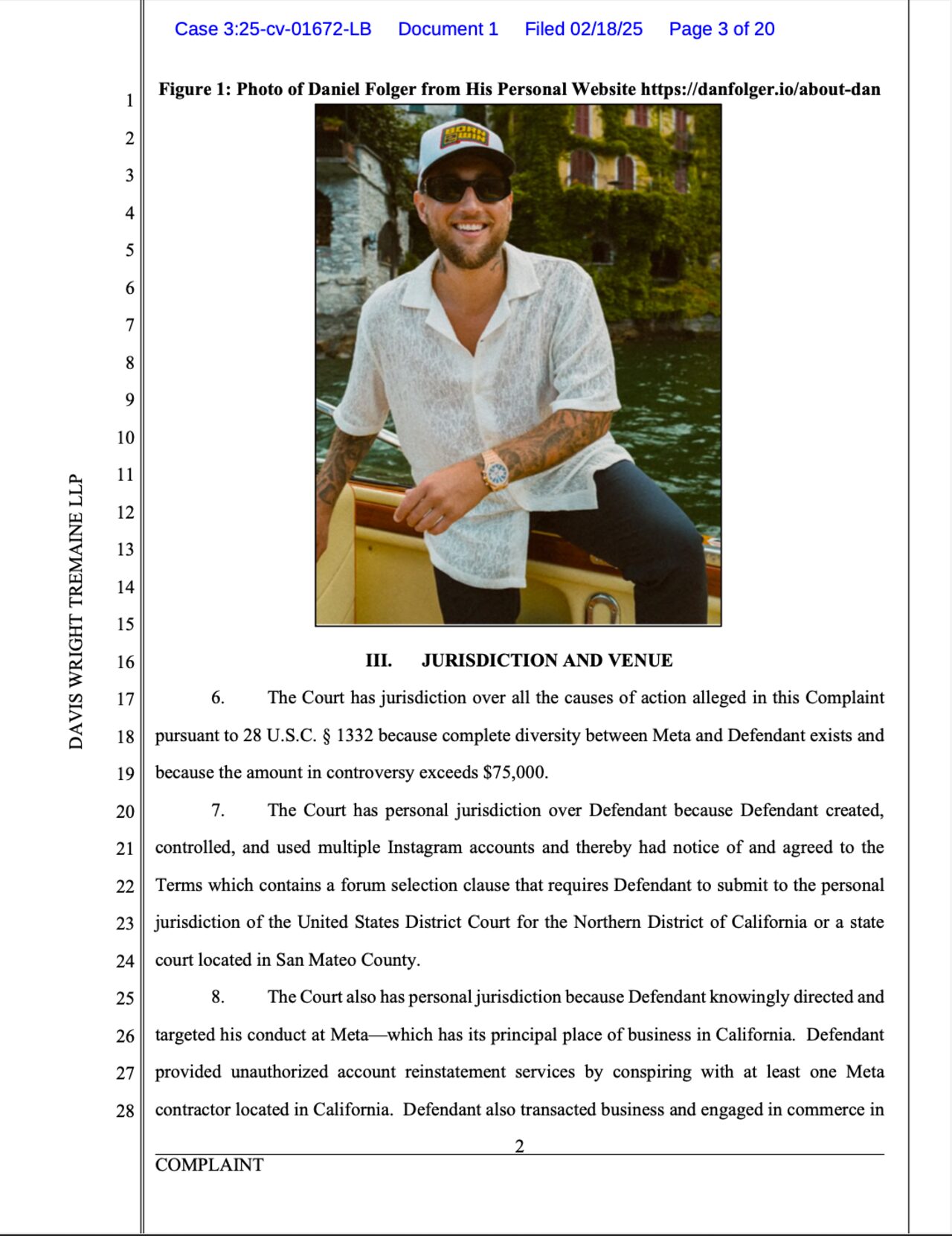
On Feb. 18, the company filed a lawsuit against a Nevada man named Daniel Folger, the founder of a jewellery and streetwear company and the one-time videographer of rapper Wiz Khalifa.
Mr. Folger was accused of selling and offering to sell Instagram usernames – in one case for as much as US$50,000 – and providing unauthorized Instagram account reinstatement services between April, 2022, and this past February. The lawsuit alleges Mr. Folger submitted deceptive requests, through at least one Meta contractor in California, to the company’s internal appeal channel. Meta, the complaint says, terminated the employment of the contractor in question.

In addition, Mr. Folger is accused of advertising his services on Instagram and the messaging app Telegram, allegedly claiming he could “bring back Instagrams from the dead.” The lawsuit also states that he offered to “whitelist” Instagram accounts to be “safe from any takedowns.”
“‘If your IG has been taken down hit me,’” he allegedly wrote on one of his Instagram accounts in 2023. “‘They coming back quick.’”
In its lawsuit, Meta is seeking to obtain an order forcing Mr. Folger to cease using its platforms altogether and, specifically, to stop “soliciting third parties to access Meta’s platforms and computer systems” on his behalf. Mr. Folger did not respond to a request for comment.
In many cases, brokers brazenly and openly advertise their off-book services. Brokers on the website Swapd.co, for example, offer to “unban” Instagram accounts for a couple thousand dollars and within 48 hours. One broker boasts that his “process is managed directly by a senior Meta rep.”
In early 2024, a Nevada man named Idriss Qibaa went on the No Jumper podcast and said he profited from extorting Instagram users by disabling their accounts and then charging to reinstate them.
According to Meta’s lawsuit filed earlier this year against Mr. Qibaa and the company Unlocked4Life LLC, Mr. Qibaa claimed that “over 200 people pay him monthly to maintain access to their user accounts and that he makes more than US$600,000 a month offering these services.”
Mr. Qibaa was indicted in a criminal case in Nevada over alleged threats to injure and kill two individuals and their families over disputes related to unauthorized Instagram services. In February, Mr. Qibaa pleaded guilty to several charges, including extortion, stalking and money laundering. Mr. Qibaa did not respond to a request for comment.
The civil suits and criminal cases speak to the level of desperation among users seeking to recover their hacked or disabled accounts. The court filings underscore the reality that there’s a huge market for unauthorized account reinstatement services because of Meta’s unresponsiveness – and because an unknown number of employees and contractors are willing to abuse an internal mechanism to make money on the side.
The company, for its part, is choosing to pursue legal action against brokers and insiders as its customer service problem persists.
Kendel Melbourne is among the contractors Meta has fired in recent years over allegations he was abusing the Oops mechanism for profit. He’s now the subject of a criminal case related to underground account services.
In the fall of 2022, The Wall Street Journal reported that Meta had terminated or disciplined more than two dozen employees or contractors it accused of improperly taking over user accounts. The Journal reported at that time that Mr. Melbourne – as a security contractor at one of the company’s offices in Manhattan – had access to Meta’s intranet, including the Oops system.
Mr. Melbourne was charged last year in the Southern District of New York with computer intrusion and conspiracy to commit computer intrusion. The criminal complaint accuses Mr. Melbourne of being the “manager” of a “takeover scheme” involving other Meta contractors who collectively submitted approximately 120 “fraudulent” requests for account reinstatement; of those requests, the complaint says, 93 were successful.
The complaint states that a cryptocurrency account registered to Mr. Melbourne received bitcoin, totalling the equivalent of approximately US$220,840, which was then apportioned between himself and seven other contractors. Mr. Melbourne accepted a deferred prosecution agreement and is currently on federal probation.
Reached by phone, Mr. Melbourne denied any criminal wrongdoing.

Jamie Holmes, owner of The Circus Fix, had two Instagram business accounts hacked. When nothing came of her attempts to have the accounts restored through Meta’s official channels, Ms. Holmes turned to a broker to regain access.Shlomi Amiga/The Globe and Mail
Access denied
When Jamie Holmes’s Instagram accounts for her circus and retreat businesses were hacked a couple of years ago, she realized just how heavily she depends on social media to promote her services and stay relevant within her community.
“The whole thing was embarrassingly stressful because I was like, ‘I can’t run my bloody businesses. This is how I communicate,’” the Toronto woman said of her accounts. “It was definitely impacting my business.”
The COVID-19 pandemic had been hard enough on her bottom line, and now this. She attempted to have her account restored through Meta’s formal request system, but nothing came of it. She submitted selfies in the hopes of having her identity verified. “I tried that like a psychopath every single day for over a month because I thought, ‘I’m going to freaking keep on trying,’” she said.
Nothing worked – until her sister put her in touch with someone she described as a “white hat hacker.” Ms. Holmes communicated with the broker through direct message via her personal Instagram account.
She’s unclear how, exactly, the broker retrieved her business accounts, but within about an hour of making contact, her access was restored. The broker didn’t accept the payment of roughly $600 until the job was done. The payment arrangement gave Ms. Holmes the comfort she needed to proceed; she had been concerned that anyone offering to help might themselves be a scam artist.
Although the details of the broker’s methodology are unknown to her, one thing was apparent through the process: “You literally cannot contact Meta,” Ms. Holmes said.
This is the frustration of many Instagram and Facebook users who have filed lawsuits against Meta in jurisdictions around the world. A woman who was running a yoga business in Florida sued Meta last year for US$8,000 in damages after her business account was disabled. Her court filing includes e-mails she sent to Meta seeking help.
“I beg you to activate our account as soon as possible,” she wrote in one e-mail. “Our business has fallen. We lose money every day,” she wrote in another. Two months into the appeal process, she had reached a breaking point and threatened legal action. “We have already sent you proofs an infinite number of times, filled out forms,” she wrote. “All this remains unanswered. It’s like a long torture.”

A woman who was running a yoga business in Florida sued Meta last year for US$8,000 in damages after her business account was disabled. Her court filing includes e-mails she sent to Meta seeking help.Supplied
Early last year, a youth leader in the Seventh-day Adventist Church sued Meta in New York State Court for US$10,000 after her Facebook account was disabled for a community standards violation. Discouraged by the online appeal process, she sent the company a handwritten note by fax. “Please be advised that I have tried every appeal to reinstate my FB account,” the woman wrote. “I am hoping you can direct this to a human being.”
In another case in New York State, Michael Grace sued Meta for failing to “correct and rectify” the theft of his hacked Facebook account, despite the fact that the company “profits from the solicitation of membership in said social media platform and the posting therein of personal profiles, data and information.”
Mr. Grace, who is an attorney and a former town supervisor in Westchester County, described himself in a May 10, 2023, court filing as a “public figure.” Two months later, Meta’s lawyers stated in a letter to the judge that Mr. Grace’s account had been restored.
Nonetheless, the letter said, Mr. Grace elected to continue with the litigation, asserting that the social-media company was liable for US$500,000 for “an unspecified ‘economic injury and injury to his reputation.’”
The letter provides a window into Meta’s corporate mentality.
It lays out several arguments supporting the company’s case for dismissing the complaint, including this: “The terms of service expressly disclaim Meta’s liability for the actions of third parties and all express and implied warranties, including the obligation to keep Facebook safe. Courts have consistently dismissed claims where, as here, the plaintiff seeks to hold Meta liable for alleged disruptions to his access to the Facebook service or for purported failures to safeguard an account.”
The case was voluntarily dismissed.
In interviews, Meta account users and industry experts made a similar argument to the one Mr. Grace mounted, which is effectively that the company profits off its users and, in turn, has a duty to provide adequate customer service.

A screenshot of a threat issued to Amy Hamilton, the CEO of B.C.-based hair-care company The High-End Hippie, when her business account was hacked. Ms. Hamilton abandoned her hacked account after she couldn’t get help from Meta.Supplied
“As we move into this AI tech world, what is the responsibility of these companies in protecting people’s information and privacy?” said Amy Hamilton, the founder and chief executive officer of British Columbia-based zero-waste hair-care company The High-End Hippie, who about a year ago abandoned her hacked account after she couldn’t get help from Meta. “If we’re using these platforms, they should have customer service.”
Meta had US$16.64-billion in profit in the first three months of this year, up 35 per cent from US$12.37-billion during the same quarter last year. Its quarterly revenue totalled US$42.31-billion, up from US$36.46-billion a year earlier.
Although the company offers paid subscription options in addition to providing free access to its platforms, it primarily makes money through ad sales. In the first quarter of this year, advertising accounted for nearly 98 per cent of the company’s revenues.
Erin West, a recently-retired state prosecutor in California’s Santa Clara County, said Meta has the capacity to fix the account takeover problem but has so far chosen not to.
“They’re just not allocating sufficient resources to this problem,” said Ms. West, who runs an initiative called Operation Shamrock that aims to disrupt cyberscams. “Your online identity and the credibility that you’ve built up over years is an asset. They’ve allowed those assets to be vulnerable, and they’ve refused to be helpful when those assets are stolen.”
There are numerous technological solutions that Meta could employ to determine if an account has been taken over by a bad actor, according to Ms. West. “Nobody knows technology better than Meta,” she said.
The company has, over the years, attempted various avenues for addressing its customer support issues, including offering users the opportunity to pay for a Meta Verified business subscription, which includes access to account support. However, that service is hit-and-miss, with some users saying in online forums that it helped them recover their account, and others, including one user interviewed by The Globe, alleging that the paid subscription did nothing to help their situation.

Shortly after making contact with the broker, Ms. Holmes’s account access was restored. She paid roughly $600 for the service.Shlomi Amiga/The Globe and Mail
Terry Cutler, the CEO of Quebec-based cybersecurity firm Cyology Labs Inc., said one of the challenges with account-recovery mechanisms is that bad actors often find ways to abuse them. Mr. Cutler – a certified ethical hacker capable of assessing organizational security systems and identifying vulnerabilities – said it can take Meta several months to recover a hacked account because of the sheer volume of backlogged requests.
Mr. Garod, the senior assistant attorney-general in New Hampshire’s consumer protection and antitrust bureau, said he considers Meta account owners to be not just users but also customers. “Whether you pay money or not, every time you use Meta, you’re giving them huge amounts of your personal information, and that has enormous value,” he said. “That is Meta’s bread-and-butter business model. That’s how they develop targeted advertising. That’s how they build revenue.”
Mr. Garod said he’s perplexed as to why Meta is so unwilling to help people restore their ability to be active on the company’s own platform. “It truly is a mystery.”
Full circle
In May, three years after Ms. Monks was hacked and sought help from a broker, she received an alarming direct message on Instagram.
“Hello @bobbywalksdogs, we have received reports that you have violated our account rules,” the message said. “Please fill out the appeal form to review and appeal the reports.”
Ms. Monks was scarred from her experience years prior and was far more judicious about clicking on links. She saw that the name on the account was “Meta,” but the handle was @metadesignbusinesshih. It didn’t seem right. And then she scrolled up. There was a chat history of messages she had exchanged with a friend about visiting a farmer’s market.
The friend, Ms. Monks realized, had been hacked, and now the hacker was phishing for their next victim. She wasn’t going to make the same mistake again.
“I’m so paranoid about everything to do with social media – I have total anxiety every time I enter a password,” she said. “It’s insane how hackers do this. And it’s insane how there’s no support from Meta.”
With a report from Stephanie Chambers
If you have any information you’d like to share about your own experiences with hacked Facebook or Instagram accounts, please reach out to Globe reporters Kathryn Blaze Baum at kblazebaum@globeandmail.com and Alexandra Posadzki at aposadzki@globeandmail.com.