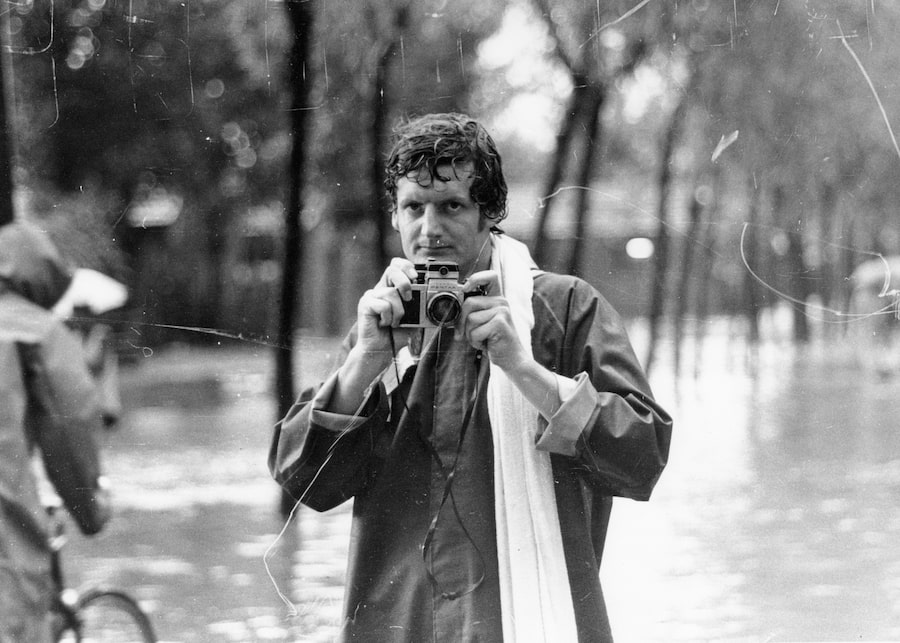
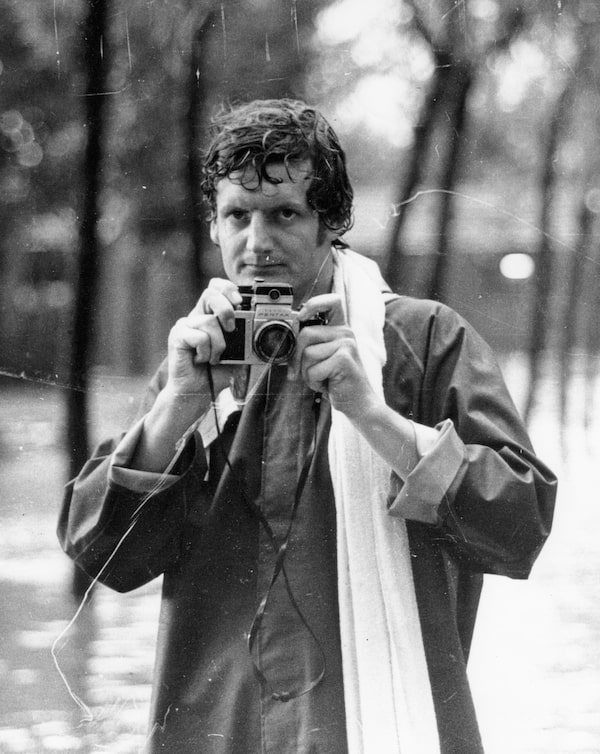
John Burns, who got his start as a political journalist for The Globe and Mail before a punch from Pierre Trudeau sent him to China, beginning a legendary 44-year career as a foreign correspondent that would see him win two Pulitzer Prizes, died on March 12. He was 81.
Mr. Burns was a 26-year-old cub reporter working in The Globe’s Ottawa bureau in late 1970 when he was accused – erroneously, he maintained – of trying to eavesdrop on Mr. Trudeau. The prime minister had been briefing Liberal backbenchers on the latest developments in the October Crisis, when separatist militants in Quebec kidnapped a provincial minister and a British diplomat.
Mr. Trudeau “threw a punch at me — actually, several punches,” Mr. Burns wrote years later. “It was a mismatch in more ways than one. Mr. Trudeau was a black belt in the martial arts, and he caught me unawares, knocking me backward and down into an overstuffed leather armchair.”

Three years after being punched by Pierre Trudeau, John Burns took this photo while covering the prime minister's historic China tour. At left, beside Mr. Trudeau's wife Margaret, is Deng Xiaoping, who became China's leader in 1978.John Burns/The Globe and Mail
Banned from the grounds of Parliament and generating embarrassing headlines for The Globe, Mr. Burns was told by then managing editor Clark Davey, “we’re sending you to China.” It was a decision that would change his life.
When Mr. Burns arrived in China, in May, 1971, the country was still largely closed off to foreigners. The Globe was the first Western newspaper to open a bureau in Beijing, in 1959, and remained a rarity in the Chinese capital.
Throughout his time in China, Mr. Burns was “de facto New York Times correspondent” due to a syndication deal that paper had with The Globe, he told author Mike Chinoy for a 2023 oral history. (His resulting bylines served him well, with Mr. Burns joining the Times in 1975 and spending the rest of his career there.)
The difficulties of operating in such an environment were made clear to Mr. Burns even before he properly arrived in the country. Crossing a bridge from British Hong Kong, “I met a dispirited fellow who identified himself as a German correspondent based in China, then one of a tiny crew of Western reporters in Peking,” Mr. Burns said. “The sad-eyed German fellow had some ominous advice. ‘Turn around!’ he said. ‘Go back! It’s crazy where you’re going! Save yourself now!’”
Undeterred, Mr. Burns continued to Beijing, where he soon learned to read between the lines of the relentless Mao Zedong-era propaganda, official misspeak, and self-censorship by ordinary Chinese citizens to give readers an accurate view of the country.
“I decided I have two eyes, two ears, two feet, two hands, that I’m in a really remarkable position as a correspondent to work out what the truth is,” he told Mr. Chinoy.
“The tale most often told about covering China during the Cultural Revolution was how restricted we were. But I discovered the bicycle. I could go out in the evenings and cycle, either down the hutongs, the old alleyways of the city, or out into the countryside to a village – and I felt I had all of China spread out before me.”


This desire to roam would bring an abrupt end to Mr. Burns’s second stint in China, for the Times, in 1986.
Accompanied by a Chinese translator and a U.S. academic, Mr. Burns set off on a marathon motorcycle ride across the country, intending to retrace the steps of Edgar Snow, whose book Red Star Over China introduced much of the West to Mao’s Communists in the 1930s.
Mr. Burns’s trip went off without much issue, and he published a lengthy magazine piece about his travels. Leaving the country for a vacation weeks later, however, Mr. Burns was detained and accused of spying. He was taken to a cell on the walls of which was written “the penalty for spying in China is death.”
Demonstrating a bravado that would help him weather similar incidents with even more dangerous captors later in his career, Mr. Burns ridiculed officials’ demands that he decipher the “hieroglyphic scribble” he used in his notebooks.
“Let me explain something to you,” Mr. Burns recounted saying. “You can’t read this. I can barely read it, the scribble. But if there were anything here related to espionage, do you think that I would read it to you? This is a pointless exercise.”
After a week – and the interventions of U.S. ambassador Winston Lord and former president Richard Nixon – Mr. Burns was released and put on a plane to Hong Kong. He had only been in the country for two years.

A police officer escorts Mr. Burns out of Hong Kong's Kaitak airport in 1986, when he was expelled from China. Hong Kong was then under British rule, outside Beijing's official reach.Dick Fung/The Associated Press
John Fisher Burns was born in Nottingham, England on Oct. 4, 1944. He attended Stowe, an elite boarding school he would later credit for teaching him “all kinds of ruses” that helped him as a foreign correspondent. While Mr. Burns’s father – a fighter pilot and later NATO commander – was born in South Africa, and the family lived all over the world, including Canada, where Mr. Burns attended McGill University, he kept a British accent from his days at Stowe, and travelled throughout his life on a British passport.
After his initial stint in China with The Globe ended in 1975, Mr. Burns joined the Times in New York, where he landed a story on the front page about a fatal bombing at La Guardia Airport “that may have saved me from failing my probation.”
The following year, Mr. Burns was dispatched to South Africa, where he wrote about the “ugliness of apartheid,” and learned a disdain for right-wing regimes that equalled his feelings for the “left-wing dictatorships” he lived under in China and the Soviet Union, where he was bureau chief from 1981 to 1984.
It was as a conflict reporter that Mr. Burns would become famous. He won the first of two Pulitzer Prizes for dispatches from Bosnia in the early 1990s, describing evocatively the destruction of Sarajevo.
“It is a disaster of such magnitude, and of such seeming disconnectedness from any achievable military or political goals, that those who take shelter for days in basement bunkers, emerging briefly into daylight for fresh supplies of bread and water, exhaust themselves trying to make sense of it,” Mr. Burns wrote.
His second Pulitzer was awarded “for his courageous and insightful coverage of the harrowing regime imposed on Afghanistan by the Taliban,” including an account of the stoning to death of a couple accused of adultery.

Vendors in war-ravaged Kabul set up their wares on Oct. 2, 1996, five days before Mr. Burns published a Pulitzer-winning report on the city's new Taliban rulers.George Fetting/Reuters
As he transitioned from young gun to rugged veteran, Mr. Burns developed a reputation as a journalist’s journalist, working to ensure his fellow reporters could report in safety and comfort, no matter the conditions of the country they were in.
“It was often said that the correspondent you wanted to follow in any bureau was John Burns,” fellow Times correspondent Nicholas Kristof wrote in 2024. “Wherever you were in the world — Kabul, Baghdad, Delhi — if you found particularly fine Times lodgings, you could guess that John had been there.”
A lot of this was thanks to Mr. Burns’s second wife, Jane Scott-Long, who accompanied him on many of his deployments, and became a vital member of the paper’s support staff. (“If they had a Pulitzer Prize for enabling great journalism, Jane would be my first nominee,” former Times executive editor Bill Keller said of Ms. Scott-Long, who died in 2017.)
But while Ms. Scott-Long was universally revered, Mr. Burns was more controversial. Based in Baghdad in the 2000s – from where he reported throughout the U.S. invasion of Iraq, his mop of grey curls becoming a fixture on CNN and PBS – Mr. Burns was accused of pushing out his predecessor as bureau chief, and bigfooting colleagues on the best stories.
The disaster that unfolded in Iraq after Saddam Hussein’s overthrow shook Mr. Burns’s Cold War-era faith in the Western model. He grappled with whether his reporting on the brutality of Saddam’s rule “helped pave George W. Bush’s way to war,” and felt even those reporters – like himself – who were skeptical of the White House’s case, failed “to step back from the day-to-day pressures before war to look at the deeply fractured society in Iraq that would emerge when the carapace of Saddam’s terror was lifted.”

Looking back on his career in later life, Mr. Burns would remember The Globe's 'serendipitous decision' to send him to China as a pivotal moment.The Globe and Mail
Mr. Burns retired from the Times in 2015. The last of his more than 3,300 bylines for the paper was a characteristically colourful account of the reburial of Richard III. He spent the last decade of his life in Cambridge, about 80 kilometres from Stowe, until he died on March 12 from pneumonia. Mr. Burns leaves three children, Jamie Scott-Long, Emily Scott-Long and Toby Scott-Long.
While most associated with the U.S. paper of record, Mr. Burns credited his career “to The Globe and that serendipitous decision all those years ago by Clark Davey, choosing a reporter with no knowledge of Chinese, and little of China’s turbulent history, for the only bureau any of the Western world’s newspapers had in Peking.”
In a sense, he acknowledged, he also owed a debt to Mr. Trudeau, whom he met years later in Beijing, burying the hatchet during a trip together “across Tiananmen Square in the Red Flag limousine provided by his hosts.”
“Recalling our fistfight,” Mr. Burns said, “we shook hands.”
You can find more obituaries from The Globe and Mail here.
To submit a memory about someone we have recently profiled on the Obituaries page, e-mail us at obit@globeandmail.com.