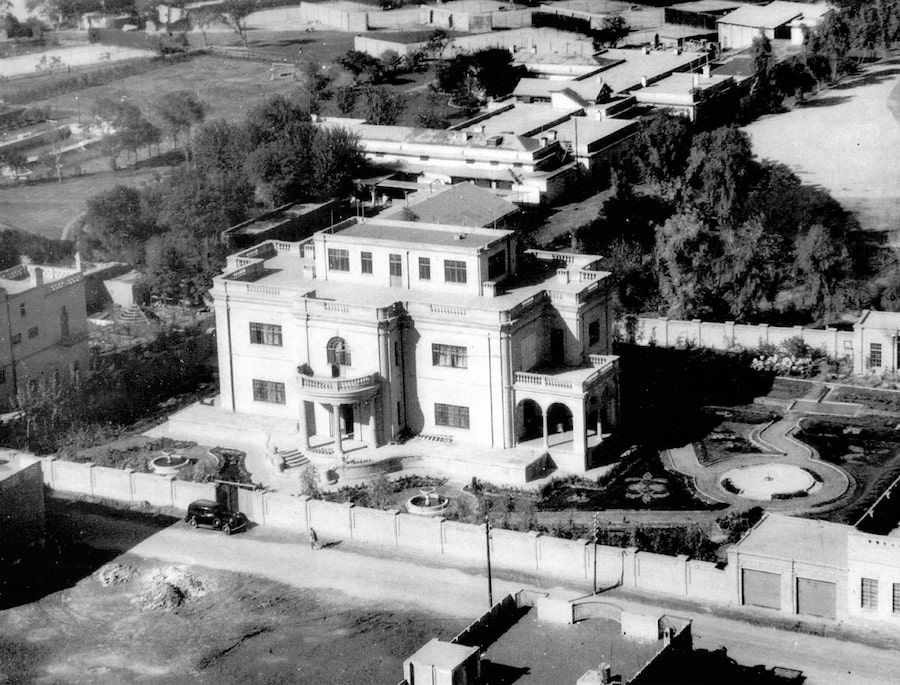
In the shaded garden of their Baghdad home, the Lawee family ate fresh dates straight off the palm trees. They fished in the Tigris River and strolled to the country club with tennis rackets under their arms. Brothers Ezra and Khedouri owned the General Motors concession for a section of the Middle East and the house they built together was suitably palatial, with columns and fountains and a swimming pool, a cook and a driver, and enough bedrooms to sleep 12.
Looking back, the family would come to think of this era as a kind of lost Eden.
The Lawees counted themselves, at the beginning of the 1940s, among Iraq’s roughly 150,000 Jews. They lived in one of the great centres of Jewish life, rivalling Krakow and Odesa and Vienna; a community with roots dating back 2,700 years to ancient Babylon, in a city where one in three residents shared their religion.
Then, in the fateful year of 1951, it virtually all disappeared. More than 100,000 Jews were airlifted out of the country amidst rising antisemitic repression in the once relatively tolerant Arab society. Most of the Lawees’ contemporaries ended up in Israel, like nearly one million more Middle Eastern Jews from Morocco to Iran whose flourishing worlds collapsed in a spasm of recrimination spawned by the creation of the Jewish state in 1948 and the corresponding displacement of hundreds of thousands of Palestinians.
The Lawee brothers instead brought their families to another great Jewish city thousands of kilometres away: Montreal. They became proud Canadians in their new home and built a thriving real estate business. But they never forgot Baghdad and Beit Lawee, or Lawee House – the charmed, palm-shaded world that had been stolen from them.

Philip Khazzam of Montreal argues that France owes his family millions in unpaid rent for their old home.Andrej Ivanov/The Globe and Mail
Now, more than 70 years later, their grandchildren are seeking justice. Philip Khazzam, grandson of Ezra, is suing the government not of Iraq but of France, which started using the house as its embassy in the 1960s, and then in the 1970s, abruptly stopped paying the family rent at the behest of Saddam Hussein’s new regime. Mr. Khazzam and his lawyers reckon the French owe more than $20-million and counting, given that France continues to occupy the Lawee House and pay rent to the Iraqi Treasury.
Because of the involvement of a Western, democratic government, it is a rare chance to achieve redress for the billions of dollars in property confiscated from Middle Eastern Jews in the 1940s and 50s, Mr. Khazzam believes. Few would expect the undemocratic regimes of Egypt or Jordan to make good on such claims, but the birthplace of the Enlightenment is perhaps another story.
“You have France sitting in a house for 55 years, not paying rent to the family that owns it,” said Mr. Khazzam. “This is a world leader in human rights and this is what they do?”
Apart from the legal and monetary questions, the family has a desire to stake a moral claim to the vanished world they still hold dear. Beit Lawee, improbably still standing after decades of dictatorship and war, remains a potent symbol of all they have lost.
“It’s not just a house,” said Mr. Khazzam. “All of us are so proud of our Iraqi heritage. For a long time, it was a magical place for our families to live.”



For the Jews of Iraq, “a long time” really meant something. The community traced its roots to ancient Babylonia when the Judean people were taken there in bondage. In the intervening millennia, through the advent of Islam and the rise and fall of empires, the local Jewish population became among the most prosperous and best integrated in all of the Middle East.
Especially in the 19th century, Baghdad’s strategic location meant that local Jews such as the Sassoons branched out to other nodes of global commerce like Bombay and Shanghai before funnelling their immense wealth back home.
Under the Ottomans who ruled Mesopotamia until after the First World War, Jews faced certain legal restrictions but largely flourished in a climate of religious tolerance. Muslim neighbours were known to bring them hot tea after Yom Kippur or bread and cheese to mark the end of Passover.
The creation of the Kingdom of Iraq under British control in the 1920s marked a high point for Jewish Baghdad.
The British were quick to do business with Western-educated Jews while the Iraqi government appointed them to senior roles in the civil service. Great fortunes were minted, including those of the Lawee brothers, who made the leap from trading in horse-drawn carriages to automobiles.
They built Beit Lawee in 1937, a sprawling mansion with lofty ceilings, sweet-smelling magnolias in the garden, and those date trees that cousins would still be dreaming about half a century later. To escape the sweltering summer heat, the families would sometimes happily camp on the roof overnight.

Mr. Khazzam has an old photo of a wedding at one of the Lawees' Baghdad homes.Andrej Ivanov/The Globe and Mail
Like most Baghdadi Jews, the Lawees spoke Arabic at home and considered themselves deeply Iraqi. Zionism had little purchase locally well into the 1940s, to the chagrin of the movement’s leaders; families like that of Ezra and Khedouri felt they already had a homeland, the same one they had inhabited for more than 2,000 years.
Nevertheless, the virus of antisemitism made landfall on the banks of the Tigris River just as it was rampaging across Europe. A combination of resentment over Jewish success under the British Mandate and Nazi propaganda that aimed to sow hatred of Jews in the Arab world led to a vicious pogrom in 1941 known as the Farhud, in which nearly 200 Iraqi Jews were murdered.
Israel’s declaration of independence in 1948 and subsequent defeat of Arab armies and expulsion of Palestinians led to increased persecution of Jews across the Middle East. That year, Iraq’s wealthiest Jewish businessman, Shafiq Ades, was hanged after a show trial accusing him of Zionism. Jews were fired from government jobs and Jewish property was seized by the state.
The community now realized its position in Iraq was impossible, and thousands began escaping overland to Iran and from there to Israel, although the government was reluctant to allow a mass exodus that would hobble the country. In March of 1950, the Prime Minister gave Jews a year to leave the country on the condition they forfeited their Iraqi nationality. Their property in Iraq would also be frozen.
To the government’s surprise, virtually the entire Jewish population signed up to leave. Most opted to become Israeli, prompting a frantic year-long airlift – Operation Ezra and Nehemiah, it was called, after the biblical figures involved in the return of Jews from Babylon to Jerusalem.
The Lawees were wealthy enough not to depend on the airlift and decided along with thousands of other families to try their luck in North America, finally settling in Montreal. Ezra and Khedouri tried to recreate a semblance of their lives in Baghdad: They bought adjoining houses with a shared backyard where the cousins could play together. They attended the Spanish and Portuguese Synagogue of Montreal, Canada’s oldest, with their Sephardic co-religionists.

France acquired Beit Lawee in the 1960s, though later political events would disrupt its agreement to pay the family a nominal rent.Courtesy of Philip Khazzam
All the while, Beit Lawee sat vacant in Baghdad, watched over by a caretaker the brothers had hired. But the family retained their title to the house and in 1964, they found a tenant. France needed a new embassy and the brothers were only too happy to derive some income by having their former home inhabited by a friendly democratic government.
The lease provided for a nominal rent to be paid in Iraqi dinars, and another more substantial sum to be paid in francs, to avoid raising local suspicions. Like that, they had a renewed connection to their Edenic past and some financial compensation for their effective expulsion from Iraq.
The arrangement didn’t last long. After the Six-Day War in 1967 that saw Israel rout the armies of its Arab neighbours, Iraq grew even more hostile to its few remaining Jewish citizens. A coup in 1968 brought the Ba’ath Party to power with Saddam Hussein as vice-president, and the next year, nine Jews were publicly hanged for allegedly being Zionist spies.

A Baghdad antique shop sells keychains with portraits of Saddam Hussein and, at left, one of his predecessors, Abdul-Karim Qasim. France moved into its current embassy soon after Mr. Qasim's ouster in 1963.MURTADHA RIDHA/AFP via Getty Images
Around the same time, the Iraqi government informed the French embassy officials that from now on they were to start paying rent to the regime instead of the Lawees. The family was given no notification or compensation. Their home had been confiscated, apparently for the crime of its owners being Jewish.
France made only a show of complying at first, redirecting the portion of the rent they had been paying in dinars to the government, but continuing to pay the Lawees separately in francs – a tacit acknowledgment of the injustice of Iraq’s demand.
It was not until 1974 that the French committed their ultimate betrayal, in Mr. Khazzam’s view, when they stopped paying the family altogether amidst a pro-Arab turn in the country’s foreign policy.
When Ezra protested - Khedouri had died in 1967 - he was brushed off with a verbal explanation that Iraq had “sequestered” the building. Then, silence.
The Lawees had now been fully dispossessed and experienced the final blow of their exile. But they were in good company among the Iraqi Jews of Montreal – their injustice was one of many – and the prospect of taking on the French government seemed daunting. So, they moved on. Decades went by, and the house moved gradually into the realm of family lore.
As for the bitter and prolonged way the family was parted from the home, Mr. Khazzam said, “Everybody forgot …”


It was on a whim that Ezra’s grandson started looking into the fabled Beit Lawee. Mr. Khazzam, now 65, was curious what property in Baghdad was worth after decades of tumult, and he was surprised to find that even in a relatively poor and arid country, the scarcity of land meant that the family home was likely worth millions.
France would have known this, and therefore the scale of the “unjust enrichment” it had taken part in, he thought. And not since 2004, when an uncle briefly revived the affair by hiring former Quebec premier Lucien Bouchard to send a letter to the French foreign minister, had the situation been broached.
The story of the house continued to haunt Mr. Khazzam. He was a proud Canadian, but equally proud of his cosmopolitan Iraqi heritage. Sometimes he listened to the Muslim call to prayer on Baghdad radio stations over the internet; the plaintive melodies reminded him of the prayers he grew up hearing in the Spanish and Portuguese Synagogue of Montreal.
All of a sudden, he said, “Something hit me, and I realized this is not just about a property. … It’s not just the house, it’s human rights. And France has trampled all over human rights. And just the unfairness of the whole situation led me to take action.”
In 2021, he and a couple of cousins hired the impeccably well-connected lawyer, Jean-Pierre Mignard, a close friend of former French president François Hollande. The respected, patriotic jurist was immediately struck by his country’s “inexplicable” conduct in the matter.
“Where I’m scandalized is that the Lawees were dispossessed of their property because of their religion, because they are Jewish,” he said in an interview. “France never should have accepted that.”

Jean-Pierre Mignard, the lawyer representing Mr. Khazzam, has told his country's Foreign Minister that the case is 'a scandal that we would do well to put an end to.'THOMAS SAMSON/AFP/Getty Images
Mr. Mignard’s indignation is palpable in a series of letters addressed to the French Foreign Minister and the ambassador to Iraq, and then their successors, as the habitual turbulence of French politics created a merry-go-round in the diplomatic corps. He never imagined launching a lawsuit against the Fifth Republic, he writes.
“But France has occupied a stolen Jewish property for 50 years in full knowledge of the fact and without ever having undertaken any moral or economic redress,” he continued in one letter to the Foreign Minister in the winter of 2024. “This seems to me a scandal that we would do well to put an end to.”
Although Mr. Mignard initially got a sympathetic hearing from the highest reaches of the French foreign service, the government’s response was ultimately to stonewall. Formal correspondence was vague and evasive. Both lawyer and client hoped that France, the birthplace of the rights of man, would recognize an unjust situation and come to a settlement – “do something decent,” as Mr. Khazzam said.
Instead, he and Mr. Mignard took the French government to court earlier this year, demanding $22-million in back rent and $11-million in damages. They have now offered to enter into mediation as a way of resolving the impasse; the government had until May 15 to respond and did not. The tribunal will now set a date for a hearing.
A spokesperson for the French Ministry of European and Foreign Affairs declined to comment on an active judicial case.
The fact that France has allegedly profited from a stolen Jewish home in Iraq is not unlike the museums and collectors who enriched themselves through artwork stolen from Jews under the Nazis, said Edwin Black, author of a book about the 1941 Iraqi pogrom. The lawsuit against the French may help draw attention to the lesser-known expropriations of the Middle East, he believes.
“It is a David and Goliath story, and it’s an overdue one.”

The French embassy in 2010. Mr. Khazzam is pressing France for $33-million in back rent and damages for its use of the building.Eric Gaillard/Reuters
Such a case has rarely, if ever, been resolved through the courts, said Stanley Urman, executive vice-president of the non-profit Justice for Jews from Arab Countries – although a recent report by his organization found that some $34-billion in contemporary U.S. dollars was seized from Iraqi Jews alone.
Philip Khazzam has “a very unusual story and it’s to his credit that he’s taken it this far, despite many obstacles,” said Mr. Urman. “I think it would be an important precedent for the right of Jews to compensation and hopefully establish a precedent for similar cases to be adjudicated in the future.”
Money is not the main issue, however, said Mr. Khazzam. His pot would ultimately be split widely amongst the descendants of Ezra and Khedouri, and anyway he runs a successful dried fruit-and-nut importation business and lives comfortably in Montreal.
The crux of the case is something bigger, something moral and deeply personal, about one family’s connection to a home and its shaded garden and the swaying date palms of Baghdad.
“I somehow wanted to go back there,” said Mr. Khazzam. “I think Ezra and Khedouri would be very proud.”