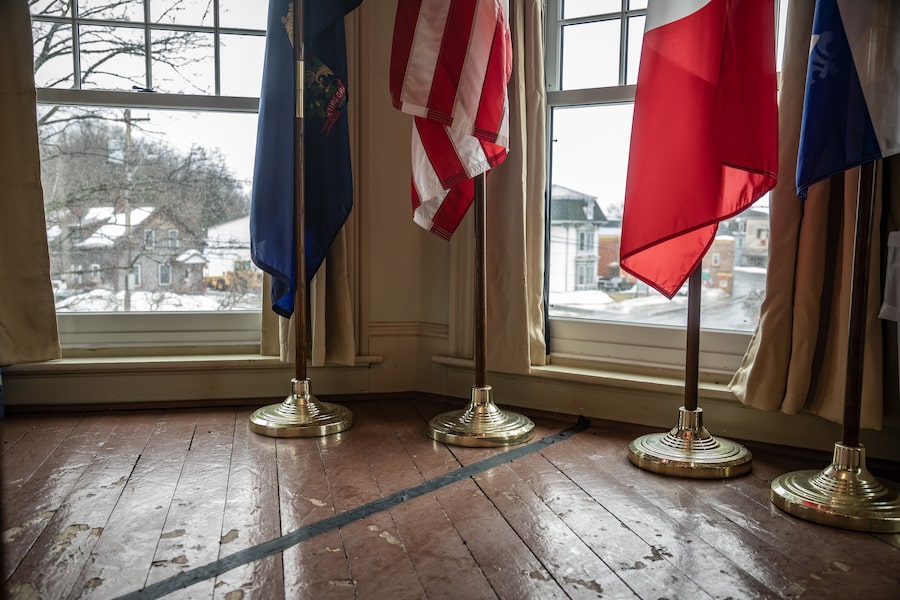
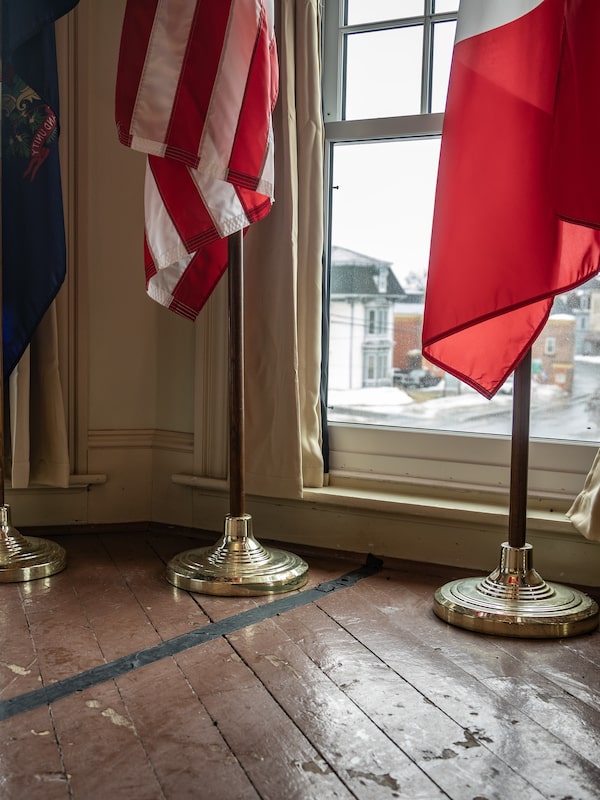
A strip of fraying black tape on an old hardwood floor is the only evidence of the Canada-U.S. border as it cuts across the Haskell Free Library & Opera House.
The boundary is easy to ignore, which is how Martha Stewart Haskell wanted it when she built her shrine to high culture straddling the frontier between Derby Line, Vt., and what is now Stanstead, Que., all the way back in 1904.
The dual-citizen Haskell, who inherited her husband’s lumber fortune, thought the turreted palace of music and learning should stand as a symbol of neighbourly friendship, and for 120 years it mostly has.
“I prefer to call it Switzerland,” said Sylvie Boudreau, president of the board of trustees and proud custodian of a strange distinction: the world’s only library – or opera house – divided by a closed international boundary.
There was something especially shocking, then, about a recent violation of the Haskell’s neutrality, one that has put this whimsical no man’s land in the crosshairs of bilateral tension. The incident was an escalation of gradually increasing tensions over the library, as the Canada-U.S. border has grown more fraught with concerns about illegal immigration, the smuggling of guns and drugs – and now tariffs and annexation threats.

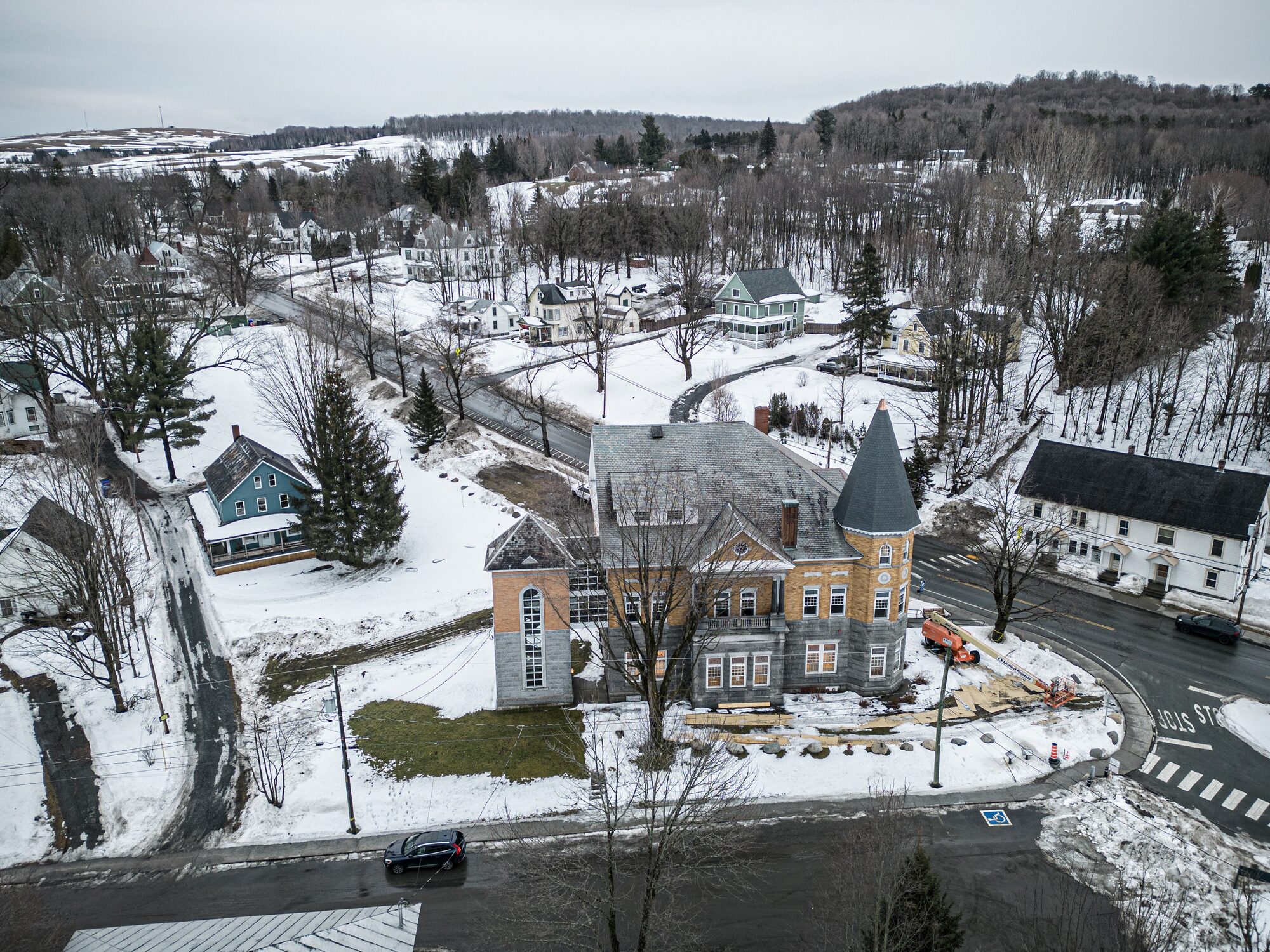
While the entrance to the Haskell is in Derby Line, VT., much of the building is located in Canadian territory.
Once a nationless bubble smelling sweetly of old books and wearing its border-bestriding status as a lovable quirk, the Haskell has become uncomfortably enmeshed in geopolitics.
In January, U.S. Secretary of Homeland Security Kristi Noem visited the library while commemorating the death of a border agent killed in the line of duty nearby. Like many visitors, Ms. Noem danced back and forth over the electrical tape that represents the 49th parallel, but added a taunt: “U.S.A. No. 1,” she said on one side, “51st state,” she said on the other, with a grin. Two or three times, she repeated Donald Trump’s provocation about annexing Canada while somebody filmed her, and her entourage laughed.
Staff at the Haskell were “outraged” and “shocked,” said Ms. Boudreau, who is herself Canadian. “For me it was a lack of respect.”
This was not what Martha Haskell had in mind when she built the library, but it was a different time in many ways then. The library originally contained separate men’s and women’s reading rooms, and the first performance at the upstairs concert hall included a blackface minstrel show.
For decades, the international border was a legal fiction dotted with buildings similarly divided by the boundary line, including a bar called the Halfway House. Cow smuggling was the sort of quaint criminality that authorities worried about.
Everything changed after the terrorist attacks of 9/11. The entire Canada-U.S. border “thickened” as security took on a premium. U.S. border agents began scrutinizing the family reunions that regularly took place at the library between relatives separated by visa or immigration issues.
Authorities later charged a Montreal man with smuggling handguns into Canada, in part by using the Haskell bathroom as an entrepôt, generating further suspicion. He pled guilty to U.S. weapons charges in 2018.
The scam was facilitated by the building’s unusual layout in relation to the border. The front entrance is in Vermont, and there is only an emergency exit on the Canadian side, but it’s possible to walk across the border and into the library from Stanstead, Que. without any passport check.
This setup, and the rare instances of people exploiting it, have made American authorities increasingly vigilant about the Haskell. When a newspaper reporter told agents at a border crossing that he was going to visit the library this week, he was taken aside for questioning in the name of “national security.”
“You’re going to be telling people how to cross the border illegally?” one agent asked. “It’s one of the most illegal crossings in the United States.”

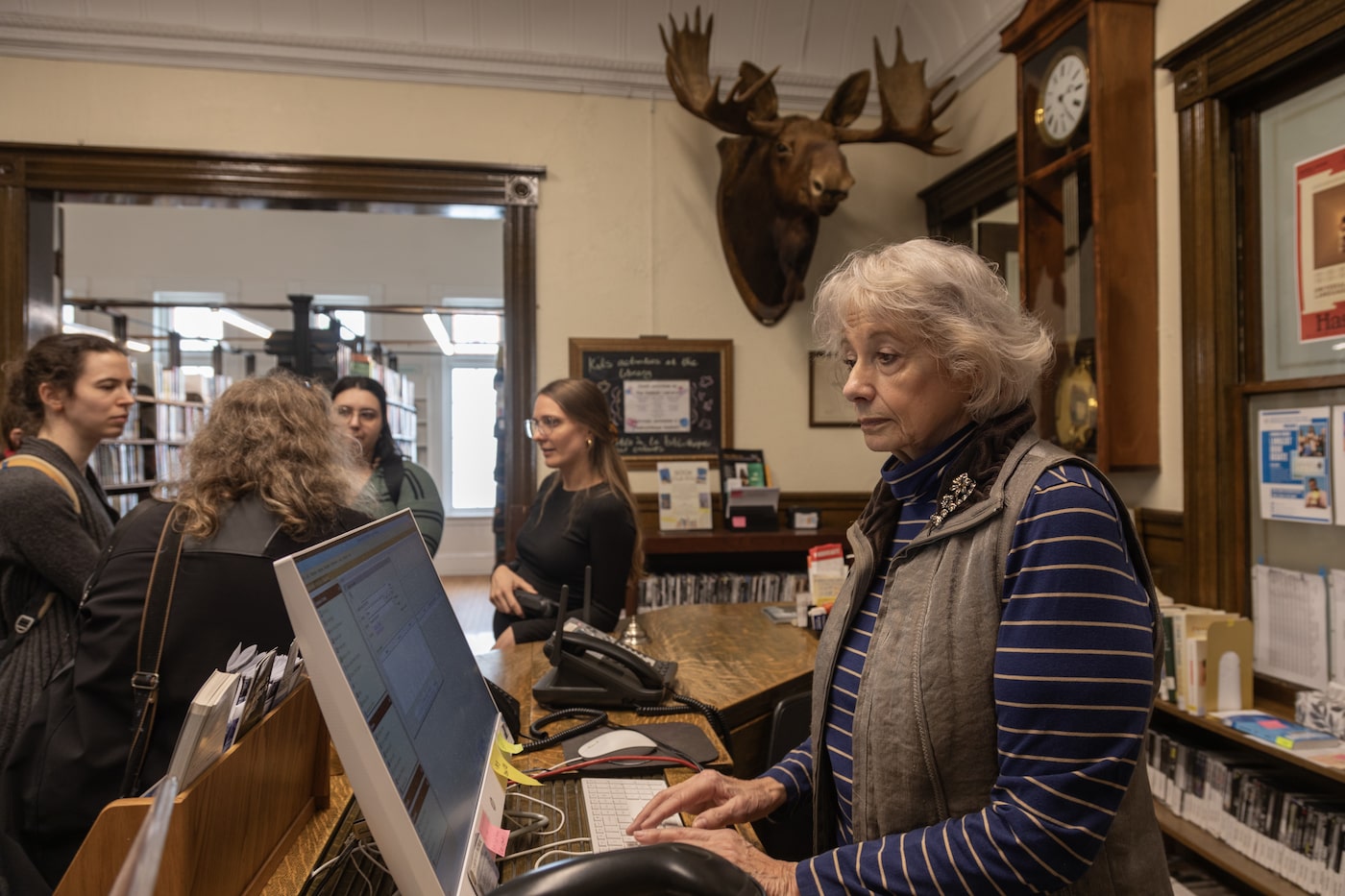
Sylvie Boudreau, president of the board of trustees of the Haskell Free Library & Opera House, is also a retired Canada Border Services Agency officer.
That outlandish claim made Ms. Boudreau visibly angry when it was related to her. There are countless places to traverse the border unchecked in Quebec and Vermont, never mind the rest of the nearly 9,000-kilometre land boundary.
“You don’t have to come to the library to know how to cross the border illegally!”
(Asked to clarify the agent’s claim, U.S. Customs and Border Protection spokesperson Ryan Brissette sent a brief statement calling the library “a unique landmark.” But he said that it “poses challenges to border enforcement and historically has been used for illegal crossings,” adding that his agency “continues to work closely with the Royal Canadian Mounted Police to ensure proper monitoring of this location.”)
Relations with authorities in both countries have to be carefully managed these days, and Ms. Boudreau, a retired Canada Border Services Agency officer, is well-placed to accommodate their concerns. Since the library reopened after the height of COVID, border guards have been allowed to perform spot checks of people entering or exiting the building. The library keeps the authorities informed of any event they are holding, like readings or film screenings, and any new hire they make.


Above: A stone pilon and non-loitering sign mark the Canada-U.S. border in Stanstead, Que. Below: Inside the Haskell, a sign warns visitors that cross-border family reunions are forbidden, and the building is under surveillance.
Today, the library is surrounded by concrete barriers and boulders to discourage crossings. A sign in languages including Haitian Creole and Farsi warns visitors not to loiter outside. Security cameras stare out from a gnarled old tree on the front lawn, and signs inside forbid “cross-border meetings.”
The once-joyful sight of divided families reuniting briefly within the walls of the Haskell is no longer possible. Just the other day, Ms. Boudreau had to ask two Venezuelan men to leave for that reason. It was disappointing, she said, but “we’re walking on eggshells.”
Staff at the library – some paid, some volunteer – have managed to retain a sense of humour about their situation. It remains a source of amusement that certain couples call to inquire about being married at the library, perhaps thinking it might magically confer dual citizenship. Another couple split between Canada and the U.S. recently asked, even more audaciously, to hold a conjugal visit in a dark and quiet corner of the opera house.

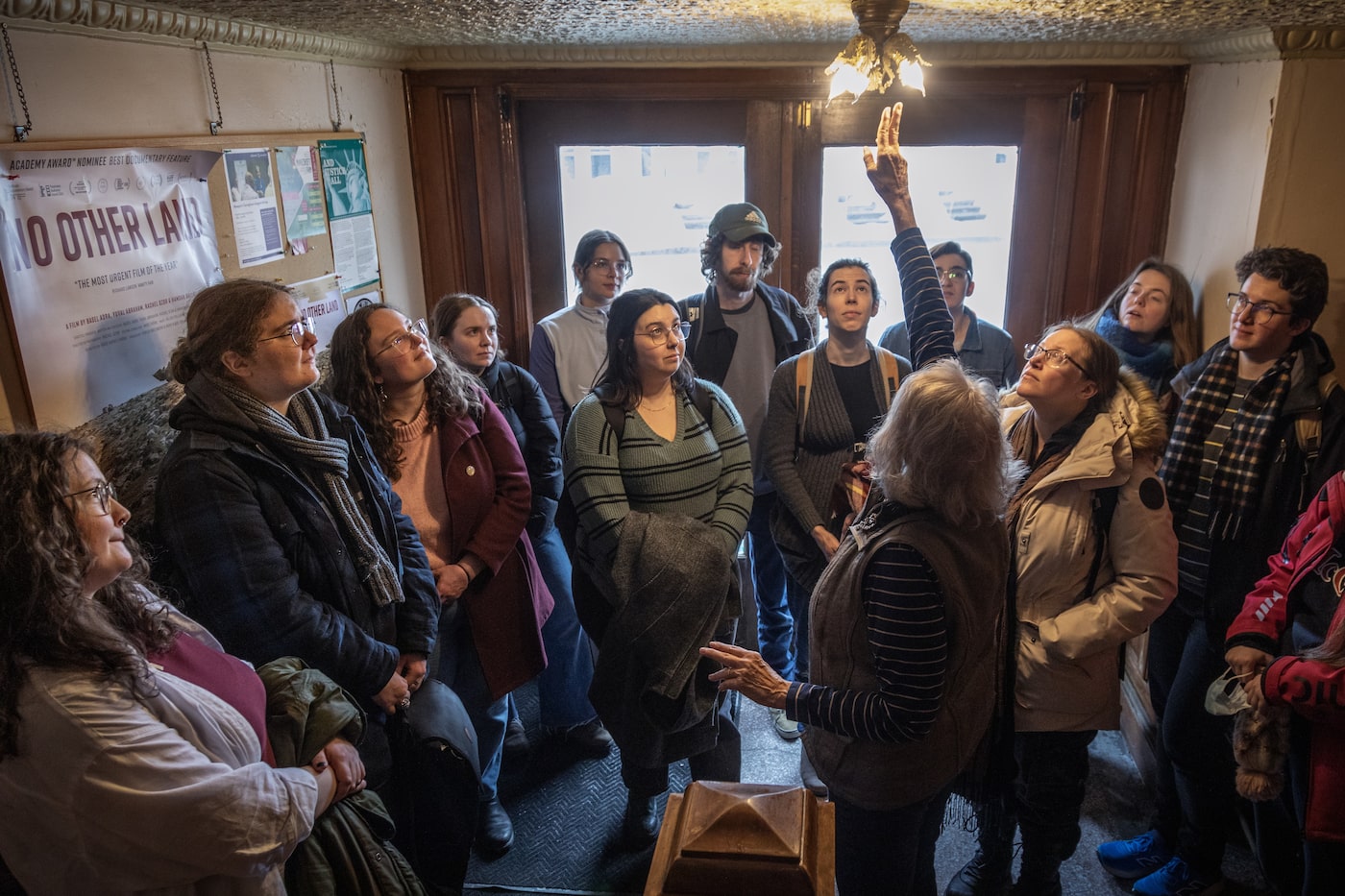

The logistics of managing a binational building are cause for wry head-shaking as well. The Haskell pays its hydro bill in Quebec and its oil and water bills in Vermont, while the paint on the upstairs floorboards is peeling because a contractor realized he would need permission from two separate heritage boards and decided not to bother.
“It’s crazy,” said Ms. Boudreau, with a smile.
For now, the library is just scraping by with government grants for special projects, some long-standing endowments and donations from patrons. Some Americans feel so passionate about the place that they leave money for it in their wills.
Love for the library runs deep in Vermont as well as Quebec, and ties between the regions are tight: cross-border rivalries tend to revolve around innocent subjects like curling tournaments and who makes the best maple syrup.
The Haskell’s American patrons, who come in for $5 movie screenings in the old-timey opera house and an endless supply of Louise Penny novels, have been apologizing profusely since the “51st state” stunt by Ms. Noem, said Ms. Boudreau.
Then again, even if the U.S. administration grows more hostile to the library and tries to shut it down, she has room to manoeuvre.
“If they shut the American door, I’ll just open one in the back,” she said.

The border crossing between Stanstead, Que., and Derby Line, VT. For decades, the international border was just a legal technicality at the Haskell. But since the terrorist attacks of 9/11, the entire Canada-U.S. border has 'thickened' as security took on a premium.