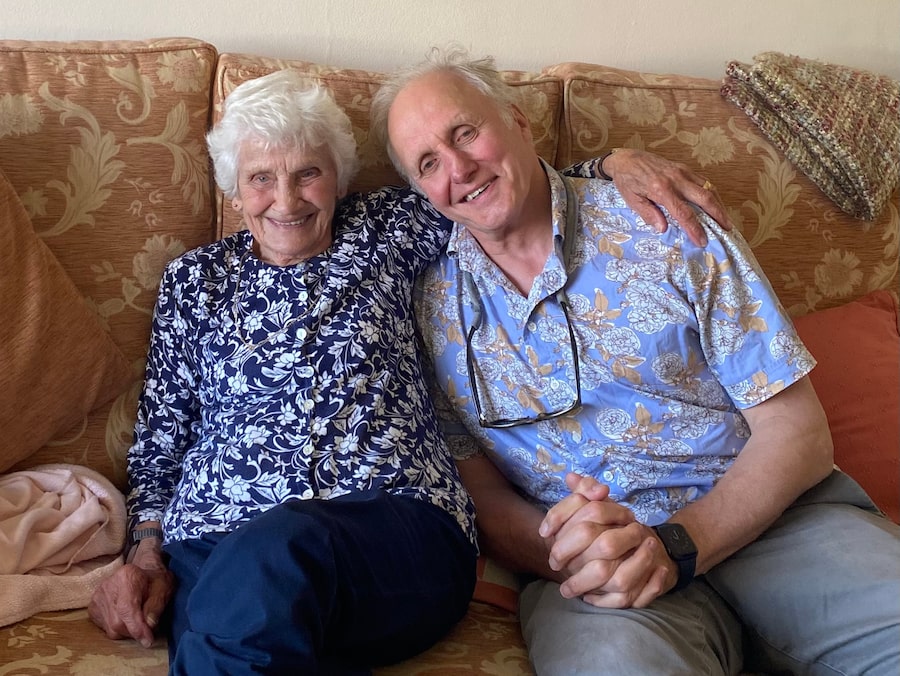

One day this fall, my phone rang too early in the morning for it to be anything but bad news. Stephen Appleby, one of my English cousins, was calling. His mother, my aunt Audrey, had died hours earlier – sadly but not unexpectedly, given her congestive heart failure and fragility at 96.
“She just kind of stopped breathing. It was very peaceful.” He was trying to contain his emotions. “She left five pages of instructions. And she wanted you to give the eulogy at her funeral.”
“Surely I am just one possibility,” I said. I’d been in England only weeks before, to see Audrey one last time. Her last words to me were, “I expect I’ll see you around.”
“No,” Stephen said. “She’s quite specific that it be you.”
I loved Audrey like a second mother – a kinder one who helped free me from my own when I was a teenager. But she lived in rural Suffolk. It took a day and a half and a thousand dollars to get there and back to Toronto. I’d seen her four times in the past 15 years, and knew very few specifics of her life. How was I supposed to write a eulogy? Plus, the funeral was three weeks away and would be well-attended (she and her late husband, John, owned a series of pubs), not least by my English relatives, all of whom have exacting standards.
I agreed to do the eulogy and immediately began to worry about it. My brother had been asked to read the lesson at the funeral. We decided to fly over together, make a quick stop in London afterward, keep each other company. He adored Audrey as well. I noticed we were both trying to be upbeat, matter-of-fact. Fifteen dead on a beach in Sydney is a tragedy. A 96-year-old who wants to be relieved of her bewildering decline is not.


Eulogies are an old, old habit. To eulogize means to praise – the original invocation not to speak ill of the dead. Historically, the tone of eulogies has been strictly panegyric, rah-rah exaltations. There is some science suggesting that praising the deceased mitigates “death-related anxiety,” which is why eulogists aim for (hideous-word alert) closure. But positive send-offs have gone in and out of fashion, such as in the late 1700s, when empiricism raised its snotty little head in France and people thought they needed to be more objective about the dead.
That seemed a little harsh. The best eulogies, in my experience, do more than praise and pacify: They help mourners across the terrifying gap a death leaves in our lives and give them reason to move on, from missing the deceased to remembering them. So the best eulogies are accurate (you can’t exaggerate the departed’s accomplishments too much) but also candid.
After the Challenger space shuttle exploded in 1986, Ronald Reagan delivered a public eulogy for the dead astronauts. “I know it’s hard to understand,” Mr. Reagan said, establishing his bona fides with his grieving countrymen.
Then he continued: “But sometimes painful things like this happen. It’s all part of the process of exploration and discovery. It’s all part of taking a chance and expanding man’s horizons. The future doesn’t belong to the fainthearted; it belongs to the brave. The Challenger crew was pulling us into the future, and we’ll continue to follow them.”
Memorable eulogies are candid to the point of satire, but they are also forgiving.
Martin Amis delivered his public consolatio for the much-too-early death of his friend and fellow writer Christopher Hitchens in 2011. Mr. Amis knew he had to address Mr. Hitchens’s bombastic vanity as much as his enormous popularity as a writer.
Mr. Amis began with the many reasons for Mr. Hitchens’s charm – “First, very handsome”– and then moved on to his grandiosities. For instance, that Mr. Hitchens often referred to himself in the third person as The Hitch (“not a habit consonant with cloudless mental health,” Mr. Amis noted). One day in Southampton, on Long Island, Mr. Amis remembered, he pointed out that no one had recognized the Hitch (he was stopped constantly by passersby in New York) for at least 10 minutes.
“Longer,” the Hitch replied.
In the end, Mr. Amis said, it was Mr. Hitchens’s openness about his intellectual about-faces (Marxist to capitalist, pro-Iraq invasion to anti-Bush) that made his readers love him. “He contradicted himself as if Christopher felt the only person worth really arguing with was the Hitch.”
That’s the point of a eulogy, of talking about someone who has died. You come not just to praise Caesar, but to explain him.

Christopher Hitchens, at left with Martin Amis in 2000, died of pneumonia 11 years later after undergoing treatment for cancer. An outspoken critic of religion, he donated his body to medical research, and his memorial was held not at a church, but the Great Hall at Cooper Union in New York.Axel Koester/The Globe and Mail/The Globe and Mail
I procrastinated for two weeks. I did not resort to AI; it felt like cheating to use an unfeeling machine to lament and contextualize the loss of someone I loved.
You can use AI, of course, to write a eulogy: The US$50-billion-a-year North American “death care” market thrives online, packed with websites and guides and rules and bots that will help you write a eulogy. They have names like Everloved and My Farewelling and Dignity Memorial and their advice is always the same: talk to others, jot down memories and details, find common themes. Keep it to five minutes. Avoid the embarrassing and the overly private, and, above all, don’t make it about you.
I had already called my English relatives. Their families have lived in the same small patch of Suffolk for somewhere between 200 and 400 years, and the farthest any have wandered for any significant length of time is three hours away by car. Stephen’s revelation that Audrey had left five pages of instructions to her children regarding her own funeral was more useful than any of the specific items on her to-do-after-I’m-dead list: It was proof that she was a dedicated planner and list-maker, and a bossy one at that, like all her siblings. That detail works in a eulogy.
There were other gems to be mined: the strength and equality of her marriage, her affection for strangers, her love of a vulgar double entendre. (Tricky, but possibly usable.) Stephen even remembered a poor girl in the village my aunt had befriended, which seemed like eulogy gold. But none of Audrey’s other children had ever heard of this little girl. “He’s a compulsive liar,” Sarah said of her brother, fondly.
A eulogist quickly learns that a family is a keen but unreliable source of information. But the contradictions (such as the fierce debate about where Audrey met her husband: in church or at a party? In South Weald or in Pleshey?) are useful. Stephen advised me to keep it light: “You’re not talking about the Queen.”
My uncle Pat, Audrey’s younger brother – there were suddenly only two of five siblings left – recalled some details of her early life. I suspected he was more upset than he was letting on: He was close to his sister, they lived near one another all their lives and his siblings were dying in chronological order, eldest to youngest. He was next in line. I didn’t want to make it more painful than it already was. He mentioned that Audrey didn’t always get along with her father, a ruffian who called her stupid. That was helpful for context but unusable in the eulogy per se, because it was too complicated and dark to explain.
My cousin Polly, Audrey’s youngest daughter, mentioned that her mother, bombed out of a house during the war as an 11-year-old, was terrified of thunder for the rest of her life; that she loved to talk and listen to people throughout her town of Wickham Market, especially if she thought they needed a friend; that she cheated shamelessly at Scrabble, pretending non-words were words; that she and her sisters loved to exaggerate the details of a story.
She reminded me of my aunt’s talent for creating beauty – in her brilliant garden (once featured on the BBC), in her inviting pubs. My brother knew that her famous recipe for caramel sauce was actually sweetened evaporated milk and instant coffee, and that Chicken Marengo was the most popular order in her pubs. I knew that Napoleon served the dish to his troops the night before they set out to conquer Russia, which meant Audrey’s recipe was more successful. The eulogy seemed to be coming together.
“Why did she want me to give her eulogy?” I asked Polly, just before I hung up. Her reply: “Because she loved you.”
Finally, I called Audrey’s younger son, Finny, the executor of her estate. He had found in her papers not only letters to each of her children and the five-page funeral instruction manual, but a document outlining the facts of her life that she had written during the pandemic, when she was convinced she might die. She displayed some evidence of hypochondria. It runs in the family.
My brother and I were flying over on a Wednesday evening. By Monday night I had a draft. It was twice as long as it needed to be, and half as interesting as I wanted. I edited on the plane and printed the new draft at the car-rental office and made new changes on the way to the crematorium.
Church of England funerals in that part of the country have an initial private ceremony to commit the body to be cremated: the casket perched on rollers for the immediate family to see before being consumed by fire. Everyone was a wailing wreck. The ensuing funeral service in a church brings everyone together. Between the two events, Stephen read my eulogy for accuracy and wondered whether the Chicken Marengo joke would land. I assured him it would.

A few days ago, I called Rev. Aaron Orear at St. Alban the Martyr, an Anglican church in Glen Williams, a hamlet northwest of Toronto. He had presided over the funerals of both my parents.
“I do death well,” he told me. He could remember only two really dreadful funerals in his 30 years as an Anglican minister. “In one, the family couldn’t stand the deceased and didn’t want to stand up and say that, so they said nothing. It was probably a 20-minute funeral, tops.” The other disaster had been an open-mic funeral for a young man where anyone in the church could get up and talk. His friends were pot smokers. The eulogies rambled on forever.
Eventually I asked Father Orear what the purpose of a eulogy was. “It puts everyone on the same page,” he said. “It gathers the various griefs and gives them body. It gives the memory of the dead person an almost tangible presence in the room.”
Anglicans and Jews make room for eulogies during a funeral, followed by the priest’s or rabbi’s homily. If he didn’t know the deceased, he always talked to the family beforehand. “I’m appalled by clergy who don’t,” Father Orear said.
He also has the eulogists speak first in the service, so he can mine their content for his sermon. “The eulogy is the story of the person who has died, and the sermon is where you see how they rest within the story of God.”
(The Catholic Church doesn’t allow eulogies during the funeral mass, which is the exclusive preserve of the word of God, only as adjuncts before, at the visitation, or afterward, in a cemetery or at a wake. The Muslim funeral service doesn’t permit eulogies either: Excessive praise for the deceased is frowned upon, and mourners are encouraged instead to pray for the forgiveness of the departed.)
But why is the hunger for a eulogy so strong? I live a secular, materialist life. I am not a believer; I don’t think there’s a life everlasting or a heaven to go to. I wish it were otherwise, but there you are. We die, some people are sad, the dinner parties resume and the world tumbles on. A third of North Americans – the non-believers, the largest single religious category – believe something similar. But we keep staging these rituals, delivering these eulogies, hoping for some transcendence.
Father Orear didn’t see this as a contradiction. “Funerals remain one of the things that even secular people will participate in. ‘I don’t want a funeral, I want a memorial.’ Okay, we’ll use your term and pretend that it’s new.”
They need that rite, no matter what it’s called. “Something massive has happened,” Father Orear said. “Someone they love has died, and they need to find some meaning for it. And in my opinion, there is a meaning. That appetite for connection to something bigger and lasting and meaningful is there because there is something bigger and lasting and meaningful.”

With help from Audrey's family members, Ian Brown crafted a speech to give at the funeral.Supplied
My eulogy ran 11 minutes, in the end. The service was overseen by the Reverend in a flint-and-wattle country church that dated to the 1300s. I started with the story of the £10 I borrowed from Audrey as a teenager and forgot to pay back, a debt she reminded me of whenever we spoke, at one point (she was 90) calculating that, with compounded interest, I now owed her £647.79.
People laughed at the Chicken Marengo joke. I talked about her upbringing, her fears, her joys, her talents, her kindness, her sentimentality, her indiscriminate love of everyone and her peerless talent for bringing people together as she had again that day.
“Audrey loved being alive,” I said in closing. “The only thing she loved more was loving all of us.”
Polly’s son Archie gave a short and brilliant tribute, we sang a hymn and then it was over. People tumbled out into the overcast day, lingering like an exultation of larks in front of the church. It was a relief to be outside again, to see the sky.
At the pub afterward, I talked to people I hadn’t seen in years. Everyone seemed a bit lighter. The eulogies and the rituals had done their job. We had followed Audrey into the valley of the shadow of death and had come out the other end, thrilled to be able to talk about who we had been with her, and who she had helped us become.