
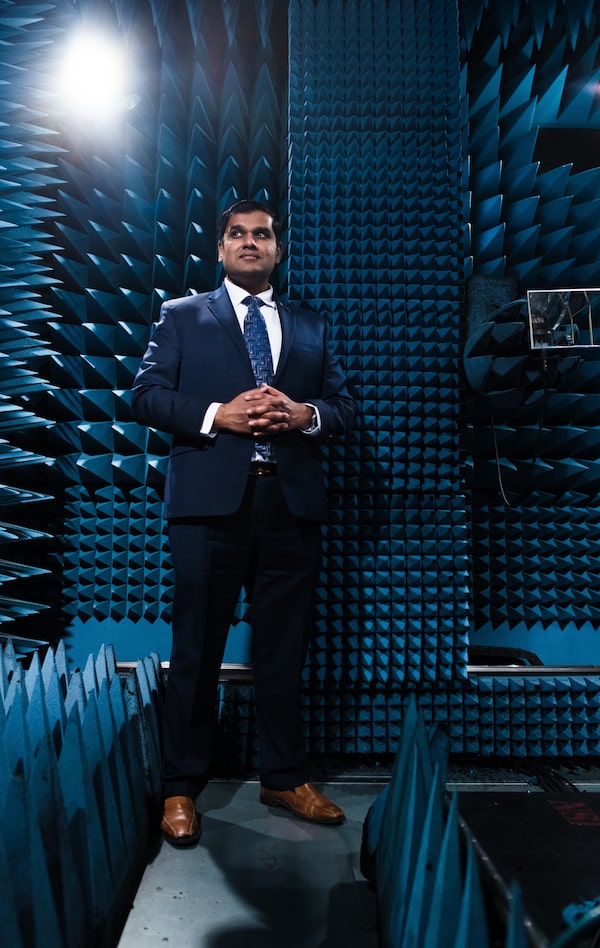
Engineering professors Ashwin Iyer and James Hogan run an academic research centre focused on defence and dual-use technology that the University of Alberta calls the first of its kind in Canada.
It also represents a new and rapidly growing area for university research, part of a national mobilization of talent and resources to defend the sovereignty and security of Canada and its allies.
The University of Alberta’s Centre for Applied Research in Defence and Dual-use Technologies (CARDD-Tech), which the two professors co-direct, develops military technology that can also serve to benefit civilians.
Some of their recent projects include a coating material for ship hulls that would reduce drag and allow boats to move more quickly through ice. They’re developing wearable biometric sensors that monitor health conditions in cold environments without batteries, useful for soldiers or emergency responders, as well as multiple applications for drone technology, from detecting wildfires to battlefield surveillance and anti-drone spoofing.

One of the models in CARDD-Tech's Edmonton lab is for wireless sensors that monitor soldiers' body temperature, hydration and other health indicators.

The penetrator tests how different types of vehicle armour would stand up in the field.
Defence spending is expected to jump to 2 per cent of gross domestic product this year and 5 per cent by 2035. Ottawa has also promised a $6.6-billion defence industrial strategy that features the Bureau of Research, Engineering and Advanced Leadership in Innovation and Science, known as BOREALIS, as well as money for quantum technology, aerospace and infrastructure.
Universities are hopeful that some of that new spending will be directed to their campuses. If and when that occurs, it will likely prompt some applied research priorities to shift as well.
“There’s a lot of possibilities there in bringing academia and industry together for the benefit of defence research,” said Robert Asselin, chief executive officer of the U15 Canada group of large research universities. “We can be a serious engine for technological innovation in this country, particularly with dual-use research.”
The U15 recently joined with the Department of National Defence to create a working group on Canada’s defence industrial strategy. The working group includes five university research vice-presidents and is co-chaired by Mr. Asselin and an assistant deputy minister from DND.
Mr. Asselin said the scale of the investments contemplated by the federal government indicates there will be significant opportunities across a range of disciplines, some of them not readily associated with military technology, from engineering to life sciences, quantum computing and biotechnology.
“It’s very broad,” Mr. Asselin said. “I feel very bullish about it.”


Many of Canada’s leading universities already have projects in defence and dual-use technologies under way. Mr. Asselin said all the top research institutions have areas that they will target.
Dalhousie University, for example, has researchers working with Defence Research and Development Canada, the federal branch that provides research to the Canadian Armed Forces, on a program to devise parts for naval submarines using advanced additive manufacturing. At the University of Waterloo, researchers are working on dual-use technologies related to space launch and atmosphere re-entry, as well as cybersecurity and the supply chain.
Prof. Hogan and Prof. Iyer both said that although the University of Alberta’s dual-use research centre opened formally in March, it has taken several years to develop relationships with the Canadian Armed Forces and defence manufacturers. CARDD-Tech works directly, on-site, with both the military and private-sector contractors to devise technological solutions for military and dual-use problems.

CARDD-Tech has been officially in business for less than a year at the University of Alberta, but the work to build contacts in the defence industry began long before that.Kelsey McMillan/The Globe and Mail
The centre has eight research themes, from artificial intelligence and cybersecurity to advanced materials manufacturing as well as drones, energy, quantum and communications. Prof. Hogan said they already have $25-million in funding and partnerships across those areas.
“Canada has a lot of catching up to do to meet this moment,” Prof. Hogan said. “And we don’t have 10 years to deliver on it. We don’t even have five years to deliver on it. We need to be shovel-ready in the next couple of years or sooner.”
There is pressure to deliver on projects and train students at a moment when the country’s sovereignty is under threat, he said, but he also feels a sense of pride in the work. One of the projects he’s developing involves 3-D printing valves for the Royal Canadian Navy. The same valve, however, would have applications in the oil and gas industry.

James Hogan is mindful of the pressure to roll out new technologies soon. 'We don’t have 10 years to deliver on it. We don’t even have five years to deliver on it,' he says.
The regional aspects of this phase of research expansion will be significant, Prof. Iyer said. Edmonton, with its proximity to the oil industry, is a natural site for research that has applications for the oil patch. Its northerly location makes it a good fit for research that involves temperature extremes, he said. “If you want to do something meaningful for defence, you need to understand the cold, you need to understand threats that could present themselves over the Arctic. You need to understand the connection between infrastructure for northern communities and defence infrastructure as well,” Prof. Iyer said.
There has been a learning curve for the academics in the transition to this kind of research, the professors said. Technology, testing and communication have to be approached carefully because of the security issues around military work, which is different from the default openness of academia.
Prof. Iyer said military-related research at universities can also be politically sensitive. In recent years, for example, student protesters have frequently called for institutions to divest from weapons manufacturers. How student and faculty groups will respond to a shift to defence-related projects that involve major weapons companies is not at all clear.
But Prof. Iyer and Prof. Hogan said they’ve also recently observed an increase in interest from undergraduate and graduate students curious about pursuing careers in this sector.
“Academia was not always considered, at least in recent decades, part of this ecosystem,” Prof. Iyer said. “I’m really happy to see this conversation now emphasizes the role of universities.”

Canada arms itself: More from The Globe and Mail
The Decibel podcast
Thanks to a recent defence deal with Europe, the Carney government says Canadian companies could soon get lucrative access to military contracts across the pond. Reporter Steven Chase spoke with The Decibel about how that fits in the larger sovereignty strategy. Subscribe for more episodes.
The business of defence
Canadian firm’s armoured-vehicle production for ICE taking place in U.S.
Canada provides $50-million to buy drones and drone parts for Ukraine
U.S. approves $3.8-billion sale of air strike weaponry to Canada