For as long as we’ve existed, we’ve danced.
From the dancing women engraved in Indian cave paintings from 9000 BCE to the frolicking figures etched on ancient Egyptian tombs, dance has always been an essential part of our culture as humans. And older adults have often played an important part in passing on these traditions. Some styles – such as flamenco and bharatanatyam, an Indian classical dance – in fact favour all of the knowledge and experience that older dancers bring.
So all around us, older adults are dancing. They’re grapevining at the community centre. Taking ballroom lessons. Doing Zumba at the gym. And mounting research has shown that it’s all of benefit to their physical and mental health – for their balance, strength and cognitive abilities.
But it’s also, for many of them, an opportunity for fun. For joy. They dance simply because they love to.
The Globe met with dancers in their 60s, 70s and 80s. Some were professionals, but most were not. The stories they shared illustrate the strength, beauty – and resilience – of what it means to be a dancer in an aging body.
‘Courage to be imperfect’


Class had just begun, and the dancers were lined up at the barre.
The pianist started a waltz, and teacher Bob McCollum (known simply as “Ballet Bob”) guided the class through their exercises. He called out the positions – plié, tendu, jeté – before issuing a gentle reminder.
“We have to tone up our focus,” he said. “Especially at our age.”
At 70 years old, Mr. McCollum is no typical ballet teacher, and this was no typical class. All of the students are over the age of 55. Some are much older. Many have chronic injuries. Trouble with balance. Hip replacements.
But every Sunday morning, they gather at Canada’s National Ballet School. Their form isn’t always technically correct. Often, they wobble out of their pirouettes. When Mr. McCollum implores them to hold their balance on one foot – really, really focus – few succeed.

Ron Johnson (centre) has embraced the ideology in his dancing of having the courage to be imperfect.
Still, they dance.
“You know those movies about the inner-city kids who have all kinds of things up against them – who somehow come together to win the championship?” said Ron Johnson, a 78-year-old student. “That’s like us.”
He has a tremor on his left hand that causes his fingers to twitch in the middle of some movements. But he said he’s embraced the ideology of the psychologist Alfred Adler: “It’s the courage to be imperfect.”
To many, ballet is all about perfection. But Mr. McCollum recognizes that with aging bodies, there’s more and more that can’t be controlled. So he encourages his students to focus on adapting the movements to suit them.
For instance, while the rest of the class does an arabesque – standing upright and extending one leg behind – Ellen Badone, 68, performs hers leaning slightly forward. Between surgery for scoliosis and her age, it’s her best way of staying balanced.

Ellen Badone (left) attends a class every Sunday at Canada’s National Ballet School.
And when Mr. Johnson feels his fingers begin to twitch, he looks for alternative hand movements. “This” – he said, demonstrating his fingers fluttering – “is the way the leaves dance when the wind goes through it.” Instead of hiding the tremor, he said, he wants to express it.
“When you’re not thinking about it – and instead of dancing to the music, it dances you – it’s extraordinary.”
Throughout the class, Mr. McCollum offered his characteristically colourful commentary.
“Light as a feather, not the whole goddamn bird!” he called out at one point.
And when the students held their hands like grasping claws, he tutted from the corner. “I don’t want to see Loblaws melon testers.”
Margaret Gabourie, 66, has also had to find a new way to dance; years ago she had surgery that left her unable to bend one of her toes. She’d been taking Mr. McCollum’s class by then for years. After her surgery, she stayed away for almost six years.
“But then my sister sent me a video of people in wheelchairs, and they were dancing. She said, ‘What’s your excuse?’ ” She came back to class soon after, and it was “so joyous,” she said. ”I can’t do what I did before, but I can do a lot more than I thought.”

‘An absolute blast’
It was a few hours before the tipoff, and the Northern Classics dancers were running through their final rehearsal.
Loud hip-hop music was playing from the giant speakers at Scotiabank Arena, and Trish Adams, 66, and six others were practising “the Gucci.”
Not to be confused with the Northside Crew – the Toronto Raptors’ main dance group, made up of professional dancers in their 20s and 30s – the Northern Classics are the NBA team’s official senior squad, with ages ranging from 54 to 68. The troupe made its debut in January of this year.
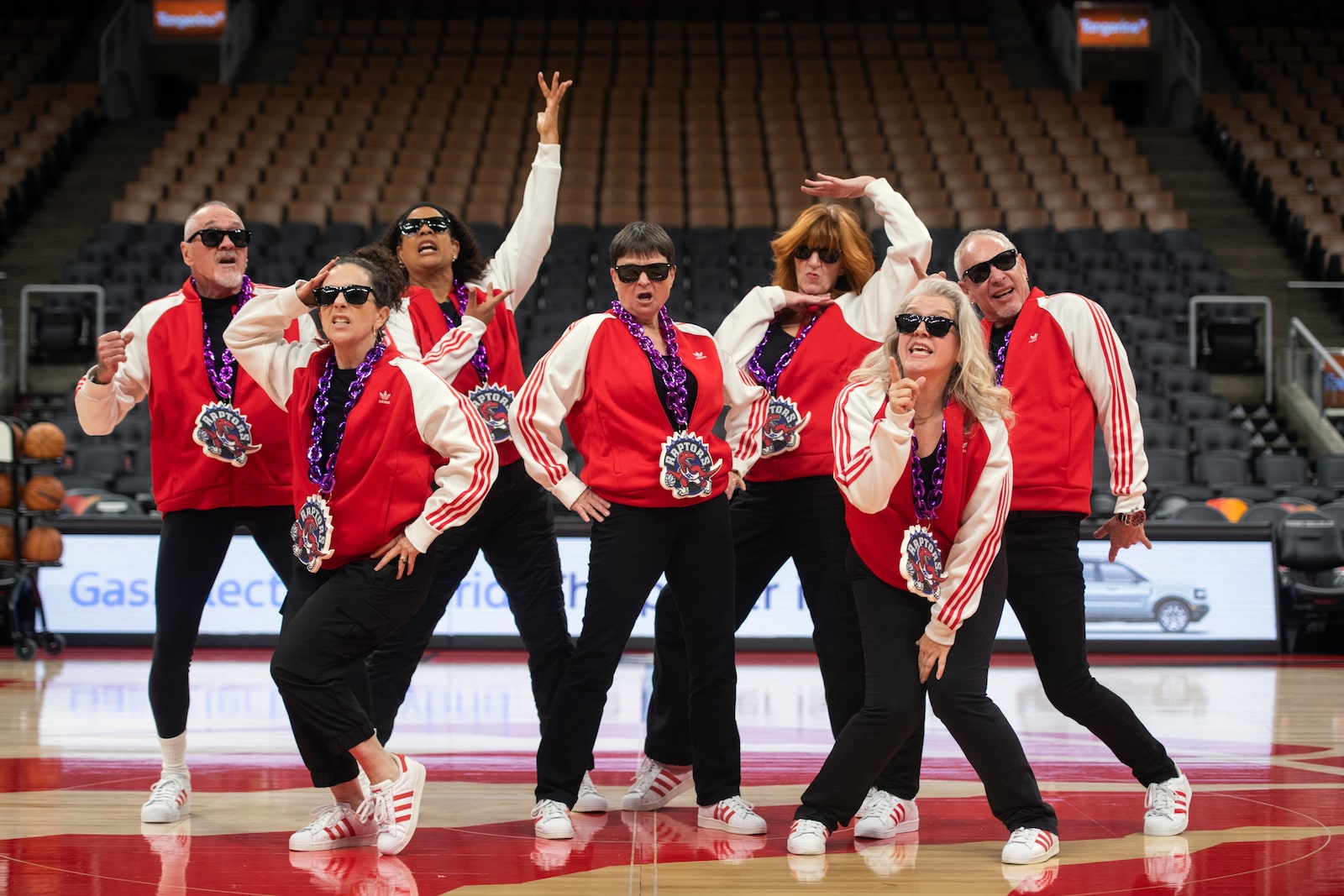
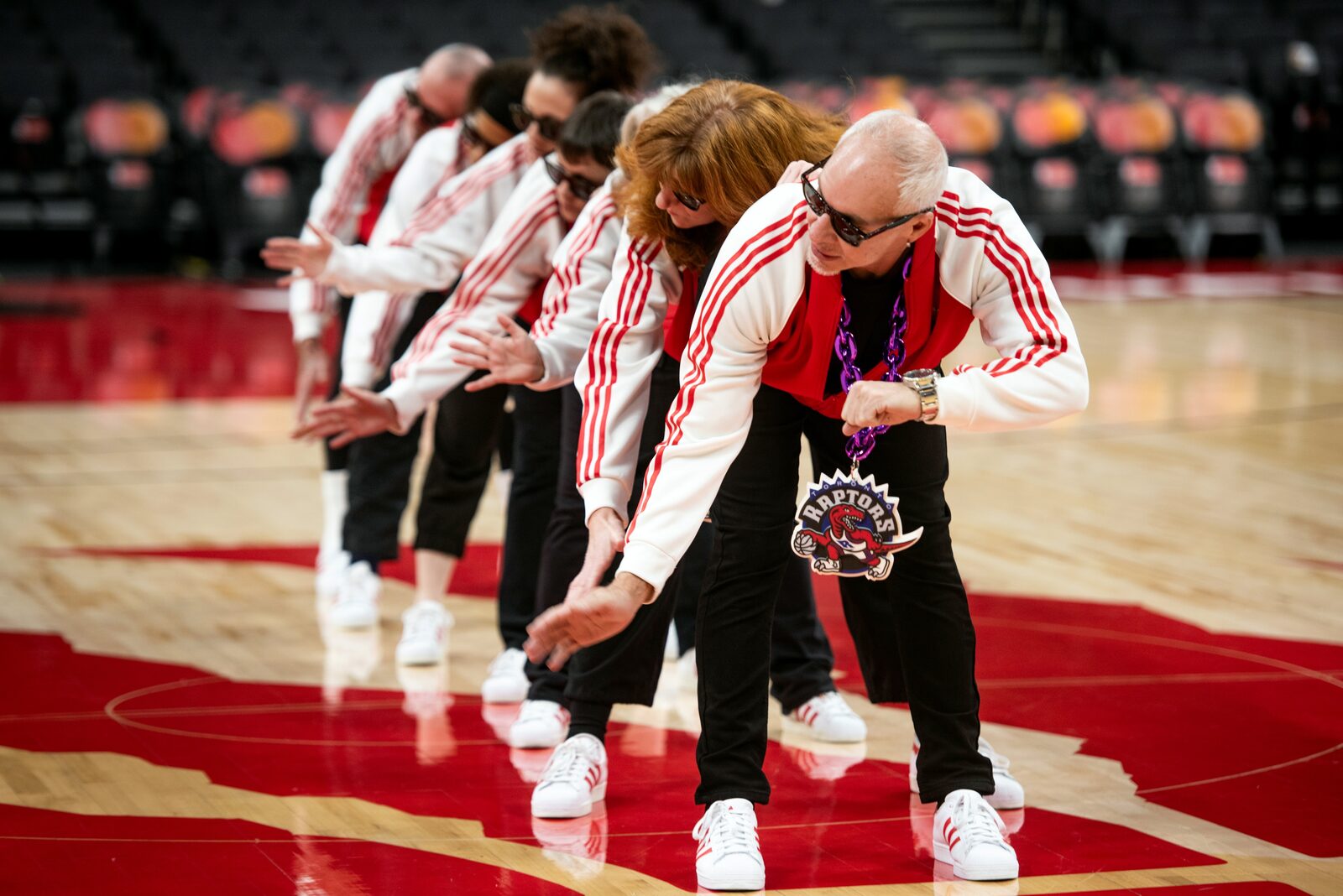
“When we first got out there, our hearts stopped because very few of us had ever performed to 19,000 people in one place,” Ms. Adams said. “But we had an absolute blast.” And judging by the roar of the crowd, the fans felt the same.
Since then, they’ve performed about once a month, during time outs and halftime. Their performances lean heavily into the element of curiosity – the surprise of the crowds to see greying seniors decked out in red Adidas tracksuits doing the “booty slap.”
That night, the Raptors were set to play the Indiana Pacers. The squad was scheduled to perform early in the game, during the first quarter.
“It’s so they can leave right after,” said Taylor Lau, a game presentation specialist with the Raptors. “So we’re not holding them up all night.”
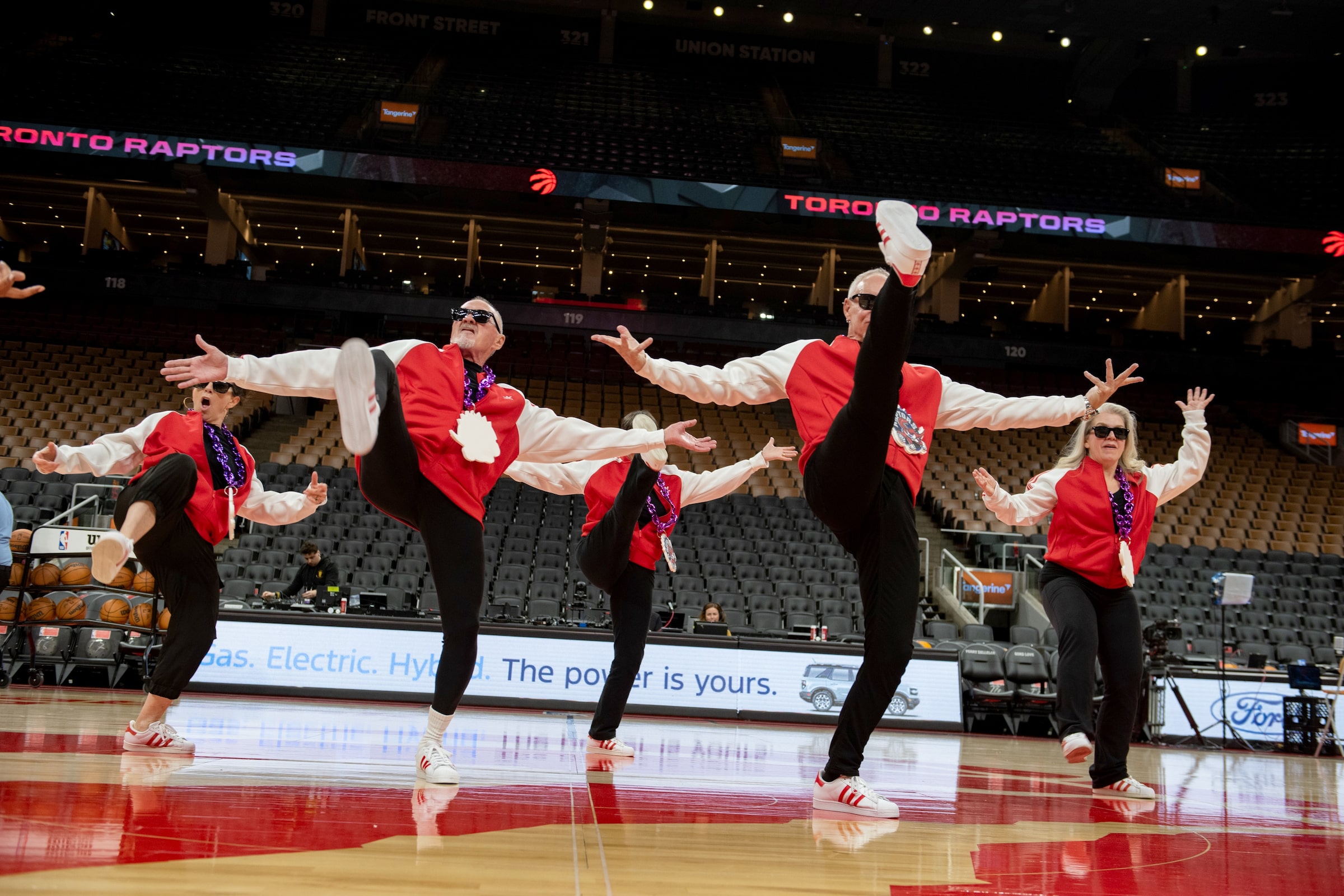
It was Ms. Adams, a trained dancer, who approached the Raptors in June, 2023, with the idea. As luck would have it, the organization (inspired by a dozen or so other NBA teams who have formed similar senior squads in recent years) already had it on their to-do list.
As with most of the other eight members, Ms. Adams’s background is in musical theatre, ballet and jazz. She had never done hip hop before this. “It’s been a challenge.”
She held up her arms to demonstrate the fluid movements she’d spent most of her life learning. But with hip hop, “it’s the accent of the beat. The hard edges. Changing directions very quickly.”
Still, she said, “it’s been great showing them all what 60-plus-year-olds can do.”
As they ran through their number at the rehearsal, Ms. Adams was in the back row, centre. They were set to perform a one-minute dance (a medley of Blurred Lines, Barbie Girl and Gettin’ Jiggy Wit It) during the first quarter. The music was blaring, and she was nailing every beat. By the time the Will Smith track began, she was forgetting to hold her face in the same fierce expression as the others. She was singing along – na-na, na, na, na-na-na-na, gettin jiggy wit it – smiling and having fun.
For Ms. Adams, the best part has been sharing the experience with her family. Her daughters and grandchildren are all basketball fans.
“They’re all very, very proud. Unbelievably proud,” she said.
“I showed them a video the other day. And they were like, is that you, Granny?”
‘We’ll close the party’

The Harmony Club hosts a weekly dinner and dance, with many attendees over the age of 60.
Every Friday night, hundreds of seniors turn up in their weekend best at the Peter and Paul Banquet Hall in Scarborough, Ont., located on a commercial stretch just north of Highway 401. The ladies come in layered chiffon dresses and dance heels; the gentlemen in fedoras, button-up shirts and ties.
This is the Harmony Club. Anyone with a ticket is welcome at the weekly dinner and dance, though most regulars are 60 and older. On this night, many had grey or greying hair. A few navigated the ballroom using a cane – around the lineup for the roast beef buffet, across the parquet dance floor, toward DJ Cecil up onstage.

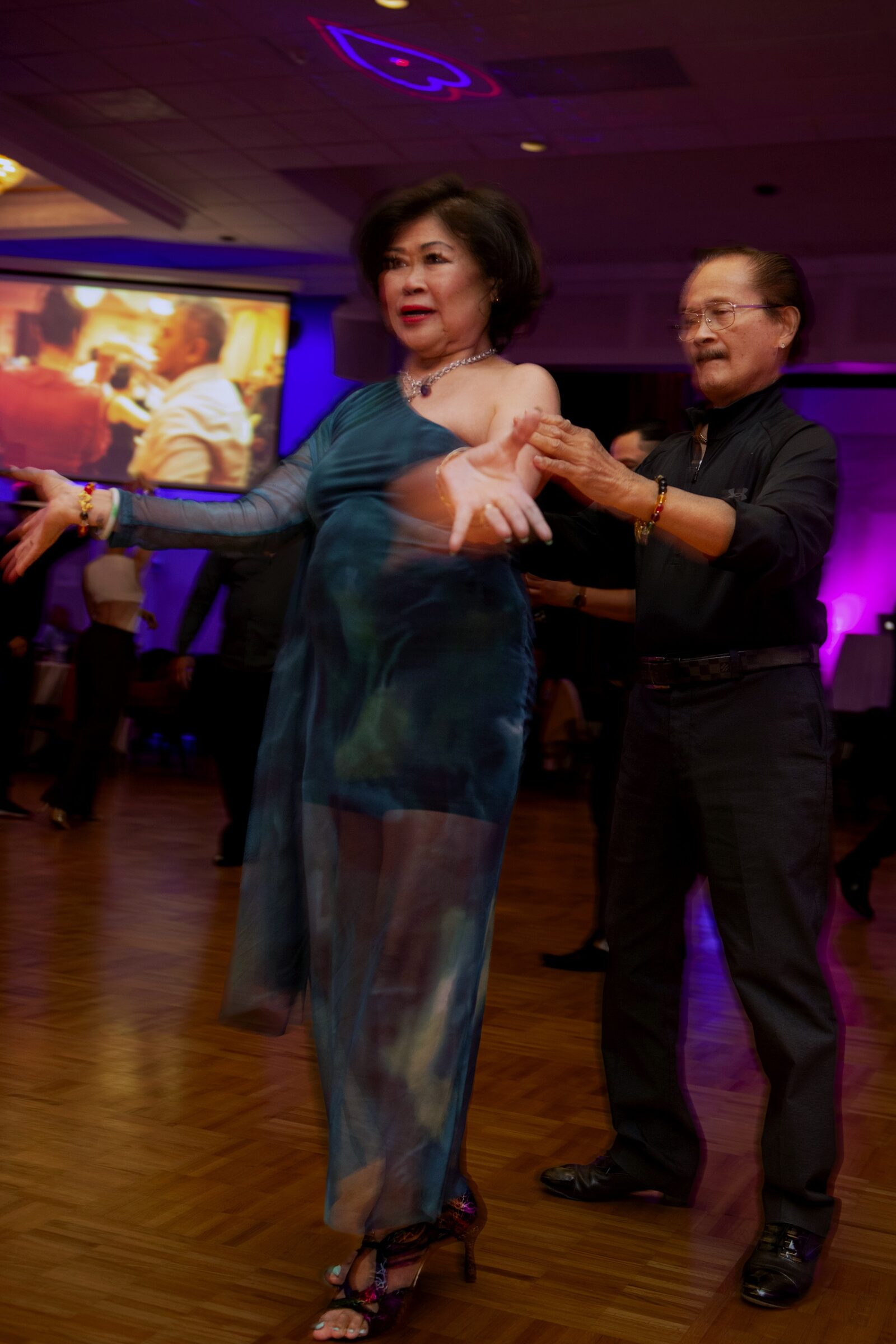
Regulars William and Norma Eran were waiting in the doorway before the party had even started. They’ve been dancing together as a hobby for 50-plus years, since they met in the Philippines when he was 22 and she was 24.
“I have no choice. I’m married to a dancer,” said Mr. Eran, 77. “Anything to make her happy.”
Ms. Eran, 79, was dressed, as always, to the nines, in a black and red dress, with sequin roses embroidered across the front and red ribbon trim along the hem. A stack of bracelets glittered on her wrist. She sewed the dress herself, she said – all of the fabric cost less than $5.

She keeps a busy schedule. Line dancing from Monday to Friday. Regular trips to the casino at Niagara. Travelling. And, of course, dancing here every weekend. “We do what our bodies allow us to do,” she said. “That’s how you live.”
The music was a mix of ballroom and Latin, with the occasional pop song mixed in. It wouldn’t be a party, after all, without Itsy Bitsy Teeny Weenie Yellow Polka Dot Bikini or YMCA.
Many of the other attendees were seasoned performers. Among the former competitive dancers were Rennie and Vicky Cipriano (81 and 77).
Unlike them, the Erans weren’t on the floor for every song. They took long breaks to rest in-between, and they sat out songs that called for quick footwork, such as the foxtrot and tango. When they were up, their movements were languid and unhurried – their steps often more like a shuffle.
But they moved together effortlessly. They glided across the dance floor with the familiarity of more than half a century together. They didn’t have to look at one another, so practised were they in each other’s movements. They were at ease. Content.
“Usually, we’ll go home between 9:30 and 10:30,” Ms. Eran said, back in her seat.
“But if the whole group is here,” she continued, nodding at their friends around them, “we’ll close the party.”

Norma Eran (centre), says, “We do what our bodies allow us to do. That’s how you live.”