Canadians should prepare for another summer infested with ticks, a bloodsucking arachnid responsible for growing rates of Lyme disease, scientists and public health experts are warning.
Montreal’s public health agency on Thursday advised residents to be vigilant as warmer temperatures drive people outdoors. It said 161 cases of Lyme disease were recorded in 2025, the highest number recorded since data collection began in 2003.
Lyme disease is the most common tick-borne illness, primarily transmitted through the bite of an infected blacklegged tick (or deer tick). It can be cured with antibiotics if caught early, but if left untreated can cause long-term issues, including joint pain and cognitive problems.
More than 40 different types of ticks inhabit Canada, several of which can carry disease. These small creatures – the size of an apple seed – thrive in wooded areas, forests, tall grasses and leaf litter.
Research scientist Nicholas Ogden, director of the modelling hub division at the Public Health Agency of Canada, takes The Globe and Mail through the summer tick forecast and how people can protect themselves.
Lyme disease is the most common
tick-borne illness in Canada
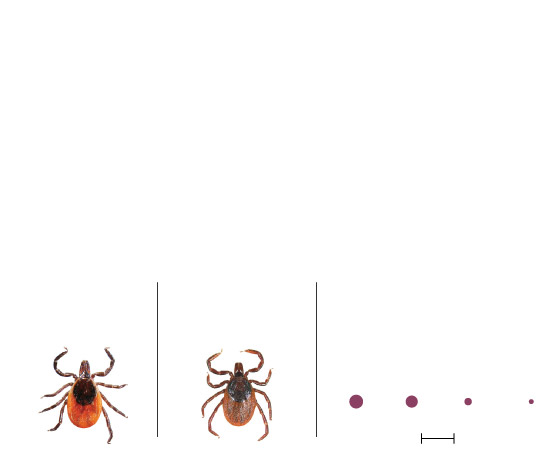
There are two types of ticks that carry Borrelia burgdorferi, the
bacteria that cause Lyme disease in humans: The blacklegged or
deer tick is found in Southern and Eastern Canada, and the western
blac-legged tick in the West. They go through a two-year life cycle.
The ticks can become vectors of the Lyme disease-causing bacteria
after feeding on infected birds or rodents. Humans often contract the
disease after being bitten by tiny ticks in the nymph stage.
To prevent disease, ticks should be removed within 48 hours.
Blacklegged or
deer tick
(Ixodes scapularis)
Western
blacklegged tick
(Ixodes pacificus)
Relative sizes
Adult
female
Adult
male
Nymph
Larva
1 cm
Lyme disease is the most common
tick-borne illness in Canada
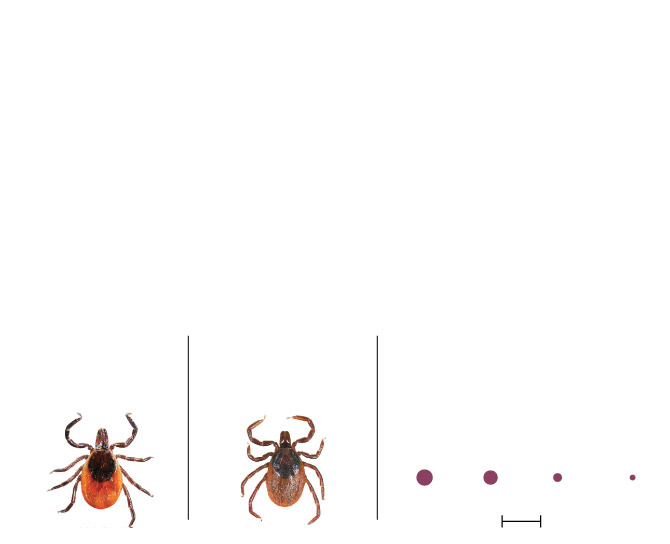
There are two types of ticks that carry Borrelia burgdorferi, the
bacteria that cause Lyme disease in humans: The blacklegged or
deer tick is found in Southern and Eastern Canada, and the western
blacklegged tick in the West. They go through a two-year life cycle.
The ticks can become vectors of the Lyme disease-causing bacteria
after feeding on infected birds or rodents. Humans often contract the
disease after being bitten by tiny ticks in the nymph stage.
To prevent disease, ticks should be removed within 48 hours.
Blacklegged or
deer tick
(Ixodes scapularis)
Western
blacklegged tick
(Ixodes pacificus)
Relative sizes
Adult
female
Adult
male
Nymph
Larva
1 cm
Lyme disease is the most common tick-borne illness in Canada
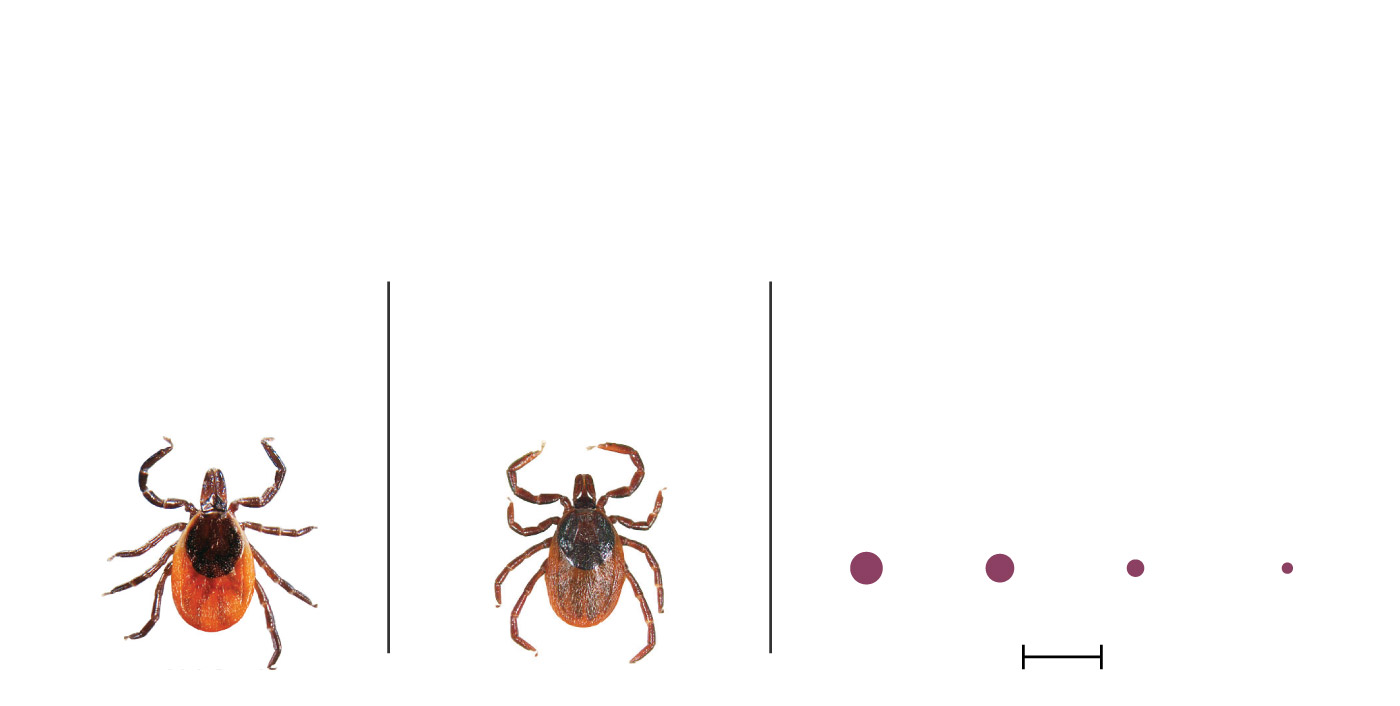
There are two types of ticks that carry Borrelia burgdorferi, the bacteria that cause Lyme disease in humans:
The blacklegged or deer tick is found in Southern and Eastern Canada, and the western blacklegged tick
in the West. They go through a two-year life cycle. The ticks can become vectors of the Lyme disease-
causing bacteria after feeding on infected birds or rodents. Humans often contract the disease after being
bitten by tiny ticks in the nymph stage. To prevent disease, ticks should be removed within 48 hours.
Blacklegged or
deer tick
(Ixodes scapularis)
Western
blacklegged tick
(Ixodes pacificus)
Relative sizes
Adult
female
Adult
male
Nymph
Larva
1 cm
What is the outlook for ticks this summer?
This summer is going to be similar to recent summers in terms of the risk for tick-borne diseases, although that risk is increasing year over year in terms of the geographic footprint of where people in Canada can get tick-transmitted diseases.
Particularly, we’re talking about Lyme disease and other tick-borne diseases transmitted by the blacklegged tick in central and eastern parts of Canada. These ticks are marching northwards as the climate warms, so more people are becoming exposed to ticks when they go out during the summer months. The ticks are increasing in their abundance and the proportion of ticks that are infected with the micro-organisms that cause disease is increasing.
Where are the hot spots in Canada? Or should people be on the watch anywhere that’s green and wooded?
The main hot spots are where the tick populations have been established the longest. That includes southern Manitoba and, next to that area, the northwestern part of Ontario. Then there is the southern part of Ontario, along the shores of the Great Lakes, but now extending up to the Ottawa area and further north into Quebec and then in the Maritimes.
There are question marks as to whether the blacklegged tick population is setting up in Saskatchewan. There have been some signals from surveillance, but it needs confirmation.
But there is a fairly widespread, low-level risk of getting Lyme disease because migratory birds do disperse the ticks over long distances. So, even if the climate is not suitable for them to complete their life cycle, they can survive over winter if the habitat protects them from the cold. They will then molt and can bite people but the risk is very low. That’s mostly the situation in Alberta and Saskatchewan.
When you get into B.C., there is another tick species there, the Western blacklegged tick. But they don’t bite people very readily, and the proportion of ticks that are infected is generally quite low compared to the blacklegged tick that’s further east.
How can people protect themselves?
People need to first know whether there’s risk in their region before they go out and do outdoor pursuits. Provincial public health websites and the Public Health Agency of Canada website are points of reference for that information, as well as on how to prevent tick bites by wearing appropriate clothing when you go outside. Icaridin and DEET-containing insect repellents also repel ticks from biting.
When you get home, because you may have picked up ticks that haven’t fed on you, put your clothes into the dryer on high. That’ll kill the ticks. But also do tick checks, because when they feed, they attach for days, unlike a mosquito that feeds, bites and flies off.
At least for the bacterium that causes Lyme disease, it takes between 24 and 48 hours before there’s a chance that an infected tick actually transmits the bacterium. So, if you have a shower or a bath, look yourself all over and help examine your kids and animals; you can use a pair of forceps and remove it. In most cases, that will prevent transmission of infection.
If you haven’t removed the tick straight away and find it feeding, get a single dose of doxycycline antibiotic. In most cases, it will stop any infection in its tracks.
How have ticks migrated over time?
There was one known population of ticks, Ixodes scapularis (or the blacklegged tick), from the 1970s or maybe earlier, along the north shore of Lake Erie and Ontario. That was it from the time Lyme disease emerged in the U.S. in the 1970s until the early 2000s.
But, thinking about the impact of climate change on disease risks, Lyme disease was flagged because the tick, apart from being in that part of Ontario, had wide distribution in the U.S. and didn’t have to move too far north to start to invade Canada. Over time, those tick populations have expanded their geographic range.
This interview has been edited and condensed.