Last Aug. 10, Christine Smith was preparing breakfast in the galley of the David B, the small tour boat she operates in Alaska with her husband, Jeffrey, when signs of a disaster came spilling her way.
That morning the boat was anchored in Ford’s Terror, a narrow inlet that branches off Endicott Arm, one of many spots where Pacific waters reach far into the deep and convoluted gorges of the Coast Mountains.
Eight passengers were on board for a multiday trip to view the region’s breathtaking fjords and glaciers up close.
At about 6 a.m., Mr. Smith looked out the window and spotted a surge of foamy water rushing in from the direction of the inlet’s entrance.
“It was like a river running across the sandbar,” he told The Globe and Mail in an interview. “We’ve been anchoring there for 20 years and we’ve never seen anything like that before.”
Their boat was safely anchored in deep water, but the inflow was striking. The David B repeatedly rose and fell by a few metres at intervals that lasted several minutes.
The effect was not violent enough to alarm the passengers, Ms. Smith said. But they could see that she and her husband were on high alert and using their satellite connection to check for any news that might tell them what was going on.
A few hours later they got their answer from a seismologist who also happens to be their neighbour in Bellingham, Wash. There had been a landslide, Jacqueline Caplan-Auerbach of Western Washington University told them, but it was nowhere near their location. Rather, seismic data had pinpointed Tracy Arm, a different fjord near a tidewater glacier some 75 kilometres away by sea and tucked around a series of sharp bends.
This seemed remarkable. If waters were disturbed so far from the event, what did that mean for sites that were closer?
For the Smiths it was more than an idle question. They had originally planned to be in Tracy Arm that morning, but unfavourable tides and rainy weather had persuaded them to change their plans. Had the Smiths stuck to their itinerary, they might not have survived what transpired.
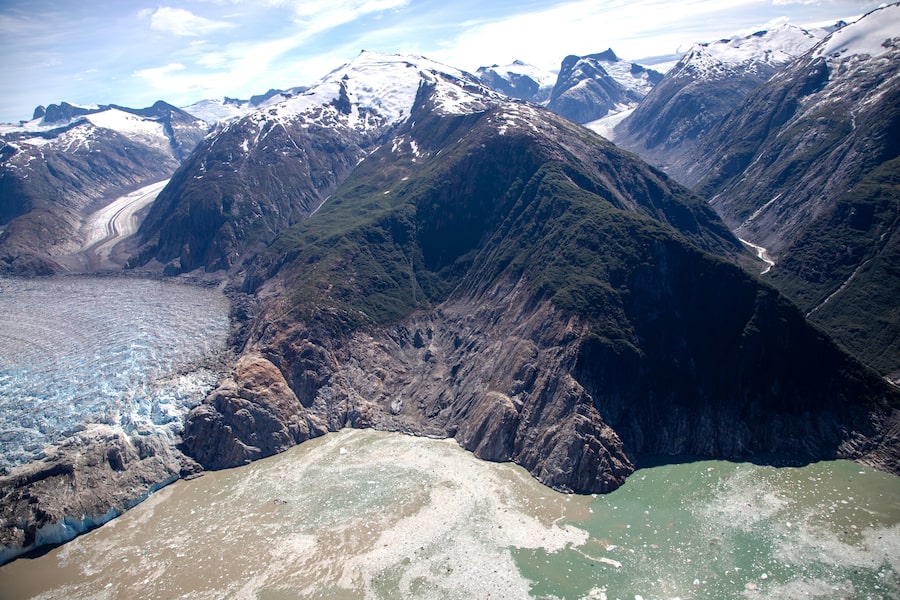
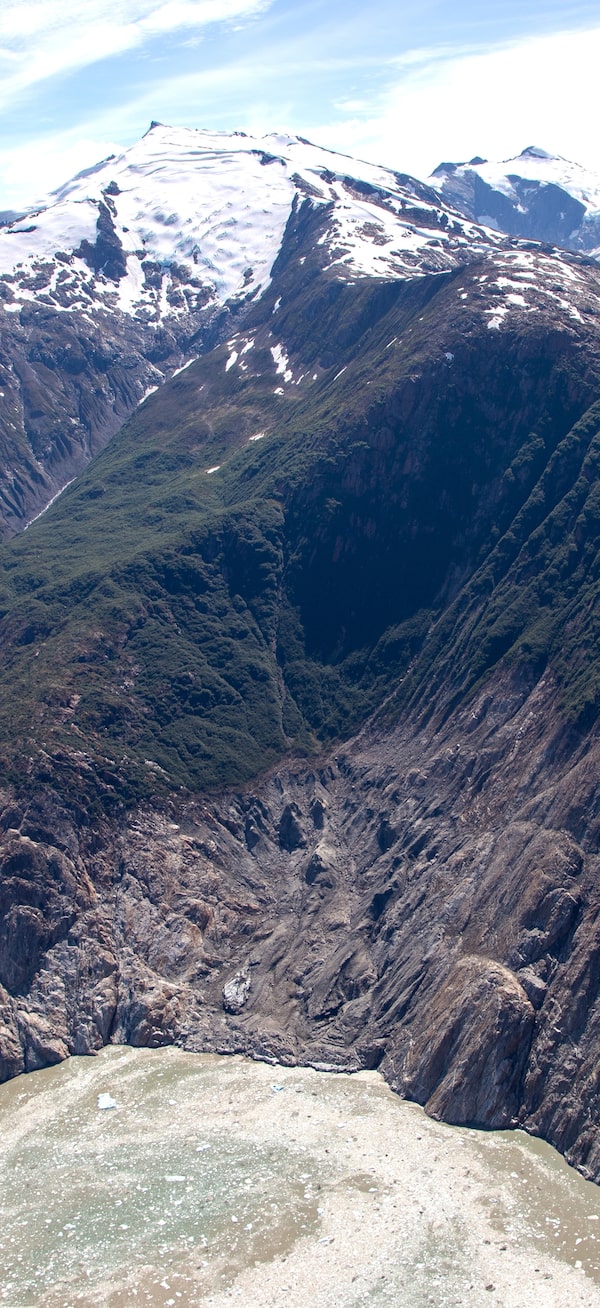
“Essentially, the side of a mountain collapsed into the fjord,” said Daniel Shugar, a geomorphologist at the University of Calgary and first author of a newly published study in the journal Science that reconstructs the massive landslide and the tsunami it generated.
The study highlights a type of geological hazard that could become more frequent thanks to the rapid retreat of glaciers as Earth’s climate warms. Over thousands of year, those glaciers have carved steep valleys that reach into the seas. As the ice recedes, canyon walls lose their support, leaving them susceptible to sudden collapse.
In Tracy Arm, the South Sawyer glacier lost several hundred metres of ice last summer alone. It was there that a newly exposed and destabilized cliff gave way.
Once that happened, Dr. Shugar said, the result was like someone doing a cannonball into a hot tub. Water displaced by the falling rock and confined by the narrow fjord then climbed an estimated 480 metres − about 85 per cent the height of Toronto’s CN tower – up the steep-walled banks near the slide.
“It’s just an unbelievably terrifying height,” Dr. Shugar said.
A tsunami then surged down Tracy Arm, carving a path of devastation that stripped and uprooted trees along the banks of the fjord for several kilometres.


The tsunami turned some trees into stumps at Williams Cove, near the mouth of Tracy Arm.Cyrus Read/U.S. Geological Survey
Because the slide occurred just before 5:30 a.m. local time, its effects would have caught any nearby ships unawares, including cruise ships that are frequently in Tracy Arm during the summer season.
Fortunately, the nearest vessel, the National Geographic Venture with 150 people on board, was closer to the entrance of Tracy Arm and did not experience a strong wave, though the disturbance all around was obvious.
“A little frightening on our end,” the vessel’s captain, Thomas Morin, later reported to researchers. “I think we lucked out on where we were.”
Despite poor visibility because of weather, those on board the ship could see white water churning along the shore. The ship also encountered strong currents from multiple directions and, later, a wall of dense fog likely generated by a large quantity of floating ice that had shattered and broken off from the glacier during the tsunami.
Further down the arm, a charter yacht called the Blackwood was battling the surge, which came on as a series of waves. The boat then headed out of the arm to find calmer waters and was hailed by a group of kayakers who had been camping on the shore and had seen some of their gear washed away.
Dr. Shugar said the sloshing of waves within the waterway − a phenomenon referred to as the seiche − continued and was picked up by seismometers for least 36 hours after the landslide.
The relatively small number of ships and individuals affected by the tsunami was something of a fluke, the study’s authors say. At that time of year, a higher level of marine traffic would have been more likely, including the possibility of ships anchored much closer to the landslide or rangers camped on the shore.
“It isn’t even so much that there could have been people in there, but how incredibly anomalous it was that no one was there,” Dr. Caplan-Auerbach said.
After the landslide, a team from the U.S. Geological Survey viewed the area by helicopter and recorded the damage they saw there.
But the full scope of the disaster and the risk it posed to cruise ships and other vessels was not fully appreciated until scientists, including Drs. Shugar and Caplan-Auerbach, gathered the available evidence and undertook their analysis.
Their study includes computer simulations that recreate the height of the wave as it tore through Tracy Arm.
A key takeaway is the benefit of systematic monitoring of unstable slopes in areas where people or infrastructure are likely to be at risk. And there is also the possibility of using seismic signals as an early warning when a collapse is imminent.
Dr. Caplan-Auerbach said the seismic signal for many hours before the landslide shows a noticeable uptick in vibrations.
“Most of those are tiny earthquakes that we believe represent slip on the base of the landslide prior to failure,” she said. “This is not a signal that we always see before landslides. Whether that’s because they don’t exist or because we don’t have near enough seismic stations, we don’t yet know.”

A geologist on a cruise took this photo of the glacier at the top of Tracy Arm five days before the landslide.Courtesy of Lynn Moorman
The Tracy Arm tsunami follows a similar but even more powerful event in Greenland’s Dickson fjord in 2023.
Together the two events suggest there will be more to come as melting glaciers leave large, precarious geological formations unbuttressed. In some cases, this danger coincides with an increase in the number of ships bringing tourists to these dramatic and changing locations.
Lynn Moorman, a geologist at Mount Royal University in Calgary who was not involved in the Science study, said she was on a cruise ship close to the glacier in Tracy Arm just five days before the landslide.
“I was onboard as a speaker and was actually speaking about glaciers and deglaciation hazards, including landslides from oversteepened slopes, while we were in Tracy Arm fjord,” she said. “I do think there is a need to better understand geologic hazards and risk in popular tourist areas, just as we try to understand them to keep people safe where they live.”
In its initial assessment of the event last summer, the U.S. Geological Survey noted that areas that have experienced landslides are inherently unstable and subject to further change after an initial event.
Since then, several cruise lines that operate in the region have said they will no longer take ships into Tracy Arm.
Ms. Smith said that about two weeks after the landslide, she and her husband took their boat up Tracy Arm and could see the way the wave had reshaped the landscape and deposited debris, including large icebergs beached on rocks.
“It was a very surreal scene,” she said. “Both humbling and scary, but it also kind of fills you with a sense of wonder and curiosity.”
Editor’s note: This article has been updated to correct the names of Christine Smith and Jacqueline Caplan-Auerbach.
See the North: More from The Globe and Mail
The Decibel podcast
The Arctic is getting warmer, fast. That’s a geopolitical challenge for Canada, and a potential threat to Inuit communities that risk becoming more remote and harder to feed. Journalist Jenn Thornhill Verma took The Decibel to Nunatsiavut, in northeastern Labrador, to see how elders are adapting. Subscribe for more episodes.
Northern science
Beavers, moving farther north, gnaw away at an Arctic way of life
Arctic warmth and retreating climate action leaves the North exposed