
The Artemis II crewed lunar mission lifts off from Pad 39B at Kennedy Space Center in Cape Canaveral, Florida, on April 1.JIM WATSON/AFP/Getty Images
Long delayed by a series of technical challenges, NASA launched Artemis II on April 1 in its first human mission to fly around the moon in more than 50 years.
The mission sends four astronauts, including Canadian astronaut Jeremy Hansen, on an approximately 10-day journey into space with the aim of opening a new and sustained future for exploration and development on the moon.
Here’s what you need to know about the Artemis II mission, its astronauts, Wednesday’s launch and its previous delays.
What happened on launch day?
The Artemis II mission lifted off from NASA’s Kennedy Space Center in Florida at 6:35 p.m. ET on Wednesday.
The Globe’s science reporter Ivan Semeniuk describes the scene from Cape Canaveral, Fla.: “The intense glare of the rocket’s powerful exhaust made for a striking sight as it roared upward into a clear blue sky brightly illuminated by the setting sun. The rocket then arced eastward, pushing its crew toward outer space with increasing speed and remained visible as a glowing spark that persisted for more than three minutes before receding from view.”
Soon after liftoff, control for the mission was handed off to the Johnson Space Center in Houston.
The day leading up to the launch proceeded with very few hitches, particularly when the SLS rocket was being loaded with liquid hydrogen and oxygen fuel. The fuelling, which began about 7:45 a.m., was accomplished in good time with no indication of the hydrogen leaks that had plagued a dress rehearsal earlier this year and delayed the launch to April.
During a post-launch press briefing, mission managers noted a few anomalies that had arisen in the first hours of flight that were still being investigated and worked on by engineering teams. One was a temporary communications failure during which the crew could hear ground controllers but their responses were not being heard on the ground. But it was quickly resolved.
Earlier in the day, the four-member crew donned their space suits and were driven out to the rocket on a road lined with well-wishers. They were sealed into their capsule by late afternoon. At that point, some of the cloud cover that had built up over the day was being driven away by shoreward winds.
What is the Artemis II timeline, and how long will it take to get to the moon?
Canadian astronaut Col. Hansen and his crew mates are now in space but they aren’t heading to the moon just yet.

The astronauts on Artemis II from left to right are Jeremy Hansen, Victor Glover, Reid Wiseman and Christina Koch.Joe Raedle/Getty Images
The roughly 10-day mission will ultimately carry the crew and their Orion capsule around the far side of the moon, but before that happens they are spending approximately 24 hours in a long orbit around Earth to check out their spacecraft and to rest for the bigger journey ahead.
By 8:30 p.m. ET on Wednesday, the four-person crew had already gone through the second-stage engine burns that put them on their current trajectory around Earth. The capsule deployed its solar panels to generate power for the duration of the mission.
The crew also experienced their first technical glitches of the mission. The first was a temporary communication failure that prevented their responses from reaching mission control. Another was a problem with the electronic controls for the onboard toilet. A few hours later that evening NASA confirmed that the problem was resolved.
Also on Wednesday evening, pilot Victor Glover and commander Reid Wiseman took control of the capsule – a first for Orion –and demonstrated its performance in a simulated docking operation.
The main focus on the Thursday is preparing for the “translunar injection burn,” the engine firing that will send them out toward the moon.
If all is going well, this is expected to occur at about 8:12 p.m. ET.
NASA launched four astronauts on the first crewed lunar voyage in more than half a century on Artemis II. Canadian crewmember Jeremy Hansen called it a mission for all humanity via radio in the lead up to the launch.
The Globe and Mail
Who are the astronauts?

Official crew portrait for Artemis II, from left: NASA Astronauts Christina Koch, Victor Glover, Reid Wiseman, Canadian Space Agency Astronaut Jeremy Hansen.Josh Valcarcel – NASA – Johnson Space Center/NASA
The Artemis II crew consists of three Americans and one Canadian: commander Reid Wiseman, pilot Victor Glover, mission specialist Christina Koch and London, Ont.,-born astronaut Jeremy Hansen, who will make history as the first Canadian Space Agency astronaut to fly around the moon. The mission’s crew was selected in 2023.
Artemis II will be Col. Hansen’s first flight into space. He was selected as one of two recruits by the Canadian Space Agency for its astronaut recruitment program in 2009 and began working at the Mission Control Center in Houston in 2011.
In a video posted to X on Wednesday, astronaut Jeremy Hansen shared a final message for Canadians ahead of the Artemis II launch.
“Canada, I am thinking of you and am hoping all of you see your greatness reflected in this journey around the moon,” he said in the message ahead of his final sleep before the journey.
“I’m just so proud of all of you.”
Col. Hansen also previously spoke to The Globe about his final preparations for the upcoming journey.
NASA astronauts in the latest phase of training for their flight around the moon.
The four-person crew entered quarantine on March 18 in Houston “to ensure they remain healthy leading up to launch.” The astronauts are expected to fly to Kennedy Space Center approximately five days before the expected launch and continue their quarantine from the astronaut crew quarters.
What is the Artemis II moon mission?

A half moon rises as the Artemis I unmanned lunar rocket prepares to lift off from pad 39B at NASA's Kennedy Space Center in Cape Canaveral, Florida, on Nov. 16, 2022.JIM WATSON/AFP/Getty Images
Artemis II is the first mission in more than 50 years that is planned to take astronauts further than about 400 kilometres above Earth’s surface – the orbiting altitude of the International Space Station.
It marks the first crewed launch of the 98-metre-tall rocket – known as the Space Launch System or SLS – carrying the Orion crew capsule with astronauts on board.
The goal of Artemis II is to send four astronauts on a looping trajectory around the moon’s far side. During the 10-day trip, crew members will monitor the performance of their Orion capsule, and potentially see regions of the lunar surface that have not yet been glimpsed by human eyes. NASA has released the mission agenda, outlining the crew’s schedule on launch day and each day of the 10-day journey.
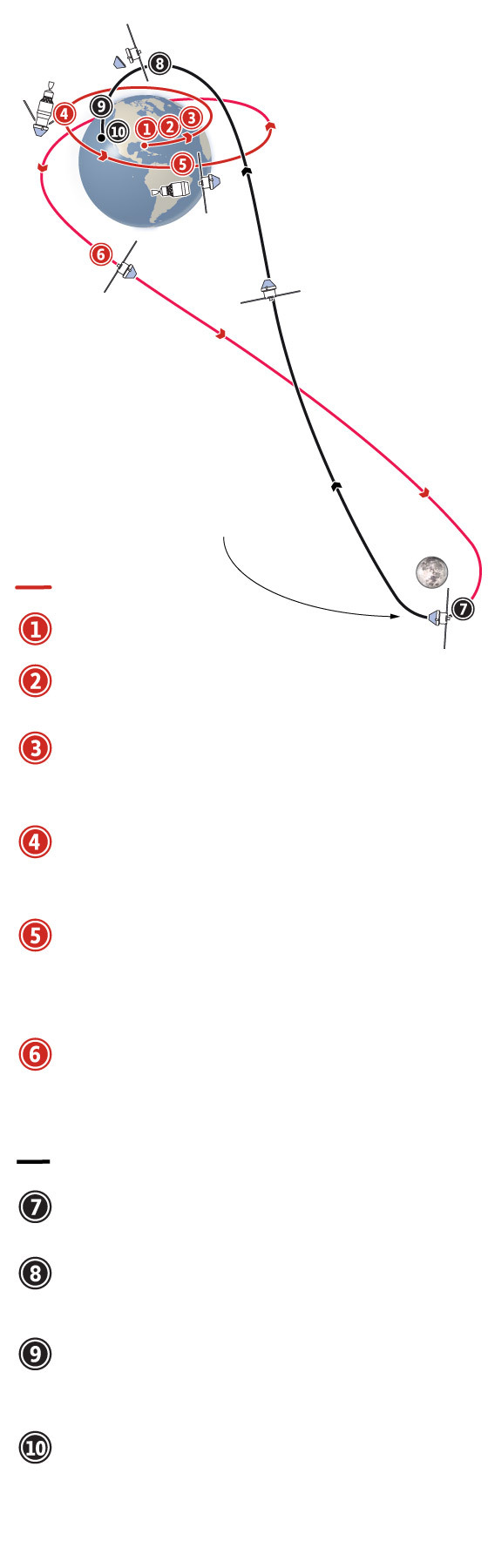
Artemis II
flight path
Orion will travel more than
400,000 km from Earth and
could set a new record for
the farthest humans have
ever gone into space
Moon
Outbound
Lift-off from Cape Canaveral
Two minutes after launch, boosters
separate followed by launch abort system
Eight minutes after launch ICPS and Orion
separate from Core stage. Orion’s solar
arrays unfurl
After 90-minute orbit, ICPS fires engines
to raise Orion to higher Earth orbit.
Crew begins multiple system checks
If everything is in order, Orion separates
from ICPS.Then, astronauts manually fly
Orion toward and away from ICPS, practising
proximity operations for future missions
Around 23 hours later, Orion Service Module
carries out Translunar Injection (TLI) burn –
sending Orion on a trajectory around
the moon
Inbound
After lunar flyby on Day 6, gravity draws
Orion back toward Earth
Just before re-entry, Orion’s crew module
separates from service module
Capsule re-enters atmosphere at speed of
32,187 km/h and temperatures of up to
2,200°C
Series of parachutes slow craft before
splashdown in Pacific Ocean
THE GLOBE AND MAIL, Sources: GRAPHIC NEWS;
NASA; ESA; Lockheed Martin
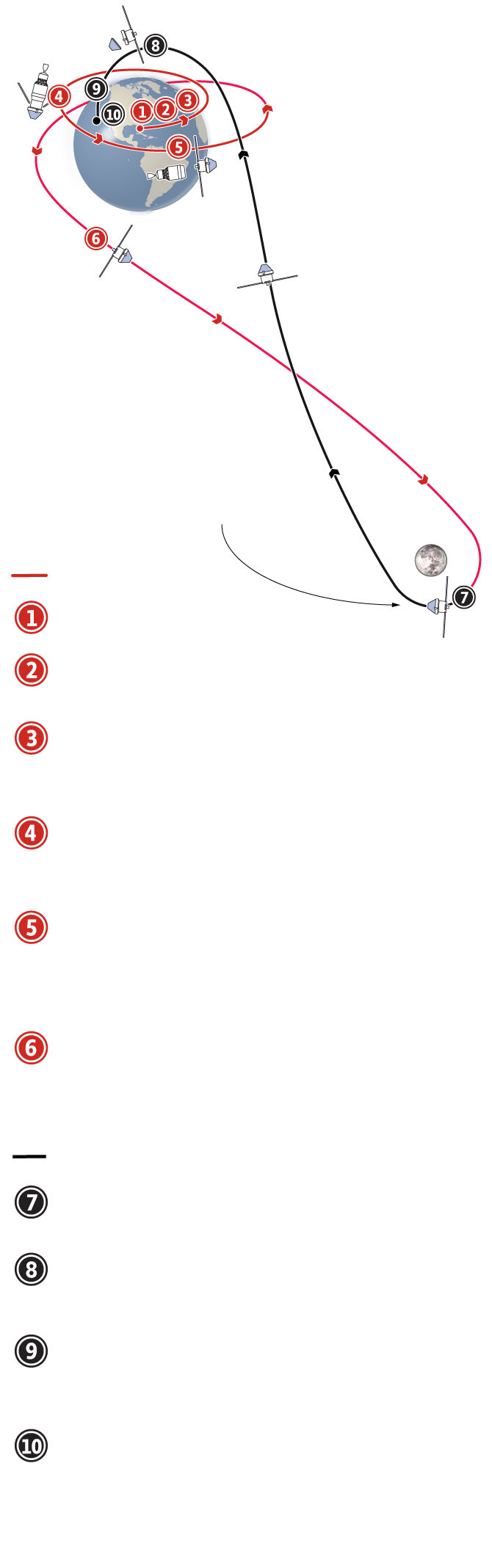
Artemis II
flight path
Orion will travel more than
400,000 km from Earth and
could set a new record for
the farthest humans have
ever gone into space
Moon
Outbound
Lift-off from Cape Canaveral
Two minutes after launch, boosters
separate followed by launch abort system
Eight minutes after launch ICPS and Orion
separate from Core stage. Orion’s solar
arrays unfurl
After 90-minute orbit, ICPS fires engines
to raise Orion to higher Earth orbit.
Crew begins multiple system checks
If everything is in order, Orion separates
from ICPS.Then, astronauts manually fly
Orion toward and away from ICPS, practising
proximity operations for future missions
Around 23 hours later, Orion Service Module
carries out Translunar Injection (TLI) burn –
sending Orion on a trajectory around
the moon
Inbound
After lunar flyby on Day 6, gravity draws
Orion back toward Earth
Just before re-entry, Orion’s crew module
separates from service module
Capsule re-enters atmosphere at speed of
32,187 km/h and temperatures of up to
2,200°C
Series of parachutes slow craft before
splashdown in Pacific Ocean
THE GLOBE AND MAIL, Sources: GRAPHIC NEWS;
NASA; ESA; Lockheed Martin
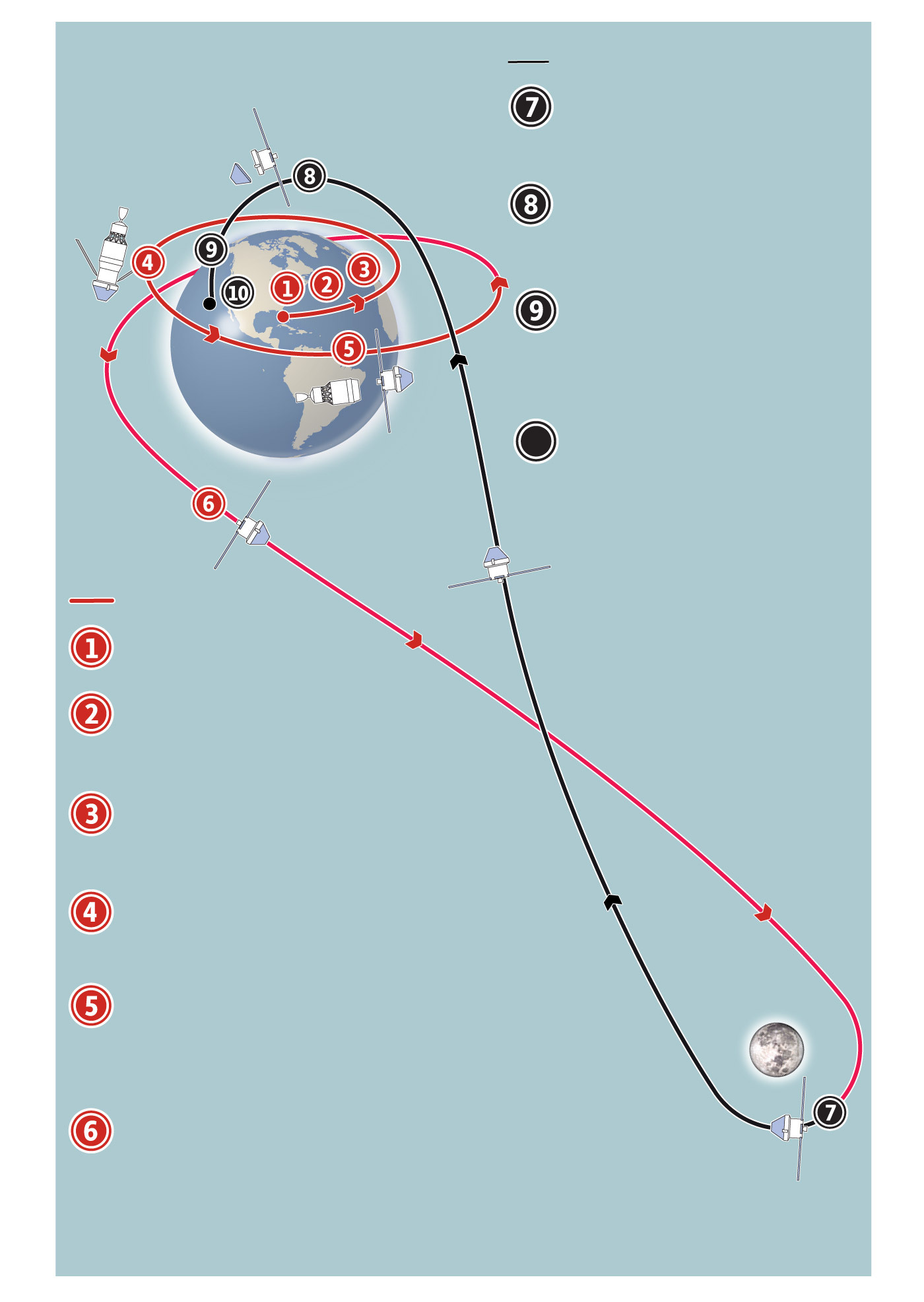
Artemis II flight path
Inbound
After lunar flyby on Day 6,
gravity draws Orion back
toward Earth
Just before re-entry, Orion’s
crew module separates from
service module
Capsule re-enters atmosph-
ere at speed of 32,187 km/h
and temperatures of up to
2,200°C
Series of parachutes slow
craft before splashdown in
Pacific Ocean
10
Outbound
Orion will travel more than
400,000 km from Earth and
could set a new record for
the farthest humans have
ever gone into space
Lift-off from
Cape Canaveral
Two minutes after launch,
boosters separate followed
by launch abort system
Eight minutes after launch,
ICPS and Orion separate from
Core stage. Orion’s solar arrays unfurl
After 90-minute orbit, ICPS fires engines
to raise Orion to higher Earth orbit.
Crew begins multiple system checks
Moon
If everything is in order, Orion separates
from ICPS.Then, astronauts manually fly
Orion toward and away from ICPS, practising
proximity operations for future missions
Around 23 hours later, Orion Service Module
carries out Translunar Injection (TLI) burn –
sending Orion on a trajectory around the moon
THE GLOBE AND MAIL, Sources: GRAPHIC NEWS; NASA; ESA; Lockheed Martin
This is the second mission in NASA’s revived lunar program. Its predecessor, Artemis I, was an uncrewed 25-day lunar flight that took place in late 2022.
The mission’s broader goal is to pave the way for astronauts to return to the lunar surface and, ultimately, set the stage for future expeditions to Mars. NASA’s plans call for at least one moon landing per year starting in 2028 and a moon base under construction by 2030. But the ambitious schedule depends on the success of Artemis II.
NASA is going back to the moon more than a half-century after Apollo. The Artemis mission with four astronauts on board won't land on the moon this time or even orbit it. But it's the first step for future moon landings.
The Associated Press
What happened at the wet dress rehearsals, and why have there been delays?

Artemis II mission's Commander Reid Wiseman speaks next to pilot Victor Glover, mission specialists Christina Koch and Jeremy Hansen at the Kennedy Space Center in Cape Canaveral, Florida, Jan. 17.Joe Skipper/Reuters
NASA was aiming for a February departure for Artemis II, but leaking hydrogen fuel during a “wet dress rehearsal” on Feb. 2 caused mission managers to postpone the launch in order to deal with the problem. Engineers replaced the seals where the hydrogen is pumped into the rocket’s core stage, and where fuel lines must detach promptly at the moment of launch.
During a second wet dress rehearsal on Feb. 19, the seals performed well with no significant leakage of hydrogen. The rocket was fully fuelled and the rehearsal then proceeded through its countdown sequence, stopping, as planned, just 29 seconds before launch. This went smoothly enough for officials to green light preparations for a March liftoff.
But the rocket suffered another setback in March when the flow of helium to the rocket’s upper stage was interrupted, officials said. NASA announced on March 3 that it repaired the helium flow issue and was continuing preparations for a potential April launch.
What is Canada’s contribution to the Artemis II mission?

This is what a NASA artist imagined Gateway and Canadarm3 would look like.NASA
The Artemis II mission is especially momentous for Canada. Until now, no representative of any country besides the United States has ever travelled beyond low Earth orbit. But Col. Hansen is set to make history.
Canada is a partner in the Artemis program, and officials negotiated the country’s role between 2018 and 2020. At that time, it was understood the deal could involve future lunar missions for Canadians. In exchange, Canada would invest $2.05-billion over 24 years in a lunar program including an AI-enabled robotic arm, the Canadarm3.
But NASA recently announced a significant restructuring of the Artemis program that puts important aspects of Canada’s contribution in question. The space agency said on March 24 it is dropping its plans to build an orbiting space station, known as Gateway, around the moon. The change presents a dilemma for the Canadian Space Agency, which is slated to provide hardware for Gateway, including the $1-billion-plus AI-enabled robotic arm currently being built by MDA Space in Brampton, Ont.
How can people watch the Artemis II launch and track the mission?

Media members visit different stations during an Artemis II tour at Johnson Space Center in Houston TX, on Sept. 23, 2025.Annie Mulligan/The Globe and Mail
The Artemis II launch was streamed live on NASA+, NASA’s YouTube channel, and the NASA app.
NASA is providing real-time coverage throughout the mission on its YouTube channel, including a separate livestream of the Orion spacecraft, if bandwidth allows. It also released a flight tracker on its website that will be available once Artemis II launches.
What is the Artemis II name submission?

The SLS rocket and the Orion spacecraft are seen at Launch Pad 39B at the Kennedy Space Center in Cape Canaveral, Florida, on Feb. 1.MIGUEL J. RODRIGUEZ CARRILLO/AFP/Getty Images
Is your name set to orbit the moon with NASA’s Artemis II mission?
The space agency collected millions of names as part of its “Send Your Name with Artemis II” effort. People from around the world were able to submit their names on NASA’s website leading up until the launch. The collected names have been added to a SD card that will be loaded aboard the Orion spacecraft.
The names were downloaded onto an SD card that is stored inside “Rise,” the zero gravity indicator designed by second-grader Lucas Ye from California, according to a video posted to Commander Reid Wiseman’s X account.
The crew is bringing 5,647,889 names aboard.
With reports from Ivan Semeniuk
Canadian Space Agency astronaut Jeremy Hansen will be the first Canadian to fly beyond low Earth orbit. Hansen explains the stages of the Artemis II, a mission that will fly astronauts around the Moon’s far side.