In January, when NASA first rolled out the massive rocket built to send the Artemis II mission around the moon, the event had a surprising spectator.
As the rocket – known as the Space Launch System or SLS – neared its launch pad at the Kennedy Space Center in Florida, astronaut Christopher Williams was passing overhead on the International Space Station.
Dr. Williams, a medical physicist, managed to snap a picture of the SLS and its support tower casting a shadow across the launch pad in the afternoon sun. “It is not my best photo ... but it is special,” he wrote on social media.
It was the kind of moment the space program sometimes delivers, when the present seems to be looking at the past and the future at the same time.
For NASA and its partners, including Canada, the ISS has been the focal point for human spaceflight for a generation. Racing around the planet every 90 minutes, it has hosted 290 visitors from 26 countries.
Astronauts have been living and working there without interruption for more than 25 years. But not in twice that amount of time has anyone ventured farther than low Earth orbit, where the station is perched.
Artemis II is set to change that when it lifts off as early as April 1.
More than two decades in the making, the mission harks back to NASA’s celebrated Apollo lunar program. But its aim is to open a new and sustained future for exploration and development on the moon.
For those who wonder why bother going where humans have already been, NASA administrator Jared Isaacman spelled it out this week as he laid out the aims of a re-tooled Artemis program during an event in Washington.
“This time the goal is not flags and footprints,” Mr. Isaacman said. “This time the goal is to stay.”
Artemis II will make a trip around the moon's far side, never before seen by human eyes. Canadian astronaut Jeremy Hansen will be on board to photograph the moon up close.
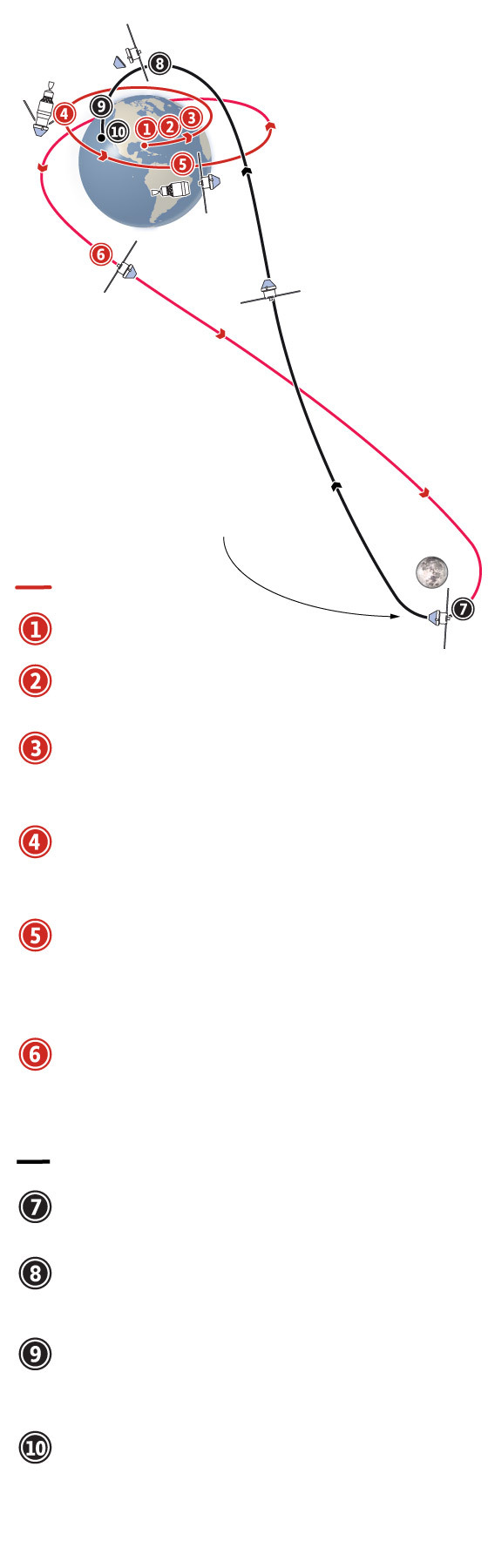
Artemis II
flight path
Orion will travel more than
400,000 km from Earth and
could set a new record for
the farthest humans have
ever gone into space
Moon
Outbound
Lift-off from Cape Canaveral
Two minutes after launch, boosters
separate followed by launch abort system
Eight minutes after launch ICPS and Orion
separate from Core stage. Orion’s solar
arrays unfurl
After 90-minute orbit, ICPS fires engines
to raise Orion to higher Earth orbit.
Crew begins multiple system checks
If everything is in order, Orion separates
from ICPS.Then, astronauts manually fly
Orion toward and away from ICPS, practising
proximity operations for future missions
Around 23 hours later, Orion Service Module
carries out Translunar Injection (TLI) burn –
sending Orion on a trajectory around
the moon
Inbound
After lunar flyby on Day 6, gravity draws
Orion back toward Earth
Just before re-entry, Orion’s crew module
separates from service module
Capsule re-enters atmosphere at speed of
32,187 km/h and temperatures of up to
2,200°C
Series of parachutes slow craft before
splashdown in Pacific Ocean
THE GLOBE AND MAIL, Sources: GRAPHIC NEWS;
NASA; ESA; Lockheed Martin
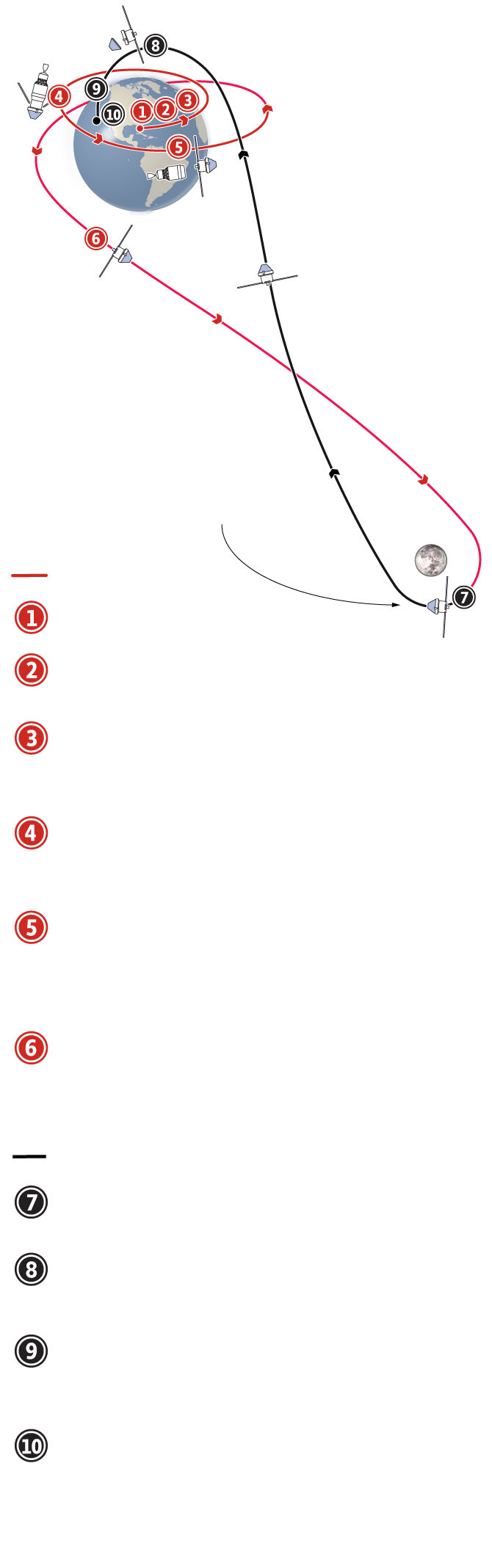
Artemis II
flight path
Orion will travel more than
400,000 km from Earth and
could set a new record for
the farthest humans have
ever gone into space
Moon
Outbound
Lift-off from Cape Canaveral
Two minutes after launch, boosters
separate followed by launch abort system
Eight minutes after launch ICPS and Orion
separate from Core stage. Orion’s solar
arrays unfurl
After 90-minute orbit, ICPS fires engines
to raise Orion to higher Earth orbit.
Crew begins multiple system checks
If everything is in order, Orion separates
from ICPS.Then, astronauts manually fly
Orion toward and away from ICPS, practising
proximity operations for future missions
Around 23 hours later, Orion Service Module
carries out Translunar Injection (TLI) burn –
sending Orion on a trajectory around
the moon
Inbound
After lunar flyby on Day 6, gravity draws
Orion back toward Earth
Just before re-entry, Orion’s crew module
separates from service module
Capsule re-enters atmosphere at speed of
32,187 km/h and temperatures of up to
2,200°C
Series of parachutes slow craft before
splashdown in Pacific Ocean
THE GLOBE AND MAIL, Sources: GRAPHIC NEWS;
NASA; ESA; Lockheed Martin
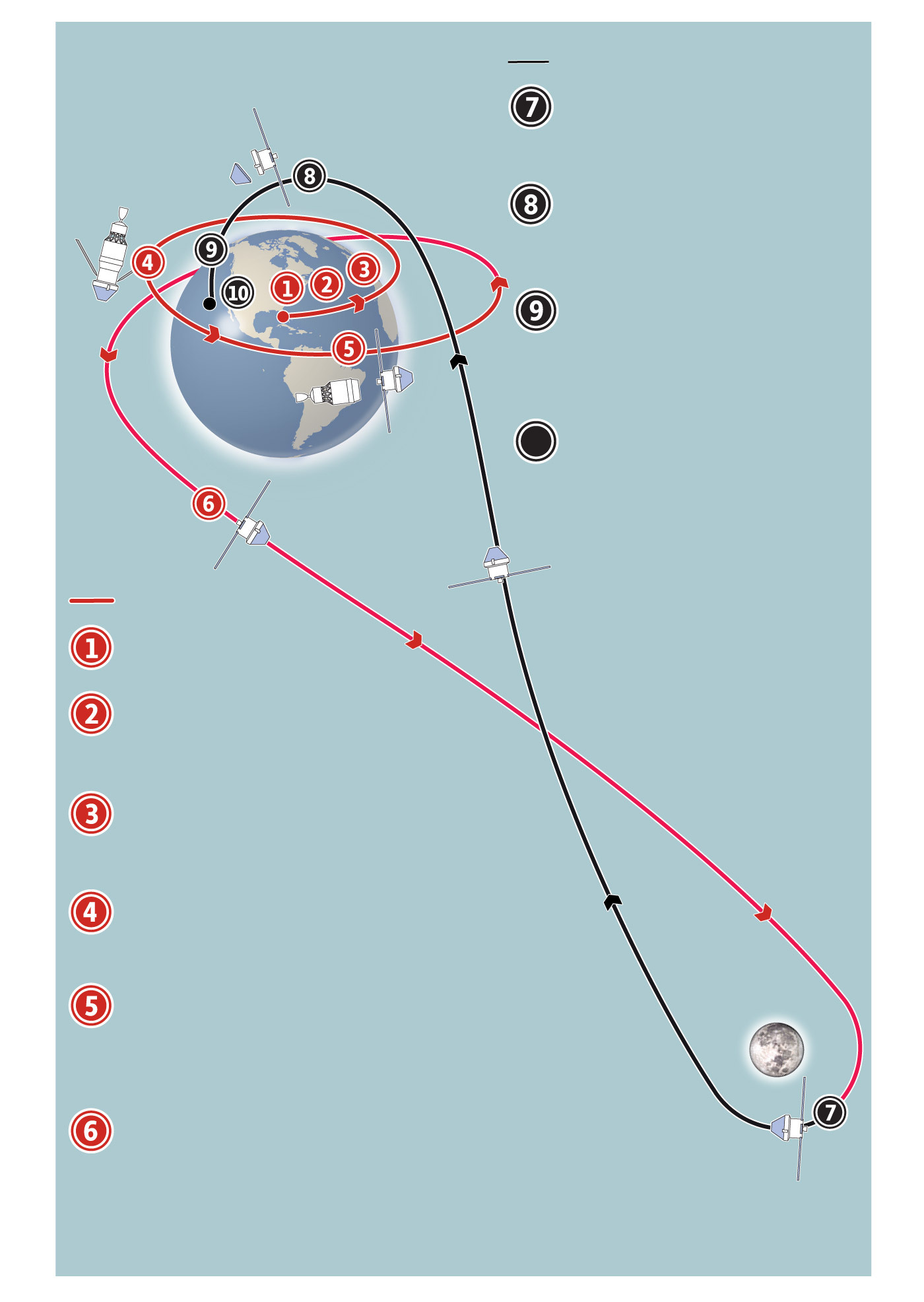
Artemis II flight path
Inbound
After lunar flyby on Day 6,
gravity draws Orion back
toward Earth
Just before re-entry, Orion’s
crew module separates from
service module
Capsule re-enters atmosph-
ere at speed of 32,187 km/h
and temperatures of up to
2,200°C
Series of parachutes slow
craft before splashdown in
Pacific Ocean
10
Outbound
Orion will travel more than
400,000 km from Earth and
could set a new record for
the farthest humans have
ever gone into space
Lift-off from
Cape Canaveral
Two minutes after launch,
boosters separate followed
by launch abort system
Eight minutes after launch,
ICPS and Orion separate from
Core stage. Orion’s solar arrays unfurl
After 90-minute orbit, ICPS fires engines
to raise Orion to higher Earth orbit.
Crew begins multiple system checks
Moon
If everything is in order, Orion separates
from ICPS.Then, astronauts manually fly
Orion toward and away from ICPS, practising
proximity operations for future missions
Around 23 hours later, Orion Service Module
carries out Translunar Injection (TLI) burn –
sending Orion on a trajectory around the moon
THE GLOBE AND MAIL, Sources: GRAPHIC NEWS; NASA; ESA; Lockheed Martin
NASA’s plans now call for at least one moon landing per year starting in 2028 and a moon base under construction by 2030. But the ambitious schedule depends crucially on the success of Artemis II.
Coming nearly three and half years after Artemis I, a test flight of the SLS with an empty crew module, this second flight in the series is the first with people on board.
For Canada, the voyage is especially momentous.
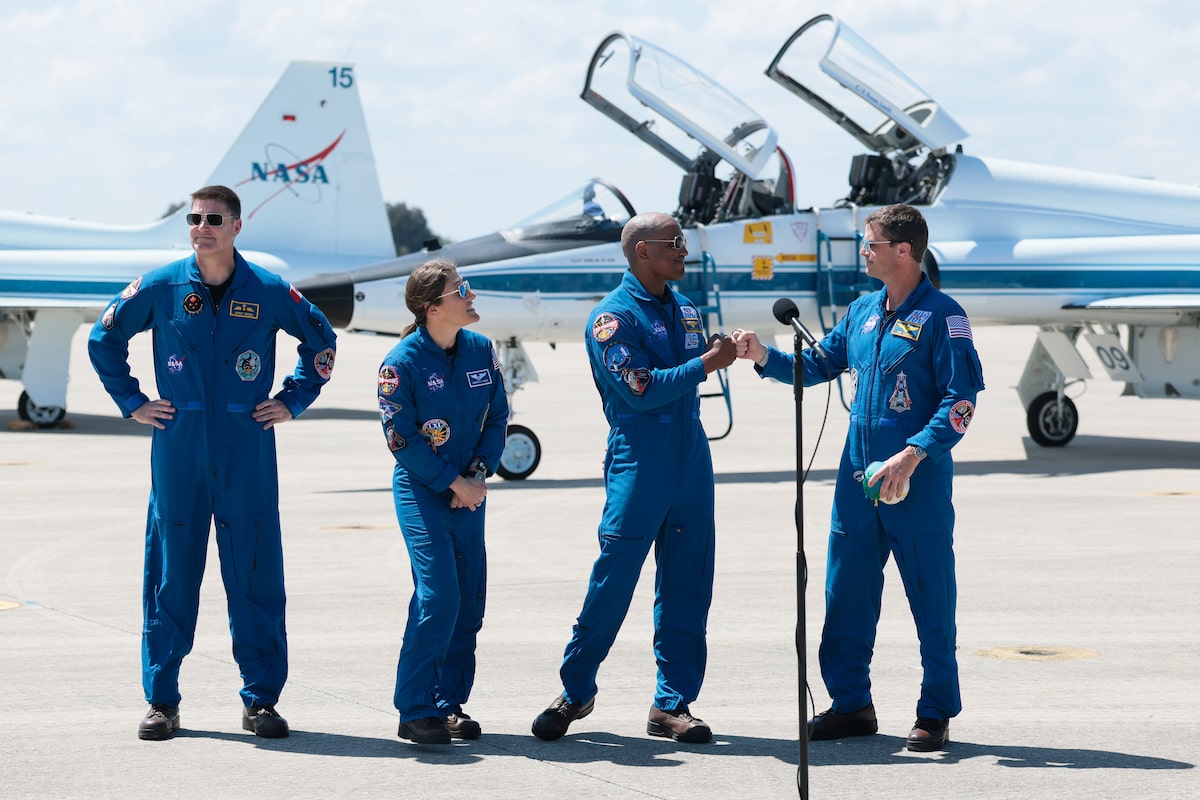
Until now, no representative of any country besides the United States has ever travelled beyond low Earth orbit. As a mission specialist on Artemis II, Canadian Space Agency astronaut Jeremy Hansen is set to make history. Together with his American crewmates – commander Reid Wiseman, pilot Victor Glover and mission specialist Christina Koch – Col. Hansen will spend 10 days aboard NASA’s Orion crew capsule as it loops around the moon and back.
Along the way, the crew will test the capsule’s suitability for deep space operations and blaze a trail for subsequent Artemis missions. And while Artemis II will not land on the moon, it is the flight NASA needs to enable future exploration on the lunar surface for years to come.
“To do that we’ve got to start getting humans into deep space again and build that transportation infrastructure,” Col. Hansen told The Globe and Mail in November, during his last trip to Canada before the flight. “That’s our job.”
It is no small step. Even today, Neil Armstrong’s famous quote about making “a giant leap” when he first set foot on the moon seems an understatement.
To put things in perspective, consider that the ISS orbits about 400 kilometres above Earth’s surface. That means anyone who has driven from Toronto to Montreal has travelled farther than the space station is from Earth.
By comparison, the moon is a thousand times farther away. From such a vantage point, Earth looks so small that an outstretched hand can hide it completely. To be in the moon’s vicinity is to be profoundly separated from the rest of humanity.
The first people to experience this did so aboard Apollo 8, which circled around the moon 10 times in December, 1968. It was the flight that produced the celebrated “Earthrise” photo – when astronaut William Anders, stirred by our planet’s beauty as it broke over the lunar horizon, spontaneously reached for a camera and captured the moment for posterity. The image has since been credited with transforming how we view our place in the universe.
The Apollo program ended in 1972. Roughly 80 per cent of the world’s current population was not born the last time astronauts travelled to the moon. While there are some obvious comparisons with Apollo, Artemis II is a new adventure for a new generation, including a crew with the first Black and first female astronauts to be selected for a lunar mission.
And, to round out the historic significance of the flight, this time Canada is part of the story.


Anatomy of a moon rocket
While similar in appearance to the Apollo capsules that first carried humans to the moon in the 1960s, the Orion crew module is 50% larger by volume and can transport up to six crew members. Together with its European-made service module and an interim stage for reaching high Earth orbit, the crew module sits atop NASA's heavy-lift rocket, called the Space Launch System (SLS).
A look inside
Crew cabin volume:
8.95 cubic metres
(50% greater than
Apollo command
module)
ORION CREW
MODULE
Crew: 2-6
Diameter: 5 m
Height: 3.3 m
Mass: 8.5 tonnes
Cargo capacity:
Can carry supplies to sustain crew for up to 21 days
Heat shield: Largest
of its kind ever built
ORION
Launch abort system:
Propels Orion capsule to safety if
rocket fails
Service
module
Interim
Cryogenic
Propulsion
Stage
(ICPS)
SLS
Solid fuel
rocket
boosters
Core
stage
98.2 m
ivan semeniuk, john sopinski and murat
yükselir/the globe and mail, SOURCE:
REUTERS; GRAPHIC NEWS; NASA

Anatomy of a moon rocket
While similar in appearance to the Apollo capsules that first carried humans to the moon in the 1960s, the Orion crew module is 50% larger by volume and can transport up to six crew members. Together with its European-made service module and an interim stage for reaching high Earth orbit, the crew module sits atop NASA's heavy-lift rocket, called the Space Launch System (SLS).
A look inside
Crew cabin volume:
8.95 cubic metres
(50% greater than
Apollo command
module)
ORION CREW
MODULE
Crew: 2-6
Diameter: 5 m
Height: 3.3 m
Mass: 8.5 tonnes
Cargo capacity:
Can carry supplies to sustain crew for up to 21 days
Heat shield: Largest
of its kind ever built
ORION
ORION
Launch abort system:
Propels Orion capsule to safety if
rocket fails
Service
module
Interim
Cryogenic
Propulsion
Stage
(ICPS)
SLS
SLS
Solid fuel
rocket
boosters
Core
stage
98.2 m
98.2 m
ivan semeniuk, john sopinski and murat
yükselir/the globe and mail, SOURCE:
REUTERS; GRAPHIC NEWS; NASA
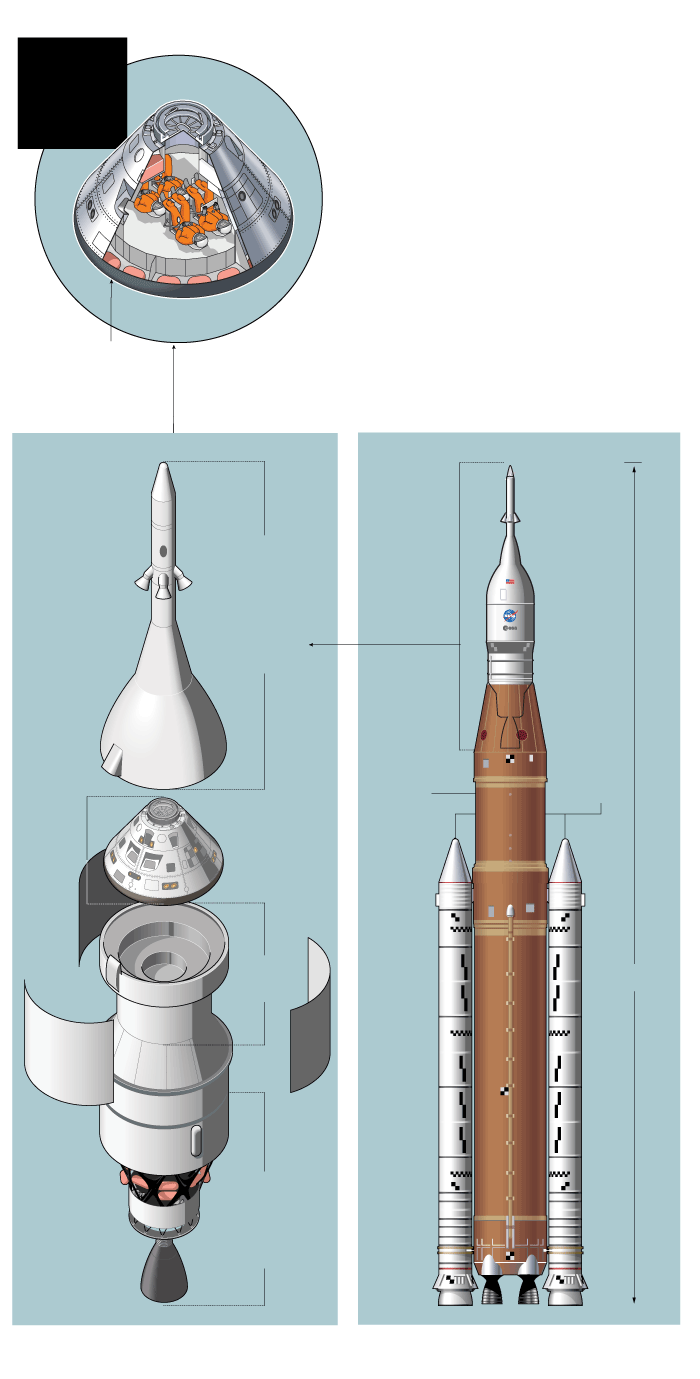
Anatomy of a moon rocket
A look inside
Crew cabin volume:
8.95 cubic metres
(50% greater than
Apollo command
module)
ORION CREW
MODULE
While similar in appearance to the Apollo capsules that first carried humans to the moon in the 1960s, the Orion crew module is 50% larger by volume and can transport up to six crew members. Together with its European-made service module and an interim stage for reaching high Earth orbit, the crew module sits atop NASA's heavy-lift rocket, called the Space Launch System (SLS).
Crew: 2-6
Diameter: 5 m
Height: 3.3 m
Mass: 8.5 tonnes
Cargo capacity:
Can carry supplies to
sustain crew for up to 21 days
Heat shield: Largest
of its kind ever built
SLS
ORION
Launch abort system:
Propels Orion capsule to safety if
rocket fails
Solid fuel
rocket
boosters
Core
stage
Service
module
98.2 m
Interim
Cryogenic
Propulsion
Stage
(ICPS)
ivan semeniuk, john sopinski and murat yükselir/the globe and mail, SOURCE:
REUTERS; GRAPHIC NEWS; NASA
An earned reputation
Long delayed by a series of technical challenges, next week’s anticipated launch arrives at an interesting time for Canada. Because of Col. Hansen’s involvement, it reinforces the country’s stature as a trusted, long-term partner in space even as relations with the U.S. have been fraying down on Earth.
This week, days before the planned launch, NASA announced a significant restructuring of the Artemis program, putting important aspects of Canada’s contribution in question. But one thing is certain – because of Col. Hansen, Canada is already on the way to the moon.
It is an impressive return on investment for a country that spends less than$1-billion on its space program annually. It’s a small fraction of NASA’s budget, or that of the European and Japanese space agencies, which are also participants in the Artemis program and similarly expecting to have their astronauts journey to the moon on future missions.
“Being first is what people will remember,” said Andrew Godefroy, an historian of Canada’s space program and fellow at the Centre for International and Defence Policy at Queen’s University in Kingston. “Canada always swings for the fences when it comes to space, and most of the time we actually hit a home run.”
That is what Canadian officials were hoping for when they negotiated the country’s role in the Artemis program between 2018 and 2020. At that time, it was understood the deal could involve some lunar flights for Canadians. In exchange, Canada would invest $2.05-billion over 24 years in a lunar program including an AI-enabled robot arm, the Canadarm3.
The arm is designed to operate on a lunar space station called Gateway – whose construction was officially paused this week when NASA said it was prioritizing construction of a moon base and other surface activities.
The status of the arm has yet to be clarified, but trading expertise in robotics for participation in space has long been a winning formula for Canada.


This is what a NASA artist imagined Gateway and Canadarm3 would look like. Now, NASA intends to build a moon base instead.NASA

Canadarm2, working with a SpaceX resupply ship in 2019, is still in operation as a workhorse of the International Space Station.NASA
It was the original Canadarm, built for the space shuttles, that got the country’s first astronauts into orbit, including Marc Garneau and Roberta Bondar. Similarly, Canadarm2 on the ISS was the ticket that provided Chris Hadfield and others with extended stays on the station.
Even with that track record, scoring a seat on the first crewed flight back to the moon since Apollo was not a given. (The deal also includes a second lunar mission for a Canadian as well as a Canadian-based control centre for the robotics.)
According to Mary Preville, a defence consultant who was vice-president of space program policy when she led the negotiations for the Canadian Space Agency, the outcome was helped by two factors: One was the performance and undisputed utility of the Canadarms. The other was that Canadian astronauts are embedded with their NASA counterparts and train alongside them at the Johnson Space Center in Houston, Tex.
Ms. Preville said that, in her opinion, “the dollar amount gave us the two flights and the control centre, but Canada’s reputation – its astronauts, personnel and technology – that gave us Artemis II.”
There would be more hoops to jump through to realize Canada’s role on Artemis, not all of them related to technology or budget. For example, the criminal code had to be changed to cover actions committed by Canadian crew members in lunar space. The relevant section of the federal law now prevents future Canadian explorers from getting away with murder on the moon.

In Ottawa – where the Museum of Nature installed this giant moon for the anniversary of Apollo 11 – lawmakers closed a loophole to make sure Canadians on the real moon could be prosecuted for crimes.John Kealey/The Globe and Mail
When Ottawa announced in December, 2020, that a Canadian would fly around the moon on Artemis II, no candidate was named. That would not come until April, 2023.
The choice was not a surprise. By then Col. Hansen was the longest-serving CSA astronaut who had yet to fly in space. And he was well-liked and respected in Houston, where he had overseen the training of a NASA astronaut cohort in 2017.
“The fact is Jeremy was recognized by everyone – including by NASA – for his leadership, his technical abilities, his humour,” said Gilles LeClerc, former director general of space exploration with the CSA.
On the day of the announcement Col. Hansen said he was in awe at the thought of flying to the moon, and seeing Earth in the distance from behind the lunar far side. He praised the U.S. for making its return to the moon an international endeavour, as well as all those in Canada who had risen to the challenge and earned the opportunity to participate.
“It is glorious,” he said. “We’re going to the moon together.”

A new space race
Artemis is a dream born out of tragedy.
When the space shuttle Columbia disintegrated during re-entry into Earth’s atmosphere on Feb. 1, 2003, it claimed the lives of seven astronauts and threw NASA’s human spaceflight program into an existential tailspin.
Columbia was the second space shuttle lost in a 17-year period. It forced the hard question of whether the cost and risk involved in sending people to low Earth orbit was justified – unless it was part of a larger vision.
One year after the Columbia disaster, U.S. president George W. Bush announced a new directive for NASA. The goal of the initiative – known as the Constellation program – was “to gain a new foothold on the moon, and to prepare for new journeys to worlds beyond our own,” Mr. Bush said in a speech in January, 2004.
The change meant abandoning a long and troubled effort to replace the shuttle fleet with a new type of space plane. Instead, NASA began working on a replacement crew vehicle that looked a lot like a scaled up-Apollo space capsule. But the road back to the moon would prove a long and rocky one.

The old space shuttles had wings to re-enter the atmosphere, but for Constellation, NASA pinned its hopes on capsules.NASA
Six years later the Constellation program was listing badly. An independent panel determined it would never achieve its goals with the funding Washington was prepared to give it. Apollo had relied on massive congressional support. At its peak, NASA accounted for 4.4 per cent of the entire U.S. federal budget. Now the agency was grappling with how to achieve an even more ambitious lunar program for a fraction of that cost in current dollars.
In 2010, president Barack Obama cancelled Constellation while specifying that its technology should be re-purposed as the Space Launch System, along with the crew vehicle, now called Orion. Instead of the moon, however, future human exploration was pointed toward something that had not previously been attempted, an asteroid mission.
But Obama’s version of the program also foundered. By then a blossoming commercial launch sector, led by SpaceX, had taken over delivery of cargo to the space station. It would eventually bring astronauts there as well. An asteroid mission was proving harder than it looked, and now Orion needed a new purpose.

NASA uses SpaceX Crew Dragons like this one to get astronauts on and off its International Space Station.NASA via AP
During Donald Trump’s first term in the White House, NASA engineers proposed Gateway. It was to be a more compact version of the ISS in orbit around the moon, where it could provide a base for trips to the surface and a springboard to Mars. It also gave Canada and other countries a venue for jumping in.
Private space companies were to be part of the new lunar push as well, nurtured by government contracts aimed at developing the sector. By 2018, opportunities for robotic lunar missions of varying scale, some that might support NASA’s activities, were available for competition.
And another kind of competition was also underway, an echo of the 1960s space race with Russia. China had successfully placed a lander and rover on the moon in 2013. It was now making its own plans to land astronauts there by 2030.
In May, 2019, NASA’s revived lunar program received its official name – Artemis, a Greek goddess associated with the moon. Its unofficial political objective was well understood: Get back to the moon before China.

Born to fly
Col. Hansen was born in London, Ont., in 1976 – the year NASA unveiled the first space shuttle.
Raised on a farm near the small town of Ailsa Craig, he later attended high school in Ingersoll, Ont. He was fascinated with flight and space at a young age and credits his father for suggesting that he join the air cadets at 12. He had his private pilot’s licence by 17 and was accepted for officer training with Canadian Armed Forces the following year, first at Royal Military College Saint-Jean in Saint-Jean-sur-Richelieu, Que., and then at the Royal Military College in Kingston, Ont., where he graduated with a bachelor’s degree in space science in 1999 and a master’s in physics in 2000.
It was during his final year as an undergraduate that the first two components of the International Space Station were launched and joined in orbit, marking the start of a new era in human space flight.
By 2003, the year of the Columbia disaster, Col. Hansen had completed his training as a CF-18 fighter pilot. He had also married his wife, Catherine, a physician.

Col. Hansen, then Capt. Hansen, helps fellow CF-18 pilot Dave Turenne deliver a Tim Hortons treat to co-workers in Inuvik in 2007.Cpl JF Lauzé/Canadian Forces
Over the next five years, while the space program reeled and readjusted, he focused on his young family (he and Catherine have three children) and honed his skills at one of the most elite and demanding jobs in Canada’s armed forces.
Then came the opportunity of a lifetime.
In 2008, Canada launched an astronaut recruitment campaign – the first in 16 years and the most selective up till then. From more than 5,000 applicants only two would be chosen. Col. Hansen, then 33, and David Saint-Jacques, an astrophysicist turned medical doctor, were named the following year.
For Col. Hansen the new role meant relocating with his family from Cold Lake, Alta., to Houston where he would spend the next several years training and working with NASA’s astronaut corps while waiting for a flight assignment.
In December, 2018, Dr. Saint-Jacques began a 204 day-stint aboard the ISS – the most recent mission by a Canadian Space Agency astronaut and the longest to date. For Col. Hansen it would be a much longer wait. But when his chance finally came, it would be to fly on a mission unlike any in the CSA’s history.
A human experience
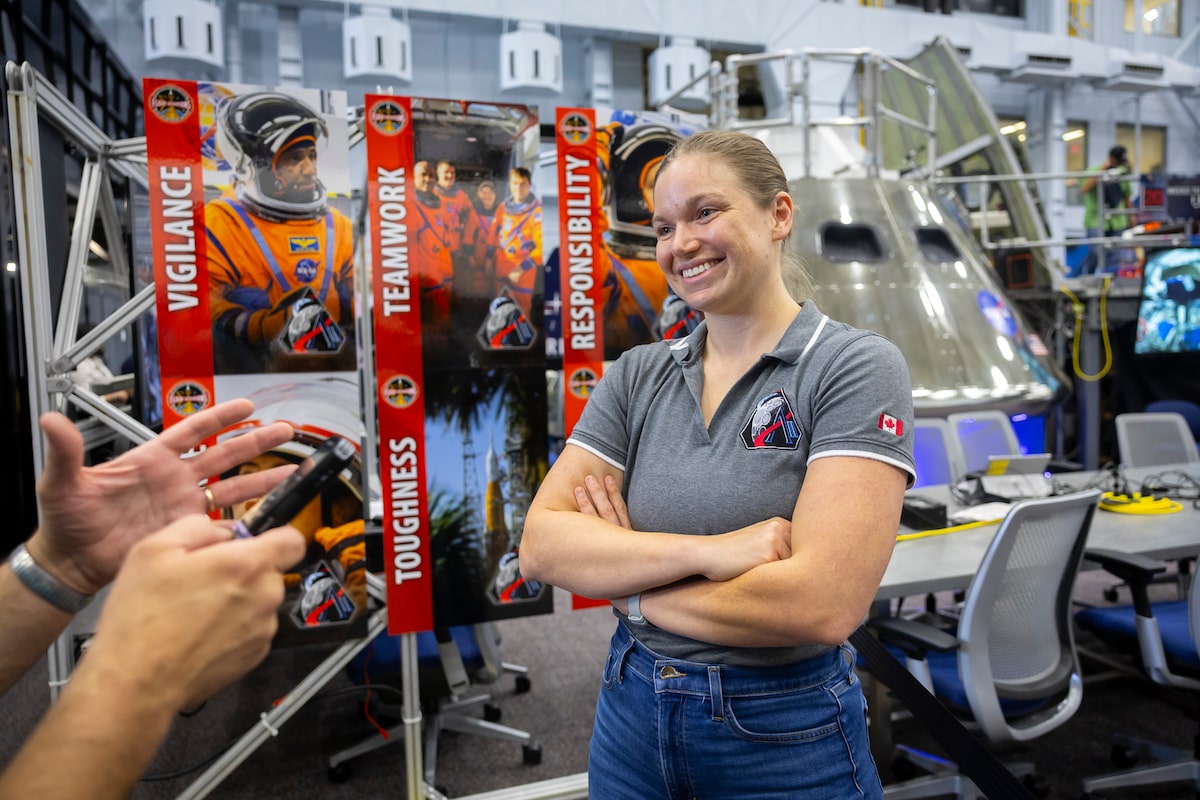
From the time of their selection for Artemis three years ago, Col. Hansen and his back-up, fellow Canadian astronaut Jenni Gibbons, have been on a different track from those training to fly to the space station. The reason is not just the destination but the vehicle, which is untested with a human crew.
Col. Hansen has relished learning about every aspect of Orion’s design and performance alongside the engineers developing the mission. It’s a role that has earned him a reputation for asking questions.
The impact of having Canadians as part of the first crew to work with Orion carries long-term significance, said Mathieu Caron, director of astronauts, life sciences and space medicine at the CSA.
“Jeremy and Jenni are helping define and validate astronaut training, mission operations and procedures for future lunar missions,” he said. “Their contributions extend far beyond a single flight, placing Canadian expertise at the heart of the Artemis program.”
During the flight, Col. Hansen and his crewmates will be focused on many tasks, but some aspects of the mission will be beyond their control.
In particular, after the return of Artemis I, engineers discovered that pieces of the capsule’s heat shield had broken away during re-entry into Earth’s atmosphere. The quest to understand the problem ultimately delayed Artemis II by nearly a year and a half. To avoid the same situation, the Artemis II version of the capsule will come in on a different trajectory to reduce the total heating. Future missions will use a redesigned heat shield.
The shield is just one of myriad critical components on which the crew’s survival depends. The mission’s core objective is to test Orion’s life support systems during the 10-day flight. Col. Hansen has spoken openly of the risk involved and the critical role testing and training play in managing that risk.

Col. Hansen has had many sessions in the Orion simulator to get ready for his real journey into space.James Blair/NASA
While there will be plenty of checking to do inside the capsule during the flight, the highlight will be reaching the moon and swinging around the far side.
Because of the mission’s trajectory, which minimizes fuel use, the capsule will keep its distance from the moon, which will appear no larger than a basketball held at arm’s length during closest approach.
Nevertheless, there is a chance that crew members will see parts of the moon’s far side that have never been witnessed by human eyes.
Depending on the capsule’s precise course as it heads to the moon, it may also carry the crew farther from Earth than humans have ever ventured before.
“It is a milestone,” said Col. Hansen during a press conference on Friday after he arrived in Florida for the launch. “If we do pass it – there’s no guarantee we will – but if we do, we should celebrate the pioneers who came before us that put us in this position to be breaking a record like that. And then we should throw that out to the next generation and say, ‘Hey, let’s go even farther.’”
Space is the place: More from Ivan Semeniuk
Meet MOTHRA, the thousand-eyed telescope in search of the cosmic web
Why hundreds of radio dishes take root in B.C.’s Okanagan Valley
Is there other life out there? NASA’s Pandora hopes for answers