04/10/26 20:07
Artemis II crew splash down, safe and sound back on Earth
- Ivan Semeniuk
Four astronauts who made history after completing the first human flight around the moon in more than half a century have returned safely to Earth.
Canada’s Jeremy Hansen and his U.S. crewmates – mission commander Reid Wiseman, Christina Koch and Victor Glover – splashed down in their crew module, dubbed Integrity, off the coast of California at about 8:07 p.m. ET.
Minutes later, helicopters and boats with divers were dispatched from the navy vessel USS Murtha to pick up the astronauts in their floating capsule.
“I’ve almost been waiting my whole lifetime to see this,” said an elated NASA administrator Jared Isaacman on a livestream from the ship’s deck. “We are back in the business of sending astronauts to the moon and bringing them back safely.”
After retrieval of the capsule, plans called for the astronauts to go first to a navy base in San Diego and then, after medical checks, to be flown to Houston where they will be reunited with their families.
A successful re-entry was the final test for a crucial mission that launched on April 1 and looped around the moon five days later, setting the stage for NASA’s longer-term project of returning people to the lunar surface by 2028.
04/10/26 20:02
Wiseman comes in loud and clear
- Globe Staff
Integrity is back in voice contact with NASA Mission Control in Houston, with Commander Reid Wiseman’s voice coming in loud and clear over the broadcast.
The capsule is five minutes away from splashdown, and will deploy parachutes shortly.
04/10/26 19:55
Planned communications blackout has begun
- Globe staff
The Integrity capsule and its crew are now out of contact with Earth for the next six minutes, an expected blackout due to the build-up of plasma around the craft as it reaches peak speed.
04/10/26 19:35
Separation of service module marks start of re-entry
The Integrity capsule has shed its propulsion system as planned, the first official step in its re-entry into Earth’s atmosphere.
- Reuters
04/10/26 19:29
Watch live: Re-entry starting momentarily
- Ivan Semeniuk
We’re nearing service module separation. After that things will begin happening fast. Follow along with our live feed from NASA mission control in Houston.
04/10/26 19:05
Less than 30 minutes to go
- Ivan Semeniuk

The Artemis II crew gets ready for the Orion spacecraft's Integrity module separation in this screengrab from a livestream video as it prepares for re-entry to Earth following the Artemis II crew's flyby of the Moon, April 10, 2026. NASA/Handout via REUTERS THIS IMAGE HAS BEEN SUPPLIED BY A THIRD PARTYNASA/Reuters
The main event tonight begins with the separation of the crew module from the service module less than half an hour from now at 7:33 p.m. ET. Four minutes late the crew module will execute a raise burn, using Integrity’s thrusters for the last time to put it in the correct orientation.
By 7:53:31 p.m. the crew module should be in contact with the atmosphere at an altitude of about 120 kilometres. There will be an expected loss of communication with the capsule for about 6 minutes during the period of peak heating and then, shortly after 8 p.m., the capsule should be back in contact, after which parachutes will deploy. Splashdown is now expected at 8:07:08 p.m.
04/10/26 18:46
A timeline of Artemis II’s re-entry and splashdown
- Globe staff
The crew are making their final preparations before they begin re-entry in less than an hour. Here’s what to expect and when as the astronauts return to Earth.
- 7:33 p.m. ET: Orion’s crew module will separate from the service module, exposing its heat shield for the spacecraft’s return through Earth’s atmosphere, where it will encounter temperatures of about 2,760 C.
- 7:37 p.m. ET: Following separation, Orion will perform an 18-second crew module raise burn to set the proper entry angle and align the heat shield for atmospheric interface.
- 7:53 p.m. ET: When Orion reaches around 120,000 metres above Earth’s surface while traveling approximately 33 times the speed of sound. The crew is expected to experience up to 3.9 Gs in the planned entry profile. This moment marks the spacecraft’s first contact with the upper atmosphere and the start of a planned six-minute communications blackout as plasma builds around the capsule.
- 8:03 p.m. ET: Around 6,700 metres in altitude, the drogue parachutes will deploy, slowing and stabilizing the capsule as Orion nears splashdown.
- 8:04 p.m. ET: At around 1,800 metres, the drogues will release, and the three main parachutes will deploy, reducing Orion’s speed to less than 218 km/h.
- 8:07 p.m. ET: Slowing to roughly 27 km/h, Orion will splash down in the Pacific Ocean off the coast of San Diego, completing the Artemis II crew’s return to Earth and a nearly 1.2-million kilometre journey.
04/10/26 18:28
The first responders after splashdown
- Globe staff
When the crew arrives back on Earth, four U.S. Navy sailors will be the first faces they see.
The Dive Medical Recovery Team members – Lt. Cmdr. Jesse Wang, Senior Chief Hospital Corpsman Laddy Aldridge, Chief Hospital Corpsman Vlad Link and Hospital Corpsman 1st Class Steve Kapala – will open the capsule, assess each crew member for injuries, and help them out of the spacecraft and onto an inflatable raft. Then, the astronauts will be airlifted by helicopter back to the U.S.S. Murtha.
Training for the crew’s retrieval has been a years-long process, and each sailor is responsible for a specific crew-member.
04/10/26 18:11
90 minutes until re-entry begins
- Ivan Semeniuk
The crew is about an hour and half away from service module separation and two hours from splash down. They are now donning their space suits and Reid Wiseman described the view of Earth, as they pass within the ring of geostationary satellites that orbit the planet from a distance of about 35,000 kilometres.
04/10/26 17:37
Where watch the Artemis II landing live
- Globe staff
NASA is livestreaming the return of the crew back to Earth.
The live coverage will be available starting at 6:30 p.m. ET via NASA+, NASA’s YouTube channel, Canadian Space Agency’s YouTube channel, Amazon Prime, Apple TV, Netflix and Roku.
04/10/26 16:59
Team from UNB tracks astronaut Jeremy Hansen’s progress
- Ivan Semeniuk

From left: Megan MacDonald, a master’s student in electrical engineering, Olivia Gerry Rice, a computer science undergraduate, and Brent Petersen, a specialist in digital communications and a professor in University of New Brunswick's department of electrical and computer engineering.Brent Petersen/Supplied
Last Saturday morning, with the aid of a repurposed satellite dish atop the University of New Brunswick’s engineering building in Fredericton, a group of volunteers, including students, was able to successfully pick up the radio signal broadcast from Artemis II, allowing them to determine its position while it was still on its way to the moon.
Since then, the team has been following the progress of the spacecraft through the heavens. They made one final detection on Friday morning, ahead of the crew’s expected return at 8:07 p.m. ET, and followed the spacecraft’s signal before it disappeared over the horizon, as Earth rotated it out of view.
The University of New Brunswick was one of 34 ground stations in 14 countries selected by NASA earlier this year to assist with tracking the lunar mission, which launched on April 1.
“I was very excited immediately,” said Megan MacDonald, a master’s student in electrical engineering, describing the moment when the signal came in. “It was so clear on the graph and so visible that I wondered for a second if we were pointed at a satellite much closer.”
A previous version of this post incorrectly stated NASA selected 47 locations to track the Artemis II mission. NASA selected 34 locations.
04/10/26 16:49
Crew bids farewell to the troublesome toilet
- Ivan Semeniuk
Mission control has just given Integrity the go-ahead to put away the onboard toilet — perhaps a bittersweet moment for the crew, considering that there have been ongoing problems with venting urine from the apparatus.
NASA even went so far as to create a video about it:
04/10/26 16:31
Astronauts begin re-entry checklist as Integrity nears Earth
- Ivan Semeniuk
It’s been remarkable watching Earth gradually getting larger in this view from outside Integrity. This view is of the morning side of the planet as the spacecraft catches up to the rotating Earth.
By the time it enters the atmosphere around 7:53 p.m. ET, the spacecraft will be over the Pacific, somewhere southeast of Hawaii and at the start of a long track that will take it to within a few hundred kilometres of the southern California coast. Right now, weather is good at the splashdown site where the U.S.S. Murtha is waiting to dispatch helicopters to pick up the crew later today. Meanwhile, the crew has begun their re-entry checklist on board Integrity.
04/10/26 16:23
Issues over the course of the mission
The nearly 10-day flight was not without technical issues. Both the capsule’s drinking water and propellant systems were hit with valve problems. In perhaps the most high-profile predicament, toilet trouble prevented the crew from using it for No. 1 most of the trip, forcing them to resort to old-time bags and funnels.
The astronauts shrugged it all off.
“We can’t explore deeper unless we are doing a few things that are inconvenient,” Koch said, “unless we’re making a few sacrifices, unless we’re taking a few risks, and those things are all worth it.”
Added Hansen: “You do a lot of testing on the ground, but your final test is when you get this hardware to space and it’s a doozy.”
– The Associated Press
04/10/26 15:47
The crew’s official space jam playlist
The four-person crew of NASA’s Artemis II have curated a selection of wake-up songs that accompanied them on their historic journey around the moon, and some of their picks might surprise you.
In a video shared by NASA, the astronauts discuss how they chose their personal favourites, a tradition dating back to the earliest days of spaceflight. From Queen and David Bowie’s classic Under Pressure to Chappell Roan’s pop anthem Pink Pony Club, it’s an eclectic mix.
You can listen to the full playlist here.
04/10/26 15:31
Where are the Artemis II astronauts landing?
– Globe staff
The astronauts are expected to land just off the coast of San Diego, Calif., in the world’s largest and deepest ocean: the Pacific.
Landing in water is generally considered to be safer than touching down on land. Not only does the ocean provide a natural cushion to absorb some of the capsule’s high-speed impact, but it also provides a larger target surface area.
04/10/26 15:12
Watch: How Artemis II is expected to re-enter and splashdown
- Reuters
A NASA animation shows the expected reentry and splashdown to conclude the Artemis II mission today.
Reuters
04/10/26 15:03
The final manoeuvre of Integrity completed
- Ivan Semeniuk

A view of NASA's Orion spacecraft in the foreground, lit up by the sun, with the first-quarter moon visible behind it, as photographed by one of the cameras on the spacecraft's solar arrays during the Artemis II lunar flyby on Monday.NASA/Reuters
Integrity has just concluded an 8-second engine burn – meant to be the final manoeuvre of a nearly 10-day journey that took it around the moon and back to Earth. Afterwards, crew commander Reid Wiseman could be heard giving a shout out to the Netherlands-based team that built the European Service Module which has powered, propelled and supplied Integrity during its flight.
The service module is scheduled to be jettisoned about 29 minutes before the capsule makes contact with Earth’s atmosphere.
04/10/26 14:32
An astronaut’s guide to re-entry
- Globe staff
Want to know what it’s like to return to earth after a journey to space? Retired Canadian astronaut Chris Hadfield is more than happy to respond to your queries.
Today, the former commander of the International Space Station took to the social media platform, X, to answer questions from curious citizens, including how loud re-entry is, and whether it will feel like a smooth or shaky ride for the astronauts.
04/10/26 14:29
Crew about to embark on final preparations
- Ivan Semeniuk

NASA astronaut and Artemis II Commander Reid Wiseman takes a moment during the seven-hour lunar observation period where the crew reported to the ground team their observations including colour nuances, April 6, 2026.NASA/Reuters
NASA’s Artemis II mission is reaching its finale today as its four astronauts prepare to return to Earth in their spacecraft dubbed Integrity.
The mission plan calls for the capsule to splash down in the Pacific Ocean this evening at about 8:07 ET. The crew is away and making final preparations, including for the last course correction burn that will keep them on track. This is expected at about 2:55 p.m. ET.
The busiest part of the process will begin about 7 p.m. ET with the descent through the atmosphere expected to last about 13 minutes.
You can read more about the sequence and about the capsule’s heat shield here.
04/10/26 14:17
How the splashdown works, and what happens to the astronauts after
- Globe staff

Jared Daum, aerospace engineer at NASA's Johnson Space Center, displays the Orion spacecraft's parachute system on April 9, 2026, at the Johnson Space Center in Houston, Texas.RONALDO SCHEMIDT/AFP/Getty Images
The Artemis II splashdown is a precise, 14-minute, high-stakes procedure where the Orion capsule re-enters Earth’s atmosphere at roughly 38,000 kilometres an hour, using a heat shield to survive 2,760 C temperatures before deploying 11 parachutes to slow to around 27 km an hour for a Pacific Ocean landing.
After the splashdown, recovery teams will retrieve the crew using helicopters and deliver them to the USS John P Murtha. Once aboard, the astronauts will undergo post-mission medical evaluations in the ship’s medical bay before travelling back to shore to meet with an aircraft bound for NASA’s Johnson Space Center in Houston, Texas.
04/10/26 14:00
What time do the Artemis II astronauts return to Earth?
- Globe staff
The crew is currently slated to splash down back on Earth at 8:07 p.m. ET, according to NASA.
However, the landing process is extremely precise, and the exact timing could change depending on several factors throughout the day.
Leading up to the big event, the crew will complete a number of tasks, including separation from the service module.
The spacecraft is expected to make first contact with the earth’s upper atmosphere at 7:53 p.m. The drogue parachutes will deploy at 8:03 p.m., slowing and stabilizing the capsule before the main parachutes deploy a minute later.
04/10/26 14:00
How to track the Artemis II mission live
- Reet Arora
NASA’s Artemis Real-time Orbit Website (AROW) is allowing people to track Artemis II live as it progresses in unexplored airspace.
Anyone with internet access can track where Orion and the crew are, including their distance from Earth, distance from the moon, the mission duration, and more.
Access to AROW is available on:
04/10/26 14:00
The mission’s flight path
- Ivan Semeniuk
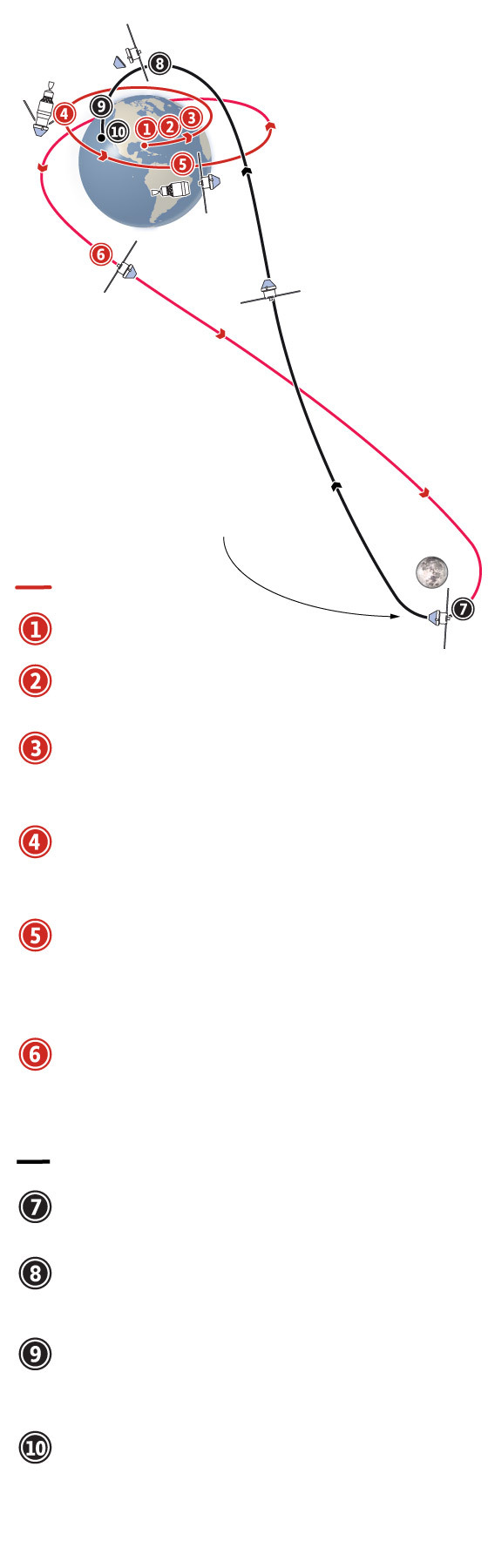
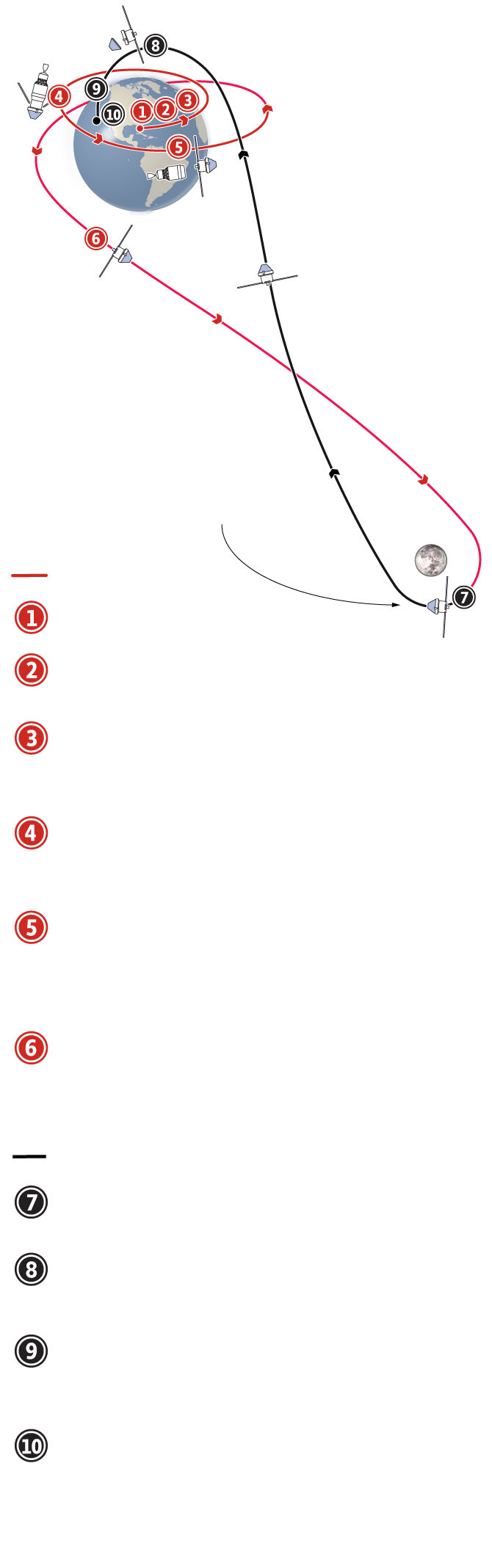
NASA called the mission a “lunar flyby” because the spacecraft did not technically orbit around the moon. Instead, it traced a figure-8 loop that started on the east side of the moon (the left side as seen from the northern hemisphere) and swung around the back to the other side.
The collective gravitational pull of the Earth and moon together will send the spacecraft back toward Earth for a splashdown in the Pacific Ocean today.
Artemis II
flight path
Orion will travel more than
400,000 km from Earth and
could set a new record for
the farthest humans have
ever gone into space
Moon
Outbound
Lift-off from Cape Canaveral
Two minutes after launch, boosters
separate followed by launch abort system
Eight minutes after launch ICPS and Orion
separate from Core stage. Orion’s solar
arrays unfurl
After 90-minute orbit, ICPS fires engines
to raise Orion to higher Earth orbit.
Crew begins multiple system checks
If everything is in order, Orion separates
from ICPS.Then, astronauts manually fly
Orion toward and away from ICPS, practising
proximity operations for future missions
Around 23 hours later, Orion Service Module
carries out Translunar Injection (TLI) burn –
sending Orion on a trajectory around
the moon
Inbound
After lunar flyby on Day 6, gravity draws
Orion back toward Earth
Just before re-entry, Orion’s crew module
separates from service module
Capsule re-enters atmosphere at speed of
32,187 km/h and temperatures of up to
2,200°C
Series of parachutes slow craft before
splashdown in Pacific Ocean
THE GLOBE AND MAIL, Sources: GRAPHIC NEWS;
NASA; ESA; Lockheed Martin
Artemis II
flight path
Orion will travel more than
400,000 km from Earth and
could set a new record for
the farthest humans have
ever gone into space
Moon
Outbound
Lift-off from Cape Canaveral
Two minutes after launch, boosters
separate followed by launch abort system
Eight minutes after launch ICPS and Orion
separate from Core stage. Orion’s solar
arrays unfurl
After 90-minute orbit, ICPS fires engines
to raise Orion to higher Earth orbit.
Crew begins multiple system checks
If everything is in order, Orion separates
from ICPS.Then, astronauts manually fly
Orion toward and away from ICPS, practising
proximity operations for future missions
Around 23 hours later, Orion Service Module
carries out Translunar Injection (TLI) burn –
sending Orion on a trajectory around
the moon
Inbound
After lunar flyby on Day 6, gravity draws
Orion back toward Earth
Just before re-entry, Orion’s crew module
separates from service module
Capsule re-enters atmosphere at speed of
32,187 km/h and temperatures of up to
2,200°C
Series of parachutes slow craft before
splashdown in Pacific Ocean
THE GLOBE AND MAIL, Sources: GRAPHIC NEWS;
NASA; ESA; Lockheed Martin
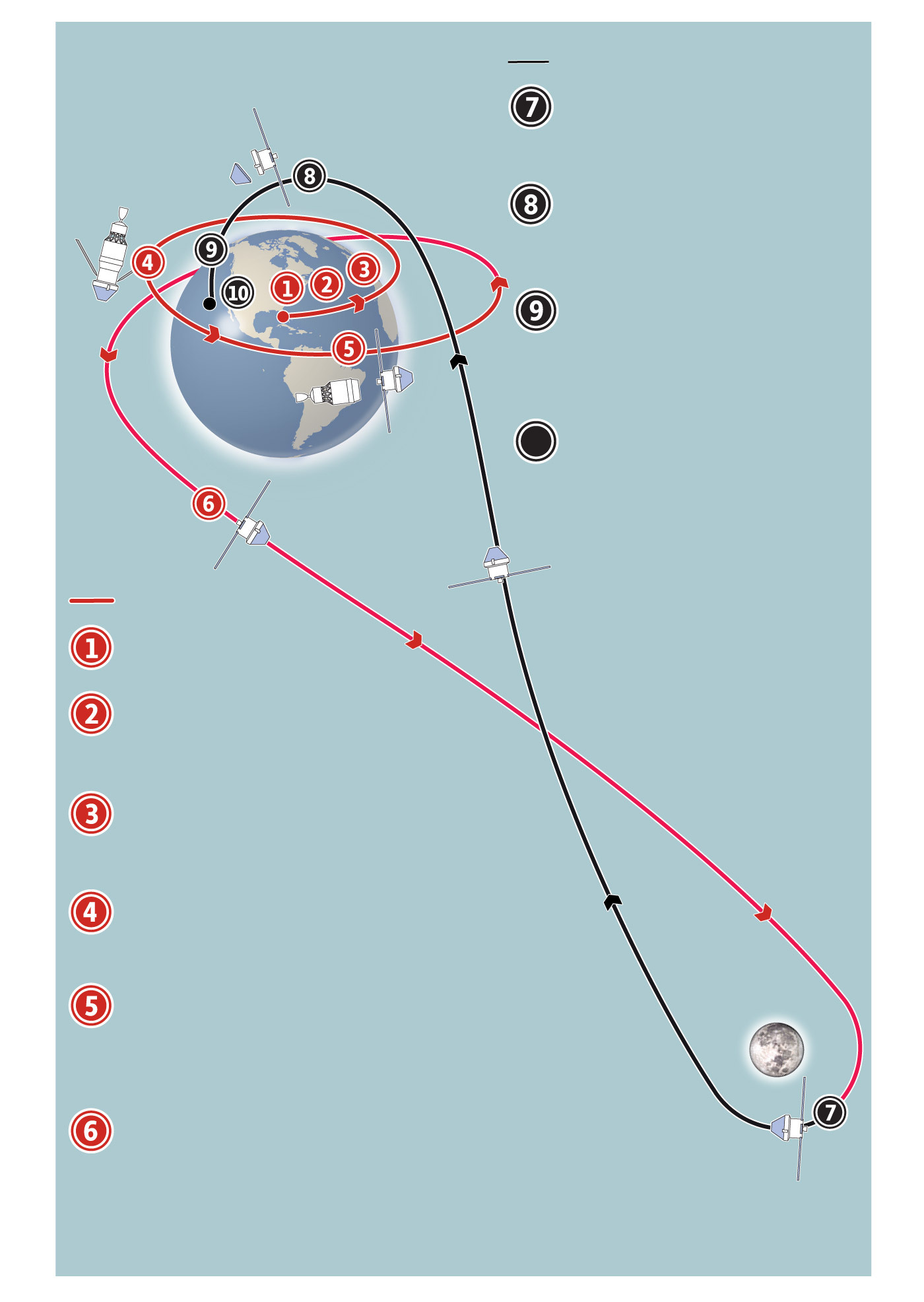
Artemis II flight path
Inbound
After lunar flyby on Day 6,
gravity draws Orion back
toward Earth
Just before re-entry, Orion’s
crew module separates from
service module
Capsule re-enters atmosph-
ere at speed of 32,187 km/h
and temperatures of up to
2,200°C
Series of parachutes slow
craft before splashdown in
Pacific Ocean
10
Outbound
Orion will travel more than
400,000 km from Earth and
could set a new record for
the farthest humans have
ever gone into space
Lift-off from
Cape Canaveral
Two minutes after launch,
boosters separate followed
by launch abort system
Eight minutes after launch,
ICPS and Orion separate from
Core stage. Orion’s solar arrays unfurl
After 90-minute orbit, ICPS fires engines
to raise Orion to higher Earth orbit.
Crew begins multiple system checks
Moon
If everything is in order, Orion separates
from ICPS.Then, astronauts manually fly
Orion toward and away from ICPS, practising
proximity operations for future missions
Around 23 hours later, Orion Service Module
carries out Translunar Injection (TLI) burn –
sending Orion on a trajectory around the moon
THE GLOBE AND MAIL, Sources: GRAPHIC NEWS; NASA; ESA; Lockheed Martin
04/10/26 14:00
The Artemis II astronauts
- Reet Arora

This screengrab taken from a NASA livestream shows Artemis II mission astronauts (L-R) NASA's pilot Victor Glover, NASA commander Reid Wiseman, Canadian Space Agency's mission specialist Jeremy Hansen and NASA's mission specialist Christina Koch from inside the Orion spacecraft on April 4.Supplied/AFP/Getty Images
The Artemis II crew consists of three Americans and one Canadian: commander Reid Wiseman, pilot Victor Glover, mission specialist Christina Koch and Canadian Space Agency astronaut and mission specialist Jeremy Hansen. The mission’s crew was selected in 2023.
Commander Reid Wiseman
Baltimore, Maryland
Previously flew as a flight engineer aboard the International Space Station for Expedition 41 from May through November 2014, logging more than 165 days in space. He has a Bachelor of Science degree from Rensselaer Polytechnic Institute and a Master of Science in systems engineering from the Johns Hopkins University.
Pilot Victor Glover
Pomona, California
This is Glover’s second flight to space having previously served as pilot on NASA’s SpaceX Crew-1, which flew to the International Space Station. He has contributed to scientific investigations, technology demonstrations and participated in four spacewalks.
Mission Specialist Christina Koch
Jacksonville, North Carolina
Koch has served as flight engineer aboard the International Space Station for Expedition 59, 60 and 61. She has set a record for the longest single spaceflight by a woman with a total of 328 days in space and participated in the first all-female spacewalks.
Mission Specialist Jeremy Hansen
London, Ont.
Hansen is the first Canadian astronaut to venture to the moon. The former fighter pilot was selected as one of two recruits by the Canadian Space Agency for its astronaut recruitment program in 2009 and began working at the Mission Control Center in Houston in 2011.
He has previously participated in the European Space Agency’s CAVES program in Italy during which he lived underground for six days. He was a crew member of space mission simulation NEEMO 19 before becoming the first Canadian to lead a NASA astronaut class.