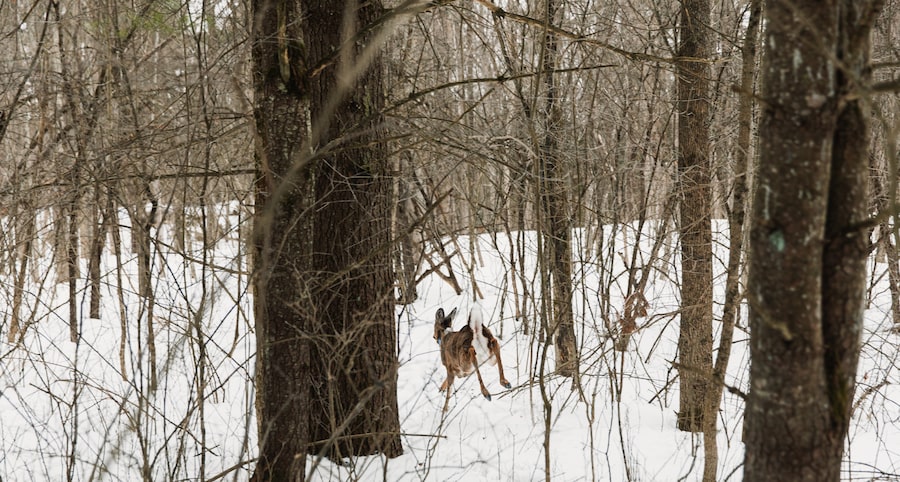
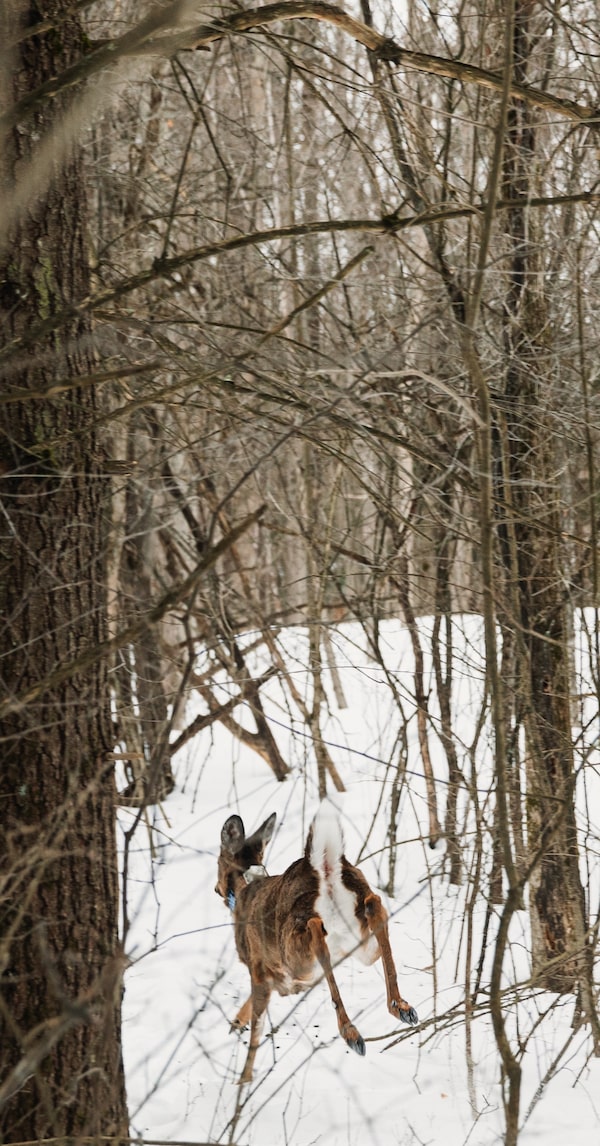
One day last winter, Aaron Shafer was kneeling in the snow in a wooded section of Thousand Islands National Park, about 50 kilometres east of Kingston. Beside him lay a drugged and blindfolded white-tailed deer.
Nearby, Sheldon Lambert, a resource conservation manager with Parks Canada, cradled the unconscious deer’s head on his leg, while veterinarian Dave McRuer monitored the animal’s pulse and breathing. The female yearling’s tongue lolled as tubes fed oxygen into her nostrils.
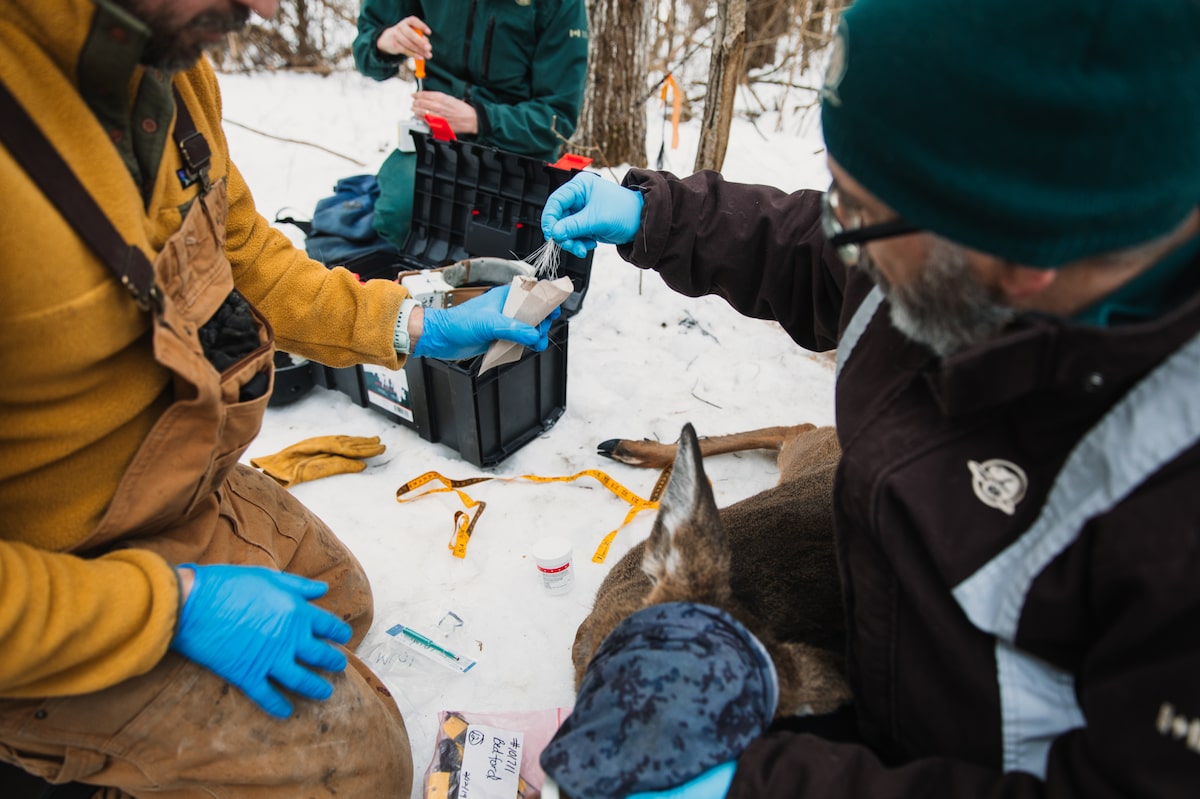
Dr. Shafer, an associate professor at Trent University who specializes in wildlife genomics, moved swiftly and quietly as he fit a radio collar around the deer’s neck. He collected hair samples and measured the deer’s hind-foot length, an indicator of body size.
With Mr. Lambert’s help, he then transferred the animal into a shallow plastic tub that they suspended on a spring scale to record the deer’s weight: 48 kilograms. The female was likely pregnant, which, for white-tailed deer can occur as early as the first year of life.
A key moment in the operation came when Dr. Shafer used a punch tool and carefully clipped a hole in the deer’s right ear. A small trickle of blood darkened the crisp white snow while he bagged and labelled the pea-sized pellet of flesh. “That gives me unlimited amounts of DNA,” Dr. Shafer said.
Capturing and tagging this white-tailed deer, dubbed ML01, was a team effort for Trent University researchers and Parks Canada. Here's how it was done.
On its own, such a genetic sample can reveal the lineage and even the age of a single animal. When combined with location data and tissue samples from other deer, it may illuminate how genes and the environment interact to shape the destiny of an entire population.
The value of such information is clear. Because of the places they go, the food they eat and the diseases they carry, white-tailed deer are a crucial species from a conservation and wildlife-management standpoint. They are also the ultimate boundary crossers – between countries, between ecoregions and between wild and human spaces. Exactly how the deer move and behave in response to a changing environment is tied to their genetics. It’s that part of the story that Dr. Shafer hopes to access.
With the sampling and measurements completed, Dr. McRuer injected the deer with a drug to reverse the anesthetic that was used to immobilize it when it was caught in a live trap. The objective is to minimize any chance of harm, so that a deer quickly returns to its normal activities.
Soon, the yearling’s legs began to twitch.
“It’s pretty special – this is a unique thing to be this close,” said Dr. Shafer, holding the animal’s head upright as it gradually regained its bearings. He carefully removed the blindfold covering its eyes. A minute later, the deer was up on four legs. The team erupted with hoots and claps to send it bolting off into the woods, away from the trap that would be reset for the next customer.


Blips and boundaries
One year later, the deer’s movements can be displayed as a series of GPS locations on a map and compared with those of several other animals captured and collared the same week. The steady streams of radio blips reveal a fascinating and diverse set of journeys.
The female yearling, designated ML01, was a homebody that stayed within the same two-kilometre radius all year. But ML04, the only male deer in last year’s cohort, was not as lucky. Though it remained within or near the park, that deer was taken by coyotes.
ML02 ranged more widely in a 10-km long stretch that includes much of the eastern end of the park.
In contrast, ML03 left the park by crossing Ontario’s ceaselessly busy Highway 401 and travelled north about 30 km. ML05 and ML06 also crossed the highway at different locations during the 12-month period.
These crossings are of particular interest to park staff. Collisions with cars and trucks are lethal for deer and dangerous to drivers. The risk could be exacerbated in the future as Ontario looks to expand the highway from four to eight lanes along the stretch that is adjacent to the park.
Data about where deer are crossing the highway could help guide decisions about where to build animal overpasses – a possible way to mitigate collisions on the future expanded highway.

Wildlife overpasses, such as this one in Alberta's Banff National Park, aim to give animals a safe space to cross busy highways.Jeff McIntosh/The Canadian Press
The 401 is just one aspect of a complex ecological system that Dr. Shafer and his colleagues are exploring.
Thousand Islands National Park is not a contiguous area, but a collection of islands in the St. Lawrence River and properties on the mainland that are spread out in a narrow band between the highway and the U.S. border running east of Kingston.
Deer are described as hyperabundant in the park, meaning their density is unnaturally high in some areas and could be having a negative impact on the ecosystem as a whole. The high population makes it an ideal test bed for a study aimed at understanding what drives deer movement.

The deer in the study get durable collars, designed to stay on in all seasons and transmit their whereabouts.Jenny Bedford
Since 2019, the study, which is a collaboration between Dr. Shafer’s lab and Parks Canada, has collared and sampled 32 deer. Each animal is tracked for two years, after which the radio collars automatically drop off. In that time, the research team has seen deer moving in and out of the park, across the St. Lawrence River and between its various islands.
“Deer are great swimmers,” Mr. Lambert said. “Even when it’s really cold, if a deer needs to swim to get from point A to point B then it’s getting in the water.”
What researchers are gaining from the tracking study adds weight and depth to years of such observations by park staff and biologists. In their silent odysseys, deer offer a window into a world that is close at hand, but often hidden from view.

Back from the brink
From woodlots to suburban flower gardens, white-tailed deer are a common sight in most parts of North America east of the Rockies and, by far, the continent’s most abundant large wild animal. The current population is estimated to be over 30 million and their geographic range has grown in response to changing land-use patterns and a warming climate.
The number of white-tailed deer in Canada is a small fraction of the species’ population in the U.S., but their presence here has expanded as far as the Northwest Territories, where sightings were once rare. The proliferation of roads into the boreal wilderness across the country has accelerated the species’ penetration. And deer are altering ecosystems as they go.
A 2014 review by researchers at Laval University offers a detailed look at how profoundly white-tailed deer can affect the growth of young trees and other plants in the forest, based on studies of Quebec’s Anticosti Island, where deer were artificially introduced in 1896.
“Economically and ecologically, it’s hard to find a more important large mammal in Canada,” Dr. Shafer said.
The economic part of the equation includes sport hunting as well as deer farming, for meat and other products.
According to figures provided to The Globe and Mail by Ontario’s Ministry of Natural Resources, the sale of deer-hunting permits earned the province $8.1-million in fiscal year 2024-25. During the same period, total purchases related to deer hunting in the province, including fuel, food and equipment, are estimated at $392.2-million. Extrapolated across the rest of North America, deer hunting is a multibillion dollar industry.

White-tailed deer are born with spots to camouflage them from predators, but they fade after a few months. Hunting and logging once pushed the species close to extinction.Amy Roach, Thousand Islands National Park
It was not always so.
At the beginning of the 20th century, the total number of white-tailed deer in North America numbered around 300,000 – about 1 per cent of the current population. Between hunting and logging, the species was nearly driven to extinction but has since made an impressive comeback.
The deer’s ability to reproduce quickly and its adept manoeuvering at the margins of a human world – where predators are loathe to follow – are key factors behind this resurgence. Now, deer are a force on the landscape like few other wild species.
To get a better handle on what deer are doing and why, Dr. Shafer has turned to the tools of modern genomics.
DNA lens
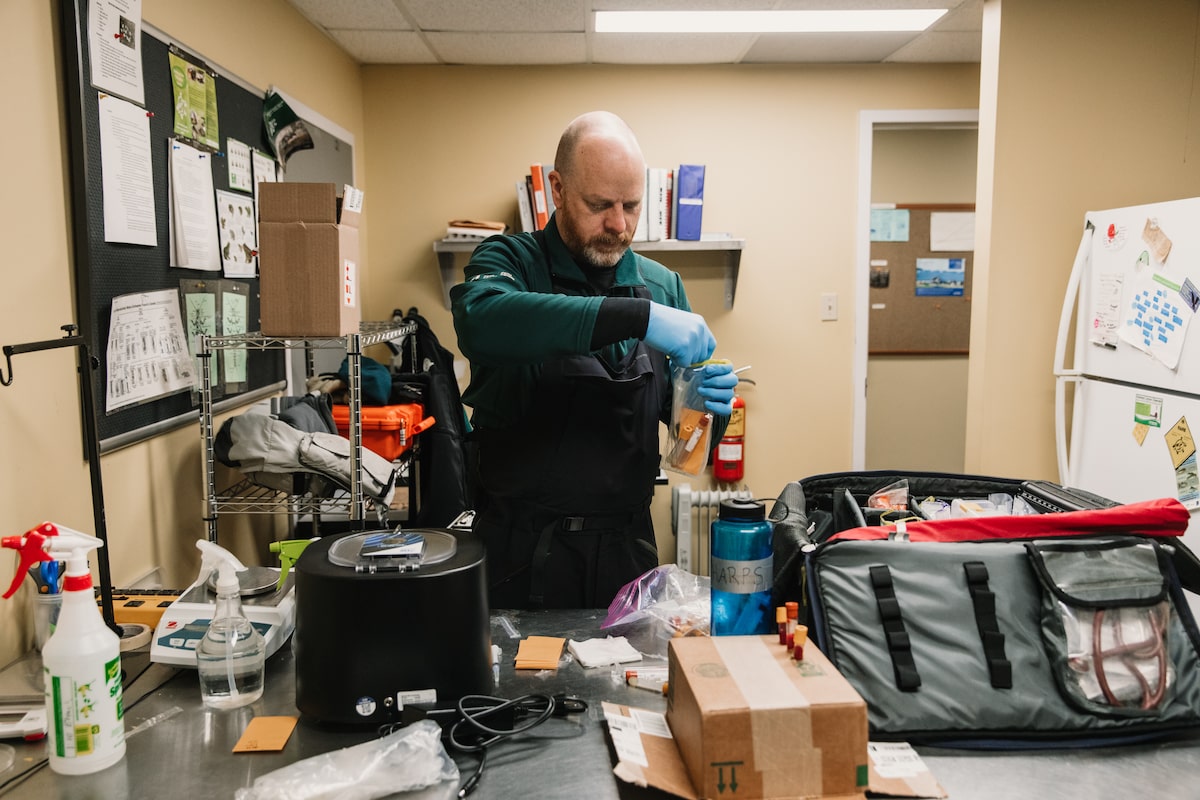
While radio collars provide information on how white-tailed deer are moving through space, the tissue samples that Dr. Shafer collects can show how they have fared as a population through time.
Woven into each animal’s DNA is a molecular library that contains traces of the evolutionary history of the species. By exploring the genetic diversity among individuals, scientists can use DNA as a lens to observe past events.
In particular, in a 2024 study based on DNA from 73 white-tailed deer sampled across North America, Dr. Shafer and Camille Kessler, who was then a PhD student at Trent University, were able to detect the genetic footprint of two great crises, during which deer numbers crashed precipitously.
The first was at the height of the last ice age, some 18,000 years ago, during which much of North America was buried under glaciers and white-tailed deer were squeezed into a narrow fraction of the current range of the species.
The second crisis was the extremely narrow bottleneck the population faced about 150 years ago. Overhunting likely played a role, when deer skin and other products were being shipped to European markets in mass quantities. But Dr. Kessler said fragmentation of deer habitat may have been a larger factor.
“Habitat connectivity influences how often deer interact with each other,” she said. “The more they interact, the more likely they are to transmit diseases, which affects immunity.”
Intense logging during the 19th century would have crammed more deer into smaller areas where disease transmission likely increased. Today, habitat and its transformation as the climate changes is likely shaping deer populations as well.

Radio collars give Dr. Shafer an idea of how deer live now, but he hopes genetic testing can illustrate their future in a changing environment.
One of Dr. Shafer’s aims is to look at genetic variations among individuals and see what that portends for how deer will adapt. To that end, each tissue sample he collects is like a star in a constellation of genetic data that is flowing through the environment.
From the Thousand Islands study, it’s clear that individual deer can behave quite differently from one another, even when they experience common factors such as snowfall, which impedes movement, and food availability through the seasonal greening of the forest. As data accumulates, the plan for the study is to search for trends that may have a genetic component, with a focus on common routes that individual animals follow, known as “movement corridors.”
“Animals that use similar movement corridors are often more related,” Dr. Shafer said. “Movement corridors facilitate gene flow – they act as a highway for the movement of genes and keep populations connected.”
Local lore suggests that deer in the area once migrated seasonally between the St. Lawrence and Charleston Lake, several kilometres to the north, Dr. Shafer said. The completion of the 401 in the 1960s would have disrupted this flow of animals and genes, and possibly led to new behaviours that the deer study can detect.
An interesting question is whether deer are tending to move north of the 401 but are not coming back to the park later on. If the overall flow is in one direction, it suggests a long-term pattern may be at work – a reflection of the large context within which the deer study is unfolding.

The big arch
Thousand Islands National Park sits precisely at the midpoint of a geological formation called the Frontenac Arch, which connects the Adirondack Mountains in upstate New York with the Canadian Shield, including Algonquin Provincial Park in Ontario.
Many wildlife species, including white-tailed deer, are known to move along the length of the Arch, where the terrain is less suitable for agriculture than surrounding areas and, therefore, less developed. In 2002, a portion of the Arch that includes the park was recognized by UNESCO as one of Canada’s unique biosphere regions.
The Algonquin to Adirondacks Collaborative, or A2A, a conservation group that focuses its activities on the region, has been advocating for strategies that can reduce animal mortality when Highway 401 is expanded to eight lanes of traffic. In a 2023 report that incorporates tracking data on white-tailed deer among other species, the group identifies potential locations where wildlife overpasses are likely to be most effective.
Ryan Danby, a professor of environmental biology at Queen’s University in Kingston and a co-author of the A2A report, said the kind of data that the Thousand Island study is providing is crucial.
While he has conducted detailed surveys to tally roadkill along the stretch of the 401 near the park, he said such data collection leaves a big gap in knowledge.
“It doesn’t tell us what the animals were doing before they got hit, and it didn’t tell us anything about animals that successfully crossed the highway either,” he said.
For deer, at least, the Thousand Islands project is helping to address this gap by providing insight about where animals are crossing the highway and why.

Studying how deer move is an indirect way to track the pests that hitch a ride with them, such as deer ticks and viruses.Stegerphoto / Getty Images
The movement of deer in and out of the park is also tied to a different kind of biological current: the parasites and pathogens that are associated with deer, and potentially entering Canada through the Frontenac Arch.
Some of the health risks in this category are well known, including deer ticks that carry Lyme disease, a growing problem in Canada. Other risks are less predictable, such as the revelation that deer in Ontario and Quebec are carrying COVID-19 picked up from humans.
Samira Mubareka, an infectious-disease researcher at Toronto’s Sunnybrook Health Sciences Centre, whose lab was the first to detect the coronavirus in Canadian deer in 2021, said she remembers the ominous feeling she experienced after the positive test.
“It was a reality that dawned on me that we have, through this pandemic, spread the virus so abundantly that it’s now spilled over into wildlife,” she said.
Between 2022 and 2024, Dr. Mubareka and her colleagues tested more than 2,800 white-tailed deer and, based on antibodies, found a COVID-19 infection rate of 6.8 per cent. Fortunately, the worst-case scenario did not materialize: It seems that white-tailed deer did not become a significant reservoir for COVID-19 or generate new variants that might threaten humans. But the possibility that such a scenario could unfold during a future pandemic is another reason why it has become imperative to better understand deer movement.
Dr. Shafer said a more immediate concern is the spread of chronic wasting disease, a neurological disorder caused by misfolded proteins that is universally fatal in deer, but so far not reported in humans.
Data compiled by the U.S. National Wildlife Health Centre in Wisconsin show that CWD has turned up in both captive and free-ranging deer populations in the U.S. and Western Canada, but it is not yet present in Ontario, where its arrival could devastate the province’s deer population. A likely entry point would be through the Frontenac Arch.

The 300
The analysis of the deer collared and sampled in the winter of 2025 is still under way. This year’s heavy snowfall made trapping deer more challenging and only one additional animal was added to the growing database.
Dr. Shafer said his next step is to work with partners in the U.S. to collar deer south of the border and see how deer movements in New York State tie in with what he and his colleagues have observed on the Canadian side of the St. Lawrence River.
At least one of the study’s animals from a previous year has crossed into the U.S., but there are no hard data yet on deer coming the other way.
Ultimately, he said, the goal is to build up a much larger database that he can use to examine the genetic underpinnings of a species on the move.
“I’m personally aiming for 300 animals,” he said. “That’s going to take me another decade to get, but when I hit that threshold, then I can ask these questions, which we’ve done in other species, about how heritable are these movement patterns.”

The wild life: More from The Globe and Mail
The Decibel podcast
Birds are even more accomplished travelers than deer, and they, too, are adapting their habits to climate change and human activity. Two years ago, a team from The Decibel went to Point Pelee to see the spring migration up close, and hear as many kinds of birdsong as they could. Subscribe for more episodes.
Creature features
Genetic sequence promises new window into ‘camp robber’ Canada jay
Showing humanity to endangered North Atlantic right whales pays off
Teaming up on salmon hunts, orcas and dolphins in B.C. have developed a strategy that really clicks