In their quest to explore the universe, generations of astronomers have relied on a tried and true formula: For a better view, build a bigger eye.
The latest version of this strategy is the Extremely Large Telescope, now under construction on a Chilean mountaintop called Cerro Armazones.
When completed around 2030, its vast, cyclopean mirror, measuring 39 metres across, will gather 100 million times more light than the human eye.
The ELT is an impressive device, but it will take more than 15 years to realize it at a cost of over $2-billion. That’s why one team of astronomers has embarked on another path. Their aim is not to reproduce the ELT but explore the universe in different way.
At El Sauce Observatory, a site 500 kilometres to the south of the ELT, they are building a telescope so utterly novel in design that it barely seems like it’s performing the same function.
Yet, if successful, this new instrument will reveal the cosmos in a way never thought possible.
Meet the Massive Optical Telephoto Hyperspectral Robotic Array, otherwise known as MOTHRA.
Officially unveiled on Wednesday, the project is partly inspired by a giant moth-like creature from Japanese monster movie fame. And like its cinematic namesake, MOTHRA has compound eyes. Instead of an enormous mirror, it utilizes 1,140 telephoto lenses, identical to those used by professional photographers.
“It sprang from a sincere desire to do science in a faster and better way,” said Roberto Abraham, a University of Toronto astronomer and co-founder of the project.
“What is going to emerge from this thing is mind-paralyzingly cool,” he said in an interview.


MOTHRA's namesake, a fixture of Japanese monster films, has compound eyes in her larval and adult forms. Both appear on this poster for 1996's Rebirth of Mothra.Supplied
MOTHRA has the equivalent light-gathering power of a single telescope 4.7 metres across, but its off-the-shelf optics makes it less costly. The data captured by all those lenses can be combined into a single image by using computer techniques that were designed to steady the shaky pictures we take with our smartphones.
As an astronomical tool, its unique characteristics mean that it is uniquely suited to spotting very faint and diffuse objects in the night sky.
Scientists behind the project say they are after nothing less than the “cosmic web.” The term describes how gravity is thought to have shaped the contents of the universe after the Big Bang.
While matter would have started off evenly distributed, theory suggests that over time, slight fluctuations grew into a web-like pattern of filaments, with galaxies forming at their intersections.
Today, only the galaxies are visible. MOTHRA aims to change that by perceiving the much fainter glow of atoms that trace the outlines of the web.
“The computer simulations tell us that there’s all this gas that connects the galaxies in the universe together,” said Pieter van Dokkum, MOTHRA co-founder and astronomer at Yale University. “The imprint of that connectivity is still there today.”

Roberto Abraham and Pieter van Dokkum, left, laid the groundwork for MOTHRA with a project called Dragonfly, which set up this array in New Mexico. Deborah Lokhorst (standing, second from right) is now MOTHRA’s project director.
The project is daring, but it’s grounded in experience. It began over a beer 15 years ago, when Dr. Abraham and Dr. van Dokkum were bemoaning the financial and technical barriers that slow the pace of big astronomical facilities.
They were determined to try something new, possibly by leveraging the growing capabilities of commercial optics.
Starting in 2012, they decided to test the idea of using camera lenses mounted in tandem.
Their first attempts were modest, growing from one lens to three, then eight, then 10, and eventually to 48. They dubbed their array Dragonfly.
Based under dark skies in New Mexico, the researchers used their unusual instrument to probe the local universe for anything dim enough to have escaped notice.
What they found were “ultra diffuse galaxies,” a class of astronomical objects that have surprisingly few stars relative to their mass.

Dragonfly 44 is an ultra-diffuse galaxy that the Dragonfly Array located 330 million light years away from our solar system.Pieter van Dokkum /NASA
Based on the success of Dragonfly, the team then began to muse about a more ambitious project. Instead of looking at targets with few stars, what about regions of the universe with no stars at all? Might a bigger version of Dragonfly coax the cosmic web out of the shadows?
Deborah Lokhorst, now a research scientist at the Herzberg Astronomy and Astrophysics Research Centre in Victoria, was a PhD student looking for a project when Dr. Abraham told her about the idea for MOTHRA.
She said her immediate reaction was: “That sounds amazing and I will be working on that with you.”
The core of her PhD work became the technical innovation that makes MOTHRA different from Dragonfly.
In order to see the cosmic web, MOTHRA must first peer through the fog of interstellar gas that exists within our own Milky Way galaxy. The way to do this is with a special type of filter that allows only certain wavelengths of light to pass through.
Because gas outside the Milky Way is moving at a different speed than gas embedded inside our galaxy, the light it emits is shifted in wavelength. MOTHRA’s filters are designed to separate that light.
This effect relies on the same physics that causes different colours to appear when a thin film of oil or gasoline is floating on a pool of water. The challenge for Dr. Lokhorst, who is the project director for MOTHRA, was finding a way to control the effect precisely enough to admit only the desired wavelengths of light into its many lenses.
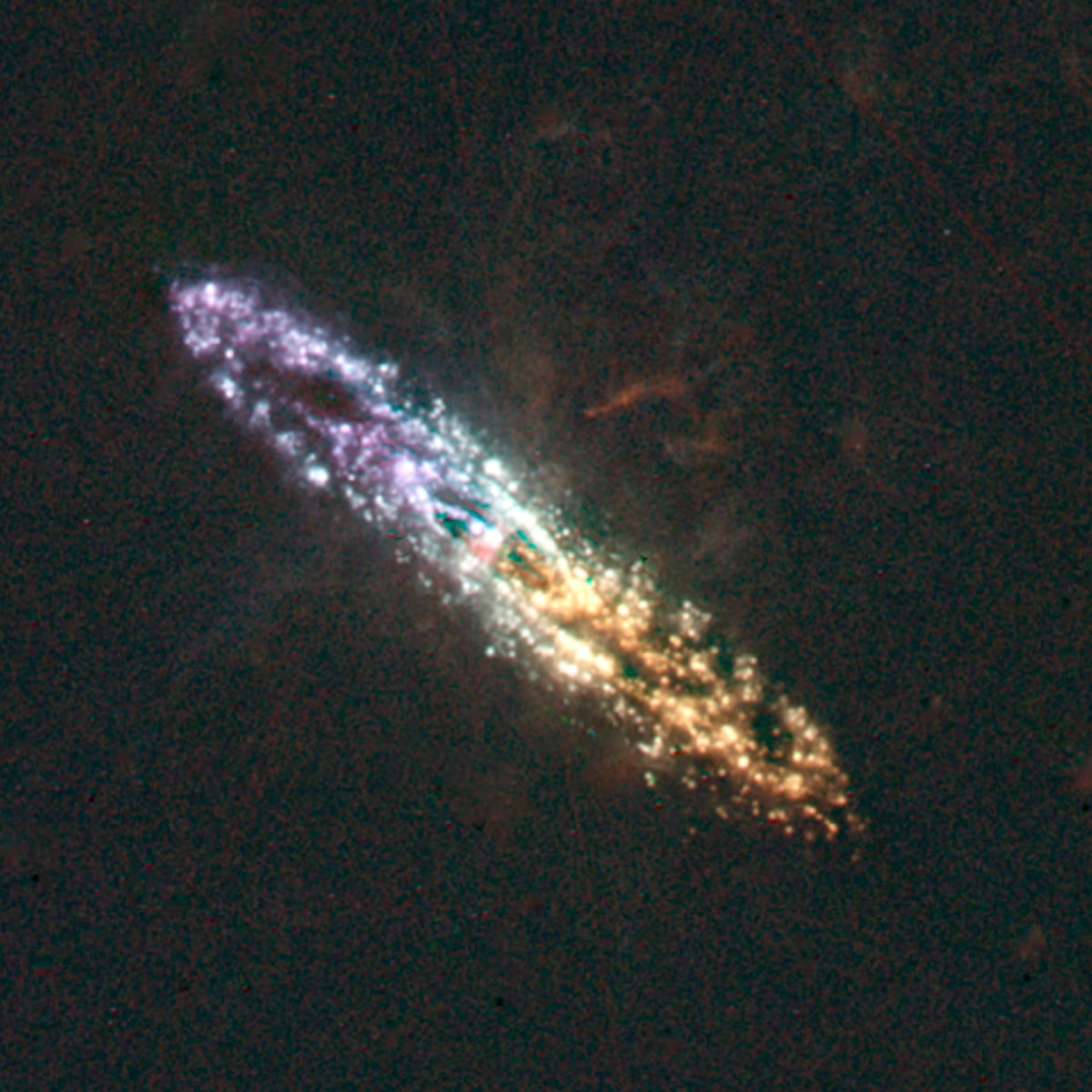
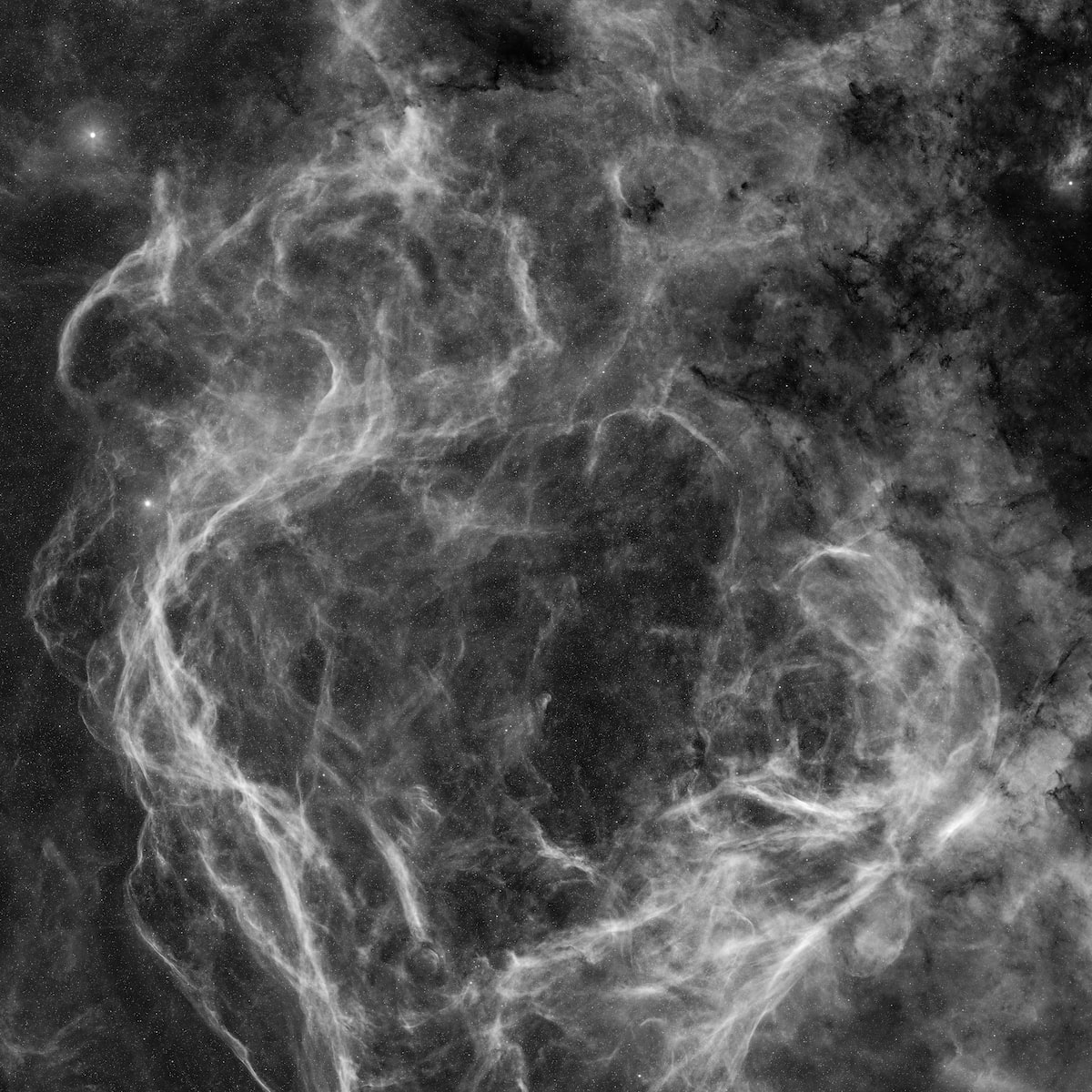

This illustration outlines how light is distributed in the universe on a very, very large scale: In filaments. It's a close approximation for what MOTHRA is looking for.The Virgo Consortium / Max Planck Institute for Astrophysics
This and other hurdles have now been surmounted. The project is funded by a donation from Alex Gerko, the Britain-based financial entrepreneur and founder of XTX Markets. Unlike traditional public-funded science, MOTHRA operates as a “focused research organization.” It is a not-for-profit entity based on a tech startup model, meant to implement a particular approach to a scientific question.
Although the project’s budget is not public, the cost of the array is in the tens of millions of dollars, the researchers said.
The payoff is a direct test of astronomers’ understanding of how the universe is put together at large scales.
A key part of the picture is dark matter, an unknown substance that makes up most of the mass in the universe, and which forms the bulk of the cosmic web. If MOTHRA can pick up the faint light of gas associated with the web, it will provide a ready-made marker for where dark matter lies.
“Detecting this gas directly by its emission would be a major observational breakthrough, and it would provide a wonderful confirmation that our current understanding about the spatial distribution of matter in the universe is on the right track,” said Julio Navarro, a cosmologist and professor at the University of Victoria, who is not a member of the project.
At a more fundamental level, Dr. Abraham said that whenever astronomers come up with a new way of looking at the cosmos, “there are always tons of surprises.”
Dr. Lokhorst, said the facility in Chile is now one-third complete and could be operating at its full capacity by the end of this year.
If the cosmic web can be seen, she said, “we have the best shot out there of actually detecting it.”

Space is the place: More from Ivan Semeniuk
To probe the cosmos, radio dishes take root in B.C.’s Okanagan Valley
Is there other life out there? NASA’s Pandora looks for answers
UBC researchers delve into deep space to study galaxy formation