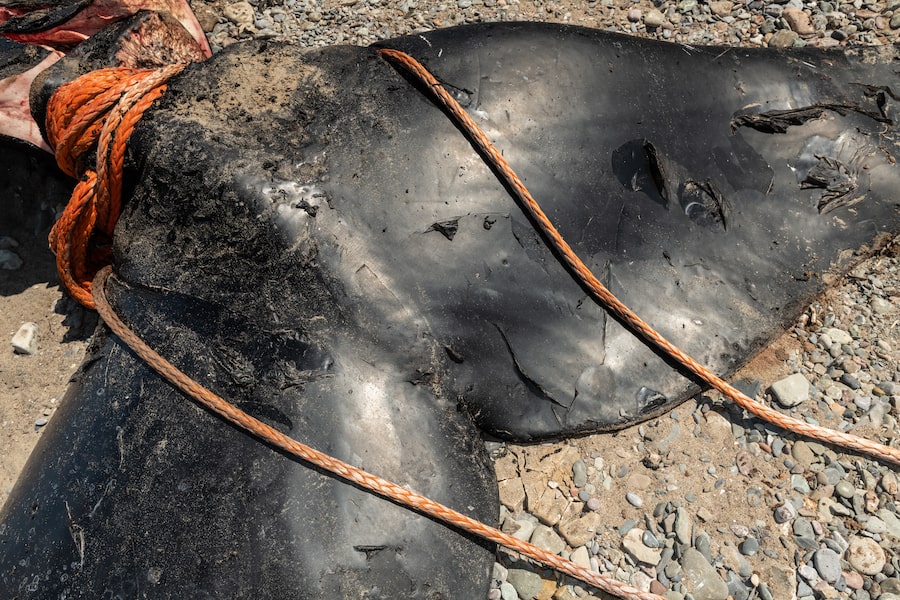
With a population of 372, North Atlantic right whales are critically endangered. Although whaling is no longer a threat, human interactions still pose the greatest risks to the species. Recovering this population requires measures to mitigate fishing-gear entanglements, vessel strikes, ocean noise pollution and climate change. Success hinges on co-ordinated actions across the Canada-U.S. border.
Here’s a high-level timeline of critical policy and management measures taken by both countries, over the past century, along with the continuing challenges and achievements in protecting the species.
The Globe and Mail will continue to update this timeline for the duration of the Entangled series.


1931-37
The League of Nations, the precursor to the United Nations, signs two treaties (the 1931 Convention for the Regulation of Whaling, ratified in 1935, and the 1937 International Agreement for the Regulation of Whaling), which provide the legal framework for the future regulation of commercial hunting of whales, including North Atlantic right whales.
1946
To further manage dwindling whale populations, Canada and the U.S. are among the countries that create the International Convention for the Regulation of Whaling, leading to the development of the International Whaling Commission, (IWC) the central body of the Convention that still exists today.
1971-73
U.S. and Canadian governments ban commercial whaling in 1971 and 1972, respectively. North Atlantic right whales are protected under the Marine Mammal Protection Act (MMPA, 1972) and the Endangered Species Act (ESA, 1973) in the U.S.
1982-86
The IWC introduces a ban on commercial whaling in 1982 and Canada leaves the commission that same year, largely driven by its disagreement with the proposed moratorium. The ban takes effect in 1986.
1990
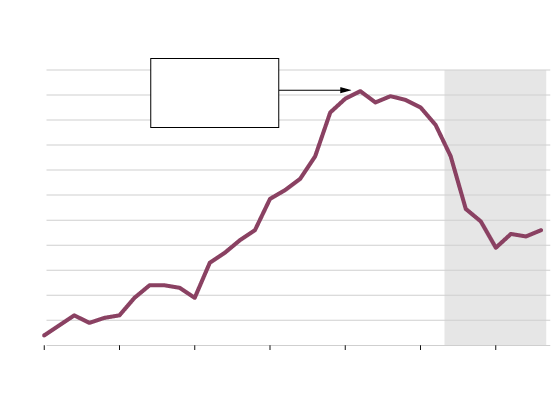
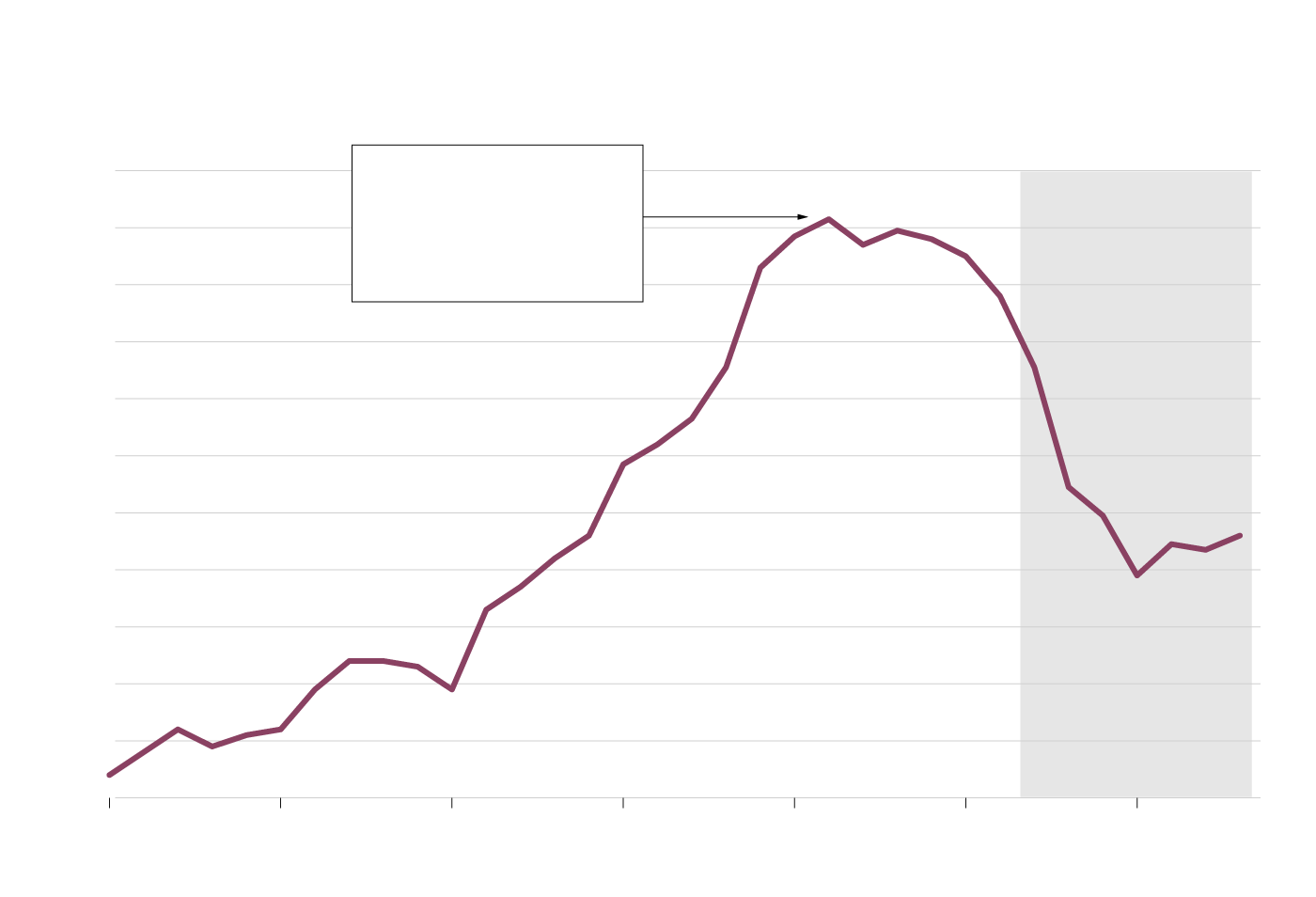
The National Oceanic and Atmospheric Administration (NOAA) National Marine Fisheries Service (NMFS) initiates annual population estimates of the North Atlantic right whale, recording the population that year at 288.
Endangered North Atlantic right whale population
Number, 1990-2023
500
Population was
10 times this peak
500 years ago
480
UME*
period
460
440
420
400
380
360
340
320
300
280
1990
1995
2000
2005
2010
2015
2020
*Unusual Mortality Event

Endangered North Atlantic right whale population
Number, 1990-2023
500
Population was
10 times this peak
500 years ago
480
UME*
period
460
440
420
400
380
360
340
320
300
280
1990
1995
2000
2005
2010
2015
2020
*Unusual Mortality Event
Endangered North Atlantic right whale population
Number, 1990-2023
500
Population was
10 times this peak
500 years ago
480
UME*
period
460
440
420
400
380
360
340
320
300
280
1990
1995
2000
2005
2010
2015
2020
*Unusual Mortality Event
1993
Canada adds Marine Mammal Regulations to the Fisheries Act and designates two right whale conservation areas: the Bay of Fundy (Grand Manan Basin) and Roseway Basin. It will be two more decades before these are formally designated as critical habitats.
1994
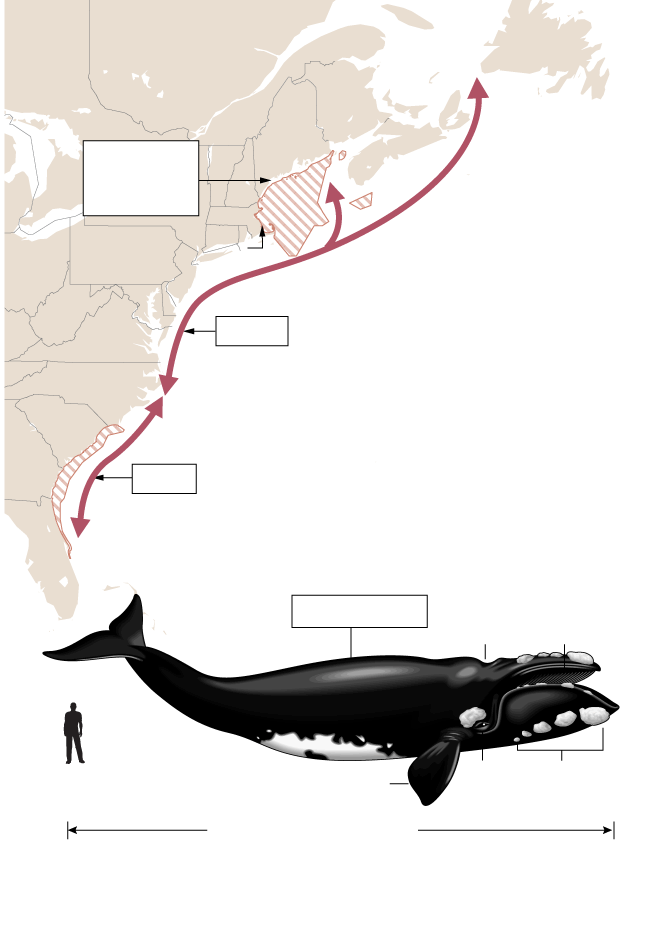
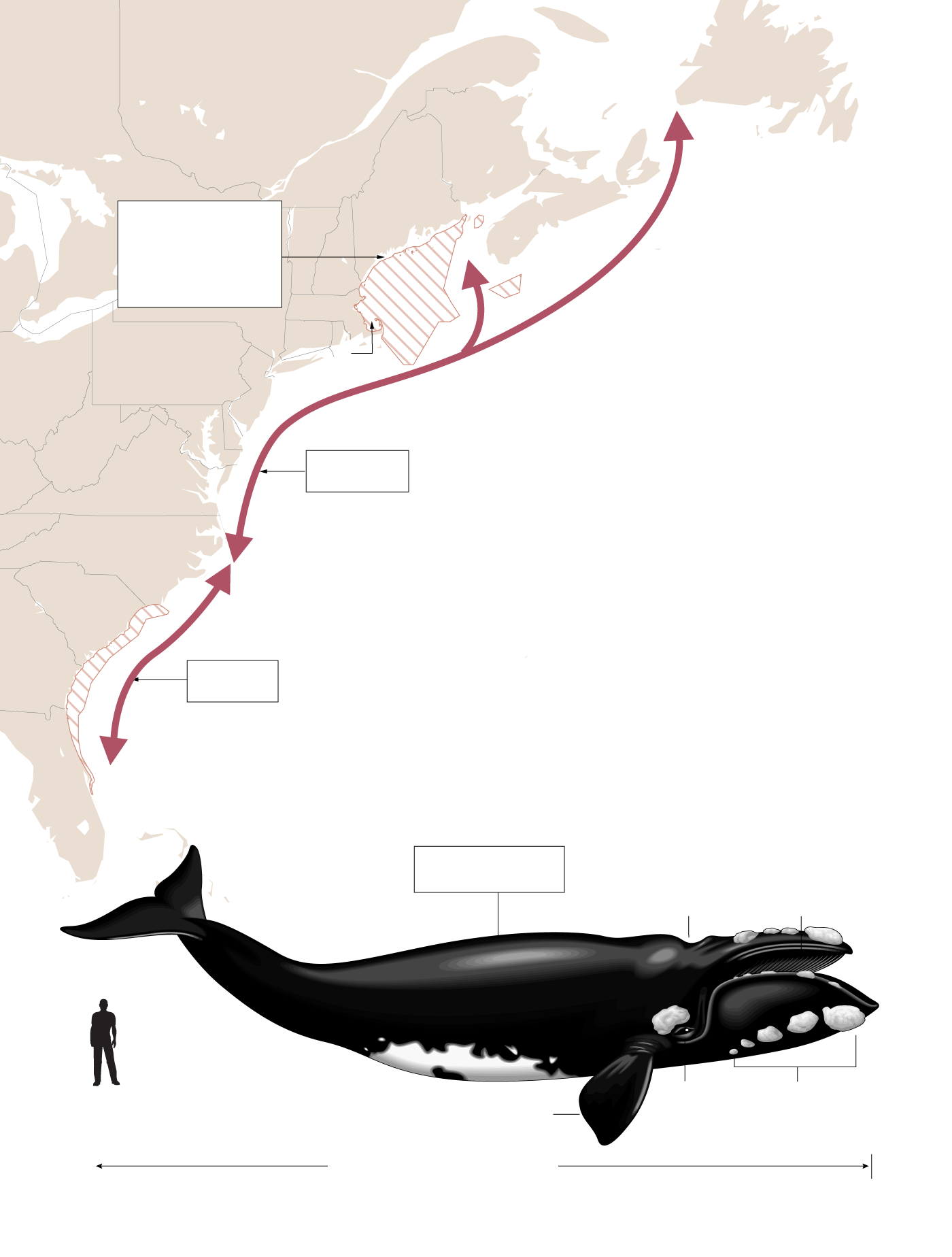
The U.S. designates critical habitats, including portions of Cape Cod Bay and the Great South Channel off Chatham, Mass., as well as an area off Florida and Georgia. Two decades later, this is expanded to two areas – off the coast of New England as a foraging area, and along the southeast U.S. coast from Cape Fear, N.C., to below Cape Canaveral, Fla., as a calving area.

Gulf of
St. Lawrence
Que.
CANADA
PEI
N.B.
Maine
N.S.
Right whale
critical habitat
area
Mass.
North Atlantic
right whale
Cape Cod
Bay
Penn.
UNITED
STATES
Eubalaena glacialis
Lifespan: Unknown;
likely >70 years, but
rarely >45 years due
to human activity
Foraging
Va.
N.C.
Atlantic
Ocean
Diet: Zooplankton (copepods)
S.C.
Weight: Up to 70,000 kg
Ga.
Calving
Range: U.S.-Canada Eastern
seaboard; occasionally
elsewhere in the
North Atlantic
Fla.
Broad, black
smooth-
edged fluke
No dorsal fin
Baleen
Blowhole
1.75m
Eye
Callosities
(cornified skin)
Pectoral flipper
Length: Up to 16 metres
Gulf of
St. Lawrence
Que.
CANADA
PEI
N.B.
Maine
N.S.
Right whale
critical habitat
area
Mass.
Cape Cod
Bay
North Atlantic
right whale
Penn.
UNITED
STATES
Eubalaena glacialis
Foraging
Lifespan: Unknown;
likely >70 years, but
rarely >45 years due
to human activity
Va.
N.C.
Atlantic
Ocean
S.C.
Diet: Zooplankton (copepods)
Ga.
Weight: Up toi 70,000 kg
Calving
Range: U.S.-Canada Eastern
seaboard; occasionally
elsewhere in the
North Atlantic
Fla.
Broad, black
smooth-
edged fluke
No dorsal fin
Baleen
Blowhole
1.75m
Eye
Callosities
(cornified skin)
Pectoral flipper
Length: Up to 16 metres
Gulf of
St. Lawrence
Que.
CANADA
PEI
N.B.
Maine
N.S.
Right whale
critical habitat
area
Mass.
Cape Cod
Bay
North Atlantic
right whale
Penn.
UNITED
STATES
Eubalaena glacialis
Foraging
Lifespan: Unknown;
likely >70 years, but
rarely >45 years due
to human activity
Va.
N.C.
Atlantic
Ocean
Diet: Zooplankton (copepods)
S.C.
Weight: Up to 70,000 kg
Ga.
Calving
Range: U.S.-Canada Eastern
seaboard; occasionally
elsewhere in the
North Atlantic
Fla.
Broad, black
smooth-
edged fluke
No dorsal fin
Blowhole
Baleen
1.75m
Eye
Callosities
(cornified skin)
Pectoral flipper
Length: Up to 16 metres
1997
The NMFS publishes the Atlantic Large Whale Take Reduction Plan (ALWTRP) to reduce serious injury and mortality of large whale species in commercial gillnet and trap/pot fisheries.
2000
Canada publishes a recovery plan, while the U.S. implements measures to reduce fishing-gear entanglements such as “weak links,” so whales can break free of buoy endlines, and gear marking to improve understanding of how and where whales become entangled.
2003
Canada moves shipping lanes in the Bay of Fundy – marking a first in International Maritime Organization (IMO) history to protect a marine mammal species.
2005
Canada designates North Atlantic right whales under the Species at Risk Act (SARA).
2005
The U.S. finalizes recovery plans for each of North Atlantic and North Pacific right whales (Eubalaena glacialis and Eubalaena japonica, respectively), which will be recognized as separate species along with a third species, the Southern right whale (Eubalaena australis in the southern hemisphere), under the ESA between 2006-2008.
2006
In the U.S., areas where right whales aggregate are closed to fixed-gear fisheries, and sinking lines begin to replace floating lines on the ocean floor, removing thousands of miles of entangling lines from the water column. Additionally, the U.S. implements vessel-speed rule regulations, while moving and narrowing shipping lanes in the Gulf of Maine to further mitigate vessel collisions.
2006-08
Canada initiates a Right Whale/Lobster Fishery Mitigation Strategy around Grand Manan and implements the Roseway Basin as an area to be avoided for vessels, a measure sanctioned by the IMO.
2010-12
Given the upward population trend (the population peaks in 2011 with 483 whales), scientists increase the Potential Biological Removal (the number of whales that can be removed, while allowing the population to recover) from 0 to 0.9 in 2012. And yet, scientists begin to observe a shift in the whales’ movements, with fewer sightings observed, for example, in the Bay of Fundy.
2010-12
Marking a vital step in addressing ocean noise, the U.S. launches CetSound (Cetacean and Sound Mapping) to evaluate the impacts of human-made noise on whales, dolphins and porpoises.

Seafood-plant workers in St. George, Maine, process lobster in 2014. That decade, and the current one, brought new litigation between lobster-fishing organizations and government agencies regulating the fisheries.Robert F. Bukaty/The Associated Press
2014
The NMFS issues a biological opinion for the American lobster fishery, which becomes a focal point in the legal case Center for Biological Diversity v. Ross. The plaintiffs file their suit in 2018, and a ruling in 2020 determines that NMFS violated the ESA and MMPA, necessitating the issuance of a new biological opinion and a proposed rule to amend the ALWTRP.
2014
Canada publishes an updated SARA recovery strategy, identifying critical habitats.
2015-16
Scientists observe worrying signals that the North Atlantic right whale population is in fact on a downward trend, with births lagging deaths, as whales continue to shift habitats faster than scientists can track and policies can protect them.
2015-16
The U.S. MMPA import rule provisions (2016) requires over 130 nations, including Canada, to reduce marine mammal bycatch in commercial fishing. The U.S. also expands its right whale critical habitat (2016), implements the Massachusetts Restricted Area (MRA) for trap/fixed fishing gear through federal action under the ALWTRP (2015), and releases an Ocean Noise Strategy Roadmap (2015).
2016
Canada publishes its SARA action plan (revised in 2020).
2017
Seventeen North Atlantic right whales are recorded dead. Most are documented in Canada, including half in the Gulf of St. Lawrence, where fishing and shipping regulations were not in place. The event triggers NMFS to declare an “Unusual Mortality Event,” or UME, signalling increased risk of extinction.
2017-18
Canada’s Department of Fisheries and Oceans (DFO) closes areas of the Gulf of St. Lawrence to snow crab fishing and Transport Canada implements vessel-speed regulations, first voluntary and later mandatory.
2017-18
Canada ramps up reporting requirements for lost gear (unique to Canada as there’s no U.S. equivalent) as well as marine mammal interactions, marine mammal response support and whale detection, and launches a dedicated research program.
2017-18
The U.S. announces a five-year exemption period for nations to comply with the MMPA Import Provisions Rule.

2019-20
The U.S. launches the Right Whale Slow Zones campaign, while Canada updates its SARA action plan, expands fishery area closures, and enhances surveillance and lost gear retrieval measures.
2019-20
Both countries begin testing “on-demand” or ropeless fishing gear – which uses acoustic devices, rather than ropes and lines, to retrieve gear from the bottom of the ocean. This technology has been years in the making, beginning in 1998, while acoustic devices to retrieve bottom-fishing gear was being considered as early as 1979.
2019-20
Canada also establishes the Ghost Gear Fund and action plan, removing hundreds of kilometres of rope in Atlantic Canada. Additionally, Canada initiates work on an Ocean Noise Strategy.
2019-20
Canada and the U.S. begin annual bilateral meetings. However, despite these policy and management efforts, 2019 becomes the deadliest year on record since the UME began.
2021
The U.S. department releases its updated biological opinion, outlining its response to Center for Biological Diversity vs. Ross. However, new legal cases emerge that seek to either obstruct or expedite progress on right whale recovery measures, for example, Maine Lobstermen’s Association, Inc. v. NMFS and Oceana’s Submission on Enforcement Matters against the U.S. government under the United States-Mexico-Canada Agreement (USMCA).
2021
NOAA releases its most comprehensive plan to date, the 2021-2025 Priority Action Plan, as part of its Species in the Spotlight initiative. The plan outlines strategies for marine conservation aimed at stabilizing the population of this species.
2021
Canada announces its Whalesafe Gear Adoption Fund and implements a Lost Fishing Gear Reporting system.
2022
The U.S. proposes vessel-speed rule changes and implements an emergency rule to seasonally close the “Wedge,” an open area in federal waters adjacent to the MRA, to trap/pot fishing gear. While the U.S. also enacts its MMPA import rule provisions, the country extends the exemption period to Dec. 31, 2025.
2022
Canada publicly releases its lost fishing gear reporting data, marking the first time a country makes this information publicly available.
2023-24
The U.S. extends the emergency closure for the Wedge (2023) to permanently include it as part of the MRA boundaries, but those actions are halted by a District Court ruling (2024).
2023-24
NOAA releases a new analytical tool to show how the population would change over 100 years if threats, including entanglements and ship strikes, are mitigated.
2023-24
Both countries receive tranches of funding to support right whale protections. In the U.S., US$82-million is to be allocated to NOAA between 2023 and 2026 from the Inflation Reduction Act (IRA) on top of existing budgets. In Canada, the Whales Initiative 2.0 includes $151.9-million in the federal government’s 2023 budget over the same period, but these funds are not exclusive to right whales.
2023-24
Canada drafts a Whalesafe Gear Strategy and an Ocean Noise Strategy.

Donald Trump's return to the U.S. presidency brought massive cutbacks to environmental regulation and agencies such as NOAA, whose campus in Boulder, Colo., attracted hundreds of protesters to this March rally against the administration.Helen H. Richardson/The Denver Post via AP
2025
In the U.S., NMFS withdraws its proposed vessel-speed rule changes just before the Trump administration takes office. President Donald Trump issues an executive order pausing the disbursement of funds appropriated through the IRA. Another executive order disbands NOAA’s expert advisory committees, including the Marine Fisheries Advisory Committee, established in 1971, which evaluated processes for the ESA and MMPA. The U.S. Department of Government Efficiency begins laying off hundreds of NOAA staff.
2025
The U.S. Appeals Court reverses its decision, restoring the seasonal closure of the Wedge in the boundaries of the MRA going forward. And NOAA releases its Greater Atlantic Region On-Demand Gear Guide outlining next steps for fishers.
2025
Canada is expected to publish its Whalesafe Gear Strategy this summer and a final strategy and federal action plan for its Ocean Noise Strategy later this year.
2026
The U.S. MMPA Import Provision Rule is expected to be fully implemented, applying the MMPA’s bycatch standards to all seafood imports.
The country is also expected to evaluate its of the Ocean Noise Strategy.
This reporting was produced for The Globe and Mail’s Entangled series in partnership with the Pulitzer Center’s Ocean Reporting Network.Here are more instalments from the series.
Shifts in habitat make North Atlantic right whales harder to track – and to save from extinction
Can motherhood help North Atlantic right whales to rise again?