
Scientists prepare to deploy a spherical sensor module in the Mediterranean Sea as part of the KM3NeT neutrino detection experiment. When completed, the experiment will consist of more than 2000 such light-detecting modules.Paschal Coyle/Reuters
It was the biggest shot with the smallest ammunition.
Somewhere far beyond our galaxy, something endowed a single neutrino – a tiny subatomic particle – with 10,000 times the energy achievable in the most powerful particle accelerator on Earth. After crossing millions of light years of intergalactic space, the neutrino smacked into our planet, jettisoned a second particle and rang one the world’s largest experiments like a carnival strongman wielding a sledgehammer.
Now, physicists are very excited.
“We’ve detected by far the most energetic neutrino ever detected up to now,” said Paschal Coyle, a senior researcher at the Marseille Centre for Particle Physics. “Its energy is such that it’s in a completely unexplored region.”
The unexpected discovery, reported Wednesday in the journal Nature, was made with KM3NeT, an underwater neutrino detection experiment located near Toulon, France. The experiment consists of long strings of sensitive light detectors that are anchored to the floor of the Mediterranean Sea. When high energy particles pass through and interact with atoms in seawater, they emit telltale flashes that can be detected and used to reconstruct the incoming direction and energy of the particle.

Side swipe
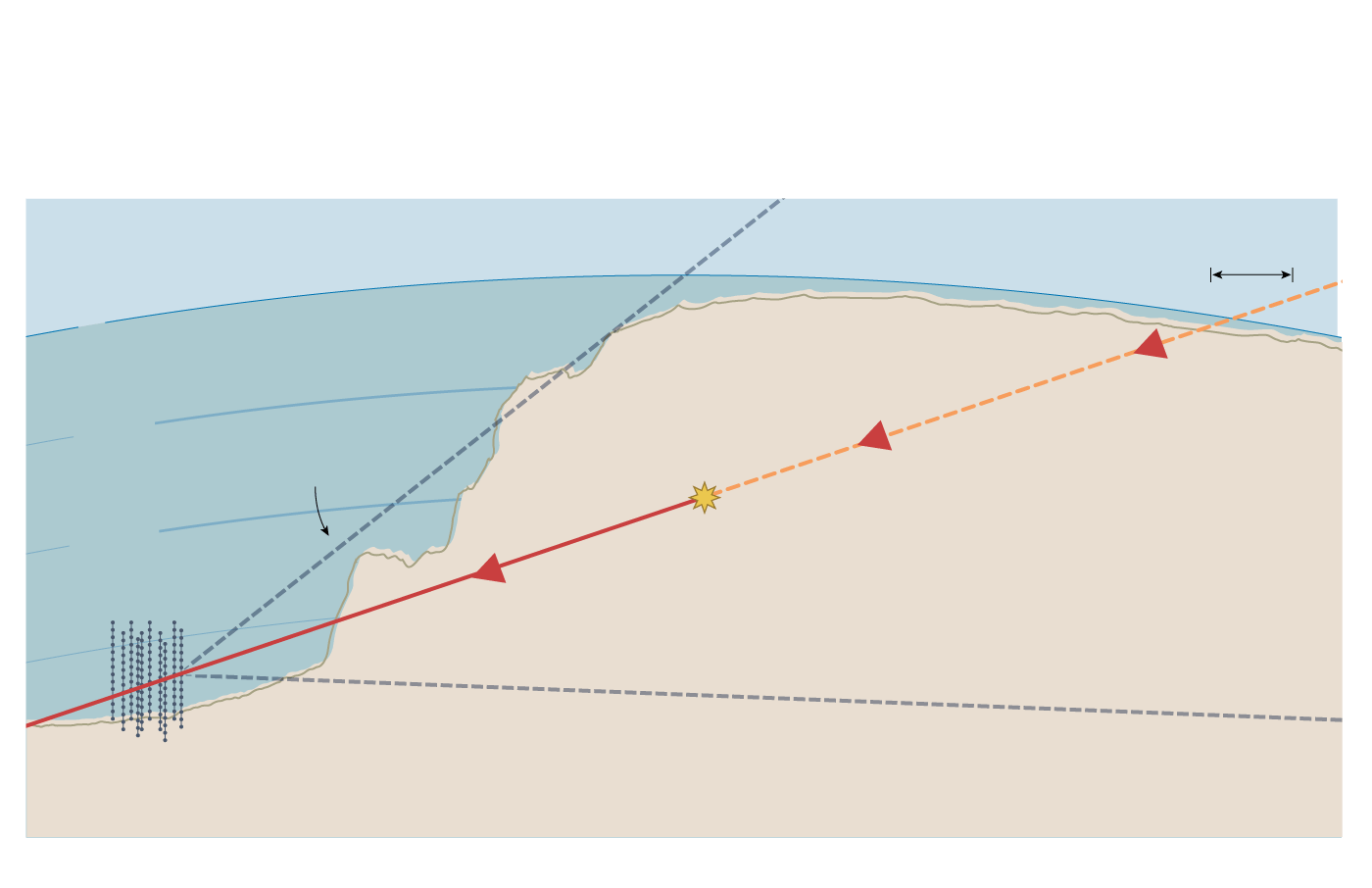
Researchers say a sideways moving muon detected by the KM3NeT experiment was almost certainly produced by an ultra-high-energy neutrino that passed through a portion of the Earth's crust before colliding with an atom there. The one cubic kilometre size experiment, made up of light sensors anchored deep in the Mediterranean Sea, recorded the flash that marked the muon's passage.
Depth (metres)
10 km
0
Med. Sea
Error
range
1,000
Neutrino
path
Collision
(precise
location
unknown)
2,000
Path of
detected
particle
KM3NeT
telescope
the globe and mail, Source: nature

Side swipe
Researchers say a sideways moving muon detected by the KM3NeT experiment was almost certainly produced by an ultra-high-energy neutrino that passed through a portion of the Earth's crust before colliding with an atom there. The one cubic kilometre size experiment, made up of light sensors anchored deep in the Mediterranean Sea, recorded the flash that marked the muon's passage.
Depth (metres)
10 km
0
Med. Sea
Error
range
1,000
Neutrino
path
Collision
(precise
location
unknown)
2,000
Path of
detected
particle
KM3NeT
telescope
the globe and mail, Source: nature
Side swipe
Researchers say a sideways moving muon detected by the KM3NeT experiment was almost certainly produced by an ultra-high-energy neutrino that passed through a portion of the Earth's crust before colliding with an atom there. The one cubic kilometre size experiment, made up of light sensors anchored deep in the Mediterranean Sea, recorded the flash that marked the muon's passage.
Depth (metres)
10 km
0
Med. Sea
Error
range
1,000
Neutrino
path
Collision
(precise
location
unknown)
2,000
Path of
detected
particle
KM3NeT
telescope
the globe and mail, Source: nature
The new report concerns a detection that was made nearly two years ago, when KM3NeT was still early in its installation phase and only 10 per cent of its detectors were operating. Despite this, the experiment provided an energy measurement of a particle that passed through the detector array which far exceeds anything previously recorded by any neutrino experiment.
At a news conference this week, researchers with the experiment said they have worked to eliminate all possible explanations that might indicate a technical glitch. They conclude the event was real, raising the possibility that a new window has been opened into the most extreme phenomena that the laws of physics allow.
“This is part of trying to understand the highest energy processes in the universe,” said Aart Heijboer, a KM3NeT collaboration member and physicist at the University of Amsterdam.
Neutrinos are the lightest units of matter currently known and also among the least likely to interact with other particles. At any given moment, we are showered by neutrinos produced through nuclear reactions in the sun’s core, which stream through our bodies and pass straight through the Earth with virtually no interference from the solid matter they encounter.
In the standard units of particle physics, most solar neutrinos are known to carry less than half a million electron Volts worth of energy. In contrast, researchers estimate the record-breaking detection made by KM3NeT was the result of a 120 quadrillion electron Volt particle.
The neutrino was not detected directly. Instead, the experiment spotted another particle, called a muon, passing through with extraordinary energy. The muon’s sideways path suggested it emerged from the solid rock off the French coast before entering the detector.
It’s this trajectory that gives away the event’s origins. Since muons can’t travel far through rock, researchers instead surmise that the particle started as a neutrino that skimmed through the Earth’s crust and collided with an atom somewhere along the way. The muon, a byproduct of that collision, then rocketed through the experiment along the same trajectory, triggering its detectors.
When researchers traced the trajectory backward into space, it did not intersect any known sources of high energy particles in the Milky Way. This suggests it originated from a more distant source outside our own galaxy.
Exactly what that source is has yet to be determined. One possibility is that the neutrino was created when a more massive particle, called a ultrahigh-energy cosmic ray, interacted with a photon of light travelling through space since the Big Bang. Alternatively, the neutrino may have originated in a high-energy environment, such as in the vicinity of a supermassive black hole at the core of a distant galaxy.
“Within our uncertainties, we cannot distinguish between these two predictions,” Dr. Heijboer said.
Erica Caden, a research scientist who specializes in neutrino detection at the SNOLAB underground laboratory near Sudbury, Ont., said the detection is an exciting development for a field that operates at the frontiers of physics.
It means “we haven’t hit the end yet,” Dr. Caden said.
The result adds new impetus to experiments in development, including the Pacific Ocean Neutrino Experiment, a facility similar to KM3NeT that is taking shape off the coast of British Columbia and includes Canada as a partner.
“Neutrinos are one of the areas where we’re always surprised,” Dr. Caden said, “where we expect certain things to happen and then our detectors tell us otherwise.”