
Planet Earth is reflected on Firefly Aerospace's Blue Ghost spacecraft's solar panel in this handout image obtained by Reuters on March 2.Firefly Aerospace/Handout via REUTERS
Anyone who has ever looked at the full moon has seen Mare Crisium, the Sea of Crises.
To the eye it appears as an isolated patch at the upper right-hand side of the lunar disc – roughly the 2 o’clock position. In reality, it is a vast circular plain, several hundred kilometres across, where lava once flooded a giant impact basin approximately 3.9 billion years ago and hardened into smooth, dark rock.
The name has a poetic ring that must have appealed to science fiction writer Robert Heinlein. In his 1966 novel, The Moon is a Harsh Mistress, Mr. Heinlein chose Mare Crisium as the location of a penal colony whose inhabitants, called “loonies,” stage a revolution and declare independence from Earth.
Now Mare Crisium is about to be the setting for some real-life space history.
On Thursday night, that feature, along with the rest of the moon’s visible surface, will plunge into Earth’s shadow, turning the full moon’s silvery light into a dusky red.
But, in an unusual twist, as sky watchers on Earth look up to take in the total eclipse of the moon, a robotic spacecraft on Mare Crisium will be looking back.
The spacecraft, called Blue Ghost, was built by Texas-based Firefly Aerospace. Launched on Jan. 15, it made a remarkably crisis-free landing in Mare Crisium on March 2. Since then it has been busy operating 10 NASA science experiments and sending back data as fast as possible before the sun sets on the solar-powered lander on Sunday.
“It’s absolutely inspirational,” Brad Bailey, NASA’s assistant deputy associate director for space exploration, said while discussing the mission on Tuesday at a scientific meeting in Houston. As he spoke, his audience was treated to video of a pneumatic drill on Blue Ghost boring into the rock to measure its temperature.

TOTAL LUNAR ECLIPSE, MARCH 13–14
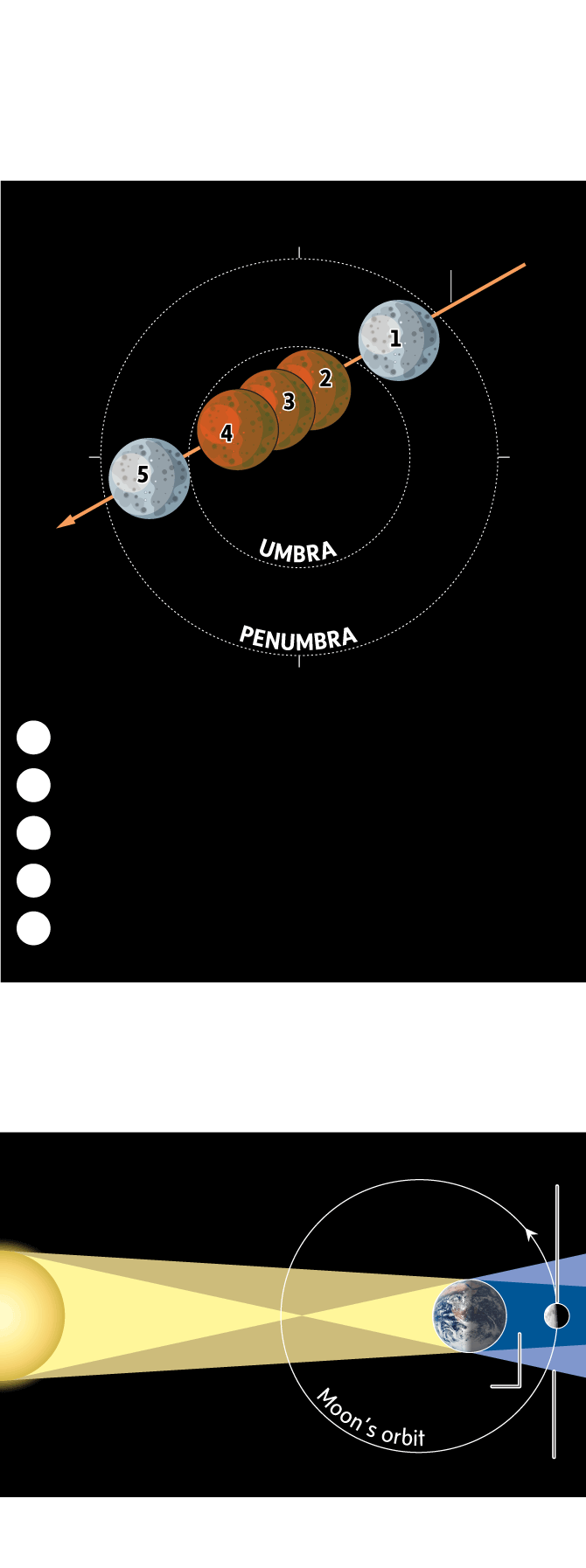
The eclipse will be visible anywhere in the world where the moon is in the sky. Watch for the moon to turn from white to orange once it is completely immersed in the umbra – the darkest part of Earth's shadow.
Moon’s
path
N
1
2
3
4
E
W
5
S
1
Partial eclipse begins:
1:09 a.m. ET / 10:09 p.m. PT
2
Total eclipse begins:
2:26 a.m. ET / 11:26 p.m. PT
3
Mid-eclipse:
2:59 a.m. ET / 11:59 p.m. PT
4
Total eclipse ends:
3:32 a.m. ET / 12:32 a.m. PT
5
Partial eclipse ends:
4:48 a.m. ET / 1:48 a.m. PT
TOTAL LUNAR ECLIPSE
Earth blocks sunlight usually reflected by moon, creating partial (penumbra) or total (umbra) shadow.
Moon
Sunlight
Sun
Earth
Umbra
Penumbra
Note: Not to scale
the globe and mail, sources: graphic news;
sky & telescope; NASa; The Old Farmer’s
Almanac
TOTAL LUNAR ECLIPSE, MARCH 13–14
The eclipse will be visible anywhere in the world where the moon is in the sky. Watch for the moon to turn from white to orange once it is completely immersed in the umbra – the darkest part of Earth's shadow.
Moon’s
path
N
1
2
3
4
E
W
5
S
1
Partial eclipse begins: 1:09 a.m. ET / 10:09 p.m. PT
2
Total eclipse begins: 2:26 a.m. ET / 11:26 p.m. PT
3
Mid-eclipse: 2:59 a.m. ET / 11:59 p.m. PT
4
Total eclipse ends: 3:32 a.m. ET / 12:32 a.m. PT
5
Partial eclipse ends: 4:48 a.m. ET / 1:48 a.m. PT
TOTAL LUNAR ECLIPSE
Earth blocks sunlight usually reflected by moon, creating partial (penumbra) or total (umbra) shadow.
Moon
Sunlight
Sun
Earth
Umbra
Penumbra
Note: Not to scale
the globe and mail, sources: graphic news;
sky & telescope; NASa; The Old Farmer’s Almanac

TOTAL LUNAR ECLIPSE, MARCH 13–14
The eclipse will be visible anywhere in the world where the moon is in the sky. Watch for the moon to turn from white to orange once it is completely immersed in the umbra – the darkest part of Earth's shadow.
N
Moon’s
path
Partial eclipse begins:
Eastern / Pacific time
1:09 a.m. / 10:09 p.m.
1
1
2
Total eclipse begins:
2:26 a.m. / 11:26 p.m.
2
3
4
3
Mid-eclipse:
2:59 a.m. / 11:59 p.m.
E
W
5
4
Total eclipse ends:
3:32 a.m. / 12:32 a.m.
Partial eclipse ends:
4:48 a.m. / 1:48 a.m.
5
S
TOTAL LUNAR ECLIPSE
Earth blocks sunlight usually reflected by moon, creating partial (penumbra) or total (umbra) shadow.
Sunlight
Sun
Earth
Moon
Umbra
Penumbra
Note: Not to scale
the globe and mail, sources: graphic news; sky & telescope; NASa; The Old Farmer’s Almanac
Unlike all previous attempts by private companies to set down on the moon’s surface, Blue Ghost landed fully upright with all of its systems functioning as designed. That has made it a significant milestone for NASA’s Commercial Lunar Payload Services initiative, which funds a number of companies that are developing landers and related hardware for commercial access to the moon.
“This is one example of the success we’ve had,” Dr. Bailey said.
The success extends to the Canadian companies that have supplied parts or are participants in the mission. Among them is NGC Aerospace Ltd. of Sherbrooke, which has built its reputation providing software for a series of European satellites that are designed to show spacecraft can be autonomous in the way they understand where they are and where they need to be.
“Based on that experience, we were able to develop software for global lunar navigation,” said Jean de Lafontaine, the company’s president and chief executive officer.
The system the company designed for Blue Ghost allows the spacecraft to understand exactly what part of the lunar surface it is looking at as it comes in to land. It accomplishes this feat by carrying a vast database of lunar craters stripped down to a few key characteristics and then using this as a reference manual to calculate location with 100 times the accuracy possible from ground-tracking stations.
The company is still awaiting the data that will tell it how well its software performed.
Meanwhile, as the mission heads into its final days, Blue Ghost will have a chance to add eclipse-watching to its résumé.
The first images sent back from the lander reveal a fun fact about Mare Crisium. Because it is located near the edge of the lunar disc as viewed from Earth, anyone standing on Mare Crisium will see Earth hanging just above the horizon in the black lunar sky. And because the same side of the moon always faces us, the Earth never shifts from its location as seen from Mare Crisium.
In other words, you could build your space cabin on Mare Crisium with an “Earth window” confident that the home planet will always be framed by it, no matter when you look.
With a lunar eclipse imminent, such a window would be worth watching.
Here on Earth, the action takes place late on Thursday night and into Friday morning, depending on time zone. The total portion of the lunar eclipse will last just over one hour starting at 2:26 a.m. ET/11:26 p.m. PT.
As such times, the moon is in near total darkness as it passes through the umbra – the deepest part of Earth’s shadow. At this time a small portion of the sun’s light is refracted by the atmosphere and directed toward the moon’s surface. Depending on atmospheric conditions at the time of the eclipse, the resulting colour on the moon’s face can range from a bright copper glow to a deep crimson.
For Blue Ghost, the view will be reversed. The lander will see the sun totally eclipsed by Earth. Assuming the spacecraft’s camera is functioning by then, it should see Earth’s atmosphere light up like a giant red ring in the sky.
The first time such a situation was possible, NASA’s Surveyor 3 spacecraft captured a grainy shot of an eclipse from the moon’s surface in April 1967. If Blue Ghost is successful at viewing this week’s eclipse, it will update this rare double view of a striking astronomical phenomenon and be the first private spacecraft to do so.
If the spacecraft is successful at viewing the eclipse, the event will finally put a picture to a phenomenon astronomers have so far only imagined.
Editor’s note: (March 12, 2025): This article was further updated with a clarification as an earlier version of this story did not include mention of the Surveyor 3 observation. An earlier version of this story incorrectly said the length of the total portion of the eclipse was just over 30 minutes. This version has been corrected.