The Globe's science reporter Ivan Semeniuk answers your questions about Artemis II.
Four astronauts, including Canadian Jeremy Hansen, are currently on a historic 10-day flight around the moon, and have broken the record for furthest distance that humans have ever travelled from Earth.
On April 7, science reporter Ivan Semeniuk answered reader questions about the Artemis II mission, what it hopes to accomplish, and the science behind this incredible feat. Readers asked about each astronaut’s role in the mission, how they’re staying healthy, and the future of moon travel. Here’s a transcript from the Q&A.
Artemis II mission offers a live view of planetary science in action
Could you start by telling us a little bit about your coverage of the Artemis II mission?
Ivan Semeniuk: Sure, in a sense the Globe’s coverage of this mission began back in 2018, even before Artemis was named. But when it was clear that the U.S. space program was kind of recommitting to sending astronauts back to the moon and it was looking for international partners to join on the venture. By 2020, Canada had negotiated a partnership and by then Artemis had a name and it had a more clear direction.
Canada became a partner at that point and as part of joining into the program was going to provide some hardware for a lunar station that is now no longer going to be built, or not right away. But in return, there would be a couple of flights for Canadian astronauts.
Jeremy Hansen was selected as an Artemis II astronaut in the spring of 2023. So it was by then that we were kind of following more closely the training regimen and the overall mission plan. And it really picked up, I would say, last year, even though the mission was getting delayed a little bit for technical and other reasons, we’ve been following pretty closely for the past year.

NASA's Artemis II mission lifts off from the Kennedy Space Center in Cape Canaveral on April 1.Joe Skipper/Reuters
You were at the Artemis II takeoff last week in the United States. Could you tell us a little bit about what that was like?
Semeniuk: It was incredibly tense. You know, this is the first time people have been on board for the launch of NASA’s SLS rocket. SLS stands for Space Launch System. There had been one previous launch, that’s Artemis I, in late 2022, basically launching with an empty capsule.
So now you’ve got four astronauts on board. Everyone knows that there’s a huge amount riding on this for the crew, for the mission, and also for the entire Artemis program, which has certainly had its challenges over the years and many, many delays. So some pressure to get this mission and the program going. All of that is in the background. And of course, there’s always this sense like, is the rocket really going to go?
Suddenly on the day of, the weather was looking mostly favourable. The sky was turning blue, and the countdown picked up and it was on and there was this sense almost of being at the top of a roller coaster and about to plunge down the hill. The speed at which things were unfolding suddenly became very fast.
As the clock ticked down, no delay, no pause, all systems go. It was quite remarkable. And suddenly, you could see the propellant billowing from the bottom of the rocket. And you could see it start to rise from the launch tower. At that moment, you’re really just hoping for the very best. And then you see that flame. It is so incredibly bright as you watch this thing gradually pushing the stacked rocket into the sky.
And it took some time before the sound finally reached us. Then the sound was deafening. It was like a low rumble that you felt through your body. You just thought at one point it was just going to burst your eardrums. And then up and up and up it went.
And for three full minutes, we could just watch it disappearing into the blue. It kind of went up high, arced to the east, and then like just a fading spark disappearing off into the blue sky. It was a phenomenal sight.
What are the specific roles of each of the astronauts on the mission and what tasks or experiments will they perform during the mission?
Semeniuk: The primary function of this mission is to basically be the product testers for this Orion capsule – to put it through its paces to see how suitable it is for deep space flight. Deep space meaning going beyond low Earth orbit. So the environmental controls, all the life support systems, maneuvering and so on.
By the time they got to the moon, it really was a very egalitarian kind of situation because the stock for scientists was to have as many pairs of eyes on the moon’s surface as possible during the window at which they were closest to the moon. They kept looking out the window with cameras and with their eyes, making verbal descriptions, taking notes, going through a target list with their photos, on and off for basically six hours. So I would say for the most part we’ve seen the astronauts all doing different things, but everyone has something to do at all times, and it really has to do with how they get through that checklist.

The NASA Artemis II crew pose for a group photo inside the Orion spacecraft on April 6.NASA/Reuters
It is my understanding that one of the goals of the mission is to better understand the health impacts of deep space travel on the crew. How much can we extrapolate from a few days’ data and how relevant would that information be when planning for another long-term mission like going to Mars?
Semeniuk: It’s true that relative to long duration flights on the space station, where astronauts could be up in space for hundreds of days, this is only 10 days. So you might wonder how much exposure will really affect them. There is a big difference though.
Astronauts who go to the International Space Station are really only about 400 kilometres above Earth’s surface, so they’re in a very tight orbit around the Earth. They’re well ensconced within Earth’s magnetic field, so they’re largely protected from the kind of hard particle radiation that’s coming from the Sun through the solar wind. The Artemis astronauts, by going to the moon, are mostly outside of Earth’s magnetic field, so they’re getting a higher radiation dose in that period of time compared to astronauts on the space station, even though they’re only going to be weightless for about 10 days.
But the radiation, the weightlessness, all of those things do have effects. They can be measured and extrapolated forward as well. And of course, if there’s going to be a sense, as NASA has said, that they’re pivoting to the moon and wanting to increase the cadence of activities on the lunar surface, these are all important medical opportunities to get a sense of what they might expect when people are going to the moon and perhaps staying longer.
They’re also wearing these AVATAR chips, which I think is quite an interesting test. It’s basically some of their blood in a specially designed chip that kind of sustains their cells. And so those chips are getting exposed to radiation or whatever else is going on, just as their bodies are. When they come back to Earth, the chips will be tested, so will their bodies.
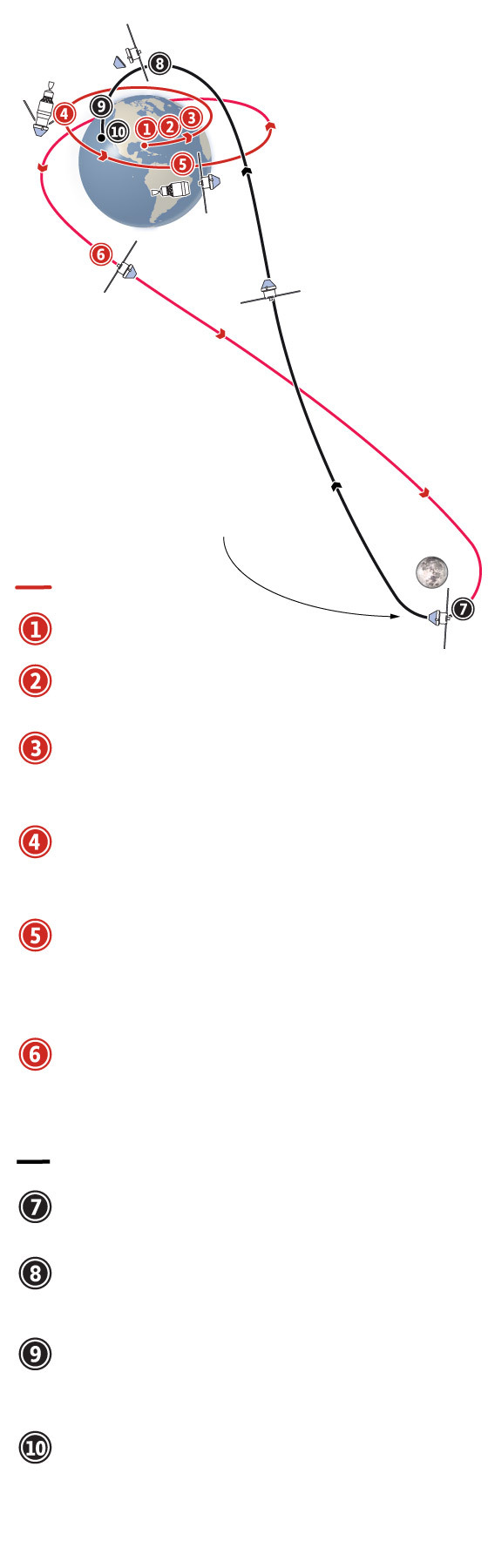
Artemis II
flight path
Orion will travel more than
400,000 km from Earth and
could set a new record for
the farthest humans have
ever gone into space
Moon
Outbound
Lift-off from Cape Canaveral
Two minutes after launch, boosters
separate followed by launch abort system
Eight minutes after launch ICPS and Orion
separate from Core stage. Orion’s solar
arrays unfurl
After 90-minute orbit, ICPS fires engines
to raise Orion to higher Earth orbit.
Crew begins multiple system checks
If everything is in order, Orion separates
from ICPS.Then, astronauts manually fly
Orion toward and away from ICPS, practising
proximity operations for future missions
Around 23 hours later, Orion Service Module
carries out Translunar Injection (TLI) burn –
sending Orion on a trajectory around
the moon
Inbound
After lunar flyby on Day 6, gravity draws
Orion back toward Earth
Just before re-entry, Orion’s crew module
separates from service module
Capsule re-enters atmosphere at speed of
32,187 km/h and temperatures of up to
2,200°C
Series of parachutes slow craft before
splashdown in Pacific Ocean
THE GLOBE AND MAIL, Sources: GRAPHIC NEWS;
NASA; ESA; Lockheed Martin

Artemis II
flight path
Orion will travel more than
400,000 km from Earth and
could set a new record for
the farthest humans have
ever gone into space
Moon
Outbound
Lift-off from Cape Canaveral
Two minutes after launch, boosters
separate followed by launch abort system
Eight minutes after launch ICPS and Orion
separate from Core stage. Orion’s solar
arrays unfurl
After 90-minute orbit, ICPS fires engines
to raise Orion to higher Earth orbit.
Crew begins multiple system checks
If everything is in order, Orion separates
from ICPS.Then, astronauts manually fly
Orion toward and away from ICPS, practising
proximity operations for future missions
Around 23 hours later, Orion Service Module
carries out Translunar Injection (TLI) burn –
sending Orion on a trajectory around
the moon
Inbound
After lunar flyby on Day 6, gravity draws
Orion back toward Earth
Just before re-entry, Orion’s crew module
separates from service module
Capsule re-enters atmosphere at speed of
32,187 km/h and temperatures of up to
2,200°C
Series of parachutes slow craft before
splashdown in Pacific Ocean
THE GLOBE AND MAIL, Sources: GRAPHIC NEWS;
NASA; ESA; Lockheed Martin
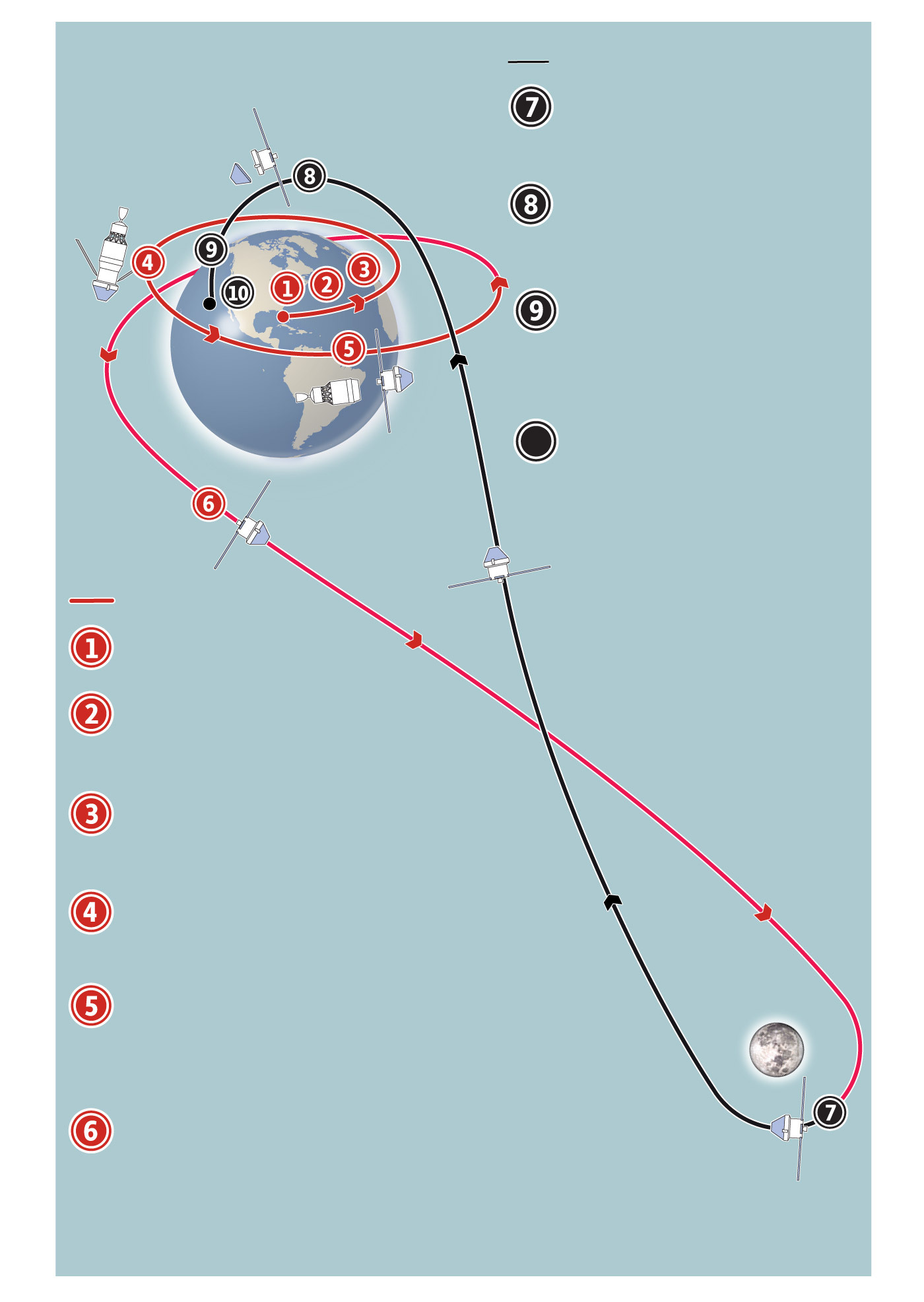
Artemis II flight path
Inbound
After lunar flyby on Day 6,
gravity draws Orion back
toward Earth
Just before re-entry, Orion’s
crew module separates from
service module
Capsule re-enters atmosph-
ere at speed of 32,187 km/h
and temperatures of up to
2,200°C
Series of parachutes slow
craft before splashdown in
Pacific Ocean
10
Outbound
Orion will travel more than
400,000 km from Earth and
could set a new record for
the farthest humans have
ever gone into space
Lift-off from
Cape Canaveral
Two minutes after launch,
boosters separate followed
by launch abort system
Eight minutes after launch,
ICPS and Orion separate from
Core stage. Orion’s solar arrays unfurl
After 90-minute orbit, ICPS fires engines
to raise Orion to higher Earth orbit.
Crew begins multiple system checks
Moon
If everything is in order, Orion separates
from ICPS.Then, astronauts manually fly
Orion toward and away from ICPS, practising
proximity operations for future missions
Around 23 hours later, Orion Service Module
carries out Translunar Injection (TLI) burn –
sending Orion on a trajectory around the moon
THE GLOBE AND MAIL, Sources: GRAPHIC NEWS; NASA; ESA; Lockheed Martin
The mission is using a slingshot effect to propel the craft using the Earth and the moon’s orbits. How does it work and have we tried it before?
Semeniuk: It was part of the Apollo program, but it’s not something that we heard a lot about in part because the point of Apollo was to get astronauts to the moon and land on the moon. So that’s not a free return trajectory because you’ve got all these different steps to get down to the moon’s surface and back up.
Since the Artemis II mission was not intended to land, and it also didn’t need to orbit the moon for some long period of time, the free return option was possible. And that meant for the minimum expenditure of fuel, they could just do that big looping figure eight, go out and come back. So it means you’re basically using almost all of your fuel burn at the beginning, you’re sending yourself off as though you’re kind of leaving Earth, but then as you get past the moon, the moon is bending your trajectory, bending it all the way around until the moon and the Earth together are kind of pulling you back.
When we see the moon from Earth, is it always the same side that we’re seeing? Is there a backside that we can never see?
Semeniuk: Absolutely. The moon kind of wobbles a little bit, but basically we only see half the moon. And we’re all familiar with that face that’s always there when the moon rises. And the moon is locked. It’s called spin orbit coupling, where the rotation of the moon is exactly locked to its orbit around Earth. So the only way to see the far side is to actually have a spacecraft on the other side and take pictures. So that was first done in 1959 by the Soviet Union – the spacecraft Luna 3 took the first pictures of the moon’s far side and there have been others since then.
Now that we’re getting these really high definition images of the other side of the moon from Artemis II, what’s your impression on what they’ve been finding so far?
Semeniuk: I think what we saw was exactly what scientists were hoping for, which is to execute a series of observations that are oriented to what the human eye can do. I mean, we know cameras are incredibly advanced now. Even the camera on your cell phone can do amazing stuff. But the human eye still sees things in a way that is different from even the best digital cameras. And in particular, human eyes are very good at detecting subtle differences in colour, hue and brightness. So a lot of what the astronauts were doing was paying attention to certain features and getting a sense of those subtle changes in brightness and hue, and partly because those differences are tied to geologic properties of materials on the surface.
The photos have been really striking. And let’s bear in mind that the great photos are still to come because even though they’re taking these pictures with digital cameras, the really high-res pictures are going to be downloaded once the spacecraft has returned.

This image provided by NASA shows a view of Earth taken by NASA astronaut and Artemis II Commander Reid Wiseman from of the Orion spacecraft's window after completing the translunar injection burn on April 2.NASA/The Associated Press
Even still, we’ve seen some beautiful pictures. There’s that picture of the full Earth that came, that was released just shortly after the burn that sent them to the moon. That was remarkable for a few reasons because you had to realize that, as they were leaving Earth, they were mostly leaving the night side of Earth.
So what they were seeing is not a sunlit daytime Earth, but actually the Earth illuminated by moonlight and a long exposure that could bring out those features. And it was amazing because when you looked at the continents, you know, you could sort of see the coast of Africa and of Spain. And also you can see near the South Pole the green glow of aurora, the Southern Lights. That was incredible.
The astronauts are still in space. They’re expected to land later this week. What are the next steps not only for this mission, but for what’s to come in the next few years?
Semeniuk: Well, the next steps for the mission are more testing of the capsule, especially of emergency procedures. There’ll be more communications with Earth, with family members and so on. And then things will get quite busy on the final day. Friday evening is when the crew is scheduled to re-enter through Earth’s atmosphere. Everyone’s going to have their fingers crossed, hoping that the heat shield holds up and everything goes smoothly. And then the capsule deploys parachutes and splashes down in the Pacific Ocean off the coast of California. Then that will be it for Artemis II.
But of course, now people are looking towards Artemis III. Originally it was supposed to be a moon landing. Now NASA’s kind of reconfigured its schedule. Artemis III is going to be a docking in low Earth orbit. This is where they’re going to test how the crew capsule can dock with a future lunar lander. And that mission is supposed to happen next year, although the crew has not yet been announced, nor has a launch date.
2028 at the moment is when we’re meant to see the first attempt to land on the moon for the first time since 1972. You know, it’s a very ambitious schedule. Basically, as soon as Artemis II is done, we’re going to see NASA turning its attention to these next steps, and it’ll be interesting to see how Canada might contribute as well.
Questions and answers have been edited for length and clarity.