Toward the end of his life, Norval Morrisseau travelled to Keewaywin First Nation in Northern Ontario to stay with his youngest son, Christian. The renowned Indigenous painter was suffering from Parkinson’s, and his relationship with his family had been strained for more than two decades. Morrisseau had squandered his money, never supporting his ex-wife or seven children.
His second-youngest child, Lisa, 57, remembers caring for him one last time with her siblings during that visit. “We cleaned him up and washed him. Washed his face in the bath. We all did it, wiping his hands, cleaning his fingernails, washing his face with a cloth and talking. I told him, ‘Dad, I’m sorry. I know you left us. I want to tell you that I forgive you for leaving,’” Lisa recalled. “You could tell he was feeling down. I saw a little tear and I said, ‘I forgive you. I love you, dad.’ He says, ‘I love you, too.’”

Norval Morrisseau circa 1978.The Estate of Norval Morrisseau/Supplied
It was the end of a long life that at turns saw Norval Morrisseau – who popularized the school of Woodland art in the 1960s – feted at international galleries as “the Picasso of the North” and living on the streets of Vancouver’s Downtown Eastside, selling drawings for a few dollars just to survive. Morrisseau’s artistic impact is hard to overstate. But so is the trauma and complexity of his life and legacy. And casting a shadow over it all is the world’s largest art fraud.
In 2023, police in Ontario made eight arrests and laid 40 charges in connection with three forgery rings they said were responsible for flooding the market with Morrisseau fakes over three decades. Officials estimate there were up to 6,000 dupes with an estimated $100-million in fraudulent sales. Among those caught up in the allegations were members of the artist’s family.
Morrisseau’s children have rarely commented on the frauds out of a desire for privacy and because cases have been before the courts. Lisa Morrisseau, a director of the Norval Morrisseau Estate Ltd., is one of four surviving siblings. In January at her home in Keewaywin, 600 kilometres northwest of Thunder Bay, she spoke publicly for the first time about the accusations against her and her siblings, her difficult upbringing and the struggles over her father’s estate with his caretakers.

Lisa is one of four surviving siblings. She says she only learned the extent of her father’s fame and fortune when she was approached by art dealers in the early 2000s.
“We’ve been talked about, my family. People saying we’re in art fraud and doing fake paintings, I even got accused of doing that, but I’ve never painted like that and put my dad’s name on it,” she said. “They don’t even know who we are.”
The frauds suppressed and diluted the market for Woodland art – characterized by vibrant colours and dark outlines – as rumours and innuendo swirled around galleries and collectors, as well as artists who practised the style. To date, more than 1,000 Morrisseau paintings have been removed from art galleries, auction houses, the Ontario legislature at Queen’s Park and private homes.
For the family, the ordeal has shaped their history and their future.
The picture that emerges when speaking with Lisa and others connected to the artist is one coloured by the multigenerational effects of the residential-school system, art market manipulation and cultural appropriation. The fallout of colonialism is splattered across the Morrisseau frauds.

Morrisseau’s painting Androgyny at Rideau Hall in Ottawa in 2008.Adrian Wyld/The Canadian Press
Norval Morrisseau was born in 1931 and raised by his maternal grandparents on the Sand Point Ojibwe reserve in Northern Ontario. His grandfather was a shaman, while his grandmother was a devout Catholic. When he was 6 he was taken to the St. Joseph’s Indian Residential School in what is now Thunder Bay, where he suffered physical and sexual abuse. He then went on to another school before returning home about four years later.
Throughout his childhood, Morrisseau was often drawing. Later in life, his huge canvases of animals and people – daring and bold, angry and erotic – revealed the inner workings of Indigenous heartbreak, spirituality and aspiration. For much of the past 40 years, the Woodland style has come to represent Canadian Indigenous art.
“It isn’t just that he painted some pretty pictures – he created a visual language that had never been seen before,” said Carmen Robertson, the Canada Research Chair in North American Indigenous Visual and Material Culture in the Faculty of Arts and Social Sciences at Carleton University. She is also the author of Morrisseau Project: 1955-1985, out next spring.
“He’s been so undervalued because of the colonial issues that he got caught up in, but otherwise his work stands as an important visual language in the history of Canadian art.”

Norval Morrisseau at the Pollock Gallery in Toronto with his wife, Harriet, and children in 1964.Erik Christensen/The Globe and Mail
In the late 1950s, Morrisseau married Harriet Kakegamic, who was from the Cree Sandy Lake reserve in Northern Ontario. By the time Lisa was born her father was already a success. His work, which caused a sensation when it came to prominence in 1962, was shown internationally and, at one time, went for upward of $300,000 at auction. But according to Lisa, her family saw little benefit from it.
Lisa, who spoke without a lawyer, has a shy but open demeanour. While her speech is often halting and mumbled, she didn’t hesitate to answer difficult questions over two days of discussions in her band office, her home and the cemetery where her parents and three siblings are buried.
She says her mother and her large family were loving but the household was unpredictable.
“I remember my dad dancing around in his native masks, he was all drunk and scaring me, yeah. I was crawling around,” Lisa recalled. “I remember hiding in the bush with my mom and little brother. But there’s good memories, too – when he was sober, holding me, bouncing me on his lap. And then he went away for a long time.”
In 1971, Morrisseau left his family. Some of the children went off to live with their maternal relatives while Christian and Lisa stayed with their mother. Lisa says the other siblings were taken to Poplar Hill Residential School.
“They got taken off the rez and forced to go as young as 5,” she said, adding that while her mother and an aunt spoke English, none of the other members of her family did.
In Oji-Cree, Keewaywin means “coming home,” and when Lisa and Christian moved there with their mother in 1985, her grandfather referred to their new home as the promised land.
“We lived down on the lake in little tents made out of plastic on wooden frames. On one side, Lake Niska was full of walleye and pickerel. And on the other, Sandy Lake had white fish and jackfish. We set our nets and fed everyone,” Lisa said. “We didn’t have generators, but one uncle had a big wooden stove and we helped each other. We lived off the land and survived.”
These days, Lisa and two of her older siblings, Victoria and Peter, who don’t want to comment publicly, live simply in Keewaywin, a dry, fly-in reserve with a population of less than 500 and a local economy as barren as the empty January streets. Eugene lives in Thunder Bay.
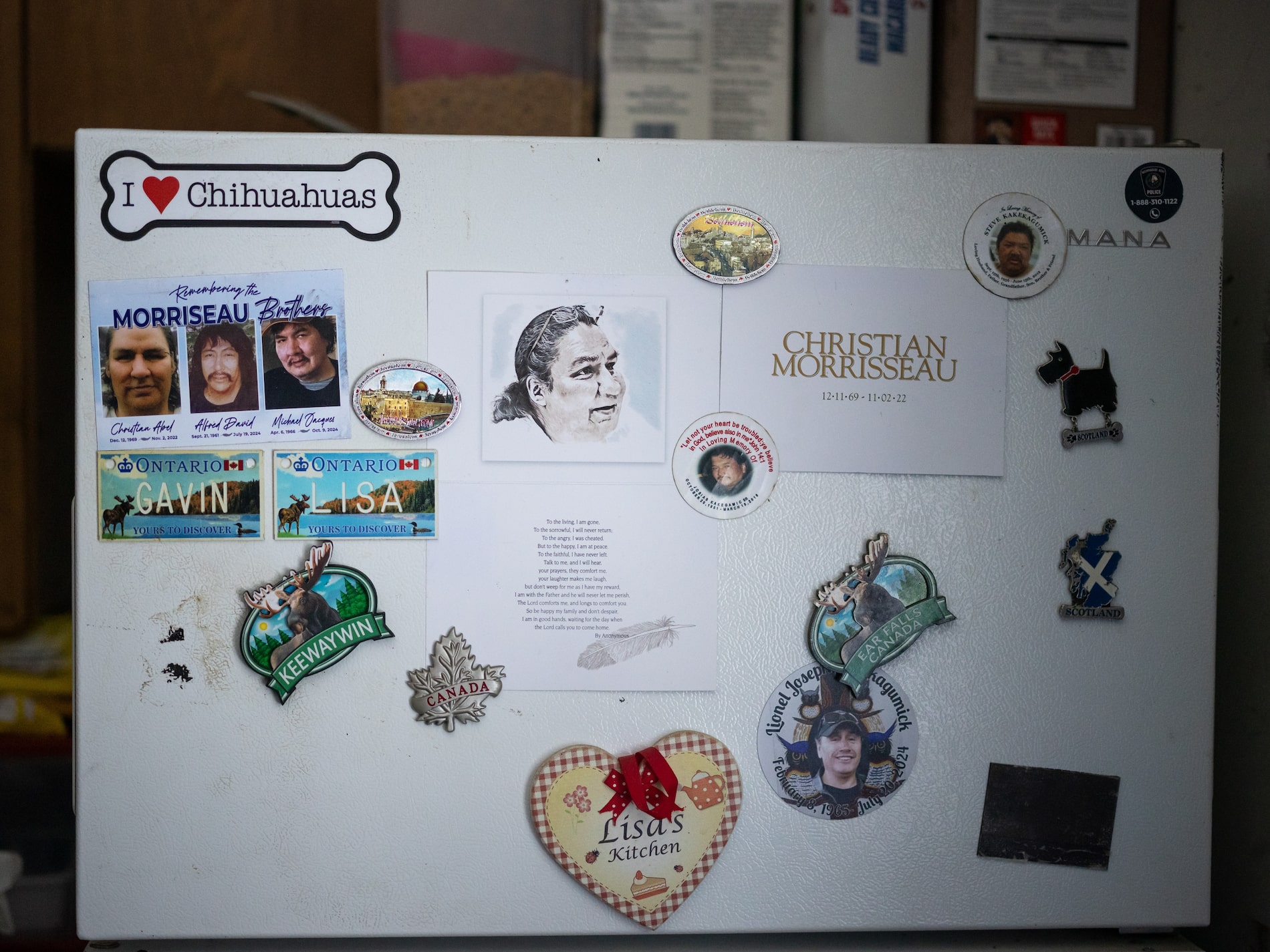
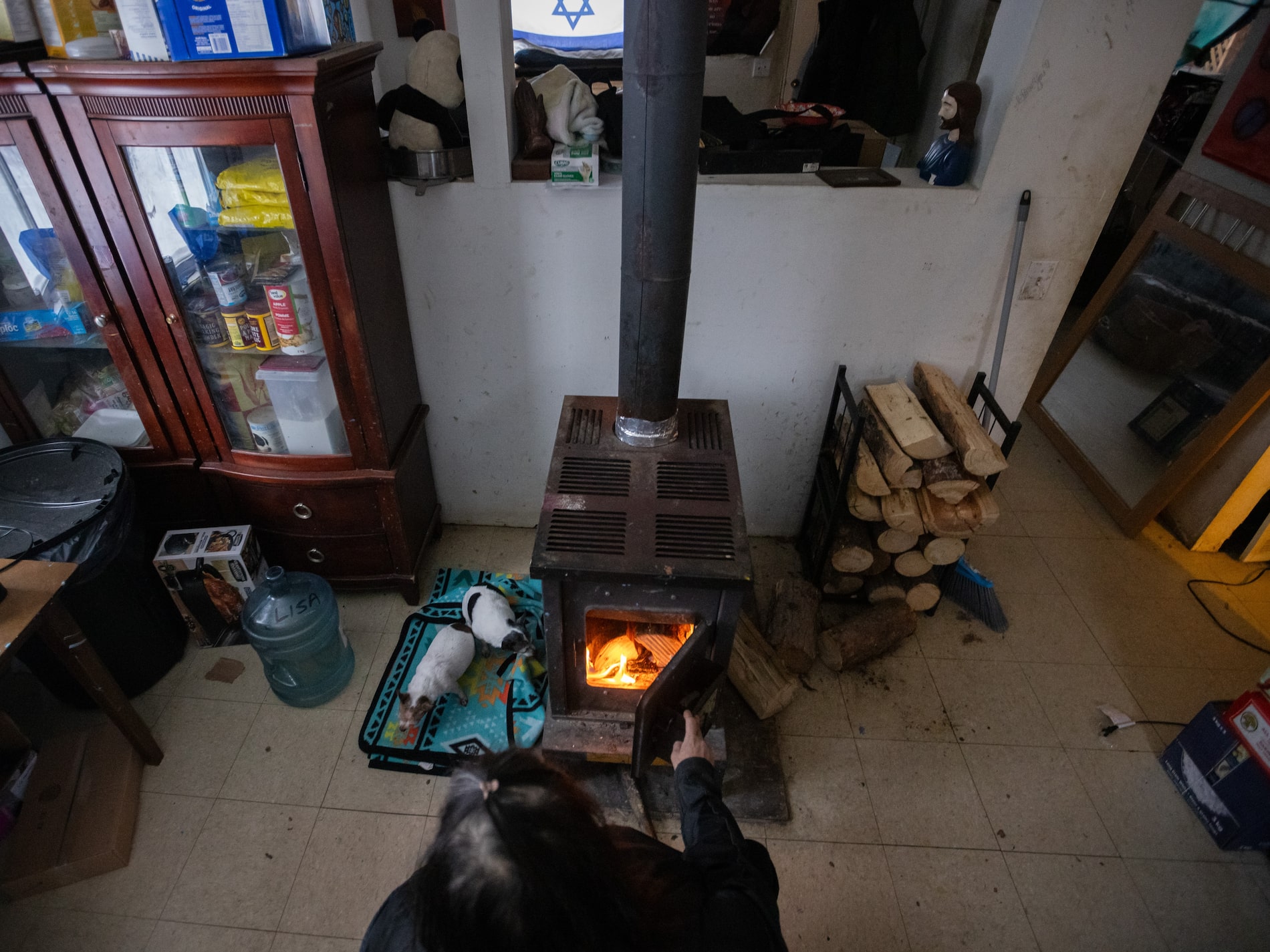
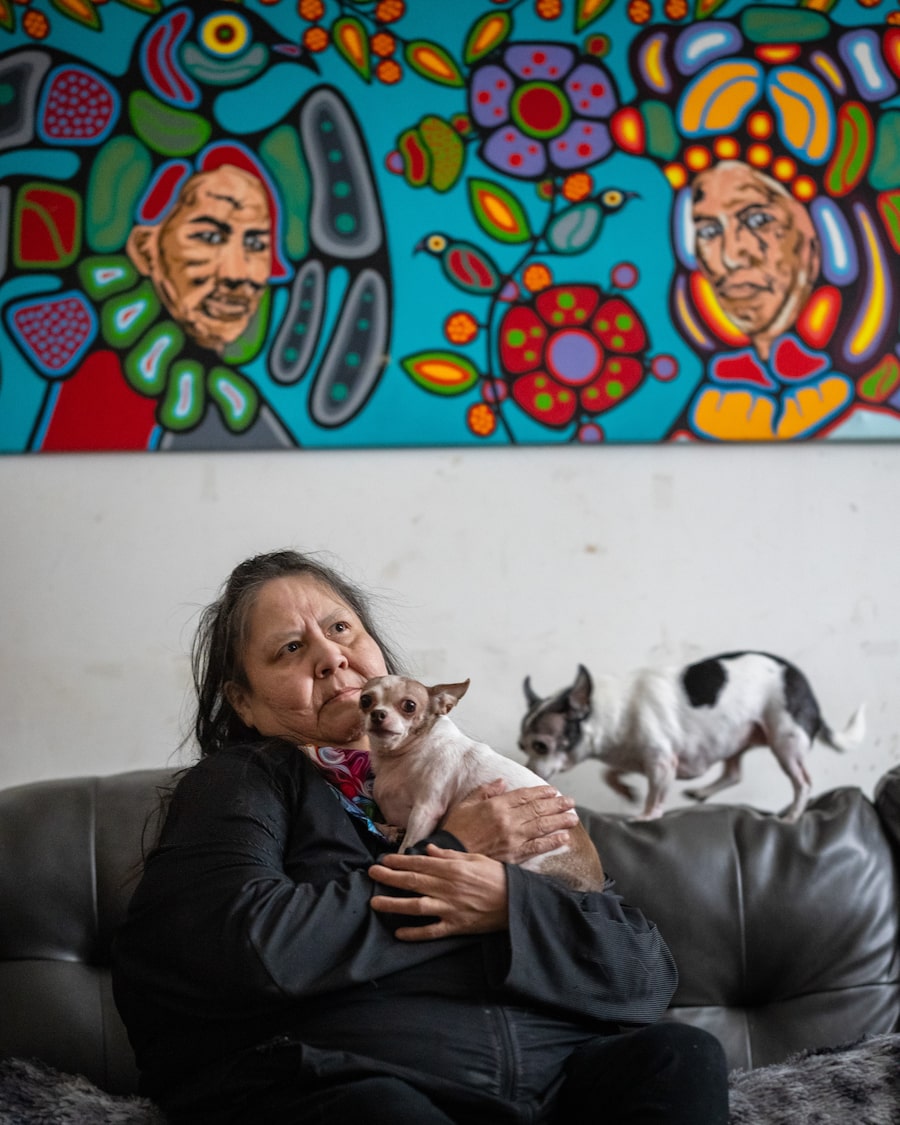
Lisa drives a Chevy with extensive dents and a passenger seatbelt that won’t latch, and the roof and walls are cracking in her small band home, which is heated by a wood stove in the kitchen and lined with boxes and ephemera of a hardscrabble life. Pots and pans cover each inch of her countertop. As we chat, her two chihuahuas skitter around unopened cartons of Lysol, some Kraft Dinner and a lamp with no bulb, its shade hanging askew.
Above the couch are paintings by her brothers Eugene and Christian, with whom she was especially close.
Lisa says she only learned the extent of her father’s fame and fortune when she was approached by art dealers in the early 2000s.

Lisa remains adamant that Eugene and her brothers David and Christian, who both died in Thunder Bay, did not forge her father’s work.
“We never lived off our dad. We never got lots of money,” she said. “It was nothing. Maybe three or four times in the early 2000s it would be three or 500 dollars, and that was it. We never got even a thousand.”
She is adamant that Eugene and her brothers David and Christian, who both died in Thunder Bay, did not forge her father’s work. Her brother Michael is also deceased.
“All I can say is, I know my brothers paint on their own. Eugene is an artist and my late brother Christian was an artist. They’ve done their own paintings and I don’t think they actually did frauds and signed my dad’s name on it. That’s what I’ve been hearing about my late brother, but he’s not here to defend himself. I don’t see him doing that.”
In 1979 Morrisseau was invested in the Order of Canada. By 1987, he was homeless.
In Vancouver’s Downtown Eastside, he met 21-year-old Gabor Vadas, who was also living on the street. Morrisseau came to view Vadas – who looked after him as his nurse, caretaker and business manager – as his adopted son. The two eventually lived together, along with Vadas’s wife and the couple’s two children.
“If I never met Norval Morrisseau I wouldn’t know who God is,” said Vadas, now 59 and living in Nanaimo, B.C.
In 1999, Morrisseau signed a will that left Vadas his entire estate, which his biological children contested after the artist died in 2007 at the age of 75.
“Thinking about my dad giving Gabe everything – why would he do that? We’re his flesh and blood,” Lisa said.
Vadas ended up dividing the artist’s estate down the middle in 2012, half to him and half to Morrisseau’s biological children. Lisa contends that she and her siblings “were rushed into that and I wish we could change it, but – we forgive. That’s how our mom raised us.”

Gabor Vadas, left, befriended Morrisseau in the late 1980s when they were both living on the streets of Vancouver.Alex Waterhouse-Hayward/The Globe and Mail
Alongside Vadas, Cory Dingle assisted Morrisseau through the 1990s, running errands, rolling cigarettes and helping the artist with day-to-day chores. He is now executive director of Norval Morrisseau Estate Ltd. Although the value of the artist’s estate remains unclear, Dingle estimates that it could be worth hundreds of millions of dollars; it includes paintings, carvings, brushes, necklaces, walking sticks and, perhaps most importantly, intellectual property. He asserts that “the legacy would’ve been sold for pennies on the dollar if not for Gabe’s spiritual power.”
Dingle is named in a $1.45-million civil lawsuit – which also accused Lisa, Eugene, Victoria, Peter and their three deceased siblings – that was filed in March, 2025, by Calgary art gallery EA Studios against Norval Morrisseau Estate Ltd. The case is in discovery, which means that once the pleadings have been exchanged by both parties, they will have an opportunity to decide whether to proceed in court. Jonathan Sommer, co-counsel for EA Studios, says the discovery process could take another few months.
Vadas looks forward to the estate’s Morrisseau artworks resuming their rightful place in the canon and believes the surviving family members are not to be blamed for any of the frauds.
“No beneficiary of Norval’s estate was ever charged with forgery and every beneficiary ever informally accused of forgery is now deceased,” he said. “There’s no beneficiary of Norval Morrisseau tainted with controversy. Anything else is a tawdry and baseless smear.”
He and Dingle are ready to move on. “Because of the controversy surrounding fakes, it’s been difficult to focus on Norval’s beautiful message,” Vadas says. “But I’m here now to be his example.”
Eugene Morrisseau, the artist’s middle child, is also eager to “turn the page and get all this stupid nonsense” regarding the forgeries out of the way.
“People called my dad Picasso of the North, but we never thought of him that way. It’s only the narrative of white society that knew my father in town, but up north, we never knew this stuff,” Eugene, 60, says on the phone from his home in Thunder Bay.
“Not just me, but my siblings. We want to put my father’s legacy to rest, not smeared all over the place by people who took advantage of my father. I’m glad the cops finally did something.”

Inspector Jason Rybak led the investigation into the Morrisseau frauds.David Jackson/The Globe and Mail
The investigation into the Morrisseau frauds began in 2019, led by Inspector Jason Rybak of the Thunder Bay Police Service. It followed the release that year of Jamie Kastner’s documentary There Are No Fakes, which outlined details of the forged Morrisseau purchased by Barenaked Ladies’ musician Kevin Hearn, along with other counterfeits.
“I went in to restore Norval’s legacy, but the competing groups all blame each other for everything because what they’re all after is money,” Rybak said.
The fraud rings operated in two main locations. In Thunder Bay, the principals were David Voss and Gary Lamont. Both pleaded guilty and were sentenced in 2024 to five years. Jeffery Cowan, based in Niagara-on-the-Lake, was convicted in November, 2025, of being a third source of fraudulent paintings, but had his sentencing postponed last month in Barrie, Ont.
Benjamin Morrisseau, a nephew of the artist, was among the first Thunder Bay arrests. He was charged with forgery and participating in Lamont’s criminal organization, which focused on getting Indigenous painters to create fakes. He agreed in April, 2024, with the mediation of elders, to restorative justice, but never pled guilty to a crime.

An image of a fake Norval Morrisseau painting called Astral Plain Scouts.Morrisseau Art Consulting Inc./Supplied
James White, an art dealer in Niagara-on-the-Lake, sold paintings authenticated by the Morrisseau Family Foundation, which was established in 2007 by the artist’s children after his death. He pleaded guilty to selling fakes and was sentenced to two years less a day in 2025. The Family Foundation is now defunct and the siblings, after the settlement with Vadas around the artist’s will, are part of Norval Morrisseau Estate Ltd.
Joseph McLeod, a Toronto-based art dealer connected to White, approached Lisa and her siblings to authenticate paintings. In 2014, when she was working at Keewaywin’s band office, she allegedly wrote a letter saying there were no Norval Morrisseau fakes. McLeod, who sold the fraudulent painting to Hearn, died in 2017.
“I thought they were good people trying to help us out,” Lisa said. She adds that she was used and that she didn’t write the letter. “I never authenticated paintings I didn’t think were real.”
Sommer, who, in addition to representing EA Studios, represented Hearn and is a lawyer specializing in art fraud, believes no one wants to put the kids in jail. “They were born into a screwed-up world and their dad was a shitty dad.”
He added: “My guess is they didn’t profit in any significant way from any of this.”
Lisa says she cried while watching There Are No Fakes because she once considered Lamont a friend. “He was supposed to be our dad’s friend.”

A still from the 2018 documentary, There Are No Fakes, shows the forged painting Spirit Energy of Mother Earth, which was purchased by Kevin Hearn.Cave 7 Productions Inc./Supplied
Eugene denies the documentary’s allegations that he was selling forgeries at a mall in Thunder Bay and travelled to China in 2015 with 300 forged paintings.
After speaking for an hour, Eugene grew agitated. “Who are these people that are talking about me and my siblings?” he asked. “I never forged a painting and I wouldn’t know if a painting was a forgery. I’m not an expert.”
He added: “You see how my sister lives. This is how we’ve been living all these years.”

Morrisseau is seen with his painting Mother Earth in 1975.James Lewcun/The Globe and Mail
As long as questions linger regarding what’s real or not, Morrisseau’s legacy will remain tarnished.
The estate’s paintings have yet to be appraised and the merchandising and intellectual rights remain mired in fraud-related confusion. But if the paintings Dingle says the estate holds are authentic, then there is reason to believe they will be worth a lot of money.
Erica Claus, an art appraiser in Ottawa who’s valued more than 160 Morrisseau works, said “Picasso brought cubism to European art and changed the pictorial aesthetics and Morrisseau, with his colour and contour, disrupted colonial archetypes. Basquiat developed a distinct language rooted in identity and cultural resistance and Frida Kahlo embedded indigenous identity in modern art. Morrisseau is comparable to those big names.”
Dingle dreams of opening a Morrisseau museum in Toronto. He wants to restore the artist’s international reputation and bring properly authenticated paintings back into circulation, once all the forgeries have been discovered and destroyed.
“The Morrisseau estate should be one of the wealthiest estates in Canadian history,” he said. For comparison, 26 paintings by Jean-Paul Riopelle, a Quebec contemporary who died in 2002, sold for US$1-million or more between 2006 and 2019.
The estate has worked with school boards in Ontario and B.C., enhanced Keewaywin’s internet bandwidth and staged an exhibit at the Detroit Institute of Art. It has also helped develop an AI program to detect Morrisseau fakes.
“It’s the largest global art fraud in history, history’s largest cultural appropriation, but it’s also a chance for a renaissance,” Dingle said. “We’re trying to turn this into a positive action. The world is watching, and it’s an opportunity for Canada to lead.”
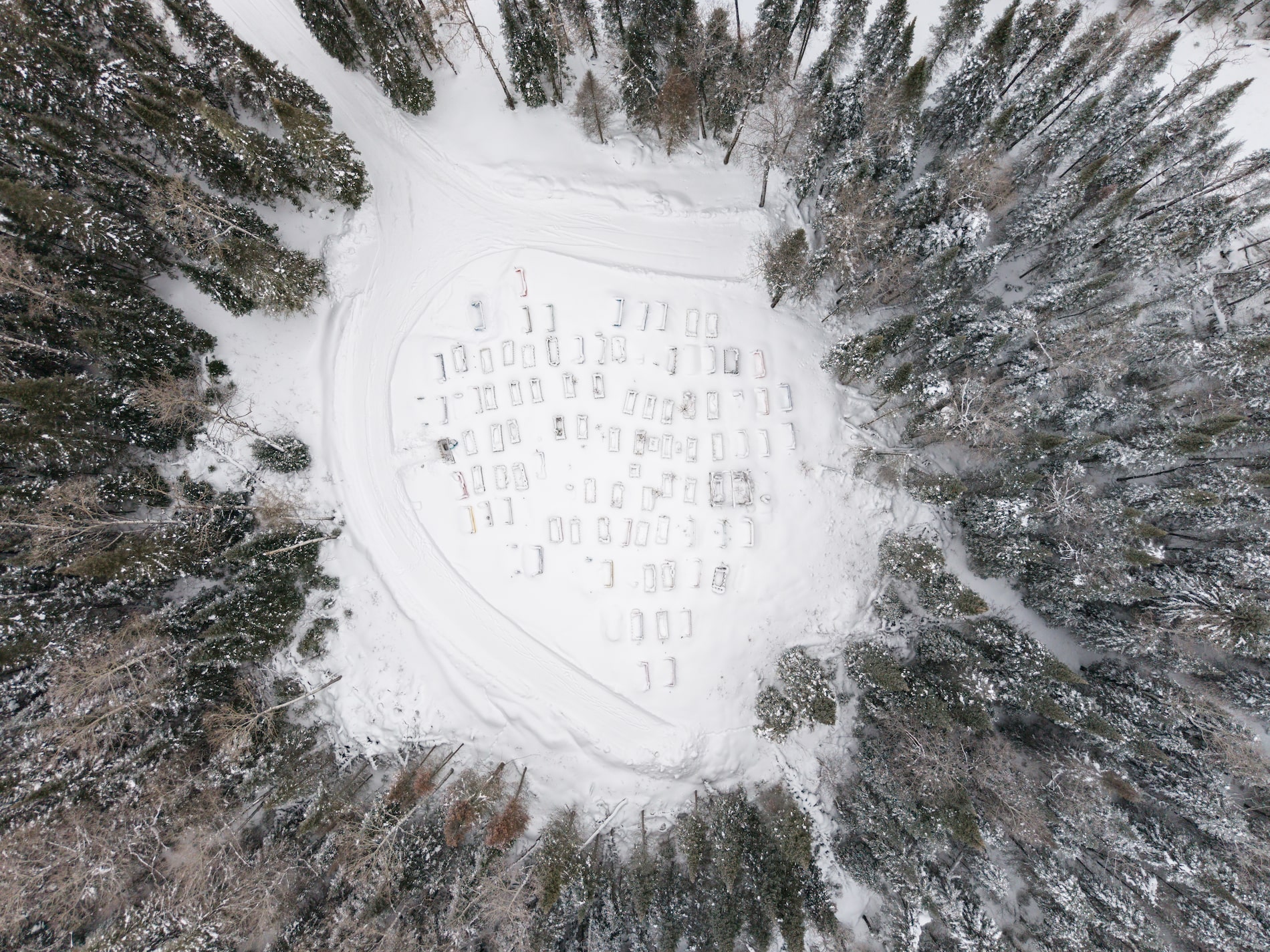
If the value of Morrisseau’s works once again rises, Norval’s children have strong ideas of where the proceeds should go.
Eugene Morrisseau says his father’s estate would be best served to help the next generation of Indigenous kids. His wish is inspired in part by Christian’s son Kyle. The Thunder Bay high-school student was discovered dead in the McIntyre River in 2009, and the circumstances of his death remain unknown.
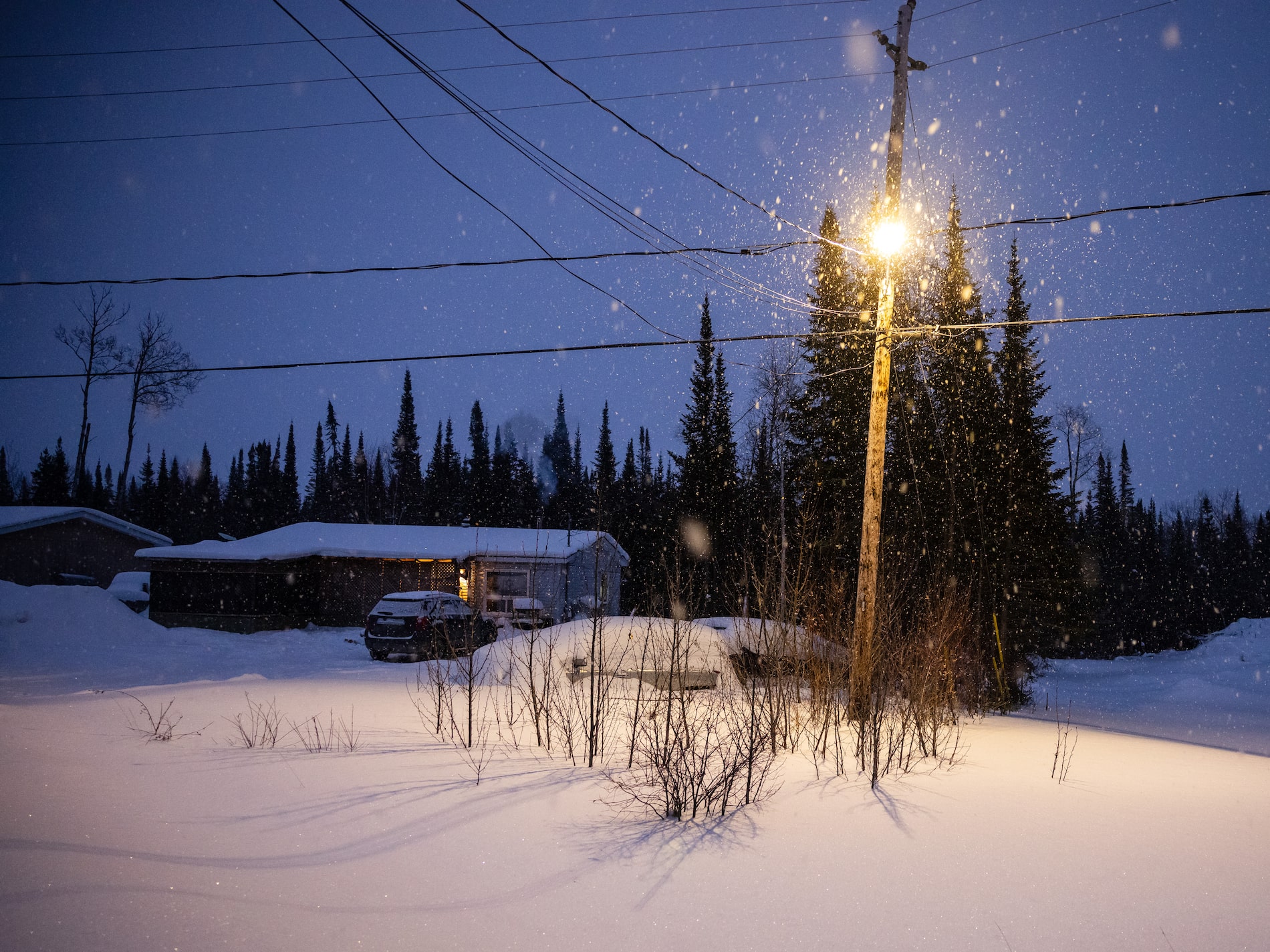
Lisa would like new boots, a better band house, maybe a less dented car. Life in Keewaywin feels a universe away from the rest of the world, she says. “Even if we got lots of money, I’d probably stay here. I’m used to it.”
Her hope is that the estate can provide a future for her nieces and nephews in Keewaywin, and that her father can be an inspiration to children living on reserves across Canada. More than money, his legacy represents freedom for the youngest members of the Morrisseau family.
“We had to skip a generation because this generation now – my nephews and nieces – are stuck in a rut. Some have addictions and they quit school,” she said. “But now my grandnephews and nieces are graduating and going further.”
At the cemetery in Keewaywin where her three siblings, parents and Kyle were put to rest, Lisa points out that too many of the graves in the quiet, empty cemetery are members of her family.
“We’re trying to get the next generation to make better choices,” she said. “In the end, that would be the best way to honour my dad.”
Editor’s note: This article has been updated to clarify a statement from Jonathan Sommer, co-counsel for EA Studios, and to correct the location of St. Joseph’s Indian Residential School.